Lord Marvin Rees at IE School of Architecture & Design: "Designing Cities Means Navigating Trade-Offs"

The former Mayor of Bristol explored housing, climate transition, and urban inclusion in the closing lecture of the School’s 2025–2026 Re_Solution series.
Madrid, 13 May 2026 - How can cities confront climate change, housing inequality and social fragmentation while remaining inclusive and economically dynamic? That question shaped the closing lecture of IE School of Architecture & Design’s 2025–2026 Re_Solution series , delivered by Marvin Rees, former Mayor of Bristol and current member of the House of Lords. The conversation was introduced by Dean David Goodman and Associate Dean Cristina Mateo, and followed by a discussion led by Santiago Iñiguez de Onzoño, Executive President of IE University.
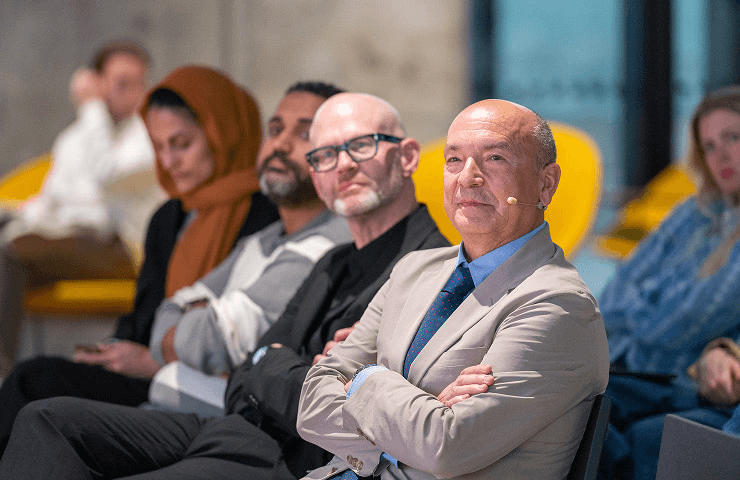
Rees reflected on his experience as Mayor of Bristol between 2016 and 2024, a period marked by post-referendum Brexit-related political turbulence, economic uncertainty, and climate urgency. He highlighted some of the main urban initiatives he initiated during his tenure, including "Bristol City Leap", a public-private partnership designed to decarbonize the city’s energy system.
The relationship between physical design and social reality became a central theme of the lecture. For Rees, physical development is inseparable from social outcomes. His administration, he explained, pursued mixed-tenure housing, mass transit and the retrofitting of low-income homes with decarbonized energy systems. But the former mayor stressed that building alone is not enough: "Even if we build a great physical place, it doesn’t mean everyone experiences it equally."
Rees illustrated this through "Temple Quarter", a major regeneration scheme in central Bristol projected to deliver 10,000 homes and 22,000 jobs while contributing £1.5 billion annually to the regional economy. The challenge, he argued, was ensuring that such developments remain financially, socially and physically accessible, or risk becoming what he described as "islands of privilege."
Rather than presenting city government as a narrow administrative function, Rees argued for a broader model of urban leadership. "A mayor is not just the leader of local government," he said. "A mayor must be a city leader."
That approach informed Bristol’s "One City Approach," a governance model intended to align institutions across sectors — universities and health systems, businesses, police and civil society — around a shared long-term vision. Rees explained that, at the time, Bristol had more than 600 strategies and 1,500 separate outcomes, but lacked coherence. In response, his administration convened over 70 city leaders to develop a common framework for the city’s future.
The resulting framework established a collective vision for 2050: to build "a fair, healthy and sustainable city" where prosperity could be shared more equitably. Structured around six pillars — homes and communities, transport, economy, health, education and climate — the model introduced long-term planning as a governance tool while making visible the tensions between competing priorities.
As Rees pointed out, urban leadership often involves navigating trade-offs rather than resolving problems neatly. Climate goals may conflict with tourism ambitions; housing growth may collide with density limits or anti-sprawl commitments. "Designing cities means navigating trade-offs," he said.
The lecture concluded by situating cities within a wider global context. With 57% of the world’s population now living in urban areas, a figure expected to rise to nearly 70% by 2050, Rees argued that challenges such as climate adaptation, migration and inequality are increasingly urban in nature. National political systems, he suggested, are often too slow or fragmented to respond effectively, while cities are becoming increasingly significant actors in global governance. Beyond Bristol, Rees has held leadership roles in international urban networks, including as former Chair of Core Cities UK, Chair of the Global Parliament of Mayors and co-founder of the Mayors Migration Council, initiatives focused on strengthening the role of cities in addressing shared global challenges.
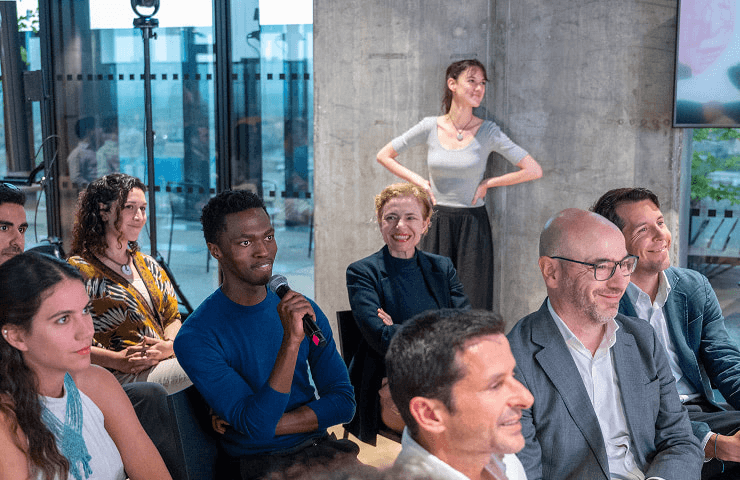
Rees's message to IE University students and faculty emphasized that designing cities is not only about shaping space, but also about shaping the social, economic and environmental conditions of collective life. As urban pressures intensify, he argued, the future of sustainability, inclusion and prosperity will increasingly depend on the capacity of cities, and of those who design and govern them, to lead.
Re_Solution is IE School of Architecture & Design’s public lecture series dedicated to advancing critical conversations on the complex realities of city-making. Since its launch, the series has brought together influential urban leaders including Ahmed Aboutaleb, David Miller, Sergio Fajardo, Jan Vapaavuori, Anna König Jerlmyr, Georgios Kaminis, and Jean-Louis Missika, among others. Through these conversations, the series explores how cities respond to crises through public infrastructure, governance and cross-sector collaboration, reinforcing the School’s commitment to understanding cities as spaces of transformation.