


Oleksandra Matviichuk on Justice, Dignity, and the Power of Ordinary People
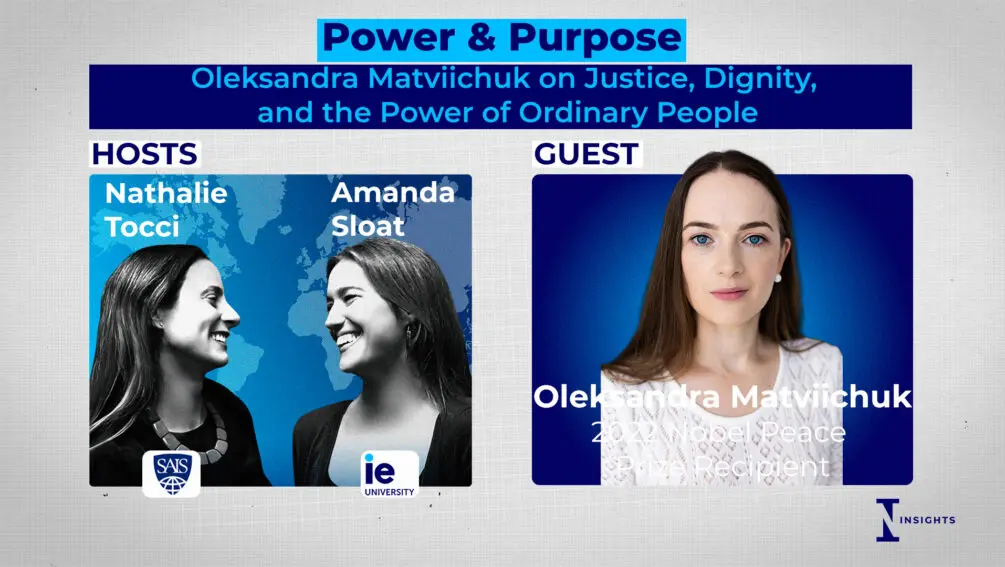
What does justice look like in the midst of war? On the eve of the fourth anniversary of Russia’s full-scale invasion of Ukraine, Nobel Peace Prize laureate Oleksandra Matviichuk joins Amanda and Nathalie to discuss the realities facing Ukraine today — from a cold winter and fragile ceasefire talks to the systematic documentation of war crimes. She explores why dignity – not victimhood – must shape the future of her country’s democracy and the power of ordinary people in extraordinary times.



© IE Insights.
Transcription
Amanda Sloat
Welcome back to Power and Purpose. I’m Amanda Sloat.
Nathalie Tocci
And I’m Nathalie Tocci.
Amanda Sloat
February 24th will mark four years since Russia launched its full-scale invasion of Ukraine the largest war in Europe since World War Two and a significant escalation of the conflict that began in 2014. To commemorate the somber anniversary and discuss where things stand Nathalie and I are delighted to be joined today by Oleksandra Matviichuk. She’s a human rights defender leading the Center for Civil Liberties which was awarded the Nobel Peace Prize in 2022 for its work in promoting human rights and democracy as well as documenting war crimes.
Amanda Sloat
Oleksandra welcome to the show.
Oleksandra Matviichuk
Thank you for invitation.
Amanda Sloat
I was working in the Biden administration when the war began and find it really hard to believe that it’s already been four years that this conflict has been raging. It’s a true testament to the courage of the Ukrainians fighting on the front line. President Trump had promised to end the war in a day. And unfortunately we’re now over a year into his term and the fighting continues.
What’s your assessment of where things stand? Is a ceasefire possible? We have seen talks ongoing in recent days let alone any sort of a peace deal.
Oleksandra Matviichuk
This is the fourth-winter of large scale war and 12th winter of war as such. And this winter is very difficult because the Russians deliberately destroy the energy grid, the very infrastructure which civilians need to survive during subzero temperatures. Millions of people in Ukraine have restricted access or no access to heat, to water, to electricity. People are freezing in their flats.
But Ukrainians don’t give up. And I found myself in a very difficult situation because on one side we see a series of international meetings conducted in Geneva, in Miami, in Abu Dhabi, in Washington about peace. And politicians try to present that we have progress on this way. But reality tells another story. The Trump year of negotiation became the deadliest period for Ukrainian civilians since the large-scale war started.
The number of killed and injured civilians increased by 31 percent in comparison with the previous year. So President Trump told that he will finish this war in 24 hours. And it’s the longest 24 hours in human history. And it’s difficult to stop this war because Russia doesn’t want peace. And now we have a situation that Russian President Vladimir Putin responded to every peacemaking effort of President Trump with escalation of attack to Ukraine.
Nathalie Tocci
You know Oleksandra the thought that really came to my mind is that one can see President Trump as having prolonged this war. What I mean by this is that given that this is a war that is only going to end when Putin comes to terms with the fact that he cannot win it by having an administration in Washington that has been up until now essentially exerting pressure on the victim rather than the aggressor.
It has actually made this war longer than it would have otherwise been. The question that I wanted to ask you as a follow up to this it seems to me that the Trump administration is essentially saying well if you want the United States to commit to security guarantees in one shape or another Ukraine needs to withdraw from the land that Russia has not been able to occupy militarily in 14 years of war. I mean there seems to be this real contrast between what’s going on the ground and these hypothetical talks.
Oleksandra Matviichuk
I think that one of the main problems is that United States administration does not understand the real goals of Putin. Putin started large-scale war not because he wants to occupy just another piece of Ukrainian land. Putin started large-scale war because he wants to occupy and destroy the whole country. He sees Ukraine as a bridge to Europe. His logic is historical. He is not transactional. He dreams about his legacy. He wants to forcibly restore Russian Empire.
People in European countries are safe only because Ukrainians are still resistant and do not let Russian army move closer. So the question is not how to sign this deal. The question is how to get peace in such circumstances.
And this is two different questions because let me remind you this war started not in February 2022 but in February 2014 when Russia invaded Ukraine occupied Crimea and part of the eastern regions.
In 2014 Ukraine had zero chance to relive these territories and Ukraine signed two peace deals with Russia. We call them Minsk agreements. And how did Russia use this eight years of so-called peace? Russia violated ceasefire almost daily and people were dying. Russia transferred Crimea and Eastern regions into powerful military bases. Russia prepared their economy for the next wave of sanctions produced artillery shells trained their army and started large scale war.
So we do not need a second Minsk. We do not need a pause for Putin to retreat to regroup and to start large scale war again. We need peace, and peace means freedom to live without fear of violence and have a long-term perspective. And if we want to get peace in such a situation it is not enough to make pressure to the victim of aggressor. Because if you make pressure to the victim you just push the victim to capitulate and to be occupied.
And occupation is not peace. Occupation is war in another form. If you want to stop this war you have to make pressure to the aggressor to make Putin understand that it is impossible for him to achieve his goal to occupy the whole country and move further.
Amanda Sloat
Ukraine is still in the news which is good. There is still support for the war in Ukraine in the United States. People are following along with the press reports of what is happening. I am interested in knowing what is your main message to our listeners. What do you think people do not understand about what is happening in Ukraine what they do not understand about the negotiations and what Ukrainians want in terms of a just peace? What is the one thing that you want listeners to know and understand?
Oleksandra Matviichuk
Russia uses peace negotiation as a tool to gain time and to make it easier to occupy the whole country. Because if Russia wanted peace Putin would agree to proposals of ceasefire which were made by President Trump and President Zelensky. But Putin rejected all these proposals. So he continues this war. He continues armed advance. He continues deliberate destruction of civil infrastructure in the country.
And I do not even know whether Americans understand that United States stopped all assistance to Ukraine when President Trump came to office because all financial and military assistance was stopped. So that is why I say that Russians use this peace negotiation as a tool to decrease the level of support to Ukraine and to make it easier to occupy the country.
And another important thing is that in this peace negotiation we lost something essential. I work with people affected by this war directly. I am a human rights lawyer. I document war crimes. I interview people who survived Russian captivity. They told me how they were beaten raped smashed into wooden boxes. Their fingers were cut their nails were torn away their nails were drilled. One woman told me how her eye was tricked out with a spoon. So I know a lot about the human cost of this war.
But politicians discuss natural minerals Russia’s territorial claims geopolitical interests even Putin’s vision of Ukrainian history. But they do not speak about people. People are not a priority for United States negotiators. And that is why we have the hardest winter during the large scale war and this increased number of murders and injuries among Ukrainian civilians. Because if people are not a priority in this peace negotiation Russians understand that there is no deadline. They can do whatever they want.
We lost the human dimension in this talk. This is my main message. And without human dimension we will never find a path to sustainable peace.
Nathalie Tocci
So Oleksandra I mean just listening to what you just said there. Let’s remind all our listeners that your organization indeed has been documenting war crimes. You also co-founded the tribunal for the Putin Initiative which is a coalition of civil society organizations that is building publicly accessible legally rigorous database of the alleged war crimes some of which you just mentioned.
And earlier you were also talking about the fundamental importance of in order for peace to be peace for a peace to be just. So could you perhaps say something about where do you think that all of this in many respects this rush about negotiations is actually leaving international accountability?
Oleksandra Matviichuk
Do you remember that in 28 points plan which was presented by American administration it was a total amnesty for Russian war crimes right. And it’s a huge mistake. It’s a huge mistake even to put this point in draft because all this hell which we face in Ukraine is a result of total impunity which Russia enjoyed for decades. Russian troops committed horrible crimes in Chechnya in Moldova in Georgia in Mali in Libya in Syria in other countries of the world.
They have never been punished. They believe they can have what they want. We must break the circle of impunity not just for people in Ukraine but logically to prevent a next Russian attack to the next nation. Because impunity is the engine of this war. And that is why now our strategy is to make justice an independent parallel track to all peace negotiation.
We have no illusion that point of accountability will appear in this deal. International criminal courts will not stop its investigation and not withdraw its arrest warrants. And we have to create several other additional international accountability mechanisms because what people don’t understand about justice — justice is not something related only to the past or sending a signal to the future.
Justice has a power to change the reality. How it works — even if part of Russians start to doubt that probably this time they will not avoid responsibility because they will see our decisive legal actions and they start to have this doubt that they will be responsible for their own actions and their own decisions — this doubt will be converted into chilling effect of brutality of human rights violations.
And because we speak about ongoing war only with decisive legal actions we can save thousands and thousands of lives.
Amanda Sloat
Thank you for sharing with all of our listeners a very honest and sobering assessment of what is happening in Ukraine. I’d like to shift a little bit from the political to the personal and in particular the story of how you got to where you are now and the human rights work that you are doing. I understand that there was a very different path that you could have taken in your life and that at one point you thought you might be a theater director and had looked at pursuing theater and law school at the same time.
So I’m interested in the story of young Oleksandra and how you started on this human rights path that you’re currently on.
Oleksandra Matviichuk
When I was a child in school I got acquainted with Soviet dissidents and dissident movement. It was a movement of intellectuals from different fields of science and arts in Soviet Union. And suddenly I appeared in the circle of fantastic people — people who say what they think and do what they say. People who had the bravery to stand up and voice against the entire totalitarian Soviet machine.
Dissident movement was severely persecuted in Soviet times. Part of people were killed part of people were jailed part of people were locked for forcible psychological treatment. All careers were ruined families were separated but they didn’t give up.
And being a child in this school I was so inspired by this very human example that I decided that I will study law and I will continue this fight for freedom and human dignity. So this is how I became a human rights lawyer.
Amanda Sloat
So was there a particular moment when you were in university something in particular that had happened or simply the conversations that you were talking about that made you think that focusing specifically on human rights law rather than on another type of law? I know you had done some work in banking initially that this was the specific direction of law that you wanted to pursue.
And I’m also interested more broadly. We certainly have people in the United States who are involved in resistance movements in different countries. What lessons did you learn from the dissidents and the artists and others who had very novel ways of resisting?
Oleksandra Matviichuk
I am from a poor family and that is why I started to work very early in the bank sector. And frankly speaking I had this idea during student time that I will combine — I will make a successful career as a commercial lawyer and in parallel I will do something good for society. And probably I would manage if I had been born in Switzerland but I was born in Ukraine.
That is why when I finished university I created the human rights organization Center for Civil Liberties and we received the Nobel Peace Prize in 2022 for our human rights work.
The main lesson from my student time — I will share with you another personal story. When I was a student I told myself I would never ever do something connected with criminal law because I have empathy for people and it will harm me. And now as you know I am doing forms connected not just with criminal law. I am doing work connected with international criminal law with the most horrible atrocities.
When I reflected about it I understood something very interesting. What I evaluated as my vulnerability — my empathy to people — is literally my source of strength. Because a lot of other people can’t do documentation of war crimes for so long because it is very difficult to deal with human pain on a daily basis.
We are documenting not just violations of Geneva Conventions. We are documenting human pain answering the question what this experience means. From communication with dissidents I know that when you can’t rely on legal instruments or when you can’t rely on international system of peace and security you can still rely on people.
We get used to thinking through categories of states and interstate organizations but ordinary people have a much greater impact than they can even imagine. Ordinary people can change history.
And Ukrainians are a bright example. Because four years ago when Russia invaded not just Putin but almost all international partners including the United States were confident that Ukrainians have no potential to resist such enormous opposing power.
And I was in Kyiv. I refused to evacuate. There was part of my team. We continued to work on the ground when Russians tried to circle my city. I remember how international organizations and their personnel left us alone. But ordinary people remained. And ordinary people started to do extraordinary things.
It were ordinary people who helped to survive under artillery fire. It were ordinary people who broke through encirclement to provide humanitarian aid. It were ordinary people who took people out from the ruined cities. And suddenly it became obvious that ordinary people fighting for their freedom and human dignity are stronger than even the second army in the world.
Nathalie Tocci
Oleksandra it’s so powerful. I actually had tears in my eyes listening to you there. When we talk about the war in Ukraine we talk about negotiations and states and as you rightly remind us if Ukraine is resisting the way it is it is largely because of Ukrainians and their individual and collective strength.
You mentioned earlier your work in the Center for Civil Liberties that you joined in 2007 and that you run today. Could you tell us how your role as a leader in this organization has changed over time?
Oleksandra Matviichuk
I always joke that I started my human rights career in 2007 when we founded Center for Civil Liberties and became the head of this organization. And I finished my human rights career immediately because 20 years passed and I’m still the head. So no career development in human rights field.
But it is a huge experience. We are famous in Ukraine for our ability to massively involve ordinary people into human rights work. If you want to transform society and build democracy in your country it is not enough to adopt good laws or build formal institutions because the values of society always prevail. That is why we have to make ordinary people part of this change.
We have been doing this for all these years. One example — 12 years ago during the Revolution of Dignity millions of people stood up their voice against pro-Russian corrupt regime. They peacefully demonstrated just for a chance to build a country where the rights of everybody are protected government is accountable judiciary is independent and police do not beat students who are peacefully demonstrating.
People paid high price for this chance because authoritarian government started large scale persecution of peaceful protesters throughout the country. So I launched a civil initiative and we brought up several thousands of people. We worked 24 hours per day providing legal assistance and other kinds of support to all persecuted protesters.
Every day during those months of revolution hundreds of people who were beaten arrested tortured accused in fabricated criminal cases contacted us. We managed to process more than 16,000 requests for help.
Not because we are a brilliant team but because enormous amount of ordinary people joined this initiative. Because people were not indifferent.
The main lesson from that time is that when you are fighting for freedom and human dignity you often have a feeling that your fight has no sense because you are faced with such enormous opposing power. At that time we faced entire authoritarian state machine paramilitary groups cooperating with police prosecutors courts the former president security service former government majority of parliament.
They were against peaceful protesters. They wanted to liquidate us even physically. And in this situation it was so easy to say what can we do we are just ordinary people.
But because people fought very honestly for each procedure and measure and our lawyers fought very honestly for each person it made a difference. We started to work not only on legal level but on symbolic level where ideas and conscience emerge.
People during the Revolution of Dignity knew that there was no guarantee in their life. You could be arrested brutally beaten even killed. But there were people who would fight for you who would never leave you alone.
And I know from that time that when you have no other instruments only your words and your own position eventually it is not so little.
Amanda Sloat
We talk a lot on this podcast about the idea of wellness. It would be ridiculous to ask you about work life balance when you are literally involved in an existential fight. You talked about struggling with empathy interviewing people who are victims of horrific crimes and living in Kyiv under constant bombardment.
How do you maintain your sense of sanity and personal well-being amidst both daily struggle of life in a warzone and the important work you are doing documenting these war crimes?
Oleksandra Matviichuk
We have a joke that we have no work life balance. We at least try to achieve more life. War ruins everything which you call normal life. Simple things like meeting friends in a cafe having family dinners hugging your loved ones disappear.
To live during large scale war means you can’t plan not just your day. You can’t plan your next several hours. You have no idea what will happen.
People in Ukraine dream about peace. We just don’t want to be occupied by Russia because Russian occupation is not just change of one state flag to another. Russian occupation means enforced disappearances torture rape denial of identity forcible adoption of children Russian camps and mass graves.
I am a human being. I feel emotions. Sometimes I feel myself broken. Last time when I felt this was after a meeting with a five year old girl. We work with the case of her mother who is a civilian. They both lived in occupied territories. She was illegally abducted by Russians because she had pro-Ukrainian sympathies. She was illegally detained in inhuman conditions and went through multiple gang rape.
She was transported to Russia and now faces fabricated criminal case. I have no doubt she will be jailed. Russia detains dozens of thousands of Ukrainian civilians on illegal basis.
When I met this five year old girl she hugged me and started crying and begged me please return my mom. I felt completely broken because I am an experienced human rights lawyer and I know human rights mechanisms but I have no legal tool to return her mom.
It is not easy to live and work like this. But we know we are not hostages of circumstances. We are participants of this historical process. Our future is not just unclear. It is not pre-written. This means we have a chance and responsibility to fight for a future which we want.
Nathalie Tocci
Listening to you and that story made me think about the gender dimension of this war. It is a war fought on the front lines mainly by men but women suffer enormously. At the same time women like yourself have particular strengths that help in this struggle. Could you say something about the role of women both in this war and in the peace that is being sought?
Oleksandra Matviichuk
We have in our database more than 98,000 cases of war crimes. It is a huge amount but still just the tip of the iceberg because Russia uses war crimes as a tool of fear to win the war and inflict immense pain on civilians.
Among these we have many crimes against women and children. But women in Ukraine are not just victims. Women in Ukraine are fighters. I know enormous amount of fantastic women who joined Ukrainian forces. Ukrainian women take political decisions coordinate civil initiatives document war crimes. Women are in the forefront of this battle for freedom and democracy because bravery has no gender.
In democratic countries women can perform any role they want. They have freedom to choose. But in authoritarian countries like Russia women are assigned limited roles in family and society. That is basis for authoritarian regime because how people treat each other in society reflects what government can do to its own people.
In Iran women can be killed for wearing inappropriate clothes. In Afghanistan women are prohibited to study. In Russia domestic violence was decriminalized. That is projection of what government does toward its own people.
In this Russian war of aggression against Ukraine we Ukrainian women fight for our daughters. We want our daughters never to face a situation where they must prove they are also human beings.
Nathalie Tocci
And perhaps a last question about youth and Ukraine’s youth because this war has had tremendous impact particularly on young people. There is risk of a lost generation. Where do you see Ukrainian young people today headed and what can be done to ensure they will rebuild the country?
Oleksandra Matviichuk
I see young Ukrainians in different civil initiatives and our youth are better than us. I am totally confident in our future. They are better than us.
We are all traumatized. In order to overcome this trauma we have to produce new ethics. Let me explain. I interviewed a professor of philosophy who spent 700 days in Russian captivity. He described solitary confinement in tiny cell with no window, no fresh air, no light. He gave lectures on philosophy to the rats just to hear a human voice.
He told me that his experience is not a reason to treat himself as a victim because the basis of our existence is dignity not victimhood. And dignity is action.
This is our ethics. We fight for the slightest chance to live without fear of violence and have long term perspective. Dignity provides strength and courage to fight even in unbearable conditions.
Hope is not confidence that everything will be fine. Hope is deep understanding that our efforts have meaning.
Amanda Sloat
Oleksandra you have spoken clearly and powerfully about Ukraine and about persistence in terrible conditions. We always end on a positive note. What has personally brought you joy in the last few days?
Oleksandra Matviichuk
I have a Twitter account which is quite popular. Last days I was in a very bad mood. Difficult winter. Too much work. I was not okay.
I found in my account messages from people. They sent simple words of support. It was healing for me.
I want to finish by saying I am very grateful. I will remember this time not only because of cruelty and horror but because of people in different countries who help us and stand with us in this dramatic time of our history.
I want to express sincere gratitude to people in the United States. Thank you for your solidarity. Thank you for your support. I know from surveys that you are with us. It is important to know that we are not alone fighting such enormous opposing power.
Amanda Sloat
Thank you for that. There is tremendous support in the United States including from the American people. I saw this when I was in government working on Ukraine. My heart continues to ache for all of you and I appreciate everything you shared focusing on the human side of war and the human side of the fight for dignity peace and justice.
Nathalie Tocci
Really moving conversation about justice dignity and the power of ordinary people. Thank you so much for being with us.
Oleksandra Matviichuk
Thank you for conversation.