

Sigrid Kaag on Straddling Divides and Withstanding Political Violence
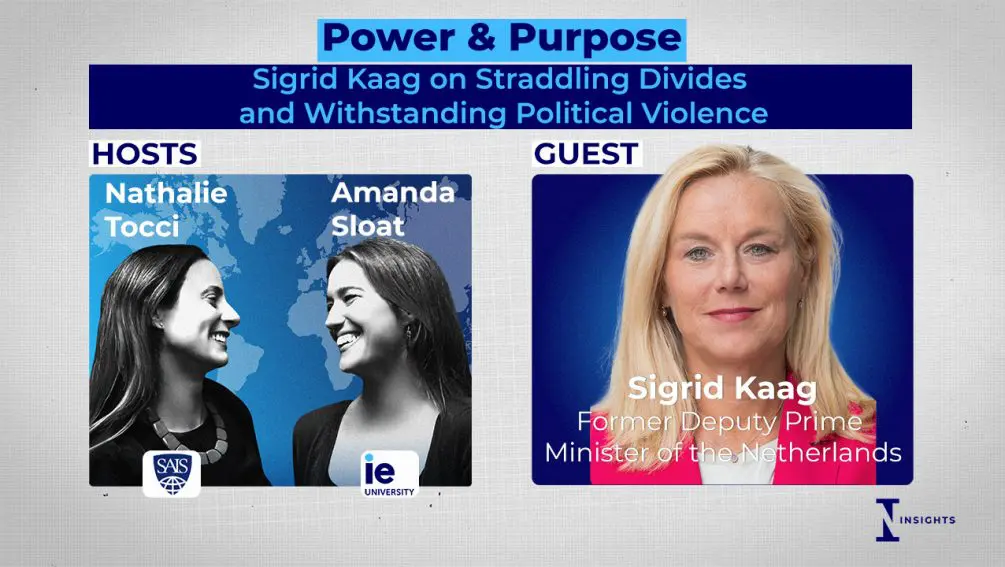
Reflecting on her experience in diplomacy and government, Sigrid Kaag discusses the leadership skills, values, and resilience she employed across her career. From confronting populism at home in the Netherlands to navigating the complexities of the Middle East, she offers an insight into principled decision-making under pressure. Sigrid delves into the demands of public service, the importance of embracing non-linear paths, and how to find inner strength amid public scrutiny.



© IE Insights.
Transcription
Amanda Sloat
Welcome to Power and Purpose. Today we are delighted to welcome Sigrid Kaag, who is currently teaching at Science Po in Paris. She is also co-chair of the Board of Directors of the United Nations Foundation and Chair of Education Cannot Wait. She’s had an impressive career spanning the private sector to politics and diplomacy. She spent many years with the United Nations, mainly in the Middle East, working on Palestinian aid and Jerusalem children’s issues in Amman, migration in Geneva, development to New York, peacebuilding in Lebanon and chemical weapons in Syria.
Until this summer, she was Under-Secretary General for Gaza as well as the Middle East Peace Process. She’s also worked in Dutch politics, leading the D66 party for several years, and she served as Minister of Foreign Affairs, Minister for Foreign Trade and Development Cooperation, as well as First Deputy Prime Minister and Minister of Finance. Sigrid, welcome to the show.
So there’s so many things that we’d like to discuss, but let’s start close to home. I am a proud Dutch American. And I have four great grandparents on my mom’s side, coming from Zeeland. So I’ve always taken a particular personal interest in Dutch politics. Many of us were heartened to see the results of the October 29th elections in the Netherlands, which were the third polls in five years after the collapse of an unstable coalition that included the far right Freedom Party, the social liberal D66 party which you previously led, won 26 seats, as did the Freedom Party in the 150-seat parliament.
Party leader Robb Jetten ran on optimism and an Obama-like we can do it slogan. And now, because he’s won more votes, he’s got the first shot at creating the coalition government. So my first question for you: is the Netherlands a good news story for moderates? Is the far right really weaker there now, and are there lessons that we can learn in other countries about pushing back on populism?
Sigrid Kaag
Thank you. Delighted to be here.
Well, like you, I’m delighted. I didn’t know that you had the strong Dutch genes in you. More power to you, I would say.
I know it is fantastic news. And it’s not just my own party. The Social Liberal Party. The Progressive Party in the country, but also the Christian Democrats have made a comeback. So it’s the voices of the center that were a response to the chaos of the last two years of the radical right wing and extreme right-wing parties.
However, if you look at the other side of the statistics, one-third of the country has voted extreme right wing or radical right wing, 33% plus. At the same time, the wing of my party, like it was when I sort of competed with Prime Minister Rutte then in 21, the win of my party is good news, of course, and I’m personally delighted.
As for Rob and my colleagues and Rob also as my predecessor at the same time, it is still a fragile win given the fact that the country has voted pretty conservatively and Labor and Green Left lost seats. So on the one hand, you could say we’re all still fishing in the same pond. On the other hand, the extreme and radical right wing have anchored themselves quite firmly and will influence very often the flow and type of discussion on narratives
other parties will emit. So I would say it’s a mixed bag. Is it a good news story for Europe, leave it alone, the rest of the world? I think it’s a good news story in the sense of optimism pays. Confidence pays. And just be steady and stay the course. I think we’ve also adjusted in this campaign some of our messages, the dynamism.
But of course, it came out of two years of total chaos and a standstill in the country. So it’s not surprising people have said, okay, enough of this. Please guys, can sort of the adults, the young adults come back into the room and take it on. But that doesn’t make it easier to deliver on the promise and or seek implementation, because for that you need a wider majority.
And you’ll see now in the start of the coalition negotiations in the Netherlands, there’s easing even the door open now to a sort of Danish model, i.e. a minority government which is quite new to the Netherlands. I mean, 27 parties competed for seats in Parliament, for your listener. That’s probably quite shocking. It’s sort of an Israeli model, or a few other countries.
But, you know, it’s sort says a lot about the fragmented and fractured nature of our current political system, too. So it will require a lot of energy, a lot of attention, and a lot of stamina.
Nathalie Tocci
Actually, can I ask you Sigrid that the Netherlands has both seen the model, which was the case in the previous government of basically the center right opening up to working with the far right, but then also the signaling ahead even ahead of this election, that this would no longer be the case. Out of these two approaches. So in a sense, cordon sanitaire yes or no, where do you stand?
Sigrid Kaag
Well, I actually think you could just cannot trade on certain norms and standards and values. So I think the cordon sanitaire is predictable. Is healthy and is required of those countries or parties that want to stand for the Constitution and inclusive society and also signal to their voters and values and words matter. If you open the door, it’s like opening the floodgates.
So I think you have to be pretty clear on that one. I think the country’s paid a heavy price by trying out this experiment, so I think it’s extremely important. The counter argument by some is always to say it’s undemocratic to exclude party A or B. My response was always and always is: you don’t exclude the voters.
You take their concerns as seriously as the next voter. However, the party, based on their political platform, their propaganda, their political behavior, very often in this, in the case of the Netherlands, it’s either xenophobia, Islamophobia, it is a political vitriolic. It’s a long list. You exclude the party on its behavior, but you take the voters very seriously.
Nathalie Tocci
I totally agree, by the way, on this. And let me just add that in instances in which that cordon sanitaire is broken, generally what tends to happen is a cannibalization of the center right by the far right. Anyway, moving on to foreign policy. You have recently stepped down as U.N. coordinator on humanitarian and reconstruction for Gaza. Since you stepped down
we have had the Trump plan, not only being agreed, but beginning to come into effect. And of course, having a Trump plan is better than not having a Trump plan. And yet… there are all sorts of question marks lying ahead in terms of the implementation of the plan, particularly as we move from the first phase of the plan featuring more or less a cease fire, featuring more or less more humanitarian assistance,
featuring in this, yes, the release of hostages, Palestinian prisoners. But of course, the kind of harder nut to crack is precisely the second phase. Whether this is Palestinian governance, whether this is Israeli withdrawal, whether this is the deployment of a stabilization force or the disarmament of Hamas. So what’s your take in terms of the prospects for the plan actually moving ahead in terms of implementation?
Sigrid Kaag
Let’s maybe take a step back. I think the 20-point plan presented and endorsed and by President Trump, I think was unexpected, very much needed and should have happened much sooner by the Biden administration. So I think, sadly, it also speaks to the inability to leverage the assets that the US has in a serious manner.
As the only party that has influence it could exercise over Israel. One of the warring parties. But in this whole conflict, of course, both parties needed to have had serious pressure on them. It’s an asymmetric situation, an occupation, a war within an occupation. And, and, and. But based on the latest conflict between Israel and Hamas. So the Israel-Palestinian conflict, that is a step removed just for the sake of the listener.
I think the Trump plan demonstrates that the US, when it wants for whatever the triggers may have been, including Israel’s attack on Qatar, but which accelerated, I think, the desire to act. But when the US wants, it can. Now the plan itself, the 20 bullet points so to speak, are woefully short on details. Now, that’s a choice.
And that, I think, characterizes also the Trump diplomacy, if I may sort of paraphrase it in that way. You make the bold move and worry about the details later. Sometimes that’s feasible. You see that in some of the trade negotiations. I’m not saying that all of them are successful, but it tends to work sometimes. But this process is profoundly complex, complicated, and you cannot leave to happenstance.
And I think we’re seeing that right now as we see a serious slowdown now that almost the last of the remains of the hostages have been returned. Aid is nowhere near the level that was agreed. The 600 trucks we’re dealing with the yellow line, of which it’s not clear whether it will be moved again. Yes or no.
We have this vague map of the yellow line, blue and red, I believe. Anyway, the different security zones. And civilians in Gaza are still stuck, bereft. And hunger is around the corner and children are acutely malnourished. Not all, but vulnerability is the big, the big factor. So what does it tell us? It needs constant nurture, constant pressure and constant benchmarking.
Benchmarking of progress on all sides. However, as we know, at least from an international community perspective and international law on the Security Council, there have been many attempts. Ultimately, if you talk peace, it’s between Israel and Palestinians. And that requires a safe and secure Israel alongside a viable, democratic, ideally Palestinian state, independent Palestinian state. This may be a pathway towards it, but all the points that are in there, many of them are subject either to the to the established peace board or the executive committee or perhaps Israel’s own assessment, whether it is good enough or not.
So it could go woefully wrong. At the same time, it’s the only game in town right now. And I’m not saying that lightheartedly. But I’m saying that more from a realistic, pragmatic viewpoint. Also knowing that the whole world has turned up and has embraced the proposal. So it’s now upon these member states, including the Europeans, to say this is the entire deal, and bullet point 19 or 20 spoke of a horizon or a pathway to Palestinian statehood, but it can’t be counter international law and prior international consensus, which is that statehood is as important.
So if you start to negotiate that, I think you lose sight of West Bank, including East Jerusalem, which if we look at the situation today or over the many, many years, that is not getting any better. And Israeli society doesn’t speak of Palestinians or statehood. So I think the sad part also of the terror attacks of the 7th of October, that empathy, what was left and understanding both ways has dissipated.
The understanding for the other as an equal human being, in a context of dehumanization and demonization is extremely thin. And we need to also or very much focus on that in the 21st century. There are many other initiatives, frankly speaking, that give me sometimes hope, that are out there by younger activists. A land for all, different peace initiatives that are no longer fixated on the old parameters.
It’s not for me to give away the old parameters, but people need to live in the here and now. And they want dignity. They want rights, equal rights, the ability to travel, the ability to come back, the ability to have a job, to have your family and live in safety and security. That is quite a fundamental human desire that is not alien to any one of us.
Nathalie Tocci
And what do you think we as Europeans actually should be doing in all of this? Because I think there are two possible sort of alternatives that I wanted to put out there for you. One is thinking about what useful things we could do in terms of reconstruction and the stabilization force and humanitarian assistance. And another approach is thinking about what are the levers that we could be or should be using vis-a-vis the parties.
And in particular Israel, to ensure that actually implementation moves ahead. And which of the two or perhaps combination of the two, do you think we should be thinking about?
Sigrid Kaag
I actually have little hope of Europe in this regard as a pro-European, as I am, my party, myself. Europe, no, the European Union rather, has never been in a position to exercise the influence it could have. It’s too disjointed. It’s too fragmented. The highly different views between recognition of statehood to not seeing any problem in any conflict, so to speak, or being very one sided in choices either way.
So I don’t think Europe has, a real, it would have skin in the game, but it’s not seen as such. I think what’s really important is that the guarantors of this arrangement or agreement step up, that Europe is willing to finance, but not to look away and pretend that because there’s a plan for Gaza, peace is around the corner because it’s not.
It is bloody hard work, if I may say so. And it needs a lot of support, and it needs an earnest and very vigilant look on the situation. This is where Europe can be helpful. Call a spade a spade. But Europe will measure its interest on trade, on tariffs, on NATO, on support for Ukraine: all legitimate foreign policy elements.
I am not dissing those, far from it. However, this will factor into the prioritization in terms of this arrangement for Gaza, let alone a future peace in the spectrum of what Europe sees as a priority right now for Europe going forward. And this is I think I’ve often tried to explain this to people in the Middle East, and somehow it doesn’t sink in. People know it, but it’s hard to swallow. And I get that because we say nice things as Europeans, but we’re not there.
Amanda Sloat
But as we shift from some of these policy questions to your personal experience. Let me try and pull something out of both of what we talked about with Dutch politics and also the Middle East, which is you talked about the difficulty of changing things and how hard that is and how time consuming that is, you know, and you also mentioned young activists.
All of us are working with students. People go into public service because they want to make a difference. But as your answer just showed, that’s really hard. And that doesn’t always happen. So I’m curious what lessons you learned from that and what advice you have for those that are fired up about making a difference right away?
Sigrid Kaag
Well, right away there, I’d say you’ll never make a difference right away. You’re part of a big value chain. You’re a small player in a very big cog or in a nice web. So stay the course, know what you’re doing it for and why. Do not expect instant success. This is not Nescafé.
So, speaking to Nathalie, this is what real coffee…
Nathalie Tocci
Exactly. I agree.
Sigrid Kaag
You get a better taste, better flavor, aroma, the lot. So it takes time. And also always be willing to change course and walk away. Do not tie yourself. Don’t get stuck into any golden chain. A lot of people don’t have a choice because you can’t afford to be unemployed. You have a mortgage, maybe, or you or you like the location.
You hate your job, you like the location, you like your team. Or you don’t like the team, but you love the job. You know, life is not perfect. So, you usually can have two of the three, or aim to have two out of the three. You like the job and the location. You manage to work with your colleagues or find support outside.
Hate the location, love the job and your team. Okay, great. You know two out of three, always try to get two out of three.
Nathalie Tocci
That’s a fantastic recipe.
Sigrid Kaag
Try to and then change course. That’s what I’ve always done. Not only because I was unhappy or not, but you need to reinvent yourself. You need to challenge yourself and do not believe you are God’s gift to on earth, to any thing or anyone. Try your best. Take yourself extremely, look at yourself always with laughter.
Don’t take yourself seriously at all, because it’s only on your grave that your parents, or hopefully not your parents, heaven forbid, your family and friends will mourn you. It’s not the latest policy memo that you write that’s going to change and make world peace. So you’re making a contribution. Believe in it. Give it the energy. But you know, life is full of beauty, friends, nature, have a healthy lifestyle.
I mean, I sound like I’m some coach or something. I’m not, obviously, but just on a reflection. You know, just don’t take yourself so seriously. Take the issue seriously, take your counterpart seriously and have integrity. But then nothing is black and white in life. But think of the two out of three and then be patient.
Amanda Sloat
I love that. Well, speaking of location, I’m curious why for you as a European, the Middle East, it’s clear from your biography you’ve spent a lot of time there. I understand you studied Arabic in university. You went to university in Cairo. You even married a Palestinian. So every part of your life, what attracted you about the Middle East?
Sigrid Kaag
Well, I think it’s partly happenstance, but you’ve got to go back into my generation. You see, in the 70s, 1973, I’m really aging and dating here. ‘73 was the, was the so-called oil crisis, the OPEC war. So Middle East in those days, all the wars, it was topical. There was always something happening. And I actually when I went to university in 1980, 81, I wanted to do political science, but I wasn’t strong in math.
So then I had to do a language and I thought, well, I don’t want to be a linguist. It’s very simple. And I was adventurous by nature, I think, and I was encouraged by my parents always to invest in studies, in learning, and be open minded. I mean, my mother at the end of the Second World War was on a scooter going through Europe.
So I think I got a little bit from my parents, but they never lived abroad. They just they were curious people and education was everything. So I just took my chances. I followed my instincts, so to speak. Now, the funny thing is that my studies, and my locations of work, I’ve often had felt the need to sometimes dive in real deeply.
So Middle East studies. But then I did International Relations at Oxford. Then I did Political Economy of the Middle East again in Exeter. So I usually go from the region or a topic, and then I feel the need to sort of, you know, come up, get fresh air and go across the spectrum. So the broader strategy not to get soaked in, let alone sort of go local, so to speak. As the old diplomatic analogy was that they feared that diplomats would become too affiliated with.
So I’ve done development, disarmament, politics, you name it, partly also out of intellectual need, I think. I never wanted to get stuck to one thing only, even though I ended up going back there. And the irony is, just by way of funny anecdote, when I was a student in Cairo, I did Middle East Studies, and I thought in those days it was both the Lebanese Civil War and of course, Palestine was always there.
And I promised myself, I’m never going to write a term paper on Lebanon or do anything with it so hopeless, let alone the question of Palestine, because half the student population was doing those two things. So I did all kinds of other term papers. My entire study life. What happens? I marry a Palestinian from Jerusalem, and I was Undersecretary General in Lebanon.
The two things I promised myself I’d never do in my realm of study. So as a word of warning and advice to your young students, be careful what you don’t wish for because it might still come your way. And then embrace it, because clearly it’s part of your journey.
Nathalie Tocci
Wonderful, wonderful.
Amanda Sloat
Well, I didn’t study international relations as an undergrad because I told my friends who were studying IR that I had no interest in what was happening in the rest of the world. So I also tell students, what you study in university does not need to be determinative of the rest of your life.
Sigrid Kaag
Absolutely no.
Nathalie Tocci
And Sigrid, you refer to the various moves that you made throughout your career, and it is remarkable that you sort of start off in the private sector as an analyst in Shell, you then move on to the public sector at the United Nations.
Sigrid Kaag
No, I was a Dutch diplomat.
Nathalie Tocci
Dutch diplomat. So national diplomacy, onto international, multilateral, diplomacy at the UN. And then, of course, there’s politics that we have also talked about. What is it that as you moved from the private, to the public, to the multilateral, to the political, what are the lessons that you brought along with you? I mean, what do you bring along in the sense in your suitcase as you transition from one to the other?
Sigrid Kaag
Maybe one at the level of work and work environment I believe that working in larger organizations or settings and of course, as you grow through the ranks, a lot of the issues that pertain to work relations, people relations, strategic thinking, collaboration, influencing it is the same. The topic may be different. I’m not suggesting nuclear arms negotiations are the same as arriving at the SDGs.
But the fundamentals of collaboration, international collaboration, partnerships, choices to be made, the scenarios, building the fundamentals of your work, approach to work and strategic thinking are the same. Just the setting and the issues are very different and the counterparts and the players are different. That’s one I often, as I moved between UN organizations as well, I tried to explain to my colleagues, some who have been 30 years in the same organization.
You’re not as unique as you think. I’m sorry. And I found the same when I went to national government. You know, when I was a minister, I left as a junior diplomat. I came back as a minister to the same Ministry of Foreign Affairs. And I said, you can say this and that. What country
A, B or C or organization A, B or C, but I see the same. You’re behaving exactly the same. It’s just the scope is more narrow. And it’s from a national perspective in the EU or beyond the EU. So I think that’s one. The second part is more of personal choices. If you want to be considered, well don’t stay at home.
Obviously your seat, no one’s going to discover you on your mother’s couch or your own. And just try it out. Don’t expect that everything is linear. I think the best career moments I’ve had were mostly when I was actually not taken for a job, or there was a political game. As you progress, at stake. And I didn’t get the role that I thought I wanted, but usually something more interesting or different
I would never have sort of turned up. So it’s those two. There is similarity in approach, and then there is open mindedness to the unexpected. Even though you never wanted it. And that’s the harder part.
Amanda Sloat
Absolutely. Can I push you on that maybe to give us a couple of examples for listeners to appreciate because certainly when you read out your bio, it sounds very coherent, very consistent. And so I’m interested if there’s examples of things that didn’t work out and what did it result in instead.
Sigrid Kaag
Yeah, I’ll give you give you two examples. One of them was I wanted to, I was working for IOM already for a number of years in Geneva, and I really peaked out, so to speak, and I wanted to go. I had decided to leave. I had done what they called the UN a Resident Coordinators Assessment. I’d passed. I wanted to be a resident coordinator.
It was early 2000. I thought, oh, that’s fantastic and good leadership and in the field and back to broader leadership issues and, you know, it didn’t really work out. And then I decided, you know what? I’m going to leave, high risk because actually I was the breadwinner. It wasn’t a great idea breadwinner in Switzerland, four kids but wasn’t a fantastic financial plan.
My husband sort of stopped breathing, I think, when I announced the great news. Then IOM offered me some other job but didn’t stick to it. And I said, you know what? You can imagine my little bubble here: just bye guys, but I’m leaving. But what happened? I left and it was a bit of a you stop breathing moment.
But then I got an offer to go to Sudan. I did that, I left my family and kids behind. So take risks. My other advice to young listeners: I went for a year and I got a much better job with a promotion, Unicef headquarters, that opened entirely new doors for me. Whereas if I’d kept doing what I was doing, feeling quite miserable at that stage, six years in the same role and job and IOM then wasn’t the IOM you know now, in terms of the broader migration perspective.
I think I would have been very miserable, maybe very bitter too, who knows? But I decided to create, but I didn’t get the job that I thought I was qualified for. Fast forward, I led the Syria chemical weapons elimination mission, but I was a contender to be commissioner general of UNRWA. But it was already, it seems, you know, decided it would go to someone else.
And I was a little bit, I was a nuisance applicant because my profile fit entirely and I spoke Arabic and I had the experience, but I wasn’t chosen. I was told you will not get it anyway because, you know, it’s been basically agreed someone else would get it. But as a result, I ended up going to Syria, which was profoundly more interesting, relevant to the security lens, and the political lens, which I wanted to go back to anyway.
But it was only because I didn’t get another job. And I can mention 20 others like this.
Nathalie Tocci
If you were to think of throughout your career, which have been the things that you have been proudest of?
Sigrid Kaag
I think Syria, I mean, it’s already at a senior level. So maybe also for younger listeners, it’s nicer to go back to a more junior level. But apologies to the listeners, that’s so long ago, it’s hard to remember sometimes. So let me let me stay a little bit in the in the recent past, ten years ago. Syria, because nobody actually expected success.
And the Americans and Russians had an agreement. But that was about it. We were there to sort of learn to build the plane, fly a plane, land the plane, and somehow get also the load of the plane safely somewhere else. And it was highly contentious, but it was the last moment the Security Council had unity of purpose on one issue, and we were a cog and leadership cog in that endeavor.
So I’m proud of that. The second one is an interesting example: is the Dutch elections in 21. Nobody expected us to do that well. I was not a politician, I came out of nowhere. I took a leadership role because people really asked me to and Rob who won now was a little bit too young, so I saw myself a little bit maybe as an interim pope.
I said, okay, if I just get around the same seats of my predecessor, that would be fantastic, because I was counting on getting 12 to 14 seats in Parliament. So we became the second party. We became the most influential party. And it’s the first time in Dutch politics that a woman leader won elections. A woman leader, let alone a woman leader of a progressive party.
It’s often forgotten, but even in 21, just out of corona, with formidable contenders such as Rute and Wopke Hoekstra, who’s now European commissioner. So, I’m proud of that because against the odds, against any expectations and already in an environment of misogyny, conservatism and of course, a flavor of xenophobia, merely because the right wing, extreme right wing used to like to target me because I have a Palestinian husband.
We withstood and we won. And that’s why you see a picture of me in corona time, dancing on a table, which is for us in the family, is quite a habit. You know if you have a real party, people end up on a table. But it was also corona time, so you can’t hug people. My husband and children were at home.
I facetimed them. None of these nice pictures you see now, everybody brings their wife and husband and partner. I couldn’t do that. I could bring one child, my eldest daughter.
Nathalie Tocci
I wish I could be a fly looking at you all dancing on tables.
Sigrid Kaag
The Dutch know how to party, you see.
Amanda Sloat
Yes. Well, speaking of the Dutch, and speaking of that election, I want to talk about how you went from dancing on the table to resigning two years later because of death threats to yourself and your family. And you know, there’s been a recent history of political violence in the Netherlands. I mean, I remember when Pim Fortuyn was killed in 2002, your predecessor in the party, who was also a woman, Els Borst was killed in her house.
I understand 1 in 4 Dutch members of parliament have security protection. Is there a culture of political violence in the Netherlands? How much of this is particularly directed at women politicians?
Sigrid Kaag
Yeah. Now it’s a fantastic question. And also, thank you for remembering Els Borst, because she’s often forgotten. But she was murdered. Yes, by sort of a psychiatric patient, but in a climate of incitement and hatred targeting her for her policy choices and legislation on euthanasia. So, he killed her a number of years later.
But it’s not innocent, and that’s often overlooked. Again, I think because it’s a woman, for many reasons, and perhaps it didn’t suit some of the other parties to look back at their own voices and their positions in the whole debate. Now, if you go back actually, it wasn’t just two years of violence. When I came back to the Netherlands in 2017, it already started because I came from abroad, because I worked internationally.
I was circumspect for some. My Palestinian husband in the eyes of some, made me a perfect target. I was like your perfect scapegoat for the extreme right wing, radical right wing. What I would call the Hillary Clinton aspect to sort of go for it, ticks all the boxes and the international outlook and the foreign husband.
Bingo. No, he’s not Belgian, no, he’s Palestinian. So it’s sort of like to market in the worst possible forms for that type of framing. It’s a populist playbook that’s been applied to me from 2017 since the day I came back. So it didn’t come out of the blue. It got remarkably or even worse. I could never have foreseen that.
I thought it would come down after a few years or so. I thought people will see me and they’ll understand. And the silent majority sees. And they were very supportive. But the emphasis is on silent majority. When we won the elections, it just skyrocketed in terms of the death threats, the hatred, the insults, the daily articles, the targeting, etc..
Now, I’m not alone. I’ve always said, this is not about me. This is how the country is behaving, what we condone and what we allow and what doesn’t here get a counter voice. For me it was about society. I’ve spent a number of speeches on this topic. Tolerance, or how can we construct a different society? How do you counter these voices, the responsibility of the mainstream to stand up, not my party or me, to stand up for myself, it’s the others.
We need to ring fence each other. That’s happening more often now than in my time. That’s sadly why my situation often is a little bit sort of a study case, almost. The other thing was in 21 around the elections, De Groene Amsterdammer, which is a journal together with the University, of Utrecht’s data center produced a study around the frequency of hate-related tweets, and other disinformation about female politicians versus male politicians.
Then the category progressive female politicians versus. And you’ll see a clear sort of the champions are women of color, women like me, and people with a migration background. So you can just see the spectrum and the contours. Only recently, the playbook has also been applied to Frans Timmermans, the former first executive vice president of the European Commission, leader of Green Left and Labor, where there was an interesting article in the Dutch press that says it’s no longer only women,
it’s particularly also because he got basically what they call the “Kaag treatment”. It also happened to him. And it fits again the profile: international, multilingual, let’s say a successful career, not necessarily in politics, but your own person needs to be unpacked, needs to be dealt with, so to speak. Pretty scary. So coming back to your last question, is there a culture of political violence?
It sounds very daunting if you say it like that. Your average Dutch person would say, no, no, we’re not like that because we don’t walk around with guns. True. However, I think the verbal violence, I would call it the deconstruction and character assassination that takes place against certain politicians, be it locally, regionally or nationally, should be of grave concern to everyone because it directly undermines and weakens democracy.
Nathalie Tocci
Perhaps just a follow up on this. I mean, as you were saying, the fact that, you were a woman on top of it, married to a Palestinian, but certainly you were a woman was one of the reasons why this was happening is there at the same time, something that you could point to, again, with you being a woman that actually helped you in dealing with this?
Sigrid Kaag
At an individual level, or you mean more broadly?
Nathalie Tocci
More broadly also in terms of managing? I mean, I imagine that this must have been a fairly, scary and stressful moment for your family.
Sigrid Kaag
Yeah, on a family level, there’s a funny interview with my daughters who said at that time it was in April that they’d rather wish me again to be like posted in Jerusalem, Lebanon, elsewhere, they were less worried about me than me because of doing my shopping at the Albert Heijn with security provision. And for your average listener, then it would be like, yeah, but how come the Netherlands is so nice?
The Netherlands is a lovely country. Great. Everybody should go there, live there, study there. Do your thing, I would say. However, it’s unacceptable for a safe and secure country such as the Netherlands and a democratic society where you are supposed to be whom you are, that certain people, because they invest and stick their neck out and they serve the national public cause, should be thus intimidated and threatened that the quality of their lives, or rather, I would say their family, because that was for me the reason to step down, is thus impacted
that it’s no longer worth it. And I’ve personally felt I’ve done seven years. I’ve given everything, I’ve had a number of leadership roles, we’ve done the elections, helped shape the government. The government fell for totally different reasons. So I’ve done my bit and as I was not a career politician, I also had a choice. You know, politics didn’t make me.
It was an additional lesson and experience in my journey, in my life and in my toolkit, so to speak. But it didn’t make me. And I think that gave me strength and independence, too. Which incidentally, very often more of a target because certain groups do not like independent people, let alone independent women. It’s very scary. That’s why the witch characterization stuck.
Because what are witches? Wise women, independent women, didn’t need everybody else all the time. Ahead of the curve.
Amanda Sloat
Absolutely. Well, you’ve described lots of stressful experiences, right? I mean, the stress of being in the Netherlands and having the death threats. Your daughter talking about preferring you be in the Middle East, which comes with its own security threats. What advice do you have on how you stay healthy and sane in these jobs? No matter what the cause of the stress is, you clearly were balancing a lot on the family front on the work front, traveling a lot, I know, for these jobs. Very long hours. How do you stay healthy and balanced?
Sigrid Kaag
I honestly don’t know. I get asked that question a lot. I think, first of all, you need to understand from within yourself if you can cope with stress generally. If you know, if you want a stable job where everything is sort of predictable, you organize your day and you roughly know what you’re doing, I think these jobs are not for you.
Just then become maybe a policy advisor where you can take your time to do it. So it depends. I think maybe it’s also in the person or the personality. If you can deal with ambiguity and uncertainty and actually maybe also thrive in it a little bit. I think I’m more creative and it’s a little bit more fluid.
If it’s stagnant, I sort of doze off, I think. So it’s also part of keeping me sharp, but not obviously a threatening environment. Don’t get me wrong, it’s purely the ability to juggle many things, I think women generally are just, dedicated and, natural multitaskers. I’m a firm believer in that. I think having a family has always really helped me because at the end of the day, for me the priority were my kids. My husband too, he always likes to be mentioned, but it’s really my kids.
Nathalie Tocci
Let’s mention this husband as well.
Sigrid Kaag
Yeah. I mean, he really helped. Of course, you know, I couldn’t have done half the things if he hadn’t been there. So credit to him. But it’s my kids. At the end of the day, if something happened to them, and especially in these horrible, you know, I have a few boys, I don’t know which sort of didn’t get the grades that their mother would like them to get.
And you get a message from school, my heart would drop. I would think, oh my God, what happened now? Much more than any policy memo being called to the boss or having a crisis. So my priorities have always been my family, the kids.
Nathalie Tocci
I belong to that category too, by the way.
Sigrid Kaag
Yeah, yeah. So you know, and then it also helps you resettle. You think, yeah. What’s really important in life? Family and friends never get lost in the job because the job forgets you the moment you step away. You think you’re a hotshot or I hope you don’t, but you know, you’re someone. Without the title, it’s only your friends and family who still come and call on you. Everybody else disappears very quickly, and that’s normal. Professional life is one direction. Everything else, hopefully, is less fungible. But that you learn through, you know, trial and error and through disappointment and joy.
Nathalie Tocci
That final word that is actually the segue for our final question. So we always want to end with a kind of lighter, note and ask you Sigrid, what is it that if you think back over the last few days, did give you joy? What made you smile?
Sigrid Kaag
Well, it made smile that I’ve started jogging again. Now I’m like a slow-mo and it never gets faster. But in Switzerland, it’s a beautiful sort of environment, and I bumped into this elderly lady. Let’s say she’s probably 85, walking with a cane. And she was smiling at me. I was smiling at her. Maybe she was laughing at me.
Beautiful view, nice weather. I felt totally blessed.
Amanda Sloat
Well, you’ve left us with so many great images, from jogging through Switzerland about maintaining flexibility and persistence and jobs, persistence and policymaking. And for me, my abiding image is going to be of you dancing on tables too, with your family. And just the that to me encapsulates everything. It’s the joy, it’s the family, and it’s the celebration of a job well done.
Nathalie Tocci
Keeping sight of what’s important. Thank you so much. Thank you for being with us. This has been a wonderful conversation.
Amanda Sloat
Thank you.
Sigrid Kaag
Thank you.