
2. Overview of this Career Area (“why”)
Corporate Finance Activities
The ultimate purpose of corporate finance is to maximize the value of a business through planning and resource implementation, while balancing risk and profitability.
The three most important activities that govern corporate finance are:
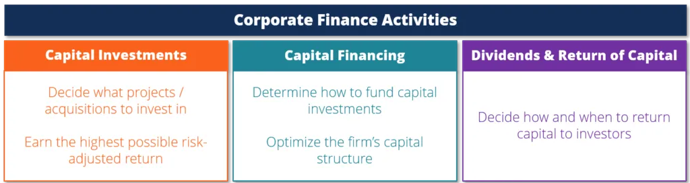
Corporate Finance
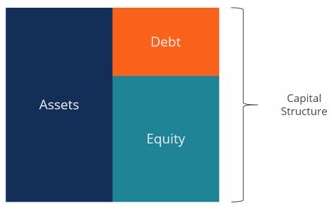
Corporate finance deals with the capital structure of a corporation, including its funding and the actions that management takes to increase the value of the company. A company’s capital structure is crucial to maximizing the value of the business, and its structure can be a combination of long-term and short-term debt and/or common and preferred equity. Corporate finance also includes the tools and analysis used to prioritize and distribute financial resources.
A company that is heavily funded by debt is considered to have a more aggressive capital structure and, therefore, potentially holds more risk for stakeholders. However, taking this risk is often the primary reason for a company’s growth and success.
Career Path
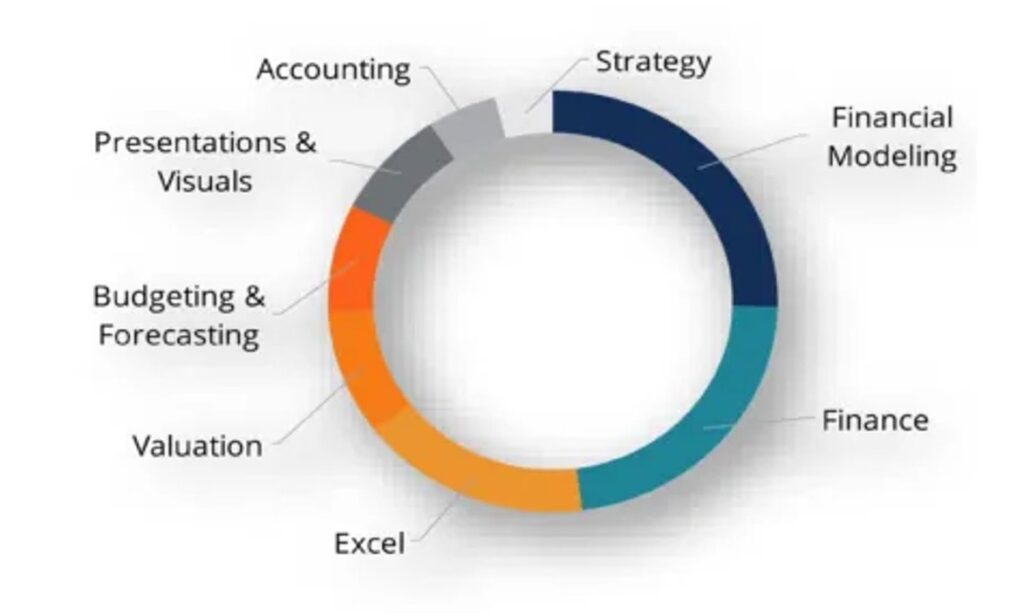
A typical career path in corporate finance starts in Financial Planning & Analysis (FP&A), perhaps as a controller or budget planner. Eventually you’ll follow the career path of a Chief Financial Officer (CFO) in a small company or in a big multinational, where you will have to deal not only with accounting but also have a heavy focus on financial modeling, finance, Excel, business valuation, budgeting/forecasting, PowerPoint presentations and business strategy.
Investment Banking
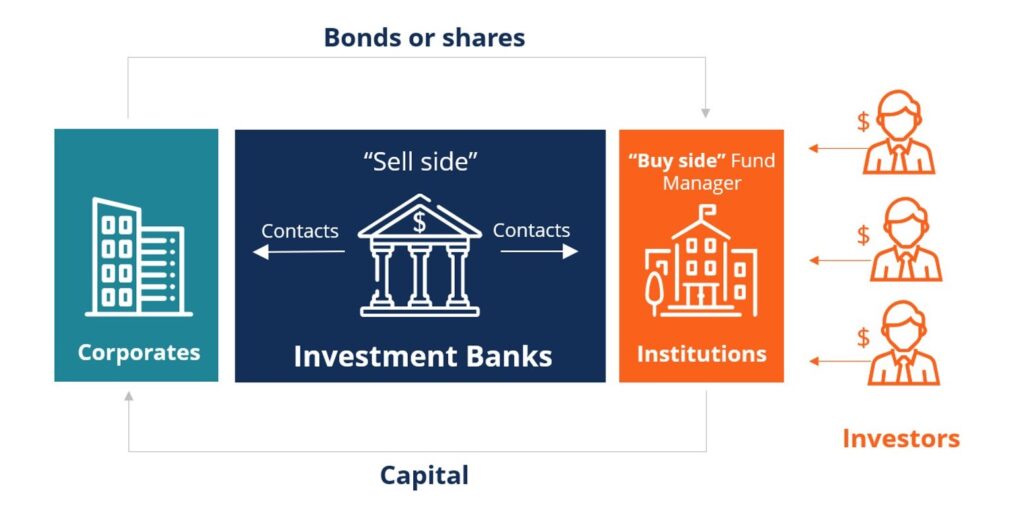
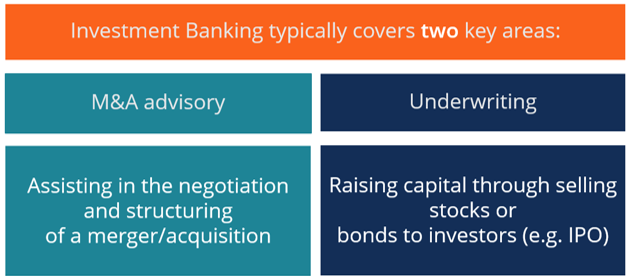
Investment banking is the division of a bank or financial institution that serves governments, corporations and institutions by providing underwriting (capital raising) and mergers and acquisitions (M&A) advisory services. Investment banks act as intermediaries between investors (who have money to invest) and corporations (who require capital to grow and run their businesses).
Investment Banking Division
Full-service investment banks offer a wide range of services that include underwriting, M&A, sales and trading, equity research, asset management, commercial banking and retail banking BUT the investment banking division of a bank typically provides only underwriting and M&A advisory services.
M&A Advisory Services
M&A advisory services or a job working in mergers and acquisitions (M&A) is one of the most sought-after and high-profile roles in investment banking. Senior M&A bankers travel the world and advise on the world’s biggest and most complex deals, reshaping entire industries.
M&A bankers are professional advisors. They operate at the highest levels, working with large global companies (corporates, as they’re known in banking), advising chief executives how best to position their organizations for the future. Unlike management consultants, who help companies determine and implement the best strategy without necessarily changing the company’s component parts, M&A bankers drive strategy through structural change.
- M&A jobs are about working with clients on deals to buy and sell companies.
- M&A juniors—analysts—work on Excel models to help value companies involved in deals.
- M&A juniors put together pitchbooks in PowerPoint to help senior bankers win a role advising on deals.
- M&A jobs are well paid: $110k+ salaries in year one are the new normal.
- M&A jobs can involve gruelling hours. M&A juniors complain of 100-hour weeks.
- Two years in M&A can leave you well-positioned for the future, with opportunities available in private equity, hedge funds and elsewhere.
M&A Bankers
M&A bankers encourage the companies they’re working with (clients) to join together with other companies as equals (a merger), to buy and control a smaller company or part of a company (an acquisition), or to sell part of their own operations (a disposal). Mergers, acquisitions and disposals happen for different strategic reasons.
Globally, the top three banks in M&A are Goldman Sachs, JPMorgan and Morgan Stanley. These are the banks that work on the biggest and the most complex deals, often involving buyers and sellers in different countries. But there are a number of other big US and European banks that are also active in M&A, and many also lend the money to finance the deals.
While the biggest, multi-billion-dollar deals grab the headlines, the majority of deals are below $500m in size, and there are a number of so-called mid-market M&A firms which earn good money advising on these deals. There is also a large number of so-called boutiques, which are independent, privately-owned firms run by a small number of senior M&A bankers who’ve left big banks to set up on their own.
Boutiques are typically purely advisory houses—unlike banks, they don’t actually provide the financing for deals themselves. The best-known ones include Rothschild, Lazard, Moelis & Co, Evercore, Centerview Partners and Perella Weinberg Partners, but there are hundreds out there.
M&A Analyst
Typically, an M&A analyst will be responsible for the financial analysis that underpins an M&A deal. This includes building a financial model, running the valuation and financial impact analysis, and preparing materials to present this analysis to the client. Very occasionally, an M&A analyst will also be asked to present this analysis to the client. Sometimes they will also be the point of contact for any questions or requests from the client relating to the analysis.
Day-to-day life as an M&A analyst largely depends on the deals you are working on but broadly speaking, mornings and early afternoons involve client interaction, status and/or diligence calls and discussions to agree on the workstreams the deal team should focus on, as well as next steps. By the afternoon or evening, meetings are less frequent, and you can focus on progressing on the deliverables, which can range from Excel modelling to preparation of marketing materials.
In 2023, the pace of M&A work has started to drop off, but long working hours (75+ a week) are still considered the norm. One reason for this is that M&A is a fast-paced, ever-changing work environment and the intensity of the job will depend on the type of project you are working on. Deal execution tends to be unpredictable by nature as it’s a live situation, whereas business development/pitching tends to be more predictable. Hours are especially long when deals reach a crunch point, or when you’re working on multiple transactions.
Career in M&A
One of the benefits of a career in M&A is that there’s regular and steady progression and a clear promotion path from analyst to associate to Vice President (VP) to director to Managing Director (MD) (although exact titles vary between different banks). The time it takes to reach the top rung varies, but as a very rough rule of thumb, it’s around 15 years.
As your M&A career develops, your job becomes increasingly client-facing. The role evolves from being technical and analysis-driven to becoming strategic and advice-driven. M&A jobs offer a wide variety of exit options. Many graduates stay at banks for their two-year M&A training program and then leave (if not even sooner) for jobs in private equity, hedge funds, corporate development teams in large companies or even consulting firms.
If you want to work in M&A, your required skills will mainly be based in financial analysis and technical areas for a short period of time, but the role also will require a degree of independent and proactive work (for example reading broker notes) to stay current on the market environment.
Alongside independence, proactivity, and having a desire to learn, M&A analysts need to be confident with numbers and have a quantitative mindset. They also need to have good people skills and to be able to communicate and interact with people confidently. Ultimately this is a client-facing job and clients look to M&A bankers to provide good judgement and advice.
Salaries & Bonuses in M&A
M&A jobs pay large salaries and bonuses to match the long hours. Investment banks offer first-year analysts a base salary of around $110k before bonuses. Salaries increase as you rise through the ranks. Recent salary and bonus surveys suggest that first-year associates are typically earning around $175k, while directors (about eight years in) can earn a basic salary of $300k in the US. Managing director pay is more varied, and depends strongly on the firm in question, but a salary of around $500k is considered standard.
Your total compensation (comp) also includes a bonus. For M&A bankers the size of the bonus depends strongly on fees paid to the bank when a corporate it is advising completes an M&A transaction. Bonuses can be 80% of your salary as an analyst, and are even greater than your salary as you become more senior. Bonuses at most banks are paid predominantly in shares, with a smaller cash element.
AVERAGE COMPENSATION BY SENIORITY IN THE IBD, US$
COMPENSATION
CM underwriting services
Capital markets underwriting services in an investment bank require bankers that are all about facilitating expansion for their clients. When companies want to make investments and expand, they need to raise money to do so. Sometimes they just take out a bank loan, but if you want to raise a lot of money at the best rates possible—or if your financial needs are a little bit more complicated than the average lending officer can accommodate—then you might need to go to the global capital markets and sell debt or equity to investors. If you do that, it’s the capital markets divisions of an investment bank you’ll be talking to.
- Capital markets bankers help clients raise money through public markets.
- Capital markets bankers usually specialize in equity or debt. They’re known as equity capital markets (ECM) bankers and debt capital markets (DCM) bankers.
- Capital markets jobs are well-paid. The highest pay goes to people originating deals and bringing in new clients rather than just executing on capital raising transactions.
- Entry to the best capital markets teams is highly competitive; junior bankers get ahead by impressing bosses with skill and hard work.
- To succeed, you need to be good with people and have a really strong eye for detail.
Capital Markets
Investment bankers working in capital markets are responsible for providing advice to companies on capital raising, and then finding investors to provide the money. As they depend on investors to be able to deliver the cash to the corporations, capital markets teams are usually split into debt capital markets (DCM) and equity capital markets (ECM), specializing in either bond or equity issuance.
DCM brings a unique combination of corporate finance (a profound knowledge of how a client’s business operates and how to advise on their financial needs), fixed-income and mastering of complex financial products. The high-volume nature of debt issuance means DCM bankers must be able to develop relationships with clients over time and provide them with relevant market information at regular intervals.
ECM bankers, on the other hand, have to go out and make deals happen by understanding the market complexities for that day and week, by reading newspapers, listening to the research briefings, and participating in team meetings. As soon as a pitching process opens up, it’s the senior ECM bankers who will hop on a plane and try and sell the investment bank to a potential client. This is the origination stage of the deal, and although it’s the directors and managing directors who are expected to be the face of the bank, junior employees are engaged in preparing the marketing material required to convince a client to go with a particular bank. If they’re successful, the team involved moves on to the execution stage of the deal.
Skills you'll need for jobs in ECM / DCM
Capital markets is a job in which long hours are constant; if you aren’t rushed off your feet with deals to execute, you’re expected to fill in the gaps by working on pitches.
Capital markets bankers are famous for their attention to detail. Since the actual service is something of a commodity, banks try to differentiate themselves by reassuring the client that they will be able to make the transaction go without a hitch, so any tiny mistake in a pitchbook or model will tend to undermine the overall branding.
Because of the way that the capital markets division works, people in these jobs also need to be good at teamwork. It’s the same in equity capital markets (ECM). Senior capital markets bankers need to have broad internal and external contacts, as well as strong interpersonal skills, marketing capabilities and strong project management skills to balance the interests of complex stakeholders.
Finally, if you have a capital markets job you’ll also be required to multitask. Even a relatively simple capital markets transaction will call for many different skill sets as it moves through the pipeline, from pitching to modeling to legal and compliance to project management. An ECM or DCM banker is expected to stay with the transaction and to liaise with the clients all through the process, and to retain grace under pressure.