
1. Overview of this Career Area (“why”)
Fintech
Fintech is a combination of the words “finance” and “technology.” Although it’s a blanket term that can mean many different things, broadly speaking, it describes the evolution of an industry where new technology use-cases are developed and deployed to streamline more traditional-looking finance functions.
While the general public typically associates fintech with really cutting-edge new concepts like blockchain and algorithmic trading, the term applies to a very wide variety of many more applications. They include, but are not limited to, everyday banking, insurance and other back-office risk management functions.
Mobile banking—something that hundreds of millions of people around the world take completely for granted—is actually technology supporting the delivery of traditional banking services (aka fintech). Even your Starbucks app is a form of financial technology in that it facilitates payments and a proprietary rewards program using a mobile device (referred to as embedded finance or fintech).
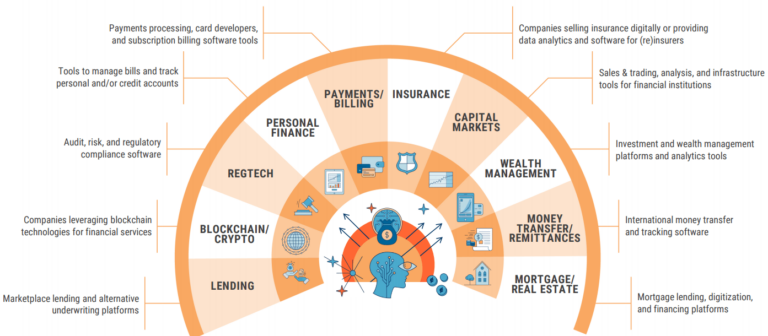
Fintech Jobs
Fintech jobs are fundamentally different to jobs in traditional finance, especially in a startup.
Software engineers and product managers (PMs) work on building and maintaining the infrastructure of the firm, as well as developing new products for it to begin selling. Sales and partnerships people look for institutions and clients to utilize their services or help broaden consumer awareness of the fintech.
Those interested in founding a fintech will find themselves in an executive role far earlier than they would in traditional finance. While the size of your team may not exceed that of one run by a banking MD (or even some VPs), the role would then also encompass engaging with venture capitalists, private equity firms and other possible investors in the company, and departments also intermingle far more frequently and the chain of seniority can also be far more ambiguous .
As for working culture, it very much depends. Fintechs can be work-from-home friendly or offer amazing benefits like a four-day working week, but the additional workload can take its toll. For fast-growing fintechs, certain structures that provide stability for employees [such as HR practices] might not be in place. Some fintechs prioritize their investments in growth, scaling and product building over supporting employees.
Fintech jobs these days are not great. They’re not terrible (depending on your sub-sector of choice), but they’re not great. After a mammoth few years for investment, funding rounds are smaller and sparser in 2023. Initial Public Offerings (IPOs) were infrequent even during the sector’s heyday; now they are exceedingly so. The industry is also at its winter for crypto fanatics, although regulation in EU called MICA is finally bringing some light into the darkness.
It’s not the only industry racked with regulation problems. BNPL was another star-child for fintech as firms like Klarna ballooned in popularity and value. The UK is clamping down on its use now, though issues over profitability spelled uncertainty for BNPL even without regulators to worry about.
The top three locations for fintech unicorns (startups valued above $1bn), are New York, London and San Francisco. Each is home to a number of the most prominent fintechs operating today. Each have too many to count, but one of London’s most prominent fintechs is Revolut. New York has Ramp and San Francisco has Chime.
Many of the biggest fintechs come from outside the major hubs. Stripe, arguably the face of fintech in 2023, has its headquarters in Ireland. NuBank, one of the largest digibanks, is based in Brazil. Rapyd, another payments giant, is based in Israel. Grab is Asia’s biggest fintech, and is based in Singapore.