Youssef Abdel Nasser studied both his Bachelor in Data & Business Analytics and his Master in Business Analytics & Data Science with us. After graduating in July, he moved straight into a pre-sales engineering role at SAS, working with an advanced analytics platform and real client data.
“I’m full IE, basically,” says Youssef as he reminisces on his studies, along with the importance of initiatives like Tech Venture Bootcamp and Venture Lab, where he built and pitched a computer vision startup with classmates.
Let’s take a look at Youssef’s journey and see what you can learn from his formative years at IE School of Science & Technology.
What’s it like working at SAS?
SAS is known for its analytics platform. Youssef’s role sits at the point where advanced modeling meets real business decisions. As part of the pre-sales engineering team, he builds demonstrations for clients, using their own datasets to show what SAS’s tools can do. “My role was to help build demos for customers and showcase what the software could do,” he says. “Now it just transitioned into a full-time role. So far, so good.”
The work is varied because the requests come directly from the sales team. “Usually salespeople submit tickets and say, ‘We need some help to build a demo for a client or address this issue,’” Youssef explains. He then picks up the case in ServiceNow, works through the client’s dataset, and prepares a tailored solution. It’s hands-on, technical work, but always with a clear purpose. “We would build a demo to help solve their use case with their data,” he says. “Usually they like the software, they like what it can do, and then they proceed to the sale.”
This positioning means he has to understand both the platform and the client’s context. Many demos involve predictive modeling, data pipelines, or intelligent decision flows. “It’s a very big analytics platform, so there’s a lot you can do,” he explains. “SAS has its own language… you can build forecasting models, clustering models, linear regression, and use Intelligent Decisioning to build pipelines.” Each case expands his knowledge because the requests rarely look the same. “Keeping track of everything the software does is hectic sometimes because there’s so much it could do.”
How do you learn new tools in tech?
Youssef arrived at SAS with a strong foundation in machine learning and data analysis thanks to both IE programs. “A lot of the machine learning we did, at least in the bachelor’s and the master’s, was using Python,” he says. He had extensive exposure to supervised and unsupervised learning, statistical modeling, business analytics, and coding projects across both degrees.
“One challenge when entering the company was adapting to their software and platform,” says Youssef. “You’re essentially doing the same thing, but you’re not using Python.” SAS’s internal language and tooling required a shift in workflow, and he had to rebuild some of his instinctive habits. The company supported him with internal courses and onboarding programs, but he credits his education for giving him the mental structure to learn fast. “They gave us some courses to onboard us, but with time it got better. Now I know how to use the platform quite well.”
The interview process reflected that preparation. Almost every conversation touched on data modeling, visualization, or machine learning concepts that IE School of Science & Technology had drilled into him. “Everything he asked me I already knew,” he says. “I remember finishing the interview and telling my friends this was literally an exam I took at IE.” The foundation he built during his degrees made his transition into industry smooth, even as the specific tools evolved.
What is the Tech Venture Bootcamp?
The Tech Venture Bootcamp was one of the most formative parts of Youssef’s time at IE School of Science & Technology. It began with a large cohort of students pitching ideas at the Tower, attracting mentors from the Venture Lab and forming teams based on complementary skill sets. “We entered a class full of well over 100 students who were ready and ambitious to come up with a project of their own,” he says. Students wore stickers showing whether they were technical, finance-focused, business-oriented, or creative, and then self-organized into teams.
After pitches and team formation, the bootcamp moved fast. Mentors coached each group toward a semi-final round in front of the Dean and senior Venture Lab faculty. Strong projects were pushed to the one-minute final pitch, a session Youssef still remembers vividly. “It was extremely competitive,” he says. “We were looking at some of the students pitching and thinking, geez, this is a really good project. We didn’t know if we were going to win, but thankfully we did.”
The intensity gave Youssef a preview of real-world pressure, where communication and clarity matter as much as technical work.
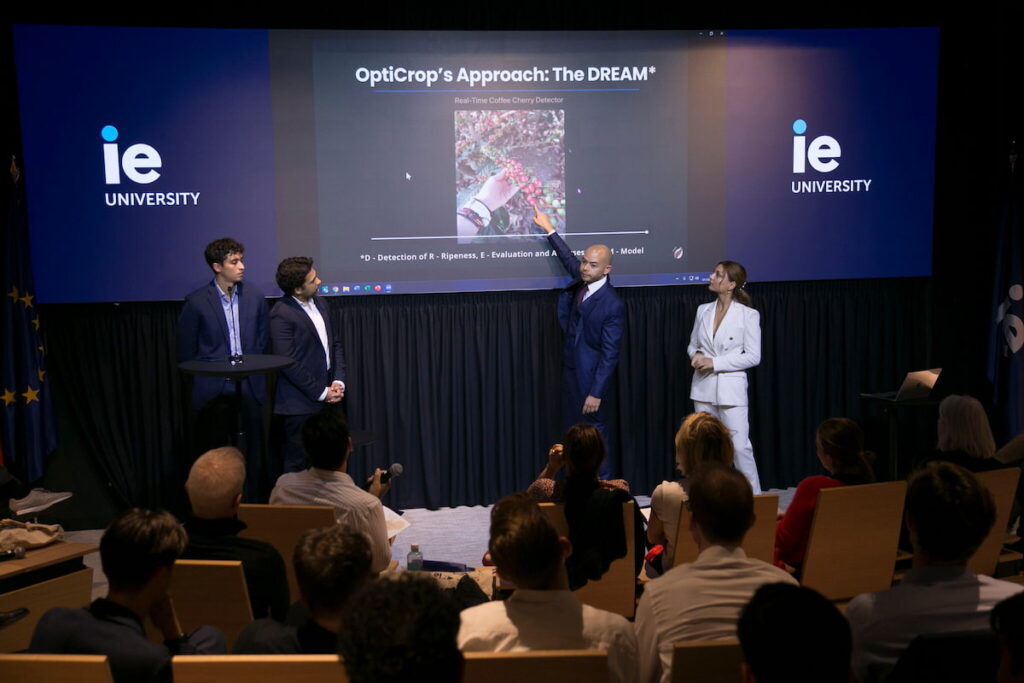
His team’s startup idea was a computer vision tool for detecting the ripeness of coffee cherries. “We developed a computer vision model which helped detect the ripeness of coffee cherries,” he says. The goal was to help Colombian farmers sell produce at specialty coffee prices, since ripeness determines price but is difficult to assess manually. “Farmers would be able to detect them in real time, pack them up, and sell them for more,” he explains. The idea had strong technical foundations, clear business value, and real-world relevance.
Why is the Tech Venture Bootcamp so useful?
What stands out in Youssef’s story is how closely the bootcamp mirrors the work he does now. Startup development required technical proof-of-concepts, data modeling, user validation, presentations, and client-style communication. “We learned the ins and outs of building your own company,” says Youssef. “Whether it’s working on the technical side, on the business development side, on understanding needs, on pitching… you use all of that later.” This balance is at the heart of pre-sales engineering, where the challenge is always to translate a technical solution into clear business value.
The workload was also similar. Youssef and his team spent full weekends and long evenings building their model and preparing their pitch. “We were working during the weekend,” he says. “We’d stay from morning to night all day.” During Venture Lab, the schedule extended into the evenings after regular classes. “We were putting in the extra hours… from 7:00 to 10:00 PM.”
In interviews, these experiences gave him tangible stories of leadership, initiative, teamwork, and problem-solving—all qualities SAS values. He could talk about real technical challenges, stakeholder communication, and product-market fit, rather than just coursework. “I don’t even think I would have landed my job if it weren’t for the Tech Venture Bootcamp,” he says. “It was extremely important.”
What do tech companies like SAS look for?
Working in pre-sales engineering requires a combination of skills that go beyond pure data science. Communication sits at the center of the role, because he often presents his work to people without technical backgrounds. “When you work with data it’s very easy to translate things in a technical way,” he says. “But most of the time you’re presenting to someone who has absolutely no level of knowledge in data.” Simplifying complex analyses into clear insights is a daily requirement.
Responsibility and initiative also matter. New requests arrive frequently, often in unfamiliar domains. “You need to take on a lot of responsibility in general,” he says. “Even when you don’t know the answer, you need to be proactive enough to say you’ll still find a way to get it done.”
Finally, language skills and adaptability play a role. SAS Madrid works with many Spanish clients, so a certain level of Spanish is required. “Although it’s a US company, the offices here in Madrid tend to work with Spanish clients,” he says. His current role involves an international manager and diverse cases, but local communication still matters. The combination of technical depth, communication, and adaptability is what helped him stand out.
What’s the best way to study data analytics?
Looking back, Youssef believes many students underestimate how valuable the IE extracurricular ecosystem can be. Technical electives, clubs, and startup labs offer opportunities that go far beyond standard coursework. “From a class of about 55 people, only four or five ended up trying the Tech Venture Bootcamp,” he says. Many chose not to take on extra work, but he sees how those additional hours shaped his trajectory.
Youssef encourages future students to take the initiative early, especially if they want careers in analytics, engineering, or consulting. “If you’re interested in working on a tech-related product and you have the chance to do the Tech Venture Bootcamp, go for it,” he says. “Someone might need you at some point for their project, and you’re going to learn so much on the business end as well.”
He also highlights the importance of staying open to the international experience the Master in Business Analytics & Data Science offers. Working with classmates from around the world helped him adapt quickly to Spain and to the multicultural environments he now works in. “Everyone from IE is from a different part of the world,” he says. “You all adapt together.”
Why should you choose IE School of Science & Technology?
Youssef began looking at universities across Europe, Canada and Asia after high school, searching for programs that combined math, statistics, and real career potential. Our master’s program was the only one offering data science among the institutions he applied to. “Data science was becoming popular, and people were saying it would be in demand in the years to come,” he says. He wasn’t completely sure what the field involved, but he was sure about what he liked: problem-solving and analytical thinking.
A friend already studying the program described strong facilities, a diverse student body, and professors with strong industry backgrounds. “You have access to amazing professors,” he says. “You’re in awe about their résumé most of the time.” That combination convinced him to move from Egypt to Madrid, where he quickly found a home within IE School of Science & Technology’s international environment.
That combination convinced Youssef to move from Egypt to Madrid, where he quickly found a home within IE School of Science & Technology’s international environment.
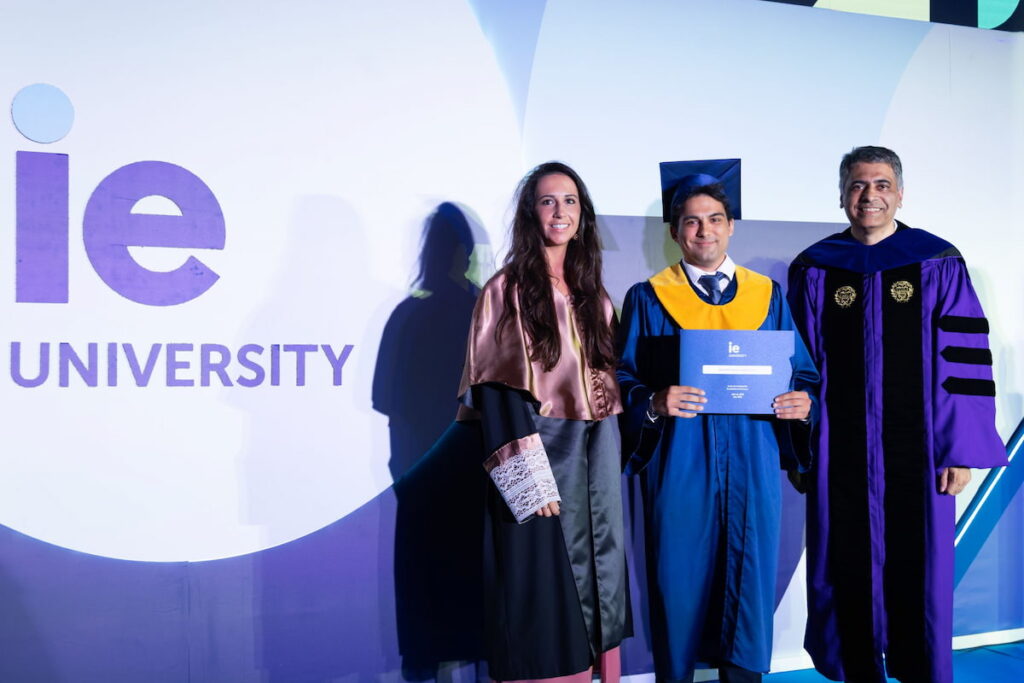
The cultural transition was a positive one. “There was a big cultural shock, but in a good way,” he says. The mix of backgrounds, the warm environment, and the pace of life in Madrid all contributed to a smooth adjustment. With hindsight, he sees IE School Science & Technology as the right choice at the right time. “It’s a very safe choice,” he says. “It’s the best choice.”
Benjamin’s writing is featured in the LAMDA Verse and Prose Anthology Vol. 19, The Primer and Moonflake Press. Benjamin provided translation for “FalseStuff: La Muerte de las Musas”, winner of Best Theatre Show at the Max Awards 2024.
Benjamin was shortlisted for the Bristol Old Vic Open Sessions 2016 and the Alpine Fellowship Writing Prize 2023.