Now is a great time to get into tech. After all, it seems to be all anyone talks about. That said, if you’ve already majored in an unrelated field or you simply lack relevant career experience, it can feel like a pretty impenetrable world. But here’s the good news: It is accessible without experience. You just need a solid process and stamina.
At IE School of Science & Technology, we know how to convert general business profiles into tech specialists. Which is why we’ve put together this guide to help you find a target role, build proof that matches job descriptions and apply consistently. You may decide to study with us – you may not. But, by the end of reading, you should be in a better position to reach your career goals.
1. Pick the right tech role
Start by choosing one lane for the next 8 weeks. Data and analytics fits you if you like structured work, measurable outputs and a direct bridge from business. Software development fits you if you want to build systems and you can tolerate debugging as a daily activity. IT support fits you if you like troubleshooting, clear procedures, and predictable workflows.
Whatever your area of interest, choose a job title that appears often in listings and is realistic at entry level. Common targets include Junior Data Analyst, Business Analyst (data), BI Analyst, Junior Developer, QA Tester, and IT Support Specialist.
2. Decide what to learn
Open 10 job posts for the exact title you chose. Copy the “requirements” section into one document. Highlight anything that appears in at least 6 of the 10 listings, and treat that highlight set as your curriculum.
For analytics, build a minimum stack around spreadsheets, SQL, and one dashboard tool. Add Python only when your target listings consistently ask for it, because employers usually screen for the core stack first. If you’re coming from business, this path often converts fastest because you can apply domain context immediately.
For software development, commit to one language and build one small app end to end. Git fundamentals matter early because they signal you can work in a real team environment. Documentation skills also matter because they reduce reliance on hand-holding.
For IT support, focus on operating systems, basic networking concepts, and troubleshooting frameworks you can explain clearly. A structured certification path such as CompTIA A+ can help if your target listings mention it or you want an externally recognized baseline. Hiring managers still expect you to communicate and document your steps.
4. Build projects
Build two finished projects that resemble workplace tasks. Each project needs a clear question, a visible method, and an output someone can review fast. A project that is small and complete will help you more than a big idea that stays unfinished.
Structure the write-up the same way every time. Start with the question you’re answering, then describe inputs and assumptions, then show the steps you took, then present the output, then end with a conclusion and what you’d do next. Publish the work somewhere stable, such as GitHub for code or a simple portfolio page for dashboards and summaries.
If you’re targeting analytics, Project 1 can be dataset cleaning, analysis, a dashboard, and a one-page recommendation memo. Project 2 should use a different dataset and answer a different question, so you demonstrate range without increasing complexity. If you’re targeting software, one project should show a complete user flow and basic error handling, and the second should show a different feature set or a different kind of problem.
5. Pace yourself
This is a marathon, not a sprint. You will start qualifying for interviews with prolonged dedication. However, the time it takes to find opportunities depends on your weekly hours and how tightly you stay aligned to job posts. With 10-15 focused hours per week, many candidates can become credible within a few months for entry-level roles. Faster timelines are possible with higher hours, but consistency usually matters more than intensity.
Use milestones to stay objective. One finished project by week 6 is a strong signal that your process works. Two finished projects by week 10–12 puts you in position to apply with proof and talk through your work calmly.
6. Apply for interviews
When you’re trying to get into tech with no experience, you want to work systematically. So, in the application process, that means setting weekly activity targets. A starting target could be sending 10 high-quality applications per month, plus 2 messages per week on LinkedIn to people in your target role. Track outcomes in a spreadsheet so you adjust based on response rates, independent of your mood on the day.
Keep your narrative short and consistent. Lead with the role you’re targeting, then cite the two projects and the tools you used, then connect your previous experience to outcomes you can deliver.
7. Keep learning as you work
Sooner or later, you will land an entry-level tech job. That’s great – but don’t sit back. You must keep learning and becoming a valuable team member. Treat the first 90 days as a delivery phase. In the first month, learn the systems and document what you touch. In months two and three, deliver at least one measurable improvement, such as reduced reporting time, fewer errors, faster turnaround or clearer stakeholder communication.
Keep a running log of results with numbers. That record becomes your promotion narrative and your salary narrative later, without needing to reconstruct what you did. Then you’re a legitimate tech professional and long, healthy tech career is finally on the cards.
Where IE School of Science & Technology fits if you want a structured conversion path
If you want a guided transition into tech, you get more value from a program that builds hard skills and forces you to produce portfolio-grade work on a deadline. The Master in Business Analytics & Data Science is built for that conversion, with two formats (11-month full-time or 17-month part-time) and a curriculum that spans business transformation, data science, data science technologies, and professional skills, with coverage of AI, machine learning, deep learning, NLP, and data visualization. You also spend real time doing the work through internships, hackathons, capstone projects, and Venture Lab-style experiential learning.
Throughout the Master in Business Analytics & Data Science, you’ll also work through internships, hackathons, capstone projects and Venture Lab-style experiential learning.

If your goal is a deeper technical pivot, the Master in Computer Science & Digital Innovation is an 11-month full-time, in-person program in Madrid that explicitly welcomes students from diverse backgrounds, including those without prior computer science training.
With the Master in Computer Science & Digital Innovation, you build from core subjects like algorithms, databases, networks, operating systems and Python. You then apply that foundation through hands-on projects and industry-style challenges.

Finally, if you’re looking for an industry-specific qualification in a growing field, you should consider our Master in Financial Technology. This program blends finance, data and emerging technologies, giving you hands-on experience with tools like Python, SQL, AI and blockchain while working on real projects with industry partners.
Sitting at the intersection of business and technology, the Master in Financial Technology prepares you for roles in areas like digital payments, financial data analysis and fintech innovation, even if your starting point isn’t purely technical.
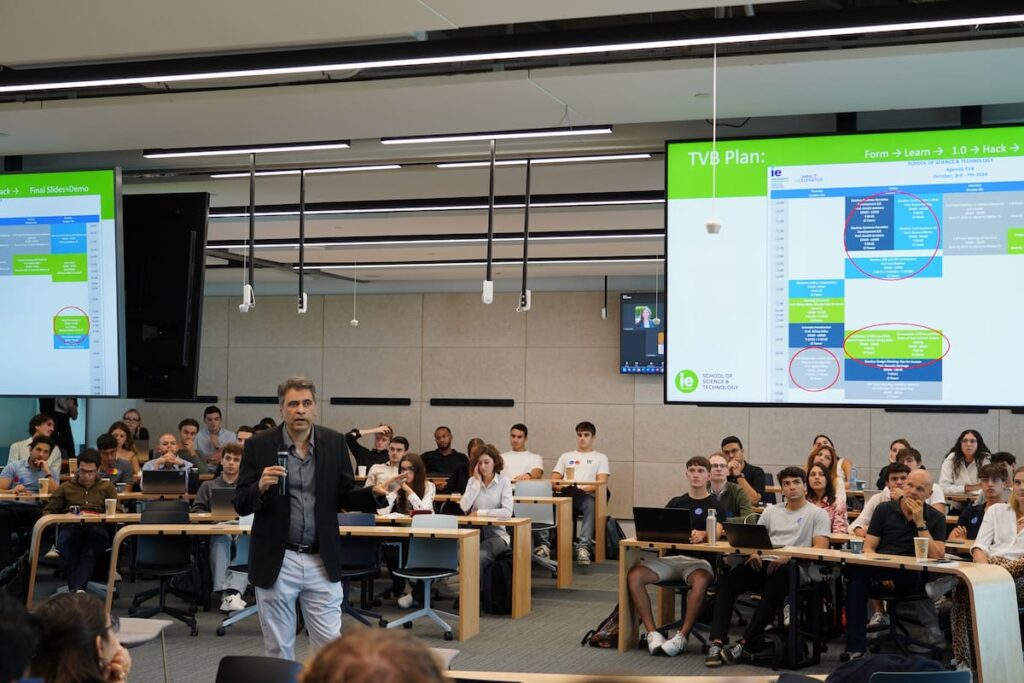
Choose a welcoming community at IE School of Science & Technology
We’re actively seeking to make positive change in the broader tech community. And our main focus lies in upping the representation of women across all types of tech careers.
As such, we can promise that at IE, you’re entering a community that takes women in tech seriously. We run mentorship opportunities designed for women, including a Tech Mentorship Program connected to women-focused initiatives and ongoing collaborations with ASTI Talent&Tech Foundation to bring girls and women into STEM spaces to learn directly from female leaders.
We detail all these initiatives on our dedicated page for Women at IE School of Science & Technology.
Want to find out more information? Browse through featured articles to see what we’re all about and get career tips. Then, when you’re ready, follow the “Learn more” button below and take a deep-dive into what our programs have to offer.
Want to see how we support our students? Read our guide on IE mentorship in tech.
Are you a woman in tech? Find out more about networks for women in data science.
Interested in our initiatives? Find out how we’re helping inspire girls in STEM.
Benjamin is the editor of Uncover IE. His writing is featured in the LAMDA Verse and Prose Anthology Vol. 19, The Primer and Moonflake Press. Benjamin provided translation for “FalseStuff: La Muerte de las Musas”, winner of Best Theatre Show at the Max Awards 2024.
Benjamin was shortlisted for the Bristol Old Vic Open Sessions 2016 and the Alpine Fellowship Writing Prize 2023.