Finance, Defence and Cohesion: Can the E6 Drive Consensus Across the Union?

On Friday, October 16th, 2026, the Global Policy Center at IE University, in collaboration with the Friedrich-Ebert-Stiftung (FES), the Institut Jacques Delors, and the Istituto Affari Internazionali (IAI), hosted the fifth edition of the Future of Europe Debates at the IE Tower in Madrid. Titled "Can the E6 become the engine for a geopolitical Union?", the high-level roundtable brought together experts and representatives from Spain, Germany, France, Italy, the Netherlands, and Poland to examine how this new format can drive reforms and consensus in a 27-member bloc.
The opening remarks were delivered by Ilke Toygür (Director of the Global Policy Center), Daniel Reichart (FES), Eulalia Rubio (Jacques Delors Institute), and Matteo Bonomi (IAI). They framed the E6 as a new format with a clear objective: to transform the european economic ecosystem into one capable of driving strategic sovereignty in an increasingly competitive global landscape.
Balancing Defence Autonomy and Social Cohesion
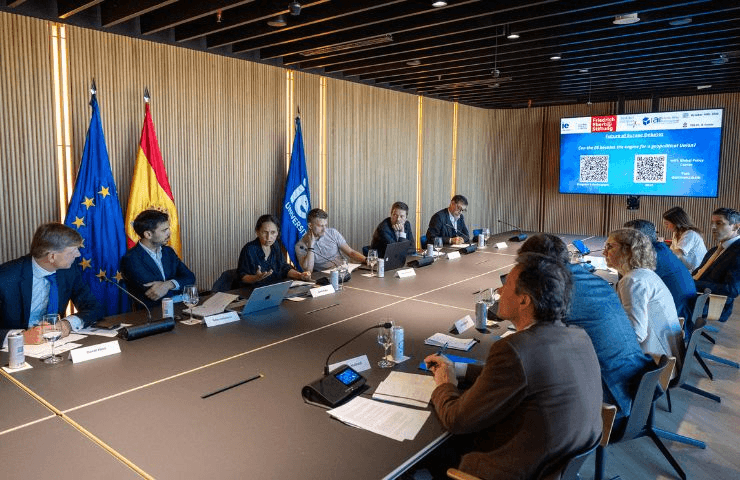
In the first panel, input givers explored how to align strategic sovereignty and social cohesion. The debate focused on the upcoming Multiannual Financial Framework (MFF) and the challenge of expanding defence and security investments amid tight fiscal constraints without undermining social welfare.
Panelists stressed that long-term competitiveness must be driven by productivity and public investment in education, infrastructure, and technology rather than wage cuts or regulatory race-to-the-bottom dynamics. Rather than viewing security and social spending as a trade-off, speakers argued that social cohesion and resilience form the necessary democratic bedrock for a geopolitical Europe. In this context, the E6 serves as a flexible mediation platform among key member states to align fiscal priorities and optimize spending efficiency.
Financing Sovereignty: Capital Markets and Fiscal Integration
The second panel, examined the financial tools required to fund Europe's strategic ambitions. Input givers addressed the role of the E6 in driving consensus to deepen fiscal integration and building a Savings and Investment Union (SIU).
The discussion highlighted the need to overcome fragmentation across 27 national capital markets to mobilize private investment at scale. Speakers called for simplifying regulatory frameworks, de-risking private capital, and creating European savings mechanisms to fund the green, digital, and defence transitions. The panel concluded that while specialized projects cannot replace the MFF, informal formats like the E6 are critical to generating the political momentum needed to deliver unified financial supervision and market integration.
A Collaborative Platform for European Strategy
The E6’s true value lies in acting as a facilitator for compromise rather than an exclusive vanguard, ultimately helping the EU navigate global fragmentation while safeguarding its social foundations.