Navigating global risks: the GPC concludes its Executive Education program with Financial Times

Current geopolitical uncertainty continues to shape the global landscape. In this context, the capacity to anticipate and adapt to geopolitical shifts is no longer a luxury, it is a strategic imperative.
The GPC, in collaboration with the Financial Times, recently concluded the latest edition of its Executive Education program: "Geopolitics and Global Risks: Strategic Insights for Leading in Uncertain Times", designed specifically for senior and mid-career professionals in charge of decision-making procedures. The program addressed the growing need for such a profile to master the art of geopolitical analysis and strategic anticipation, ensuring effective decision-making and leadership.
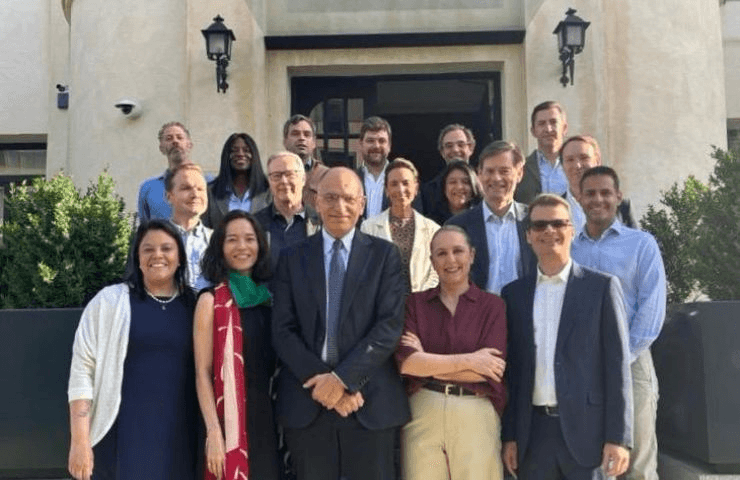
Over four intensive days in Madrid, a selected group of ten professionals engaged in a dynamic and interactive learning experience, including expert-led sessions, scenario-based exercises and collaborative workshops. The course provided them with an innovative and holistic approach to better understand the current geopolitical landscape as well as the necessary tools and skills to deliver policies and results in a context of complexity and uncertainty.
The program featured high-level experts including Arancha Gónzalez Laya (Dean of the Paris School of International Affairs), Alec Russell (Foreign Editor, Financial Times), Valbona Zeneli (Non-resident Senior Fellow at the Atlantic Council's Europe Center), Kristina Kausch (Deputy Director, South & Wider Europe, The German Marshall Fund of the United States) and Ricardo Borges de Castro (Senior Adviser at the European Policy Centre). The contribution of these distinguished speakers was complemented with insights from IE University’s own faculty and leadership, including Enrico Letta (Dean, IE School of Politics, Economics and Global Affairs), Ilke Toygür (Director, Global Policy Center and Professor of Practice, IE University), Amanda Sloat (Professor of Parctice, IE University) and Beatrice Grace Obado (Adjunct Professor of International Relations and Sustainable Development, IE University).
Together, these experts guided participants through a course structured around three modules:
Module 1 "Deep dives: Global & regional geopolitical risks"
This module examined global and regional geopolitical challenges, allowing participants to explore shifting power dynamics and key conflicts. Learners had the opportunity to explore the complexities of EU-US-China relations across trade and AI, the evolution of transatlantic ties, Middle Eastern geopolitical risks and the intersection of economic security with the climate and digital transitions.
Module 2 "Effective corporate strategies and decision-making in an uncertain geopolitical environment"
Moving from analysis to action, in this module participants acquired practical techniques to anticipate and manage geopolitical and geoeconomic risks within corporate and public affairs strategies.
Module 3 "Strategic foresight: dealing with uncertainty to shape the future"
The final module focused on strategic anticipation, combining learning with hands-on foresight exercises. Strategic foresight emerges in the present as a prime tool to anticipate change and to help shape the future. The module provided the participants with a “foresight toolkit sandbox” as they had the possibility to experiment and work with a selected number of anticipatory tools. Finally, participants learned how to translate strategic foresight into effective policies and strategies for their daily work.
Beyond the classroom
The learning experience extended beyond formal sessions to foster meaningful networking, from collaborative sessions to a private visit to El Prado Museum. The visit aimed to blend intellectual and cultural experiences to foster deeper connections and enrich the program experience.
Ultimately, the course provided participants with much more than a masterclass in current global affairs. During the course, participants had the opportunity to strengthen their skills in risk analysis and strategic foresight, essential abilities in today’s world as they allow them to translate global trends into actionable decisions. Through this collaboration with the Financial Times, the GPC continues to empower leaders not only to navigate complexity, but to actively shape the future world.