Strengthening Transatlantic Ties: GPC Fieldwork Trip to Canada

Last week, Ilke Toygür, Director of the Global Policy Center and Professor of Practice at IE University, visited Canada to engage in high-level discussions on the future of EU–Canada relations against the backdrop of a rapidly evolving transatlantic landscape. The visit took place at a critical juncture: the European Union and Canada reinforced their institutional ties by adding a new security component to their long-standing free trade agreement. This step reflects a growing recognition on both sides that shared vulnerabilities can be transformed into opportunities for deeper cooperation—although many in Canada remain cautious about loosening their structural dependence on the United States.
The visit began in Ottawa with a presentation titled "The Impact of New Geopolitical Dynamics on Transatlantic Relations", delivered by Ilke Toygür and hosted by the Spanish Embassy in Canada. This was followed by a roundtable debate with leading Canadian experts. These exchanges provided a balanced assessment of Canada’s domestic political dynamics—encompassing both government and opposition—and offered a strategic reflection on the country’s positioning in relation to the United States and the broader international order. Participants also discussed how Canadians are rethinking their nation-building process under high levels of dependence, a debate that closely mirrors Europe’s own challenge of maintaining U.S. engagement while actively pursuing "strategic de-risking."
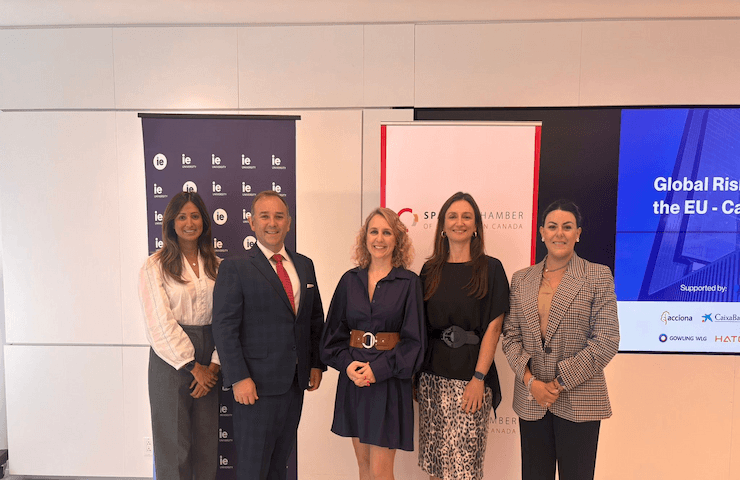
In Toronto, the Director delivered a presentation on "Global Risks and the Future of EU–Canada Partnership", hosted by the Spain–Canada Chamber of Commerce. The session provided a platform to exchange views with business leaders and policymakers on how both sides can navigate shared challenges and seize opportunities for collaboration.
Discussions and bilateral meetings addressed pressing global security challenges, the resilience of multilateralism, and the implications of the newly announced EU–Canada Security and Defence Partnership (SDP). The SDP broadens the scope of cooperation to include cyber defense, hybrid threats, military interoperability, and crisis management exercises, making Canada an increasingly central partner in the EU’s strategy of rallying like-minded middle powers in an era of great power competition.
The Global Policy Center also established a new connection with the Munk School of Global Affairs and Public Policy, aimed at strengthening academic exchange and policy dialogue on transatlantic issues.
This fieldwork trip highlighted key areas of potential cooperation: diversifying energy and raw material dependencies, developing joint approaches to disruptive technologies and tech sovereignty, and advancing democratic resilience in the face of cognitive warfare and systemic contestation. These themes are central to what European Commission President Ursula von der Leyen recently called "Europe’s independence moment", and they resonate strongly with Canadian debates on reducing vulnerabilities without jeopardizing core alliances.
Through this visit, the Director reaffirmed the Global Policy Center’s commitment to fostering strategic analysis and contributing to a stronger, forward-looking transatlantic dialogue.