“What Just Happened?” IE University experts decode the 2026 US midterms and what they mean for Europe

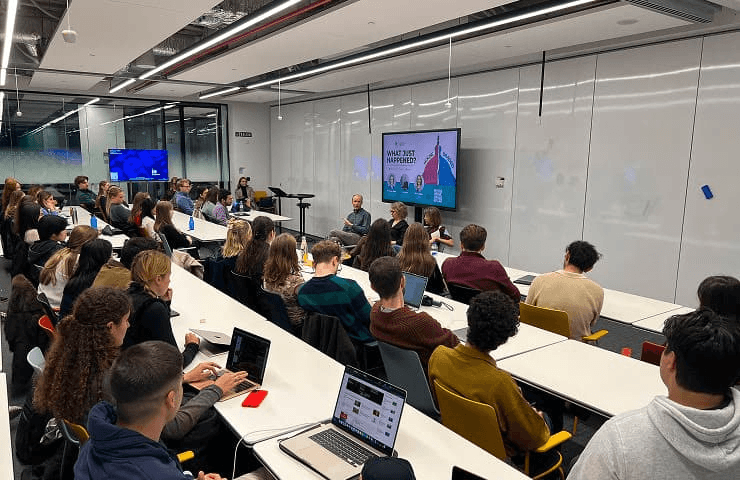
One week after the US midterm elections, Amanda Sloat, professor of practice, and D.J. Flynn, associate professor of comparative politics, joined the IE Global Policy Center to analyse the results. “What Just Happened? Making Sense of the 2026 US Midterm Elections,” took place on 10 November at IE Tower. The event was moderated by Ilke Toygür, director of the IE Global Policy Center, and was followed by a Q&A session and a cocktail.
A wave of historic size
Toygür opened the conversation by responding to recent commentary urging Europeans not to celebrate the results of the election. She argued that this represents a democratic recovery, and “every development in favour of democracy should be celebrated.”
Flynn also emphasised the significance of this blue wave, which represents a huge shift of power. Democrats are set to win the national House vote by about 12 points, the widest margin since Watergate. They will flip between seven and nine Senate seats, many of them in solidly Republican, rural, working-class states such as Kansas, Texas, South Carolina, Georgia and Alaska.
A stress test for democracy, and a vote against Trump
Sloat argued that US institutions, though they have been under severe strain, held up under pressure. Given the scale of the outcome, she says, Trump had no alternative but to accept it. Mid-decade gerrymandering did not produce gains for Republicans, and Flynn pointed out that in several states it actually backfired.
However, both speakers warned against reading too much into the result. Despite their win, Democrats are almost as unpopular as Republicans. The vote was, above all, a statement against Trump, driven by concerns about the cost of living, suspicion around corruption and unease over immigration enforcement. As Flynn pointed out, many voters who once supported Trump’s approach to immigration policies have shifted their trust towards Democrats.
Looking ahead to 2028
Flynn expects Democrats to intensify congressional oversight, while their control of the Senate will effectively block further conservative judicial appointments. Having gained larger-than-expected majorities means that they will be able to pass popular bills and force Trump to choose between signing and vetoing. Nonetheless, Trump’s most consequential moves, including tariffs and military action, are often taken unilaterally and are largely beyond Congress’s reach.
Flynn added that the electoral wave has done little to resolve the divide between progressives and moderates within the Democratic Party. Looking ahead to 2028, the party’s presidential nominee will need to appeal to both camps.
What the midterm results mean for Europe
The midterms are not the panacea Europeans hope for, said Sloat. In her view, the US will not return to funding most of Europe’s defence, and there is little appetite in Congress for additional spending on Ukraine. Even under a Democratic president, some protectionism would remain, although diplomacy would likely improve. Her advice is that Europe should keep building its own capabilities, empowering it to negotiate a proactive agenda with Washington rather than simply requesting support.
Toygür added that Europe cannot realistically pursue its agenda on security, trade, public goods and climate action without any support from the United States. The key question, then, is how to align their agendas even when the two sides disagree on industrial policy. Flynn recalled a European leader who said the future of the West cannot be “dependent on 10,000 voters in Wisconsin every four years.”
Policy challenges and the future of US politics
The audience Q&A explored how the election results could shape US domestic and foreign policy, as well as the challenges facing both parties in the coming years. Questions ranged from gerrymandering, polling and the Electoral College to tech regulation, immigration reform, Canada–US relations and Iran.
On immigration, Sloat explained that Democrats cannot afford to ignore illegal immigration, but that efforts to dismantle Immigration and Customs Enforcement (ICE) would face a presidential veto. Flynn suggested that Democrats could instead advance a comprehensive immigration reform package, putting pressure on Trump to support or reject it.
On gerrymandering, Flynn explained that both parties redraw district lines when they control state legislatures, but that Trump’s push for mid-decade redistricting was unprecedented and backfired in a wave election. He also noted that polls in competitive states underestimated the Democratic margin this cycle. Flynn shared that he expects Hakeem Jeffries to become Speaker while Chuck Schumer will remain Senate leader, as no clear alternative has emerged.
When asked about AI, Sloat said she expects that Democrats will be more active in regulating tech companies, with the location of data centres an increasingly public debate.
Turning to foreign policy, Sloat highlighted that growing public opposition to the war with Iran could make further US military action politically difficult. She also expects members of Congress to seek closer engagement with their Canadian counterparts to reassure them about the bilateral relationship.
The discussion closed with a question about the future of Trumpism beyond Trump himself. Sloat expressed doubts about whether the movement could maintain its appeal without him, arguing that neither JD Vance nor Marco Rubio possesses the same political charisma.