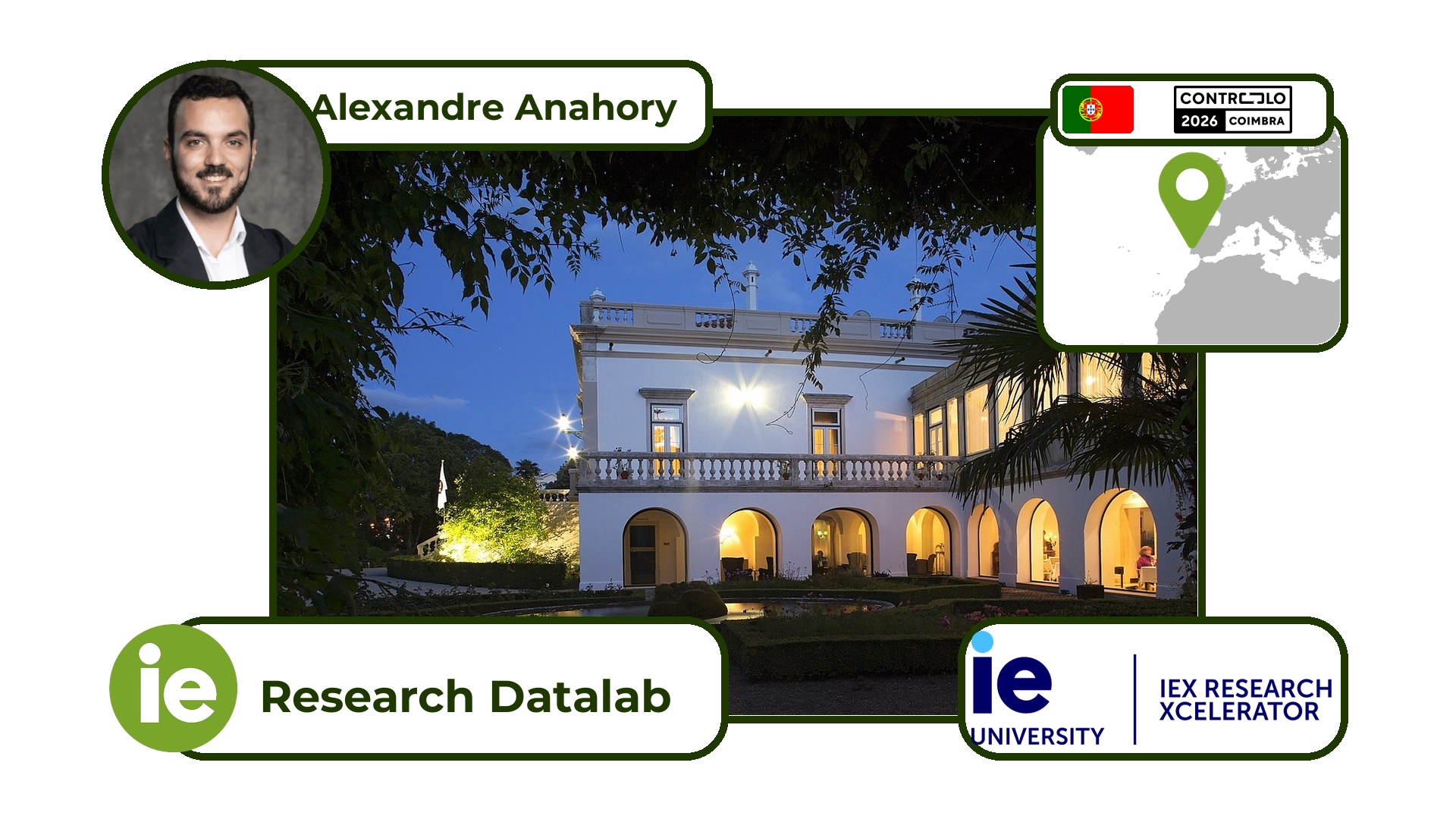
How can mathematics help guide a flow around obstacles or keep a robot under control when forces are uncertain? Research co-authored by IE Research Datalab member Alexandre Anahory featured in the programme of CONTROLO 2026, the 17th APCA International Conference on Automatic Control and Soft Computing, held in Coimbra, Portugal, from 9 to 11 September.
The conference programme listed two contributions in its session on geometric control and mechanics of nonlinear dynamical systems. Optimal Control of Incompressible Ideal Flows with Obstacle Avoidance, co-authored with Anthony Bloch and Leonardo Colombo, addressed the mathematical problem of controlling ideal fluid flows while avoiding obstacles. Robust Geometric Control of Catenary Robots under Unstructured Force Uncertainties, co-authored with Leonardo Colombo, examined control of catenary robots when forces cannot be described precisely.
These topics connect abstract geometry with practical questions about motion, control and uncertainty. Geometric approaches use the mathematical structure of a system to inform how its behaviour can be controlled.
Anahory was also listed as co-chair, alongside Margarida Camarinha, of the session Geometric Methods in Control and Optimization. Hosted at Quinta das Lágrimas and organised by the University of Coimbra, CONTROLO 2026 brought together research on control systems, automation, robotics and soft computing.
See the official conference programme and conference website. Venue photograph: CONTROLO 2026.
Alexandre Anahory is an Assistant Professor at IE University and a member of IE Research Datalab, working on differential geometry, mathematical physics and control theory.