Body-Mind Sync: How Motor Awareness Fuels Mental Exercise Performance

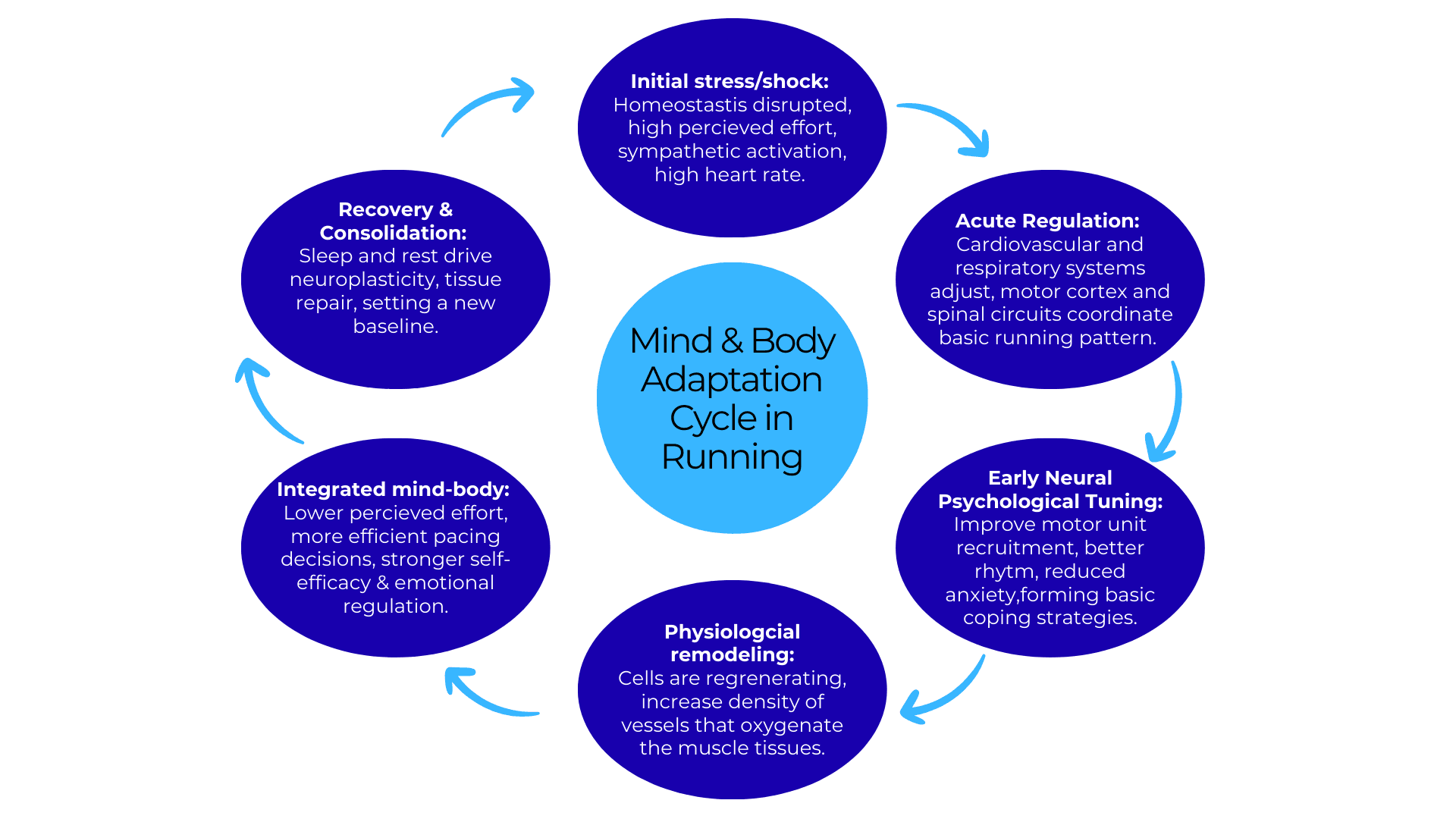
The body has a process of adaptation that takes mental resilience to see the long-term benefits. Running is a sport that is loved and hated by many, and fairly so since it does imply great physical strain. This article addresses the unconscious physiological processes that are triggered when running. It also highlights how the body can sometimes seem to work against you. Yet, by holding on to a long-term vision and recognizing the body’s efforts to protect and support you, you can offer yourself grace and trust that, in time, you might even come to enjoy the experience.
By: Josefa Brigham
Running is one of the most studied sports that time after time has demonstrated its revolutionary power to impact one's health. It has been linked to longer life, better cardiovascular health, and lower chronic disease risk. A major study conducted by the Copenhagen Cardiology Institute, followed around 1,000 participants from 2001-2015 and found that the individuals who jogged 1hr-2hr per week, had 30% lower risk of death (Schonhr, 2015). The benefits are undeniable, yet many have a generally negative perceived affect towards the sport. Studies have found that this is mainly due to negative past experiences such as, breathlessness, and injuries. Causing a bad impression on these individuals, despite all the proven positive impacts running has on longevity, and health.
In this article I want to shine a light on what happens at an unconscious level, the effort and the mechanism that takes place when you run. Possibly offering a new perspective on how running is executed, so that you might be more empathetic with your journey into running. If you give time for your body to adapt and withstand such strain, you’ll see that it can, allowing you to experience all the benefits.
Even beyond that I wish to convey the idea that in any process of adaptation, there is a friction phase that needs to be surpassed. This can be applied in any other sport or habit you wish to attempt. Final disclaimer; it is also valid to realize that maybe it is not for you, but I am trying to make the point that hopefully it will be after you give an intentional, mindful, and disciplined attempt.
How it Works
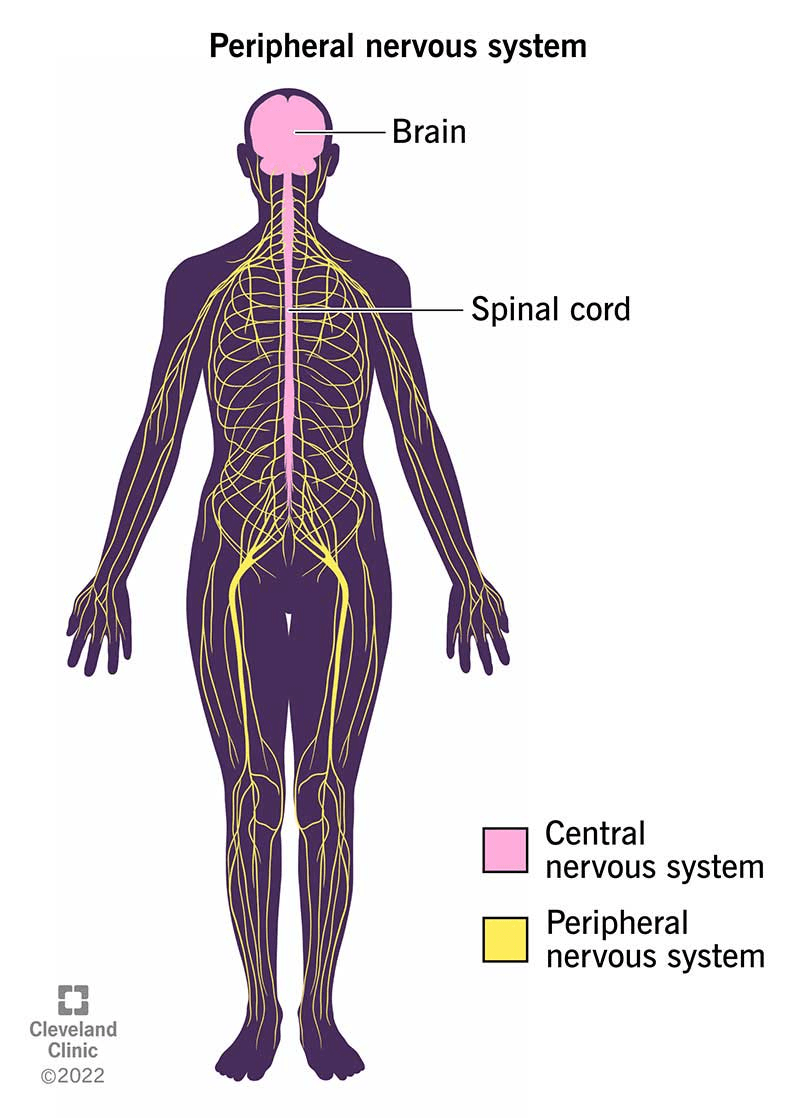
Our nervous system is organized into two main parts that work together to keep us alive and functioning: the central nervous system and the peripheral nervous system. The central nervous system (CNS) consists of the brain and spinal cord, and it is responsible for receiving sensory information from the body, integrating and processing it, and then sending motor commands to muscles and organs, often in coordination with emotional processes. The peripheral nervous system (PNS) includes all the nerves that branch out from the brain and spinal cord to the rest of the body, and it has two important divisions. The somatic division controls voluntary movements and carries sensory information from the skin, muscles, and joints to the CNS (afferent pathways), as well as motor commands from the CNS to skeletal muscles (efferent pathways) for actions like walking or lifting. The autonomic division regulates involuntary functions, such as heart rate, digestion, and glandular activity, through its sympathetic (fight or flight) and parasympathetic (rest and digest) branches.
Experiences from the IE Running Club
How was your first experience with running?
“It was over Covid and when I was the most out of shape I’ve ever been, which made everything feel difficult. Few smaller milestones like 1, 2, and 3 miles felt challenging, but it was encouraging to see that it was possible.”
How would you say your mind deals with the initial shock of starting to run?
“My body sometimes lags behind my mind or vice versa when I am forcing myself into a run, but after 5 minutes I usually feel at my best.”
“Sometimes it’s like pure excitement and oxytocin, a way to release and so the calm comes. However, some other times it is like a battlefield…”
"I would say it feels contradicting...my body enjoys working out and feeling the challenge of pushing myself in terms of my physical condition, but when it comes to running, my mind is always telling me: why are you doing this? Then I try to get distracted by the music, to feel like time is passing faster, but it is a constant inner conversation of not to stop when my mind is telling me I could just do something else."
How many minutes in running do you feel that you have integrated mind and body, and how do you know?
“The start and end are when my mind and body feel most interconnected. At the beginning, it’s when I’m determining the pace and how far I want to go given that pace. By the end, it’s more of a mental battle and trying to convince myself to push to the limit. Maybe 15/50 minutes in an average run”
“Usually 15-25 minutes in that you feel you could run forever. I know because my body feels a bit lighter, like running in the clouds…”
"I would say after km 3 so around 15-20mins, and I know because my legs start to feel lighter, my breathing is paced with my steps and my core is engaged without feeling forced."
Do you have some type of anchor when you are running to keep you grounded?
“My main anchor is probably my inner competition.”
“Not really, but I do tell myself that I can do this, I have done it before and this is nothing. I think about how good it will feel afterwards.”
"What works best for me is that every 2 km I tell myself that I have just started so I can’t stop, so in my mind if feels like a reset. Also, visualizing the feeling of when I finish the run..."
How to Enhance your Planning & Initiating Exercising Capabilities
In terms of how to physically prepare; optimizing glycogen stores (Glycogen is the stored form of glucose in your liver and muscles, acting like an energy reserve) enhances running endurance by ensuring a steady energy supply. Carb-rich meals daily, quick post-run refueling with carbs and protein within 30 minutes, and hourly intake during long efforts to avoid depletion and sustain performance. Sports scientists like Louise Burke, and Phil Maffetone advocate gradual load increases, strategic low-glycogen training for adaptations, and aerobic base building. Additionally functional exercises are important to build muscle such as, single-leg bridges and walking lunges 2–3 times a week to strengthen glutes and core. After running and training it would be beneficial to focus on hip flexor and calf streches—hold each for 30 seconds per side—to ease tightness and boost your stride. These nutritional and physical prevention measures will decrease your chances of getting injured.
In terms of how to mentally prepare; practice mindfulness when you run. Flag those discomforts, acknowledge your breathing, heart beat, the oxygen you are breathing. This will allow you to stay grounded and present. Breathing exercises are also key when beginning to run. These will allow you to regulate your oxygenation, and avoid this feeling of breathlessness and fatigue. Before starting, stand tall, hand on stomach. Breathe in through your nose for 4 seconds (watch your stomach rise, not chest), then out through your mouth for 4 (stomach falls). Do 5 rounds. On the run, match breaths to steps: Inhale for 3 steps, exhale for 3. Feel the rhythm take over—mind quiets, body flows, and running might turn into something fun.
Conclusion
Having a positive attitude, and patience will allow you to achieve that running goal you have been postponing. Give yourself a chance, and you might be surprised by the inner strength that you find within. The body is an extremely complex system that is built to protect you. It’s like having a dinosaur as your guard dog. Whenever it detects discomfort, instability, danger, it will immediately begin to stomp its feet, show its teeth, and make it really hard for you to do anything slightly out of your comfort zone. This is why cultivating a level of self-awareness and mindfulness will allow you to tame the dinosaur. If you are aware that it won’t be such an enjoyable experience at first, and that you will later adapt, you’ll be seeing the long-term vision that the dinosaur does not.

Citation
Burke L. M. (2007). Nutrition strategies for the marathon : fuel for training and racing. Sports medicine (Auckland, N.Z.), 37(4-5), 344–347. https://doi.org/10.2165/00007256-200737040-00018
Garmin. (n.d.). Full potential endurance running training phases [PDF]. https://static.garmincdn.com/shared/emea/custom/training/downloads/pl/running/Full-Potential-Endurance-Running-Training-Phases-PL.pdf
Mayo Clinic Health System. (2025, September 21). Fueling your run with good nutrition. https://www.mayoclinichealthsystem.org/hometown-health/speaking-of-health/fueling-your-run-with-good-nutrition
NESTA Certified. (n.d.). Running training adaptations. https://www.nestacertified.com/running-training-adaptation
Bonacci, J., Chapman, A., Blanch, P., & Vicenzino, B. (2009). Neuromuscular adaptations to training, injury and passive interventions: implications for running economy. Sports medicine (Auckland, N.Z.), 39(11), 903–921. https://doi.org/10.2165/11317850-000000000-00000
Physiological resilience: What is it and how might it be enhanced? (2025). Scandinavian Journal of Medicine & Science in Sports.Volume35, Issue3. https://doi.org/10.1111/sms.70032
Schnohr, P., O'Keefe, J. H., Marott, J. L., Lange, P., & Jensen, G. B. (2015). Dose of jogging and long-term mortality: the Copenhagen City Heart Study. Journal of the American College of Cardiology, 65(5), 411–419. https://doi.org/10.1016/j.jacc.2014.11.023
Trail Runner Magazine. (n.d.). How to train your breath for better performance. https://www.trailrunnermag.com/training/how-to-train-your-breath-for-better-performance
Trail Runner Magazine. (2023, August 28). Understanding the timeline of training adaptations. https://www.trailrunnermag.com/training/understanding-the-timeline-of-training-adaptations