Built on Connection: How Belonging Truly Begins at IE

By Manuela Moscoso
In an age defined by hyper-connectivity yet marked by rising loneliness, the paradox of modern life becomes evident: proximity does not guarantee belonging. To belong is not merely to be present; it is to feel recognised, valued and woven into a shared narrative. For institutions of higher education, this is no trivial matter. Belonging is not an ornamental feature of university life; it is foundational to well-being, resilience and academic flourishing.
In June 2025, the World Health Organization described loneliness as a “major public health challenge” with consequences that ripple across societies, urging coordinated action from all sectors, including education (World Health Organization, 2025).
If loneliness is a public health concern, belonging is its antidote. Hagerty et al. (2002) define belonging as the subjective experience of being an integral part of one’s surrounding systems: family, friendships, educational institutions, workplaces, communities and physical spaces. Its effects are enduring: belonging influences mental and physical health, academic achievement, employment trajectories and social trust. Despite this evidence, its foundational role is sometimes not given the attention it deserves within institutions (Jenkins, 2025).
Connection, then, is not peripheral to well-being. It forms the foundational framework. Belonging does not emerge spontaneously from proximity; it is cultivated through repeated, meaningful acts of connection.
Insights on Connection and Belonging at IE
The Fall 2025 data from our Student well-being survey (IE University, 2025) reveal a community that is, by most measures, strongly connected. An overwhelming 93.3% of students report feeling positive about being at IE, while 86.6% say they feel a sense of belonging. These figures are not merely encouraging; they suggest that IE is experienced as more than an academic institution. It is lived as a community.
The everyday social fabric of campus life reinforces this perception. Seventy-five percent of students report spending time daily with peers from different countries, a reflection of IE’s deeply international character. Meanwhile, 91.7% share at least one lunch per week with others. These small, repeated rituals, cross-cultural conversations, shared tables, informal gatherings, are where connection becomes habitual and belonging becomes tangible.
At the same time, the data remind us that connection requires intentionality. While students express high interest in well-being activities, participation rates in some practices remain comparatively modest.
The opportunity, therefore, is not to create belonging from scratch, but to strengthen and deepen what already exists.In other words, IE has the foundations. The next step is reinforcing the structures that allow connection to move from occasional to consistent, from incidental to intentional.
Why Connection Precedes Belonging
Belonging is often described as an outcome, something one either has or lacks. Yet both psychological theory and lived experience suggest it is better understood as a process. As Hagerty et al. (2002) argue, belonging is rooted in integration within systems of meaning. Such integration requires interaction, recognition and reciprocity.
Frameworks such as the “Six Points of Connection” proposed by Aaron Hurst and Nancy Connolly emphasise that connection can be intentionally cultivated through concrete behaviours: participation in identity-based groups, activity-based communities, volunteering, maintaining regular contact with friends and family, and engaging in shared civic spaces (Hurst & Connolly, 2025). The lesson is instructive: connection is not an abstraction; it is enacted through routines.
Without connection, belonging remains rhetorical. One may be surrounded by others in lecture halls or digital platforms and yet feel unseen. With connection (Through shared meals, collaborative projects, vulnerability in moments of loss, or participation in clubs) belonging becomes embodied.
In this sense, connection is the mechanism; belonging is the experience it generates.
Finding Belonging at IE: Student Voices
The lived experiences of students illustrate how connection crystallises into belonging.
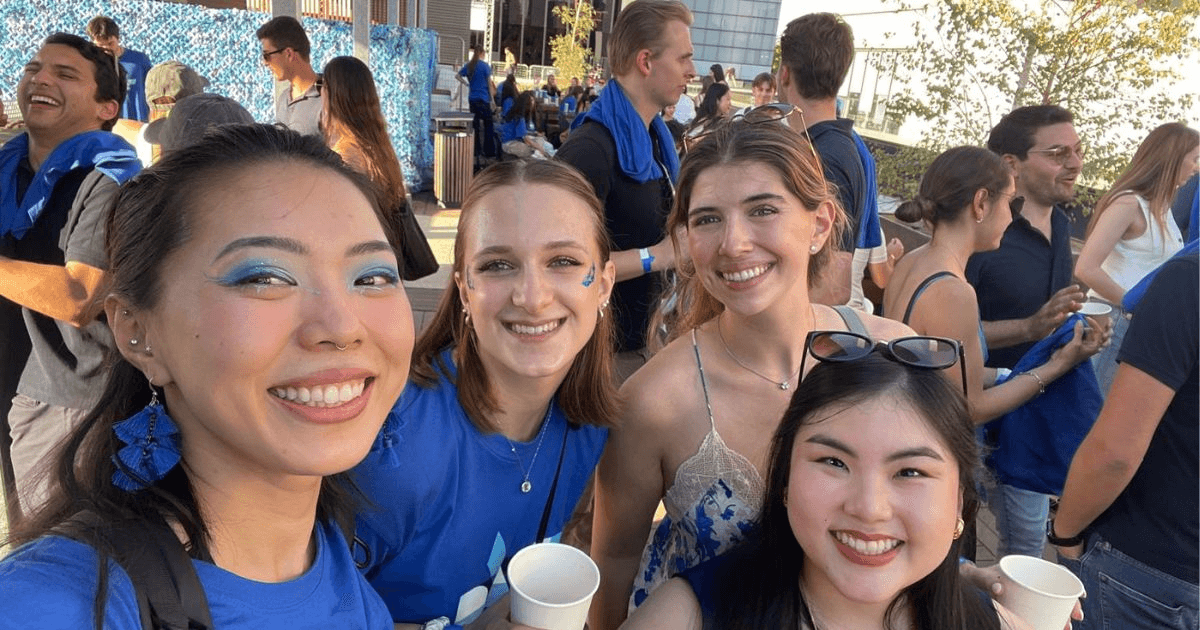
“Belonging, for me, began in vulnerability, when I realised that the people around me were not just classmates, but a community willing to show up.”
Co Co Hong
For Co Co Hong, arriving at IE was as exhilarating as it was disorienting. Faced with an intense social agenda and the novelty of living in Europe for the first time, she quickly understood that sustaining herself required balance and selectivity. Yet it was not constant participation that anchored her experience. “Belonging, for me, began in vulnerability, when I realised that the people around me were not just classmates, but a community willing to show up,” she reflects, recalling the support she received after sharing news of her father’s passing. In the warmth and solidarity that followed, she recognised that she was not navigating this chapter alone. Through Out & Allies, where she now serves as president, and in shaping the 20th edition of LGBT@Work, she has transformed connection into shared purpose. Today, she speaks of IE not simply as a university, but as a place she has chosen to make her own.

“The moment I volunteered at the Careers Forum, surrounded by students, companies and the Talent & Careers team, I felt I was finally where I was meant to be.”
Aastha Suresh Chander
For Aastha Suresh Chander, integration at IE was neither immediate nor effortless. Having grown more introverted in her final years of high school, stepping into an intensely international environment initially felt daunting. Yet she approached the challenge deliberately: attending networking events early, volunteering with IE Talent & Careers, and gradually expanding her circle of conversations. “The moment I volunteered at the Careers Forum, I felt I was finally where I was meant to be,” she reflects. As an officer in the India Club, Cricket Club and Private Equity Club, she has since built what she calls a “home away from home” one shaped by dialogue, diversity and shared ambition.
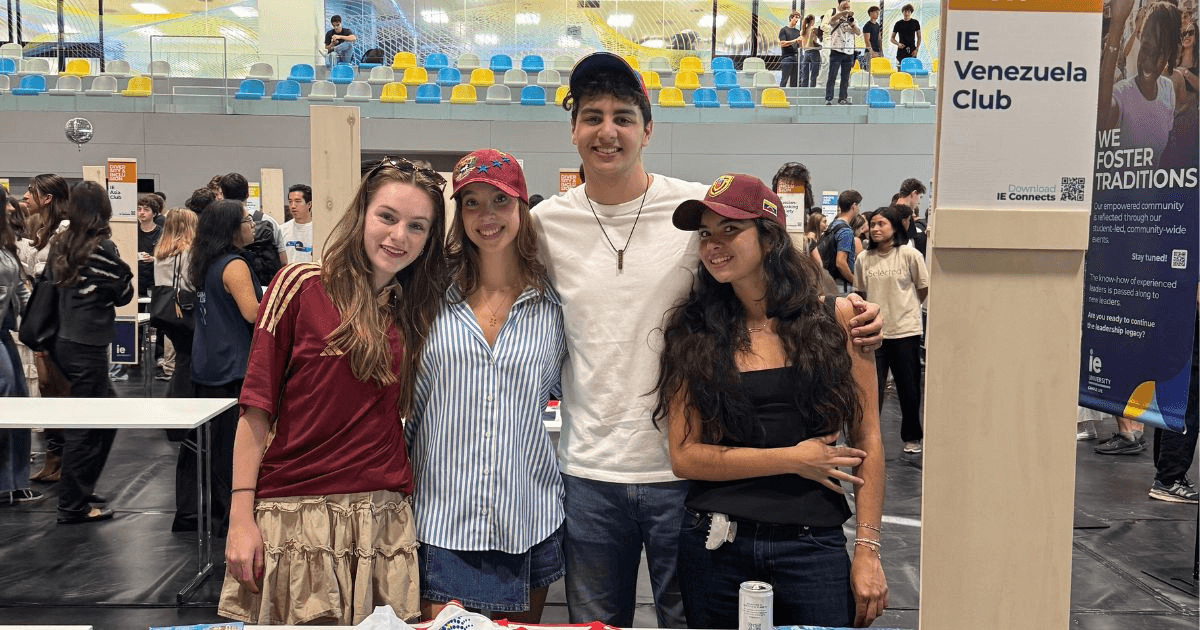
“What once felt like loneliness slowly became growth, I realised that independence is built in the moments when you choose to show up, even far from home.”
Daniel Guerrero
For Daniel Guerrero, arriving at IE meant crossing not only geographical borders but emotional thresholds. With his entire family living on the other side of the world, the distance felt acute, intensified by the complexity of returning home. Yet what began as homesickness gradually evolved into resilience. “What once felt like loneliness slowly became growth,” he reflects, describing how immersing himself in academic life and new friendships reshaped his experience. A football tournament became his first true moment of belonging, where connection emerged organically through shared passion. Since then, friendships have formed a surrogate family, grounding him within IE’s diverse and expansive community.
A Community Made Together
The World Health Organization has called for cross-sector responses to loneliness (World Health Organization, 2025). Universities are uniquely positioned to answer that call. IE’s data demonstrate high levels of satisfaction, resilience and belonging (IE University, 2025). Yet community is not a static achievement; it is an ongoing construction.
Happiness Week 2026, led by the IE Center for Health & Well-being under the theme Connection: Belong, Support, Flourish, translates that conviction into action. The programme includes 108 Sun Salutations to Welcome the Spring at The Garden, marking the equinox through collective movement; IE Creativity Day, with activities across IE Tower and the IE Creative Campus and a central event at the IE Creativity Center; and the closing Well-Being Fest at María de Molina 31 bis Patio, an afternoon dedicated to connection, live music and shared celebration. Together, these moments underscore a central premise of the week: connection is not incidental to university life, but the condition that allows individuals, and institutions, to flourish.
References
From Loneliness to Social Connection: Charting a path to healthier societies – report of the who commission on social connection (2025b) World Health Organization. Available at: https://www.who.int/publications/i/item/978240112360
Hagerty, B. M., Williams, R. A., & Oe, H. (2002). Childhood antecedents of adult sense of belonging. Journal of clinical psychology, 58(7), 793–801. https://doi.org/10.1002/jclp.2007
Jenkins, K. (2025) Why a sense of belonging matters - neurodiversity and the shaping US framework, Centre for Early Childhood. Available at: https://centreforearlychildhood.org/news-insights/guest-essays/why-a-sense-of-belonging-matters-neurodiversity-and-the-shaping-us-framework/
Hurst , A. and Connolly, N. (2025) The six points of connection we all need, Greater Good. Available at: https://greatergood.berkeley.edu/article/item/the_six_points_of_connection_we_all_need (Accessed: 23 February 2026).
IE Center for Health & Well-being. (2025). 2024–2025 IE University Student Well-Being Report. https://ieconnects.ie.edu/get_file?pid=ab7cf0629a6883064fa208ce8fec58a62246bafdc2b1c71cdb8fc45bece15