


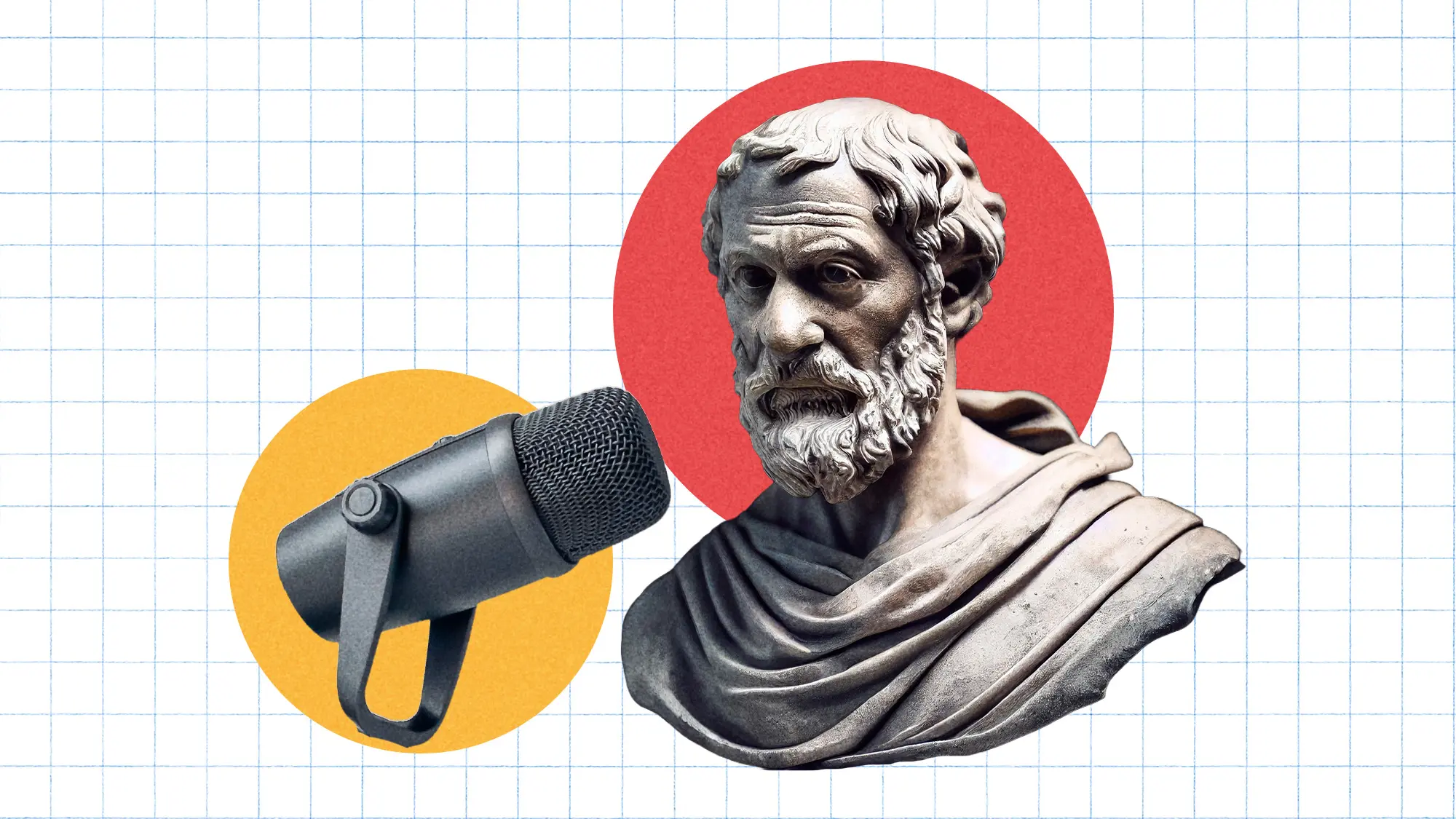
Reading Aristotle is like sleeping in the jungle: there is a lot of noise, but you never quite know where it is coming from. His texts are 2,400 years old and understanding them requires more than attention to the literal meaning of words. It means understanding the way people thought and expressed themselves at the time.
This helps explain why, in Rhetoric, Aristotle does not explicitly introduce the famous triad ethos–pathos–logos as technical terms. Instead, he describes three ways a speaker persuades an audience, through character, emotion, and argument, which later rhetorical tradition, especially Cicero and Quintilian, would come to name and systematize. As Aristotle writes, “Now the proofs furnished by the speech are of three kinds. The first depends upon the moral character of the speaker, the second upon putting the hearer into a certain frame of mind, the third upon the speech itself, in so far as it proves or seems to prove.”
Of this now-familiar triad, the moral character of the speaker, the ethos, is the hardest to shape. Unlike emotion or reasoning, it is deeply entangled with the most stable aspects of who we are. Unless you are fifteen years old, it is not easily changed. Still, ethos can be broken down into components and adjusted without altering one’s personality. And the advantage of working on it is considerable: its effects extend to any leadership context, not just to the moments spent behind a lectern.
In Aristotle’s view, ethos is built through the rhetorical display of three qualities: prudence (phronesis), integrity (areté), and goodwill toward the audience (eunoia). He does not develop these elements in a single, unified section of Rhetoric. Instead, they appear in fragments across different chapters, forcing the reader to move back and forth through the text and piece together his account from scattered elements.
When Aristotle speaks of prudence, often translated as “practical wisdom,” he is not advocating feigned ignorance, but rather the avoidance of omniscience. Phronesis strengthens ethos because it combines knowledge with a sense of limits. The speaker appears credible not only because he knows what he is talking about, but because he shows how far that knowledge goes. The point is to speak with knowledge, more or less modestly, in a way that makes it clear you are master of the subject. Let us call this credibility.
Memorizing a handful of figures shortly before a presentation works surprisingly well.
Starting from Aristotle, this aspect of ethos – credibility – can take several forms. The most basic is simply knowing your material. This often comes from spending years in the same field. We tend to be dazzled by the wisdom of CEOs and experts without noticing that they are often speaking about what, for them, is everyday life. Jack Welch, CEO of General Electric for twenty years, talks about leadership as if he were talking about his living room.
Another way to project credibility, and perhaps the easiest to train, is memory. Stalin may or may not have been particularly intelligent, but he was widely described as having a prodigious memory, which made him appear far more formidable intellectually than he might otherwise have been. He could quote phrases from Politburo meetings held years earlier and recall mistakes collaborators believed long forgotten.
For those of us with less sinister intentions, the lesson is simple. Memorizing a handful of figures shortly before a presentation works surprisingly well. You may forget them hours later, but the effect is one of mastery – and therefore of credibility.
And finally, one can display credibility by being visibly intelligent, and showing how you think, rather than simply claiming expertise. Nobel Prize–winning physicist Richard Feynman is a prime example of this. He did not need to advertise how much he knew; he let his intelligence operate in public. His credibility came not from asserting expertise, but from showing, step by step, the act of thinking by someone who understands a subject. This is prudence in Aristotle’s sense. By contrast, the CEO of Goldman Sachs during the 2008 financial crisis did pontificate, and failed to win over his audience.
In addition to these internal sources of credibility, there are also external ones, which are often easier to activate. The most straightforward is appearance. As a rule of thumb, speakers tend to benefit from dressing one level above their audience, except when they are deliberately signaling closeness, as is often the case in start-up culture.
External credibility can also be reinforced with visible credentials: being a doctor, a judge, a PhD, a retired general. This works best when done with restraint, and preferably when such credentials are mentioned by someone else, for example in an introduction. A third external path lies in one’s professional or personal achievements. Politicians, for instance, often emphasize military service as a signal of authority.
Credibility, however, is not enough. The speaker’s integrity – areté – so often scarce in politics, occupies a central position in Aristotle’s account of ethos. He includes it under the broader idea of what is noble, listing qualities such as “justice, courage, moderation, magnificence, magnanimity, generosity, affability, good sense, and wisdom.” Noble, too, is “whatever is done for the benefit of others,” and things “that endure beyond one’s lifetime.”
Some of Aristotle’s examples are clearly dated. He includes examples that today would be unacceptable, such as the idea that “the actions of those who are more important by nature… for instance, those of men more than those of women,” as well as curious cultural markers like wearing long hair in Lacedaemon as a sign of freedom “since it is not easy to perform paid labor if one wears one’s hair long.”
Latin rhetorical tradition refines this concept of integrity, translating it into fides (reliability, trustworthiness) and auctoritas. For Cicero, a speaker’s authority does not come from enumerating virtues, but from being perceived by the audience as worthy of trust (On the Orator II, 182-184). Quintilian pushes this further, defining the orator as “a good man skilled in speaking” – vir bonus dicendi peritus – and insisting that rhetorical effectiveness without moral integrity does not amount to true eloquence.
We can simplify Aristotle’s idea of nobility as the ability to appear reliable and honest. Reliable, in the way Margaret Thatcher projected consistency in her public statements. Honest in the way Churchill promised nothing but hardship before victory.
Goodwill (eunoia), the third component of ethos, is developed within Aristotle’s analysis of emotions in Book II of Rhetoric, from which later tradition incorporates it as an essential element of credibility. Aristotle discusses friendship, calm, anger, envy, fear, shame, generosity, compassion – attributes that define anyone, not just a speaker.
Some of his observations are directly applicable to public speaking. We tend to appreciate “those who are as good at making a joke as they are at taking one,” “those who praise the good qualities we possess,” “those who are neat in appearance, dress, and way of life,” “those who are not resentful,” and “those who are not malicious or obsessed with the faults of others, or their own, but with virtues.”
Distilled from this tour of emotions, there are four immediately practical ways to convey goodwill. The first – and most powerful on stage – is praise. It can appear anywhere in a speech, but it is especially effective at the beginning. This is not politeness, but strategy: by acknowledging the audience’s virtues, the speaker builds trust from the outset, making the message easier to accept. John F. Kennedy’s inaugural address achieved this when he reminded Americans that “We dare not forget today that we are the heirs of that first revolution (…) Let every nation know, whether it wishes us well or ill, that we shall pay any price, bear any burden, meet any hardship, support any friend, oppose any foe to assure the survival and the success of liberty.” Praise can target anything genuinely shared: excellence in a field, a local institution, or a collective trait – always avoiding clichés such as paella for Spaniards or tea for the British.
A second way to signal goodwill is to highlight what the speaker and audience have in common, from accent and pronunciation to shared history. Nelson Mandela did exactly this in his inaugural address when he said “each one of us is as intimately attached to the soil of this beautiful country as are the famous jacaranda trees of Pretoria and the mimosa trees of the bushveld.” This bond worked because it came from the heart.
Another way to convey goodwill is to show concern for the audience’s needs, not only by adapting the content of the speech, but by attending to seemingly trivial details like room temperature or timing. Going overtime is often the quickest way to alienate an audience. Ernest Shackleton, who brought every member of the Endurance expedition back alive after two years stranded in Antarctica, increased rations when morale sank. Barack Obama once paused a press conference to attend to a woman who had fainted, even calling in his personal doctor.
The final way to signal goodwill is humility. Public apologies are rare among politicians and executives, but when genuine, they are powerful. Apologizing signals maturity and self-confidence; it shows that one is capable of acknowledging one’s mistakes. Kevin Johnson, then CEO of Starbucks, did so after two people were arrested in one of the company’s cafés. Mark Zuckerberg apologized after the Cambridge Analytica scandal. Marjorie Taylor Greene has apologized more broadly for what she called “toxic politics.”
What matters is authentic remorse, not scripted damage control. Audiences can easily detect when an apology is delivered primarily to protect a company’s legal position. When Boeing’s CEO was asked what he would say to the families of those killed in the 737 MAX crashes, he retreated into a formulaic expression of sympathy. Volkswagen’s CEO did something similar during the Dieselgate scandal, apologizing while shifting blame onto a handful of employees.
Aristotle does not offer a recipe for manufacturing ethos. Credibility, integrity, and goodwill cannot be switched on with a technique or a well-rehearsed line. They are built over time and tested with every public appearance. Ethos is not what speakers say about themselves, but what the audience infers by watching how they know, how they decide, and how they behave. That is why it is so difficult to shape, and so easy to lose. It is not proclaimed, it is revealed. That this is difficult is precisely why Aristotle remains relevant.
© IE Insights.