Madrid is a city that rewards exploration. Its architecture, its neighborhoods, its food: everything reveals itself gradually, one street corner at a time. But if you want to understand the city quickly, and deeply, there is one shortcut that locals have always known about. Go to the markets.
Mercado culture is woven into the rhythm of daily life in Madrid. These spaces bring together food, community, history, and the particular energy that comes from people gathering around things they love. Whether you are after gourmet tapas, vintage clothing, antique furniture, or locally grown produce, Madrid’s markets have something genuinely worth your time. Here is a guide to the ones you should not miss.
What makes Madrid’s markets special?
Madrid has more indoor market halls per capita than almost any other European capital, and the variety is striking. Some, like the Mercado de San Miguel, have evolved into gourmet food destinations drawing visitors from around the world. Others, like El Rastro, are sprawling open-air events that function as much as social gatherings as shopping experiences. A handful occupy the middle ground: traditional neighbourhood markets where locals still do their weekly shopping alongside curious visitors.
What they share is a sense of authenticity that is harder to find in more curated parts of the city. The vendors tend to know their products deeply. The products tend to be genuinely local. And the atmosphere, whether in a cast-iron Victorian hall or spilling down a cobbled hill in La Latina, tends to feel lived-in rather than performed.
Mercado de San Miguel: the best food market in Madrid?
For first-time visitors to Madrid, the Mercado de San Miguel is often the starting point, and with good reason. Located just off Plaza Mayor in the heart of the old city, this stunning cast-iron and glass market hall was built in 1916 and has welcomed more than 7 million visitors a year in recent times.
The building itself is worth a visit. The wrought-iron and glass structure opens directly onto Plaza de San Miguel, right next to Plaza Mayor, and feels like a Victorian greenhouse filled with people and flavours instead of flowers.
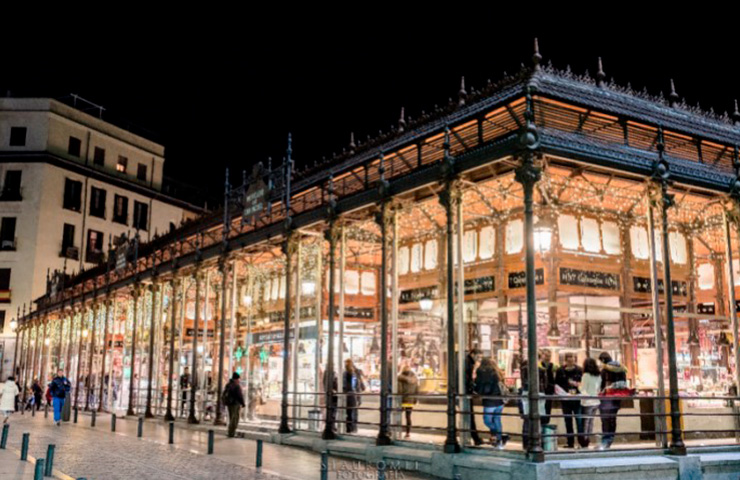
San Miguel is a gourmet food hall rather than a traditional grocery market. Unlike other neighbourhood markets in Madrid, people do not come to San Miguel to do their weekly grocery shopping. Instead, they use the market as a meeting point to celebrate and eat with friends and loved ones. The result is a place that functions brilliantly as an introduction to Spanish cuisine: there is no other place in Madrid where you can experience so many foods from all across Spain, all under one roof.
What to eat
Start at La Hora del Vermut for a glass of vermouth on tap, paired with briny banderilla skewers. Move on to El Señor Martín for outstanding fresh seafood tapas, or La Casa del Bacalao for beautifully prepared salt cod. Seafood lovers should also try the Galician octopus or scallops at Morris, and the empanadas at La Hora del Vermut, which also offers a wide vermouth selection. For cheese, Quesoba is the standout stall. For wine, Pinkleton & Co carries an exceptional selection including wines from the Madrid region itself.
When to go
The atmosphere changes throughout the day, calmer in the morning and livelier in the late afternoon. Late afternoon, from around 6pm to 8pm, is ideal for the local aperitif atmosphere. The market opens at 10am daily and stays open until midnight Sunday through Thursday, and until 1am on Friday and Saturday.
Practical note
San Miguel is less of a market where locals buy their fresh produce and more of a food hall with stands selling the greatest hits of Spanish tapas. Prices reflect its location and reputation. Come with an appetite and a willingness to graze, and it will reward you.
El Rastro: Madrid’s iconic flea market and antique market
Every city has a market that defines it. For Madrid, that market is El Rastro. This is Madrid’s historic Sunday flea market, the oldest in the city, sprawling down the hill from Plaza de Cascorro through the Embajadores neighborhood. It takes place every Sunday and public holiday from 9am to 3pm, and over 100,000 people come to this open-air market every weekend.
The name has a history as colourful as the market itself. El rastro literally means “the trail.” The name refers to the trail of blood that used to stain the streets of this part of La Latina, near Madrid’s first official slaughterhouse. The tanneries that followed brought craftspeople, then traders, then the generations-deep market culture that has defined the neighbourhood ever since.
The Rastro has roots as a secondhand goods market, and by the 1960s and 70s it was arguably the most important antique market in all of Europe. Today it remains one of the continent’s most compelling flea markets, with over 3,500 stalls offering antiques, clothing, art, toys, vinyl records, and much more.
What to look for
The main thoroughfare, Calle de la Ribera de Curtidores, is the obvious starting point, but the real treasures tend to be found by straying from it. Calle de San Cayetano is known as the street of the painters, with oil paintings, sketches, and professional art supplies. Calle de las Rodas, Carnero, and Carlos Arniches specialise in rare books, vintage magazines, vinyl records, and old trading cards. Plaza de General Vara del Rey is the place for vintage clothing and second-hand furniture. For serious antiques, head to the Galerías Piquer at number 29 on the Ribera, a lovely building arranged around courtyards with ceramic benches, where you will find proper antiques and can catch your breath away from the main crowds.
Practical tips
Arrive early if you are after something special, as the market gets picked over by professional antique hunters first thing. By 10:30am it will be too late for the best finds, though you can still fully enjoy the spirit of the market. Bring cash, as many stalls do not accept cards. Watch your belongings in the busier sections. And leave time afterwards for a vermouth and a tapa at one of the traditional bars in La Latina: finishing El Rastro with a cold glass and something fried is as close to a local ritual as you will find in Madrid.
Mercado de Motores: the flea market with a difference
If El Rastro is Madrid’s legendary market, Mercado de Motores is its most characterful one.
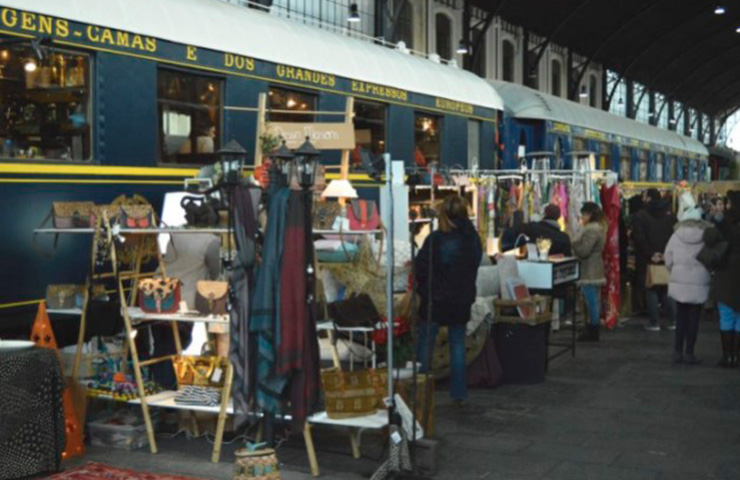
Held on the second and fourth weekend of each month at the Museo del Ferrocarril, the old railway museum near Paseo de las Delicias, Mercado de Motores takes place inside and around a working historic station. Vintage train carriages serve as backdrops to the stalls, and the combination of industrial architecture, handcrafted goods, and weekend energy makes this one of the most atmospheric markets in the city.
The offering spans designer and vintage clothing, jewellery, locally handcrafted goods, art, and accessories. Food trucks and outdoor bars fill the space between wagons, making it as much a social occasion as a shopping one. Unlike the Rastro’s frenetic scale, Mercado de Motores feels curated and relaxed, a place to spend a leisurely morning rather than battle through crowds.
Check mercadodemotores.es for current dates and times before visiting.
El Día de Mercado: Madrid’s wine and cheese market
For those drawn to local producers and artisan food, El Día de Mercado is one of Madrid’s quieter pleasures.
Taking place on the first Saturday of each month next to the Casa de Campo lake, this market is organised by the Cámara Agraria de Madrid and brings together farmers, bakers, cheesemakers, winemakers, and other local producers in a relaxed outdoor setting. Entry is free, and for a small fee you can join a guided tasting of local wines and tapas.
The atmosphere is genuinely unhurried: barrels set up as tables, local families alongside curious visitors, and the kind of conversation with producers that simply does not happen in a supermarket. The Casa de Campo backdrop makes it a natural starting point for a picnic or an afternoon walk.
Check camaraagraria.org for upcoming dates.
Beyond the big names: other Madrid markets worth knowing
Madrid’s market culture extends well beyond the four covered above.
Mercado de San Antón
Situated in the Chueca neighborhood, this is a modern multi-floor food hall with fresh produce on the ground floor, tapas and restaurant seating on the second, and a rooftop bar with genuinely good views on the third. It offers a contemporary take on the Madrid market experience.
Mercado de Maravillas
This mercado is in the Cuatro Caminos district and is one of the city’s largest traditional food markets. More than 200 stalls selling fresh fruits, fish, meats, cheeses, olives, and more create a maze of colours and flavours that feels far removed from tourist Madrid. It is where the city actually feeds itself.
Mercado de San Fernando
You can find this market in the Lavapiés neighborhood, with it now being a hub for young local producers and international food stalls. It is particularly worth visiting on a weekend afternoon, when the surrounding neighborhood is at its most lively.
How to make the most of markets in Madrid
A few things that make a real difference when visiting Madrid’s markets. Go hungry and go slowly. The best market experiences come from grazing across several stalls rather than committing to one. Order small, try widely, and let the market unfold at its own pace.
Learn the rhythms. Each market has its own logic. El Rastro rewards early arrival and random detours. San Miguel works best in the late afternoon, when the aperitif crowd arrives. Neighbourhood markets like Maravillas are liveliest on weekend mornings when local families are shopping for the week.
Bring cash, especially for flea and antique markets. Many smaller stalls, particularly at El Rastro, do not accept cards, and you will miss things if you cannot pay on the spot.
Talk to the vendors. Madrid’s market sellers tend to be knowledgeable about what they sell and genuinely interested in the people they sell to. A brief conversation often leads to a better product, a better price, or just a better story to carry home.
Experience Madrid’s markets while studying at IE
Markets are one of the most immediate ways to understand a city, and Madrid’s are among the best in Europe. For students spending time in the Spanish capital, they are also something more: a window into how a genuinely international city organizes its daily life, its food culture, and its sense of community.
At IE University’s campus in Madrid, students from across the world find themselves surrounded by a city that is as much a classroom as the lecture hall. The markets, the neighborhoods, the conversations that happen over a glass of vermouth after a Sunday morning at El Rastro: all of it shapes the kind of global perspective that IE’s programs are designed to develop.