For Nerea Álvarez, pursuing a career in finance was a natural extension of her passion for numbers. While she isn’t yet sure exactly where her career will take her, she knows she wants to apply her quantitative skills in a professional setting where they could support real business decisions. The Master in Finance at IE Business School enabled her to transform that strong analytical foundation into practical finance skills that she can use in her career.
“I studied mathematics as my bachelor’s degree, with a focus on applied mathematics, statistics and computation,” she explains. “Finance was completely new to me, so I started really from the beginning, knowing nothing.” Through the program’s applied approach and industry-focused teaching, she has developed the knowledge and practical skills needed to move confidently into the world of finance.
Nerea chose to pursue her studies at IE Business School for several reasons: the practical focus of the program, the industry experience of the professors and the network of local finance practitioners she would gain in Madrid. “We have a lot of access to events and networking opportunities, so it’s easy to meet people from the finance community. That’s definitely an advantage of IE Business School and a reason why I chose it. Because in the end, we’re all looking for a job.”
Learning finance through real-world application
Coming from a highly theoretical background, one of the first things Nerea noticed in her classes in the Master in Finance was the focus on how financial concepts are applied in real-world situations.
IE Business School faculty bring their direct industry experience into the classroom, helping students understand how finance works beyond textbooks. Projects often mirror the type of challenges students will encounter in their careers. In one recent assignment, for example, students valued a company using real financial data and practical assumptions.
“Our professors do this in their jobs every day,” Nerea says. “So we can really talk about what parameters you would use in real life. For example, in real-world cases, you won’t always have all the data you need. The teachers give you ideas of how to work around this and how to confront obstacles you might face in your career.”
A global classroom for collaborative learning
Another feature that Nerea highlights is the diverse and welcoming IE Community. Students and faculty come from a wide range of countries, academic disciplines and professional backgrounds, creating a dynamic learning environment.
“There are people who have worked previously, and there are people who studied economics, engineering, mathematics…” This means that each of her classmates brings their own perspective to class discussions and group projects.
“You learn a lot from other people,” Nerea shares. “People who have worked in a company have more of a business point of view, for example.” The program emphasizes collaborative tasks to help students learn how to leverage their knowledge and strengths. “If there is an economics assignment, the economists might take the lead. If there’s a quantitative methods assignment, I might work on that with an engineer and then share it with the group.”
Besides learning from each other, these shared experiences also build lasting connections. Nerea says that the closeness that has developed within her cohort surprised her. “I feel like the friendships we’re building here will last for a long time.”
Connecting with the finance industry
The program’s strong connection to the finance industry is another major advantage. Through events, student clubs and networking opportunities, students regularly engage with professionals working across the sector.
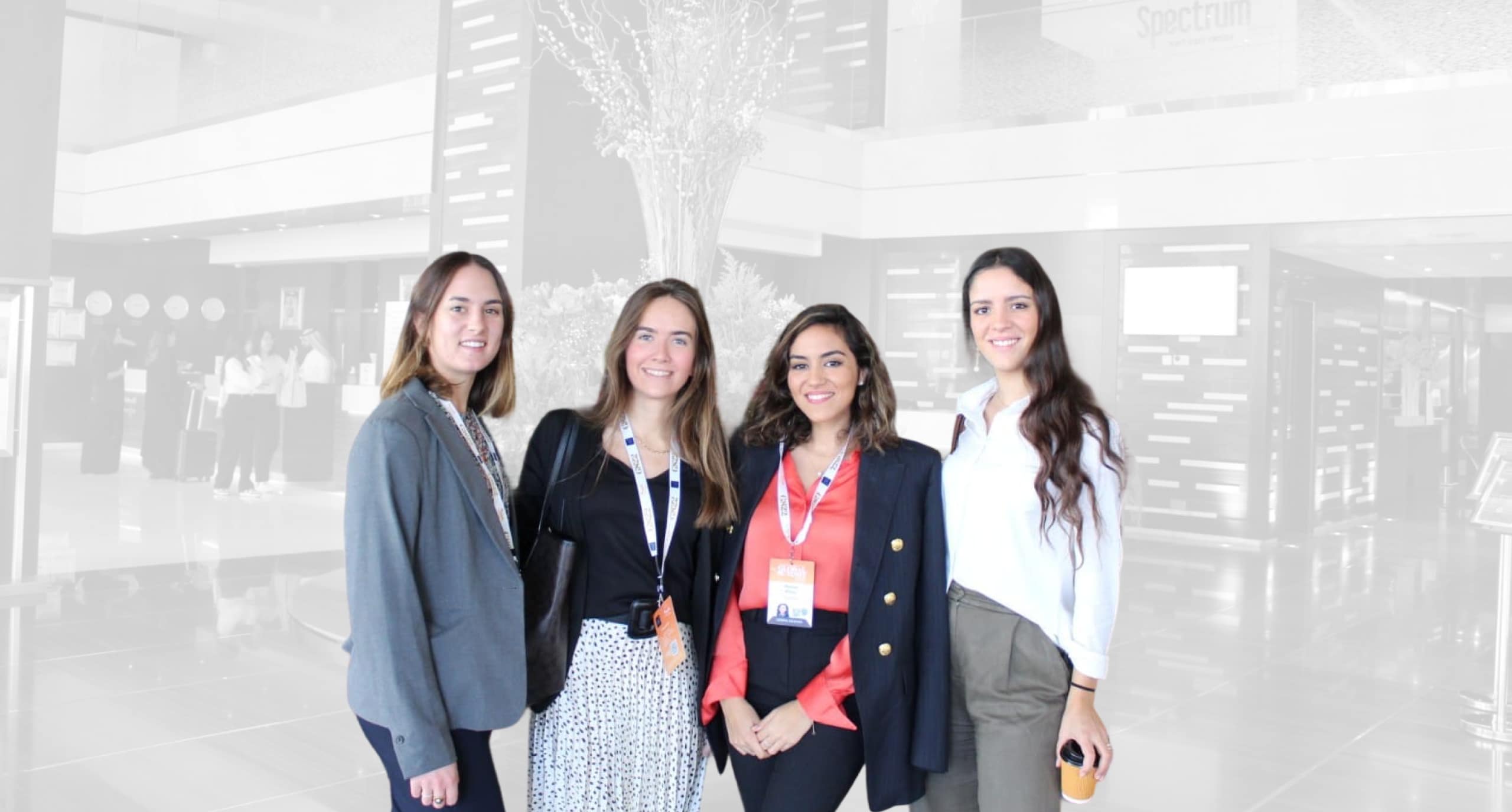
Nerea cites a recent event focused on women in private equity, which she was able to attend thanks to IE Business School. Organized by a leading European investment firm, the event introduced her to a career path she had not previously considered.
“I had never considered a career in private equity, but they told us about the different things they do and it was really interesting. That’s one of the benefits of going to events, because you meet people and they tell you about their experiences.”
IE Clubs and other student-led initiatives provide additional exposure and networking opportunities. Nerea participated in the Mergers & Acquisitions Club, where she attended biweekly workshops led by finance professionals that taught her a range of real-world skills.
“They explained how to structure a deal from the beginning until the deal is finalized. And because they work on that in real life, they know all the latest trends in the industry.”
Building a future in finance
As she progresses through the program, Nerea is still exploring which area of finance she would like to pursue: investment banking, corporate finance and consulting are all possibilities. Luckily, the program allows students to explore different branches of finance while they build foundational skills, then choose a specialization to deepen their knowledge in their area of interest.
Nerea is clear on where she wants to build her career, though. “I plan to stay in Madrid,” she says.“It’s my first year living here, and I have to say it’s amazing. It’s a big city and a finance hub, but it’s also very calm. And if you do your master’s here, it’s a big advantage because you can network with many people who work here.”
Overall, Nerea highly recommends the program to anyone looking to go beyond academic knowledge. It provides practical skills, industry exposure and a strong professional network. “It’s more than just studying. It lets you meet people from the sector and experience what finance is really like.”
For Nerea, the Master in Finance has been a defining step in turning a passion for numbers into a practical, globally connected finance career.
Dicover the Master in Finance
Accelerate your career with our English-language master’s degree in Madrid at IE Business School.