- Home
- News And Events
- News
- From Digital Geopolitics To A Renewed Social Contract At Sciences Po
From Digital Geopolitics to a Renewed Social Contract at Sciences Po

Yesterday in Paris, Dean Arancha Gonzalez Laya hosted the public presentation of our report, The Geopolitics of the Digital Revolution: Europe’s Defining Test, at the Paris School of International Affairs (Sciences Po).
The event brought together policymakers, industry leaders, researchers, and students to examine the structural dilemmas facing the European Union as it navigates technological disruption, economic security concerns, and mounting democratic pressures in an increasingly tense geopolitical environment.
Former European Commissioner Thierry Breton delivered a clear and direct message on Europe’s current fragmentation:
“We have 27 sets of rules. We are fragmented. We do have an EU common market, but we need a Common Digital Space.”
His intervention captured one of the central tensions explored in our research: Europe’s regulatory ambition and normative influence must be matched by institutional coherence and material capability if the Union is to exercise meaningful geopolitical agency in the digital age.
CGC Research Director Miguel Otero-Iglesias presented the core findings emerging from a year of research. The report examines four interconnected domains that shape Europe’s strategic positioning: (1) the growing competition between digital governance regimes; (2) the material foundations of digital power embedded in the technology stack; (3) the political economy of the machine knowledge economy; and (4) the increasing importance of monetary sovereignty in an era of digital finance.
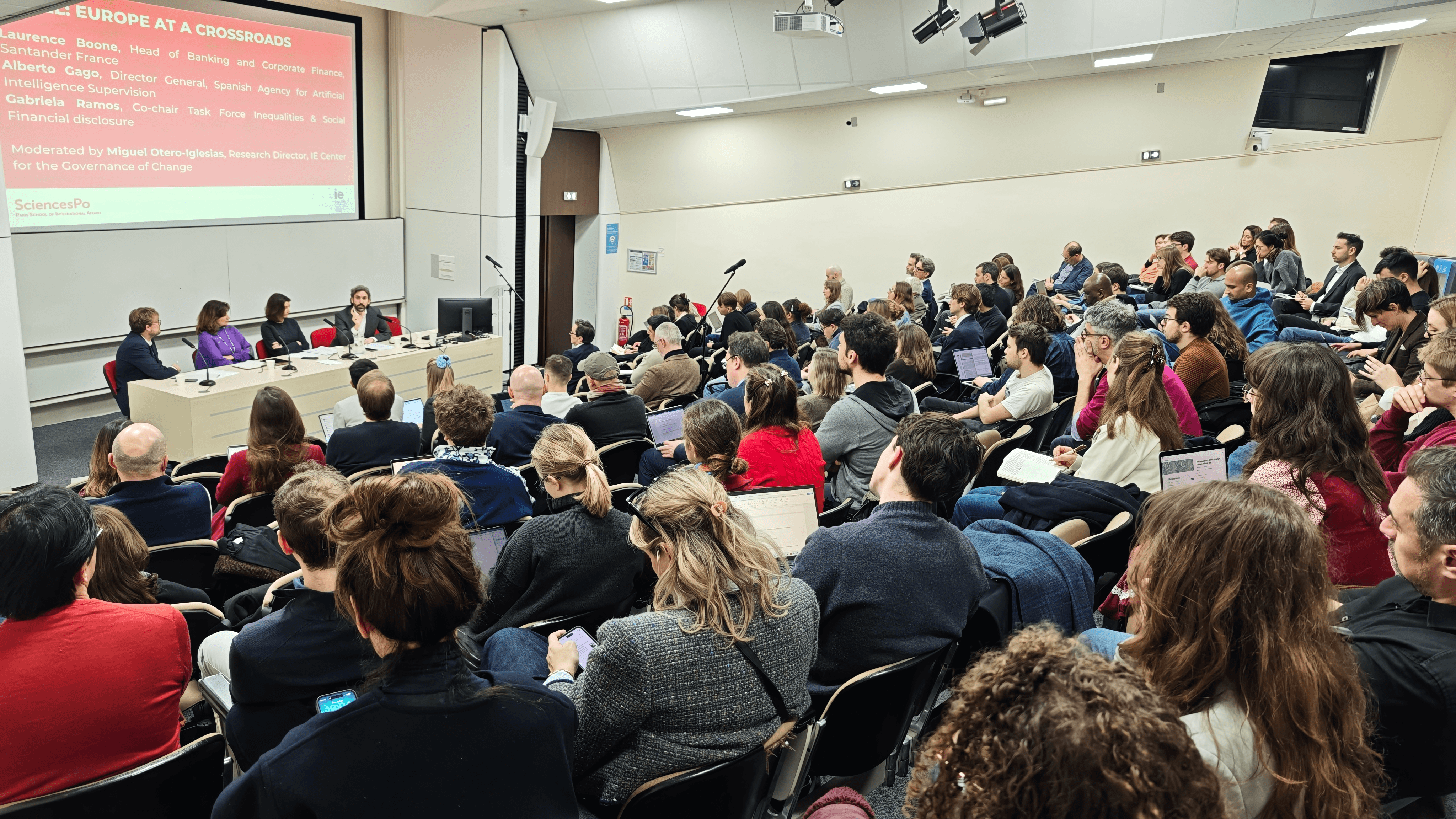
Miguel then moderated a discussion with Gabriela Ramos (UNESCO, OECD), Alberto Gago Fernández (AESIA), and Laurence Boone (Santander) on one of the defining questions of the evening: how can Europe reconcile geopolitical ambition in the digital domain with the preservation and renewal of its social contract?
The discussion made one thing clear: Europe should — and can — demonstrate that a different model of technological and geopolitical power is possible, one that continues to guarantee safety and a human-rights–based approach to innovation.
This event marks the conclusion of the third work package of our multiannual research program on The Digital Revolution and the New Social Contract. It also marks the launch of our final phase: designing a social contract fit for a world in which digital infrastructures have become instruments of power, competition, and strategic dependency.
As CGC Director Irene Blázquez Navarro stressed:
“We will rethink the foundations of a new social contract fit for the digital age, with particular attention to the social legitimacy of the exercise of power in a digital world.”
Read the full report and learn more about our research program here.
Watch the full recording of the event here.