- Home
- News And Events
- News
- Rethinking Europe's Digital Governance In Brussels
Rethinking Europe's Digital Governance in Brussels

On March 26, 2025, we led a high-level discussion in Brussels on the EU’s digital governance dilemmas.
The event brought together prominent voices from policy, industry, and research to examine strategic responses to foster competitiveness, innovation, and economic security in a shifting geopolitical context.
Andrea Renda, Director of Research at CEPS, opened the session by calling for a critical assessment of the EU’s past digital legislation. He emphasized the importance of reaffirming the Union’s strategic direction and clarifying its value proposition in the global digital sphere.
Miguel Otero-Iglesias, Research Director at the CGC, presented key questions and insights from the CGC research project on the geopolitics of the digital era. The project explores critical issues such as the global reach of the Brussels Effect, the urgency of building European digital infrastructure, digital monetary sovereignty, and regulatory approaches to cross-border data flows.
The panel discussion, moderated by Javier Espinoza (The Capitol Forum) featured leading experts from across sectors:
- Aura Salla, Member of the European Parliament, EPP, ITRE Committee
- Gloria Hervás Ortega, Global Head of Public Policy, Santander
- J. Scott Marcus, Associate Senior Research Fellow, CEPS
- Jeremy Rollison, Senior Director, Head of EU Policy, Microsoft
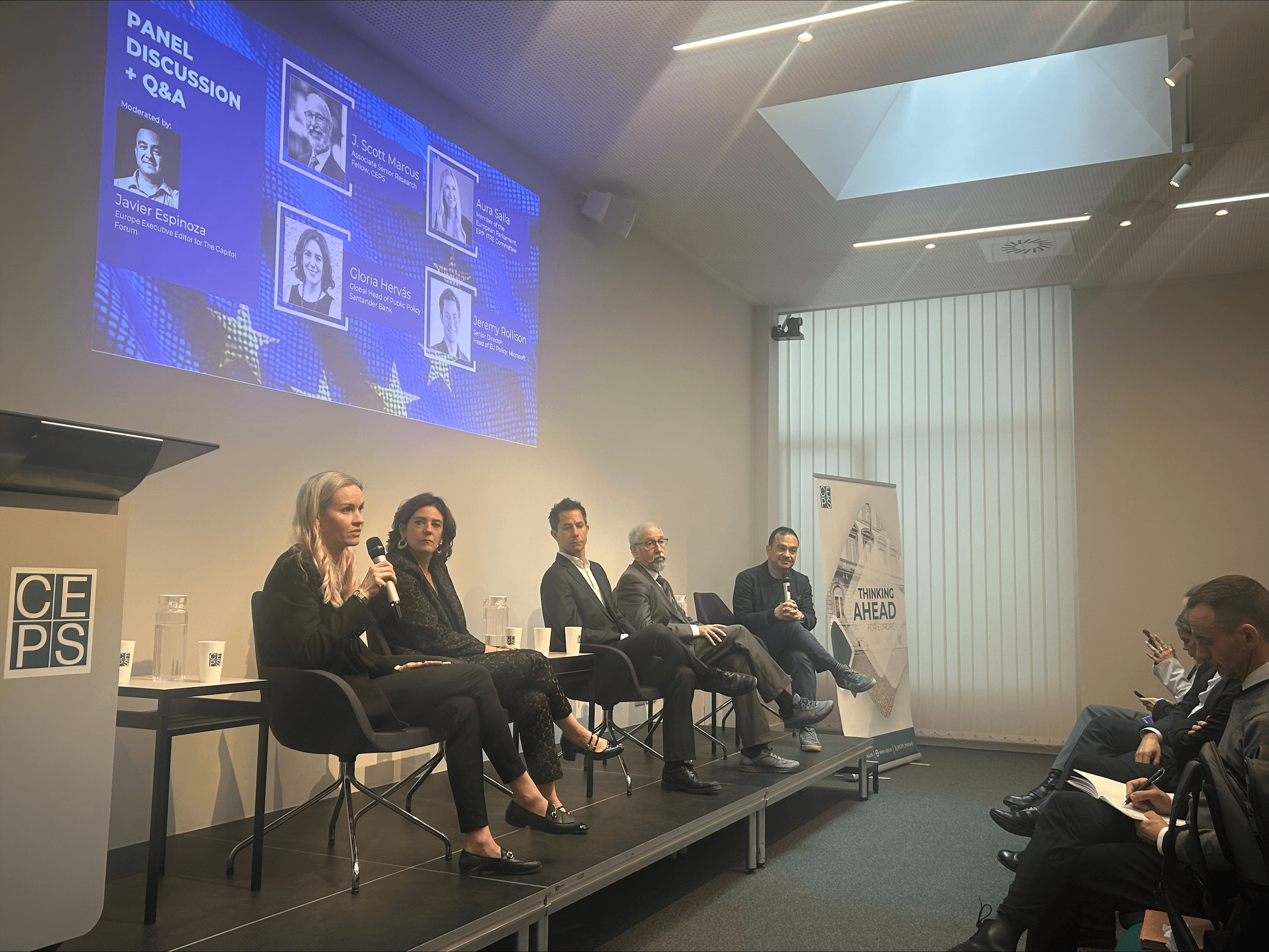
Three key themes emerged:
A European-Centered Digital Agenda: Participants stressed the need to move beyond reactive policymaking focused on the US and instead prioritize the specific needs of European companies and citizens.
Smarter, More Agile Regulation: There was broad consensus on the need to improve the legislative process—making it more transparent, evidence-based, and adaptive—while ensuring regulatory clarity for private sector actors seeking to innovate.
Greater Global Alignment: Speakers highlighted the shared objectives among major regions—balancing innovation with risk—and called for stronger international cooperation on common standards to avoid regulatory fragmentation.
As one participant aptly put it, “If a company needs to hire more lawyers than engineers to innovate and develop a project, something is fundamentally wrong with the way things are being done.”
This discussion forms part of CGC’s broader research program on the Digital Revolution and the New Social Contract, which analyzes the digital domain and the fracture of our social contract to advance realistic solutions for future agreements.
The digital revolution and the new social contract
The digital revolution and the new social contract