


I was 22 years old when I first had to tell a 60-year-old that they had 15 years until retirement instead of the two they had expected. This was not an irresponsible person. Nobody had taught them, over the course of 40 working years, how to manage their money. The compounding effect of small daily decisions had accumulated over decades.
That experience reinforced a lesson that financial well-being has more to do with psychology than with spreadsheets. Financial consulting often means helping people recognize that the patterns shaping their financial lives were never entirely rational choices. They were typical human reactions.
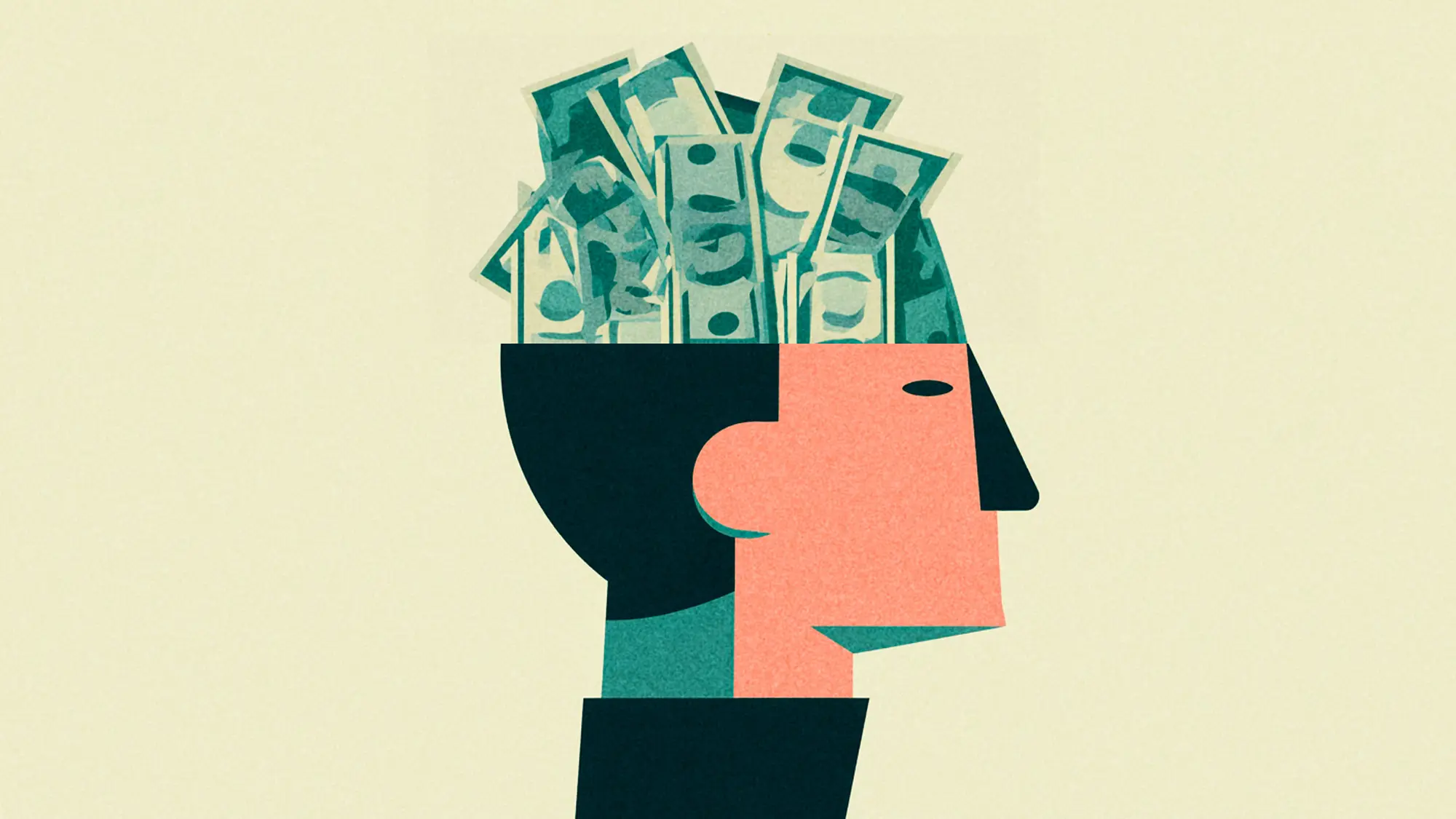
We like to believe that we make financial decisions rationally, but much of our behavior is conditioned. Our financial decisions are driven by an internal operating system that has not been updated for at least 300,000 years.
The Operating System
For hundreds of thousands of years, the human brain evolved to solve three concrete problems:
1. Finding food
2. Avoiding predators
3. Staying close to the tribe
It was optimized for scarcity, for immediate losses, and social belonging. Every bias we carry today was once a feature essential for survival:
• Loss aversion kept us from gambling away hard-earned resources.
• Herd behavior ensured that when others saw danger and ran, we ran too.
• The path of least resistance prevented us from wasting energy on decisions that were not urgent.
• Comparing ourselves to others helped maintain social status, which often determined access to resources.
Today, however, we are bombarded with financial products, conflicting media headlines, and market swings triggered by a single tweet. Our operating system remains reactionary, emotional, and intuitive, even as the environment around it has changed beyond recognition.
The result is cognitive overload, a level of anxiety and overwhelm our brains were never designed to manage. Roger Bohn and James Short of University of California San Diego found that in 1980, the average American consumed 7.4 hours of information per day and that, by 2008, that number had grown to 11.8 hours – around one hundred thousand daily.
Our brains default to fast, emotional processing when modern finance increasingly demands slow, deliberate, and analytical thinking. The result is typically anxiety, stress, and indecision.
The Five Financial Archetypes
To put this into context, let’s consider five familiar financial archetypes.
The Paralyzed Saver earns money, spends most of it, saves a little, yet never invests. They know they should, but they are staring at an overwhelming number of options and choosing none. Sheena Iyengar of Columbia University and Mark Lepper of Stanford University demonstrated this in 2000: when shoppers were offered 24 jam varieties instead of six, purchases dropped by a factor of ten. The same paralysis hits people navigating financial literacy courses, investment platforms, and a seemingly endless stream of online advice. The default becomes inaction, and inaction is its own financial decision.
The Panic Seller is invested in the markets but cannot tolerate the feeling of loss. When prices fall, they sell – which means when prices recover, they are already out. This is not weakness; it is biology. Daniel Kahneman and Amos Tversky showed that losses generate roughly twice the emotional intensity of equivalent gains. Layer herd behavior on top, and you have investors liquidating positions at the least opportune times.
The FOMO Buyer is constantly measuring themselves against others. When friends buy, they buy. When a stock goes viral, they pile in. Brad Barber of University of California Davis, and coauthors, documented this in 2022 through Robinhood’s trading data: attention-driven notifications triggered herding into specific stocks, generating short-term price spikes followed by predictable declines. One-tap trading, a concept that did not exist a decade ago, removed much of the friction that once protected investors from impulsive decisions.
The Financial Expert with Blind Spots has survived multiple crises and believes their experience makes them a reliable guide. But the advice we hear most comes, by definition, from people who did not fail. During World War II, analysts recommended reinforcing the parts of aircraft that showed bullet holes. Statistician Abraham Wald pointed out the error: the planes hit in other areas never came back. The bullet holes showed where a plane could survive damage, not where it was vulnerable. In investing, survivorship bias works the same way. Every fund manager giving advice is someone whose strategy happened to work. The thousands who pursued similar approaches but failed are largely invisible.
The Overconfident Researcher is thriving in the age of AI. They run every investment idea through a language model, receive a confident and articulate response, and feel smarter for having done so. Professors at IMD tested this in a financial context: nearly 300 executives were asked to predict Nvidia’s stock price, half consulting ChatGPT, half consulting peers. The AI group became more confident and produced worse forecasts. The peer group, regulated by social skepticism, made more conservative and more accurate predictions.
The mechanism is straightforward: AI models tend to generate arguments that reinforce the thesis that users bring to them. According to a 2025 analysis by Graphite, AI-generated content has now surpassed human-made content online, flooding social media with expert-sounding summaries often built on recycled or distorted information.
These seem like five separate archetypes, but ultimately they are five expressions of the same 300,000-year-old brain, confronting a financial system it was never built to navigate.
When a Different Operating System Enters the Arena
If the core problem is our biological wiring, what happens when a fundamentally different kind of intelligence enters the same market?
Thomas Henning of the California Institute of Technology and colleagues explored this question in 2025 by placing large language model (LLM) agents – systems capable of making decisions on behalf of users – into experimental financial markets that have historically generated bubbles and crashes when run by humans. The result: AI agents traded closer to fundamental stock values, speculative bubbles were significantly reduced, and panic selling was largely absent.
Human irrationality is what creates the mispricings that disciplined investors often profit from. If AI agents compress that irrationality out of markets, the very opportunities that once rewarded patience and contrarian thinking may gradually disappear. Anne Lundgaard Hansen and Seung Jung Lee at the Federal Reserve found separately in 2025 that while AI agents herd less than humans, their rational consistency could, under certain conditions, introduce coordinated risks the system has never encountered before – not through emotional panic, but from synchronized rationality at scale.
The Only Upgrade That Matters
Our wiring defaults to reaction rather than reflection. For the first time in history, however, we have tools that can help us process information in ways our brains were never designed to handle – but only if we use them to challenge our thinking, not confirm it.
Systems Over Instinct
So, what can be done?
1 . Start with identity. Which of the five archetypes do you recognize in yourself? Financial behavior is rarely random. Most people fall into recurring emotional patterns that shape how they save, spend, invest, and react under pressure. Understanding those patterns and the kind of financial wiring behind them is the first step toward change.
2. Ask for help. Money is one of the most socially uncomfortable subjects to discuss openly, even with people close to us. In some cultures, conversations about income, debt, and investment portfolios are considered taboo. But financial decision making in isolation can prove dangerous because, alone, we reinforce our assumptions and ignore blind spots.
3. Audit your decisions. Do an inventory of your recent money decisions. When did you overspend, avoid checking your bank account, or endlessly research without acting? Behavioral biases rarely show themselves in a dramatic form. Rather, they can emerge through repeated habits that compound over time.
4. Budget honestly. Budgeting is not simply an accounting exercise. Understanding what comes in and what goes out can help your money habits stay in reality.
5. Automate good behavior. Systems can help you succeed when willpower fails. Automated saving, recurring investments, emergency fund contributions: start small and automate. This will help reduce the number of decisions to be made, not to mention stress and uncertainty.
6. Build decision structures. If you’re already invested and looking for a way to make better decisions, define your rules in advance as a way to control future emotional actions and help prevent reactive decisions where you spend wildly, FOMO buy or panic sell.
7. Find accountability. Financial well-being, as any other type of well-being, takes a community. Mentorship and honest conversations with friends, family, and experts can help keep you on a successful and rational financial path.
Financial behavior is not fixed. Our brains adapt to the environments and the systems surrounding them – so meaningful change begins with recognizing how often our financial decisions are shaped by emotion and deeply conditioned behavior. My 60-year-old client spent decades navigating a financial system that was never designed to be intuitive and, like many people, he gradually fell behind without really understanding why. Today, we have more access to financial education, information and tools than ever before – but long-term financial well-being still depends on building habits and making conscious decisions that acknowledge, and counter, our instinctive reactions.
© IE Insights.