

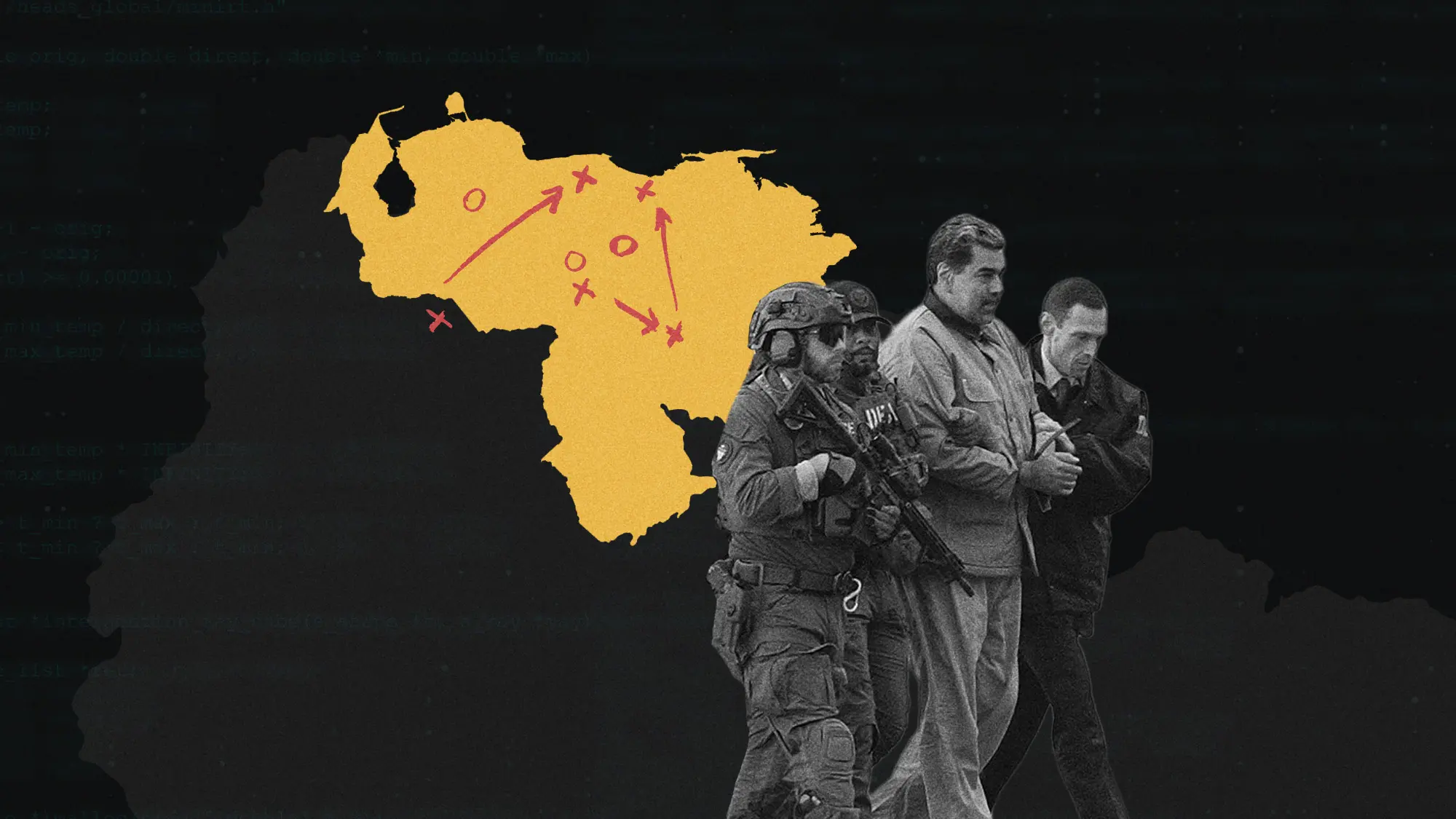
At 2:00 a.m. on January 3, U.S. missiles struck Venezuelan air defense nodes as electronic warfare aircraft suppressed radar coverage across Caracas. Hours earlier, China’s Special Envoy to Latin America, who had met with Nicolás Maduro the previous day, was asleep in the capital. By dawn, U.S. special operations forces had extracted Maduro and his wife from a fortified compound and transferred them into U.S. custody. Russian- and Chinese-supplied air defense systems remained inactive throughout the operation. The mission achieved total tactical success.
The operation was publicly framed as a law enforcement action but in practice involved cross-border missile strikes, cyber-enabled infrastructure disruption, and the forcible removal of a sitting head of state. This rhetorical framing matters because it shapes international reaction by denying opponents a clean casus belli, and reinforces a broader lesson that power, once demonstrated, creates freedom of action for strong states inside their perceived spheres of influence. Escalation is compressed by controlling legal framing, which forces opponents into narrower response pathways.
The operation revealed how Donald Trump now conceives the exercise of power and which instruments he considers decisive. Intelligence penetration, cyber and electromagnetic disruption, and elite special operations were fused into a single execution window designed to collapse decision time and preclude organized response. Power was applied through integration and speed rather than signaling, coalition building, or territorial occupation.
Intelligence as Presence Rather than Observation
The decisive phase of the Caracas operation began months before the first aircraft launched. By late summer 2025, U.S. intelligence had achieved sustained access inside Maduro’s personal security ecosystem. This phase reflected a shift from intelligence as observation to presence.
Patterns of life were mapped at granular depth. Daily routines, personal habits, clothing choices, and the movement cycles of Cuban security advisors were understood with sufficient confidence to support precise timing decisions. Once access reached that threshold, intelligence ceased to function as a supporting input and became the organizing logic of the operation. Timing replaced discovery as the dominant variable.
Traditional intelligence collection prioritizes awareness. Presence generates certainty. In Caracas, relative superiority was established before the assault force moved and, by the time the raid began, the adversary’s options had already narrowed.
This dynamic explains the collapse, at this decisive moment, of the Cuban security apparatus responsible for Maduro’s personal security. Protection systems built around loyalty networks and politicized services appear dense, but their rigidity creates openings for access over time. Once penetrated, such systems fail abruptly.
What Caracas ultimately exposed was a failure of counterintelligence rather than a technological gap as the regime had some of the most advanced Russian and Chinese air defense systems in operation and were receiving intelligence support from both. Regimes that equate loyalty with security tend to prioritize ideological alignment over systemic integrity. Vetting becomes episodic rather than continuous. Internal reporting flows upward to reassure rather than to challenge. Over time, warning indicators narrow instead of widening. The result is a security ecosystem that appears robust while quietly losing its capacity for self-correction. Once access is established inside such systems, it often persists longer than leadership assumes, because institutional mechanisms for internal skepticism weaken. This pattern emerges wherever protection is personalized, foreign advisors are embedded deeply, and counterintelligence functions serve regime stability rather than adversarial scrutiny. Caracas demonstrated how these conditions convert time into vulnerability. It also shows why intelligence success unfolds cumulatively, relationally, and invisibly until the moment it becomes decisive.
Cyber and Electromagnetic Power as Time Creation
The kinetic raid unfolded inside a deliberately shaped electromagnetic environment. Cyber and electronic actions served a precise operational purpose. They created time.
Targeted disruptions to power distribution and communications fragmented situational awareness across Venezuelan command structures. Leadership nodes were isolated from their protective ecosystem. Defensive systems designed for hierarchical response struggled once coordination failed. The disruption targeted specific sectors mapped to known dependencies rather than attacking infrastructure broadly.
The civilian digital response provides measurable evidence of this isolation. Tor Metrics data and independent monitoring indicate a marked increase in Venezuelan connections to the Tor network, a tool that allows users to access the internet through censorship-resistant pathways, during and after the operation, consistent with a surge in such traffic under blackout conditions. The spike signals a moment of information shock, as people lost access to familiar channels and searched urgently for any source they could trust. In that moment, control of the narrative environment shifted faster than control of territory, underscoring how information warfare now functions as a decisive layer of modern operations rather than a supporting one. In modern conflict, this behavioral signature matters strategically. It demonstrates how leadership isolation translates directly into societal disorientation, extending cyber and electromagnetic effects far beyond the immediate battlespace.
Precision Force as Conversion Mechanism
Elite special operations forces converted this temporal advantage into physical custody. Execution emphasized speed, sequencing, and rehearsal rather than mass or prolonged engagement. The neutralization of Maduro’s elite Cuban security detail illustrated the model’s core logic. Speed substituted for scale.
By entering and exiting the battlespace within hours, the operation removed the time required for political mobilization, external intervention, or escalation management. By the time international actors reacted, the outcome had already hardened into fact. The decisive window closed before military, political, or diplomatic response cycles could engage.
The immediate aftermath in Caracas exposes a central contradiction. Leadership removal left the regime’s institutional apparatus largely intact. Acting authorities asserted continuity, while security services retained operational cohesion across key ministries, police units, and intelligence organs. On the streets, control persisted through the familiar mechanisms of surveillance, intimidation, and rapid mobilization, signaling regime endurance rather than rupture. U.S. forces withdrew without assuming responsibility for political stabilization, leaving the coercive core of the state in place even as its top leadership disappeared.
This outcome reflects a recurring tension in intelligence-led decapitation operations. Removing a leader compresses time and reshapes perception. Control over territory, population, and security institutions follows a different logic that unfolds more slowly and resists external direction. In Venezuela’s case, authority fragmented rather than collapsed. Elements of the regular armed forces, national guard units, and neighborhood-level security groups continued to operate with overlapping mandates, uneven coordination, and competing loyalties. Such internal friction constrains rapid stabilization and raises the likelihood of localized violence or escalation driven by events rather than strategy.
This gap between tactical achievement and political control defines the strategic risk. Stabilization would require either sustained external presence or internal armed contestation of residual state authority. Both paths introduce fragility. Any follow-on operation that results in U.S. casualties would quickly alter political thresholds and increasee pressure for expanded presence and deeper involvement. Precision intervention carries a tendency to accumulate commitment through risk rather than through deliberate choice.
For Europe, Caracas raises uncomfortable questions about strategic autonomy and consultation. Washington executed regime change without prior coordination, leaving partners to absorb diplomatic fallout and regional instability. The commercial implications are immediate. European firms with exposure to Venezuelan energy assets or Latin American supply chains now operate in an environment where geopolitical logic supersedes contractual predictability. Political access increasingly governs market outcomes in contested regions.
These dynamics feed directly into alliance security. Allied capitals must now treat U.S. intelligence as both protection and a potential pressure point. Quiet reassessments of intelligence sharing arrangements and selective removal of American contractors from sensitive defense and infrastructure systems are already taking place and reflect an adjustment to this new reality. The Caracas operation succeeded because a rare alignment of conditions favored execution. Deep intelligence access, penetrable security structures, constrained retaliatory capacity, and compressed timelines converged into a narrow window that rewarded speed over endurance. That success carries a structural warning. Integrated decapitation functions effectively where counterintelligence cultures erode, command systems centralize, and escalation remains containable. Applied elsewhere, the same logic invites misjudgment at far higher strategic cost.
The consequences extend well beyond Venezuela. Caracas normalizes a model in which intelligence-enabled force substitutes for collective deliberation, reshaping alliance expectations and recalibrating trust. Allied governments absorb the lesson quietly, adjusting assumptions about intelligence dependency and strategic autonomy. Adversaries draw a different one. For them, leadership survivability increasingly depends on counterintelligence density, infrastructure resilience, and continuity of command under disruption. Beijing and Moscow now operate with clearer evidence that demonstrated capability creates latitude inside perceived spheres of influence.
Caracas revealed a powerful instrument of statecraft. Its lasting impact will depend less on how well it worked in this instance than on whether leaders possess the discipline to resist turning tactical success into strategic habit.
© IE Insights.