

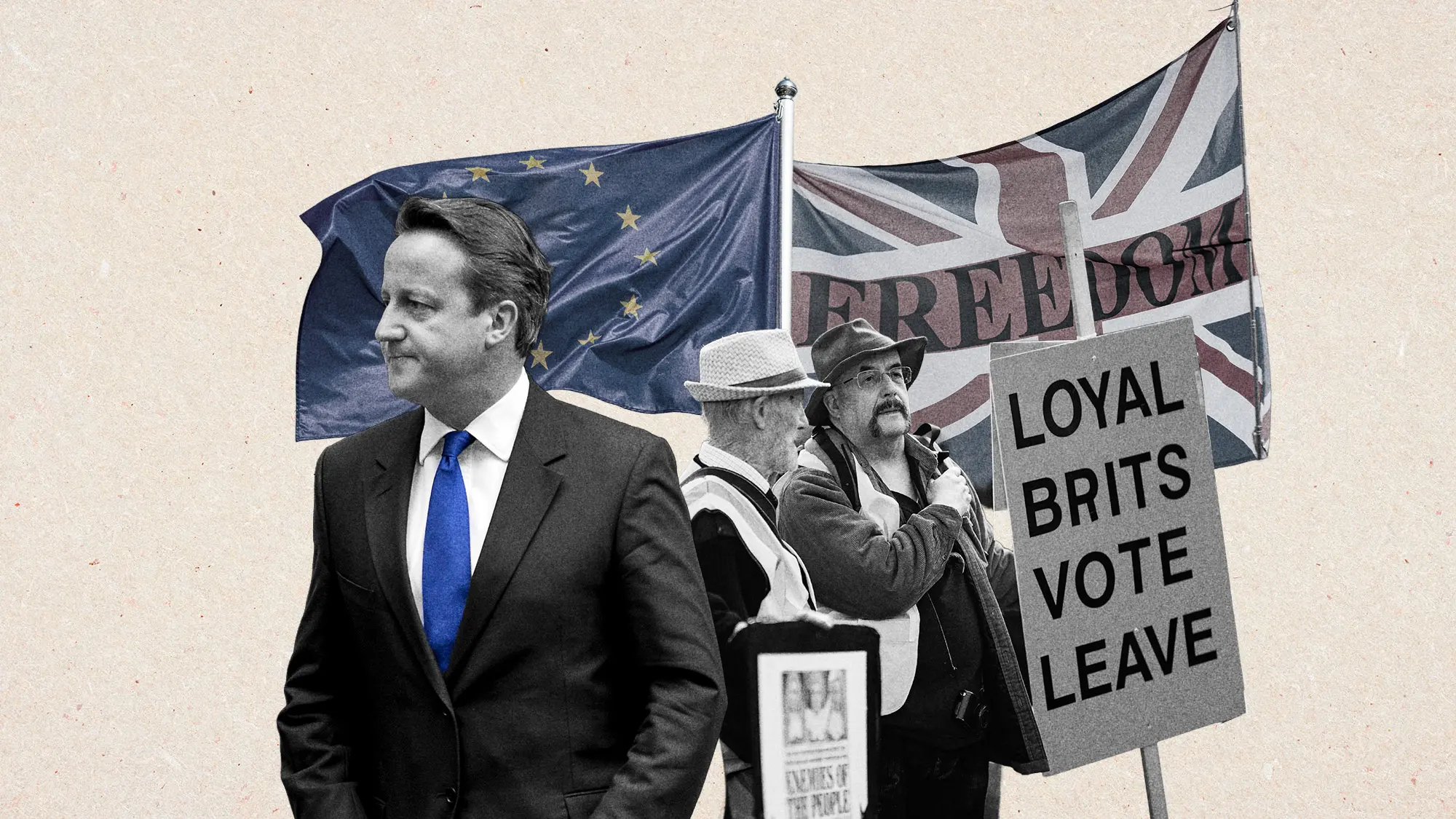
It’s been 10 years since the Brexit vote. That June morning remains difficult to forget. Many thought this would have a very detrimental impact on the European project. Losing one of the biggest and most strategically savvy member states would weaken the Union. Some even claimed Brexit would cause a domino effect, bringing the EU to its knees.
That was not the case. The EU adapted. But while the British claimed they were taking back control, the transformation of Europe and the wider world only accelerated. No European country, including the UK, could control these changes alone anymore.
In 2016, Europe had not yet lived through the first Trump administration. It had not yet seen Russia’s full-scale war in Ukraine – even though it came right after the invasion of Crimea. The world had not yet lived through Covid-19. The panic about Chinese dominance over European industries and the technological revolution were still in their stages. And surely, Europe had not yet seen Trump II, which has started to threaten democracies across the continent – in the EU and the UK alike.
The British did not foresee the weakening of NATO, or the possibility of an American threat against Greenland, on European soil they once defended together. The world has changed drastically since then. Yet this transformation is still not reflected in the framework of the EU-UK relationship. We are still talking in Brexit terms.
In search of a win-win landing zone
Ten years after the Brexit vote and six-and-a-half years after the United Kingdom left the EU, we are at an inflection point. Since the new Labour government took over, there is an ever-present conversation about a “reset.” The discussion reached new highs when many began to float the idea of “rejoin.” That is too big a step, too soon, taking into consideration how divisive this might become in the UK, let alone without knowing if the EU member states are ready for such a step.
Where we find ourselves is a major strategic gap. The desire for strategic convergence due to the geopolitical realities we face, and the frameworks for delivery do not necessarily match. The conversation is still shaped by Brexit era redlines – no to the single market, Customs Union and mobility from the UK side, and the indivisibility of four freedoms in the case of single market access and no cherry picking in institutional relations, from the EU’s side.
The EU member states are yet to decide if the UK, regardless of the complexity and the red lines of the past, can become a strategic partner in security and prosperity. The UK on the other hand, should decide if putting its eggs in the EU basket and accepting being a rule-taker in some areas might be worth the economic benefits. The outgoing Prime Minister Starmer already mentioned this in China: Getting closer to the European single market, joining sector-by-sector via dynamic alignment, might be the way to survive the zero-sum economic relations of today. There is a growing awareness in the public space acknowledging the need to look for a stable, mutually beneficial relationship.
That relationship is yet to be built, however. At this point in time, there is a mix of messy processes. There is an ongoing technical conversation, mostly led by the European Commission. This conversation includes youth mobility scheme, carbon emissions and electricity markets, and agri-food standards. The Commission does what it does the best: bringing the UK closer to EU standards, piece by piece. The EU’s regulatory power in action. Alignment for future access. This is the ongoing institutional process.
On the other hand, there is another intergovernmental security conversation going on. The UK is a part of the Coalition of the Willing for Ukraine and European NATO build-up for securing the Baltic states. It might even represent broader European security interests in a possible negotiation with the Russian President Vladimir Putin together with Germany and France within the E3 framework. This already gives the country a special place in the future of European security. Should there be the launch of a European Security Council as suggested by the Commissioner for Defense and Space, Andrius Kubilius, and other leaders before, the United Kingdom and Ukraine both would get a special place in it. Even if the overall institutional processes do not advance because of the persistence of Brexit red lines, the UK has its own place in European security.
The UK is also interested in wider Europe. It has recently hosted the European Political Community (EPC) that includes almost all EU and non-EU European countries. The positioning of the country in the broader continent is not disputed, its contributions are rather welcomed.
What is lacking, however, is the UK’s involvement in the European competitiveness debate. This is the missing economic piece. The EU remains the UK’s most significant economic partner with 45 percent of its goods trade is still conducted with the EU. Many in the EU would like to see the British financial power being added to European capital markets. There are surely many synergies to be found. However, the indivisibility of the single market with benefits and responsibilities is still the dominant view in Brussels and European capitals. Furthermore, the UK viewing the EU only through the lens of a market is conceived rather negatively by Europeans. If the UK wants to go beyond other trade partners of the EU, it should demonstrate what to offer in return.
Unless there is a strategic framework that is functional, the relationship will become more minilateral and bilateral. It is already happening anyway. Germany, France, Spain, and Poland already have their own frameworks with the UK. These countries look for a well-functioning bilateral relationship in the post-Brexit era. The UK remains the second-largest global destination for Spanish Foreign Direct Investment, for example. Financial services, infrastructure and transport are core sectors that also lead to job opportunities and mobility conversations that are at the heart of the debate. All in all, there is risk that the member states get used to resolving issues via their bilateral links instead of looking for a pan-European framework.
Where do we go from here?
One of the key reasons why there is no new framework for EU-UK relations is the British perception of where the country stands in the world. In an age where all European countries are small, the UK is having difficulties accepting that its role and presence in the world has changed. It still is one of Europe’s larger countries, but still a small player compared with China and India. However, this misperception is still the reason the UK is not willing to put all its eggs in the European basket.
When it comes to European competitiveness and prosperity, the EU-UK relationship is not a conversation of equals. The scale of the European market and its power of regulation are not comparable to the UK. This is why recent studies suggest that the cost of Brexit to the UK’s GDP per capita has been 6 percent. The UK is losing prosperity outside the market.
There is more to that story. Europeans are planning to complete their single market integration in the upcoming years. The three priority areas on the agenda are finance, energy and telecom – three sectors where there might be synergies between the two sides. This is also where the contradiction lies in the current relationship: strategic convergence may be increasing but the political and institutional framework has not yet caught up. If both sides start thinking more strategically about the future, the framework conversation will become easier to grasp. Although it cannot fully access the single market, the United Kingdom could participate more in the EU’s various new initiatives to reindustrialize the continent.
A possible game changer would be an even more drastic change in relations with the US. Britain is not fully coming to grips with the new state of transatlantic relations. Not yet. This is one of the main reasons why it is not ready to embrace Europe as a means to achieve goals, but also as an end in itself. Yet “almost two-thirds of Brits now want to develop an alternative European nuclear deterrent which is not reliant on America,” according to an ECFR survey, and 61% want to follow a “Buy European” policy on purchasing weapons.
Churchill wanted to shape the European Coal and Steel Community from outside. When the country’s global standing started to decline and the European economic capacity started to impress, the UK wanted its way in – with a lot of exceptions. Today, the country is asking for similar exceptions from the outside. The EU-UK conversation still lives in the past. It is time to invent the future.
For now, an organic evaluation of the relationship might depoliticize the conversation. However, without a strategic goal, it will be very difficult to reset the relationship. If there is not a common path forward, there will be competition. Once a Prime Minister has a real mandate from the British people, possibly through the 2029 general elections, he or she should walk into the European Council saying that the world has changed immensely, and we are in this together. Only then will the real building of the future relationship begin.
© IE Insights.