



Individualism-collectivism is one of the most widely studied ideas in business and culture, dating back to Geert Hofstede’s pioneering research on IBM employees across dozens of countries. But a new study I conducted with an international team of researchers suggests that we may have been thinking about collectivism in the wrong way. Our findings point to a misunderstanding that permeates researchers and MBAs alike, and could be leading to mistaken assumptions about how people behave and how teams work.
There were already hints that something was wrong decades ago. When I entered the field of cultural psychology as a research assistant at the University of Michigan, veteran researchers let me in on an open secret: “Don’t use collectivism surveys. They don’t work.”
What they meant was that the surveys often produced odd results. In one study, for example, researchers asked people in China and the US to rate the importance of different values. People in China said independence was more important to them than Americans did. Americans said loyalty was more important to them than people in China did – the opposite of what cultural experts predicted. A review analyzed 76 studies that used collectivism scales in East Asia and North America, found that the scales detected the expected cultural differences only as reliably as flipping a coin.
Researchers came up with several explanations. People across cultures may have different response styles – for example, they tend to agree with survey questions or find safety in the middle responses – or they implicitly compare themselves with the people around them, making cross-cultural comparison difficult. These explanations have real evidence behind them, but our new research suggests that there may have been a more basic problem from the start: our definition of collectivism.
Two Versions of Collectivism
One common idea of collectivism, which I call “warm fuzzy collectivism,” emphasizes positive emotions and broad pro-sociality. It can be understood as big team collectivism. This version of collectivism can be seen in survey items used by researchers. One item is, “I feel good when I cooperate with others.” Another is, “What is good for my organization is also good for me.”
There’s another version of collectivism that appears to be just as intuitive. For four years in a row, MBA students at the University of Chicago completed a survey asking whether people in collectivistic cultures, individualistic cultures, or neither would agree more with the statement, “We should keep our aging parents with us at home.” More than 98% said collectivistic cultures.
That item is different from the warm fuzzies in two ways. One is that it’s about a close relationship. It’s not “others.” It’s not a large organization. It’s a specific, close relationship. The other is that it’s not about how people think or feel. It’s not about expressions of emotion but about a concrete behavioral duty.
I call this version “responsibilism.” It emphasizes duties and responsibilities in close relationships, prioritizing concrete behaviors over emotions and close relationships over distant relationships.
The MBA students’ responses offer a window into how people understand these two versions of collectivism. Across a broader set of questions, their answers reflect both the responsibilistic version and the warm fuzzy version. Their responsibilistic guesses match the actual survey data across cultures well. People in China, Ghana, and Turkey agree more about taking care of aging parents than people in the US, UK, and Germany.
But with a statement such as “The well-being of my co-workers is important to me,” the students veer off course. They don’t anticipate that people in individualistic, Western cultures agree more. Only 5% guess correctly that people in cultures such as the US agree more than people in cultures such as China.
The patterns hold across the exercise. Out of 13 questions, random guessing would produce an average of 4.3 correct answers. The students average just 2.8. The experts don’t fare much better. In a survey of 40 authors of articles in the Journal of Cross-Cultural Psychology using the same exercise, their guesses on average were correlated in the wrong direction with the actual survey data. In other words, the opposite of the average expert answer would have been the better guess.
The bottom line is that many people hold both of these visions of collectivism in their heads. They expect people in collectivistic cultures to agree more both with concrete duties in close relationships and generalized positivity. They’re half right.
Putting Responsibilism to the Test
To test whether responsibilism could capture the cultural differences that conventional measures of collectivism had missed, we administered a new survey to people across 100 cultures, from Greenland to Mongolia and Madagascar. People answered questions about concrete duties to family and friends (which scored as more responsibilistic) and generalized warmth and pro-sociality (which scored as less responsibilistic.)
Where the earlier studies found no differences, the new survey revealed large, reliable differences. And the differences goes beyond East Asia. Responsibilism was high in the Middle East and sub-Saharan Africa. It was moderate in Latin America, Eastern Europe, and the Caribbean. And it was lowest in northwest Europe, North America, and New Zealand.
With these responsibilism scores in hand, we tested whether they correlated with real-world markers of duties in close relationships versus broader pro-sociality. For example, cultures that scored higher on responsibilism donated more blood to family members but less to strangers. Responsibilistic cultures were also less likely to return a lost wallet to a stranger and more likely to rack up parking tickets at the United Nations when they had diplomatic immunity.
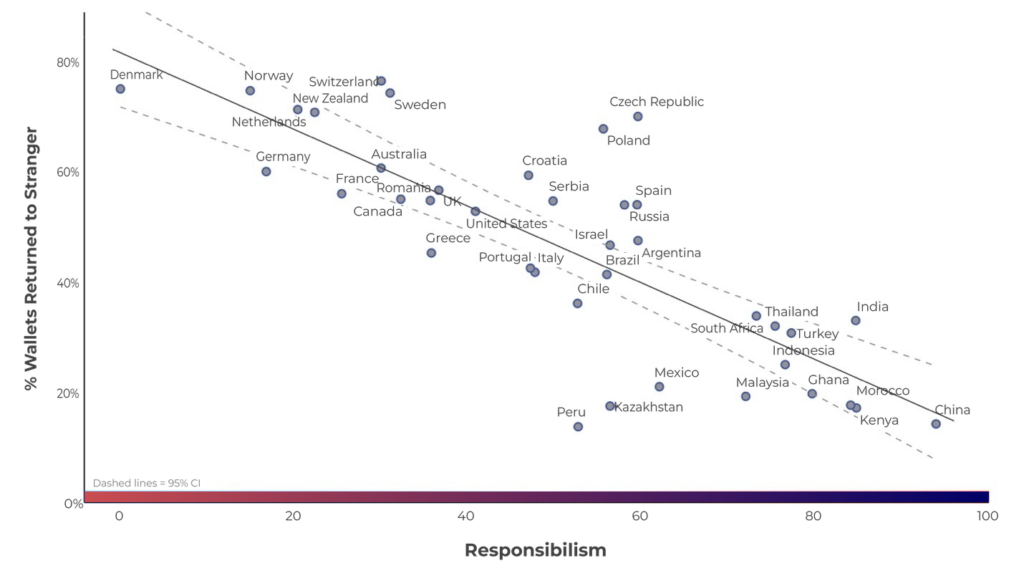 Cultures that scored higher on responsibilities in close relationships were less likely to return a lost wallet to a stranger in a study where researchers dropped 17,303 wallets in 40 countries around the world.
For comparison, survey participants also completed the most-used collectivism scales (the ones my mentors warned me not to use). The old scales often showed correlations opposite to what was predicted. Cultures that scored more collectivistic on scales containing warm fuzzy items were less likely to live with extended family and less likely to donate blood to family. Instead, they scored higher on accepting immigrants and returning wallets to strangers.
People often discover cultural differences after crossing oceans, but this divide between responsibilism and warm fuzzy collectivism also exists within regions and countries. For example, the research revealed differences between northern Europe (less responsibilistic) and southern Europe (more responsibilistic). There were also differences between the southern US (more responsibilistic) and northern US (less responsibilistic). Hispanic Americans scored higher than European Americans.
Even within the same region, the data showed that people from lower socioeconomic backgrounds were more responsibilistic. Political conservatives were more responsibilistic too. This distinction is also reflected in research led by the University of Southern California’s Ravi Iyer, which found that conservatives tended to be more oriented toward close relationships, including family, while liberals tended toward broader social connections and reported greater feelings of love toward “generic others.”
Responsibilism in Organizations
These differences show up in companies too. One survey item asked people to imagine working in a company and waiting for a meeting to start when a co-worker they had never met before started talking to them. The co-worker asks about a sales account. Will they share the details with this unfamiliar co-worker?
People in responsibilistic cultures were wary. This illustrates the distinction between warm fuzzy collectivism, which emphasizes positive feelings toward people generally, and responsibilism, which emphasizes duty within close relationships. In responsibilistic cultures, belonging to the same large organization is not sufficient to establish trust.
Understanding this distinction—and avoiding the mispredictions that originate from warm fuzzy collectivism—is useful for doing business. Responsibilism can help explain who people trust, how much shared experience team members need to build a sense of duty, and whether negotiations can be a quick shared puzzle or a long trust-building process.
For managers of multicultural teams, this means recognizing that trust and collaboration may take longer to develop in responsibilistic cultures. It would be a mistake to assume that people from collectivistic cultures are automatically more cooperative and trusting. Managers can put this knowledge into practice by giving team members time and opportunities to build relationships through working together.
How that trust develops also matters. Responsibilistic cultures prioritize concrete actions more than words and feelings. Managers can encourage collaboration in responsibilistic cultures by having team members work on specific tasks together, rather than relying on “warm fuzzy” strategies such as icebreaker exercises or team-building events focused on emotions.
© IE Insights.