

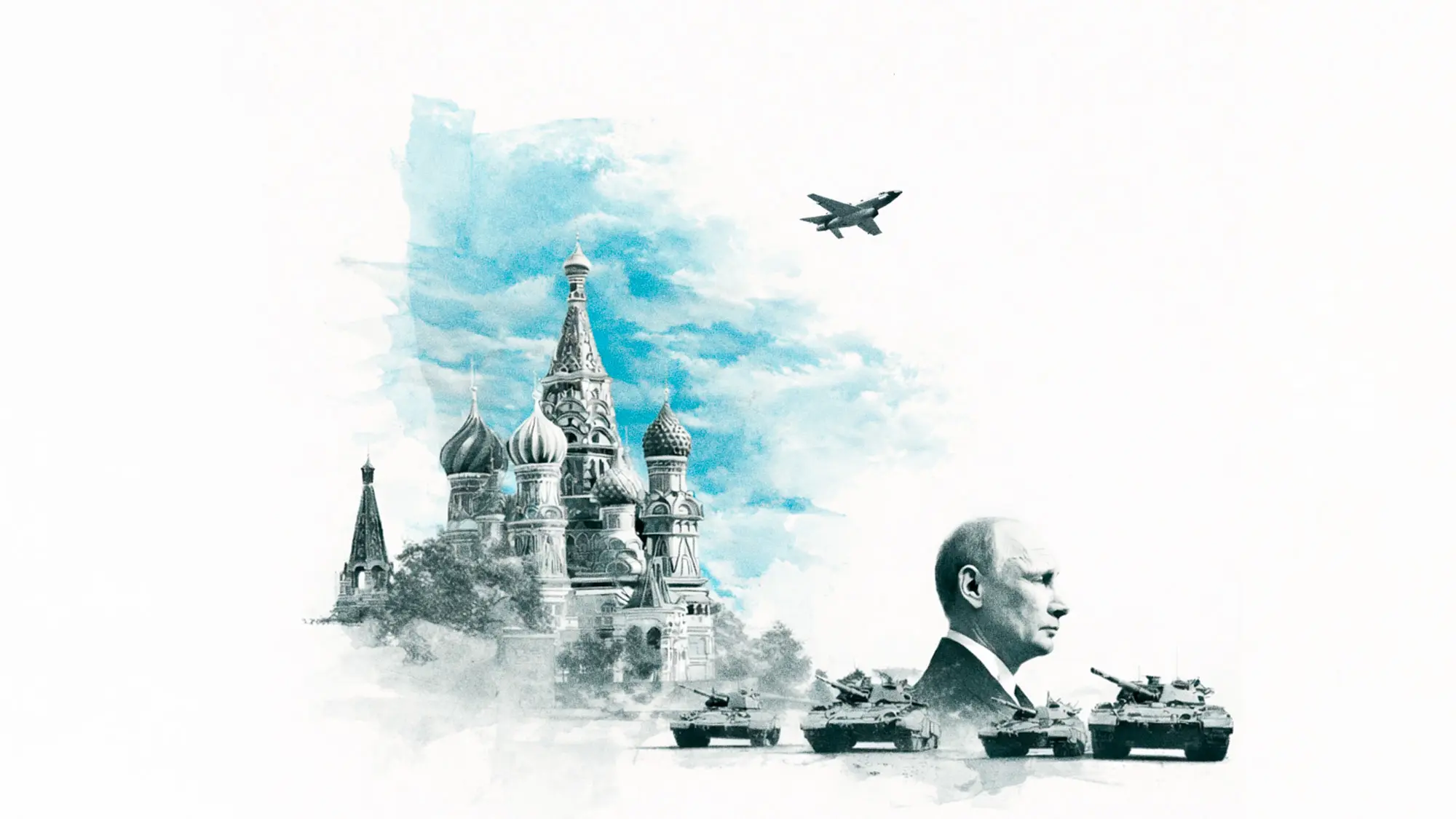
The meeting between Donald Trump and Vladimir Putin in Alaska was one of the most closely watched diplomatic events of 2025.
Every gesture, every word, and even every silence was scrutinized by cameras and commentators. Media coverage swung between alarm, as Trump appeared to grant Putin international approval, and the promise of a strategic thaw between the two presidents which, as the war continued, never quite materialized.
Since Russia’s invasion of Ukraine in 2022, Kremlinologists have once again taken center stage in international opinion pages and talk shows. They interpret. They compare. They infer. Above all, they try to work out what Putin is thinking and what he plans to do next.
These analysts repeatedly turn to the Russian President’s background and life story as the main way to explain him. They talk about his difficult childhood in Soviet Leningrad, shaped by shortages and everyday violence. His years in the KGB are frequently cited as the origin of his deeply ingrained mistrust, and his obsession with control, secrecy, and disinformation. It is an attractive approach because it works well as a narrative, personalizing the conflict, making it easier to grasp, and offering a clear chain of causality: if this is who Putin is, this is how Russia acts.
These analyses are useful. In authoritarian regimes, the personality of the leader matters, compensating for the absence of institutionalized checks and balances. In Russia, there is little doubt about who stands at the top of the power structure. Such insights help clarify styles, reactions and limits. However, they are not enough.
To explain Russian foreign policy solely in terms of the psychological makeup of its leader is to risk turning complex structural issues into the product of a single individual’s will. Thus, a second, more ambitious interpretive framework is appropriate here: one that explains Russia’s behavior based on its history, geography, and institutional track record.
Russia is not a radical “other,” frozen outside history or beyond comparison.
Here, the focus shifts from the individual to the country, and to its imperial and Soviet heritage. It extends to long-standing historical tendencies. Russia’s alleged failure to consolidate democratic institutions, its strained relationship with the West, and its focus on spheres of influence are often framed as the legacy of an unresolved imperial breakdown.
This approach is undoubtedly more solid than the purely psychological perspective. It recognizes that Russian politics did not begin in 2000 with Putin’s rise to power, and that it is driven by deep-rooted inertia. The problem comes when history is treated in essentialist terms: Russia is by nature authoritarian, has always been so, and therefore cannot change. History shifts from explanation to destiny.
Let us take the example of imperialism. The invasion of Ukraine is, indeed, an act of aggression with imperialist traits. There are clear territorial ambitions in a war that is soon to mark its fourth anniversary. However, the analysis becomes unworkable if imperialism is understood as the essence of a nation that cannot change. Conversely, the analytical debate gains clarity and direction if the concept of imperialism is taken as a starting point, and an analysis is conducted into how, when, and why Russia engages in imperial practices.
Russia and its political dynamics are often analyzed through the lens of “Russian exceptionalism,” a concept developed extensively by intellectuals. Many in the West view Russia as the embodiment of “the other” par excellence: a land of so-called “Asian barbarism” that has long challenged the liberal and democratic forces of the West: first as a reactionary empire, then as a communist power, and now through a form of authoritarian populism that lends supports to Europe’s far-right.
The flip side of this view lies in nineteenth-century Slavophile thought. Writers such as Dostoevsky articulated a largely male intellectual tradition centered on the idea of a Russian “genius” and a messianic national mission. Russia, in this reading, is said to follow a historical path distinct from the West, with Moscow cast as the “Third Rome” and the spiritual heir to Orthodox Christianity.
However, Russia can also be thought of not only as the nemesis of the West but also as a microcosm of some of the central contradictions of our time. Putin’s regime has been one of the first actors to politically, socially, economically, and geopolitically challenge the liberal order. This can be seen in the rise of an ultra-conservative, populist discourse that attacks LGBTQ+ rights and feminism while presenting itself as the defense of Christian, white, Western civilization. In Russia, this rhetoric began to gain traction as early as 2012, in what some political scientists have termed Putin’s “conservative revolution.”
A similar logic can be found in Donald Trump’s confrontational approach to US foreign policy, which divides the world into spheres of influence and rests on an unqualified belief in the law of the strongest, a view that is far from alien to Vladimir Vladimirovich Putin’s understanding of global politics.
This approach places Russia within some of the dominant trends shaping today’s complex, interconnected world. Marlène Laruelle, an academic at Georgetown University, has developed this perspective in her analysis of the country in works such as Ideology Making under the Putin Regime and Is Russia Fascist? Unraveling Propaganda East and West, contributing to a more rigorous and measured debate.
So how does the Russian regime work?
Analyses that focus on the internal workings of the Russian regime are less common, but they tend to offer greater insight. Rather than treating the system as a purely personalist autocracy, they examine it as a hybrid, complex, and highly adaptive political order.
Contrary to the image of Putin as an all-powerful tsar – unchallengeable and carved in stone – power in Russia is actually much more fluid. It emerges from interactions among elites, informal institutions, and a shared authoritarian consensus. It is not simply the will of one man, but the outcome of negotiation among many. The system operates as a network, with its own internal checks, balances, and tensions. That said, there is no ambiguity about where ultimate authority lies in a strongly presidential system. Moreover, the drift towards authoritarianism has accelerated since the start of the war in Ukraine.
This complex, weakly institutionalized ecosystem encompasses the siloviki (security services), technocrats, loyal oligarchs, and regional elites. Putin is often described not as the system’s sole architect, but as its ultimate arbiter, mediating between competing interests. His authority rests less on the imposition of a coherent personal vision than on his ability to maintain equilibrium. And this is precisely where the analysis runs out of steam.
Let us take a closer look at one of these groups: the siloviki. This informal term refers to figures drawn from the security and coercive apparatus of the Russian state, including the armed forces, national police, border and drug control agencies, as well as the Federal Security Service (FSB), the Ministry of Justice, the Main Intelligence Directorate (GRU), the Foreign Intelligence Service (SVR), and the Federal Protective Service (FSO). According to Open Democracy, as many as five million people could fall under this broad label. The most prominent figures associated with this elite include Alexander Bortnikov, head of the powerful FSB; Nikolai Patrushev, a presidential adviser and long-time associate of Putin, and former Minister of Defense Sergei Shoigu. Yet this is far from a unified bloc. Internal rivalries are common, most visibly in the confrontation between Shoigu and Yevgeny Prigozhin, the former head of the Wagner Group.
Thinking about Russia solely through the prism of Putin’s personal history, or through the idea of an unchanging national essence, leads to an analytical dead end. Both perspectives can offer useful insights, but they become limiting when interpretation gives way to the idea that Russia cannot change. Russia is not a radical “other,” frozen outside history or beyond comparison. It is part of the major political dynamics shaping our present, albeit in a conflictual form: the challenge to the liberal order, the rise of fascistic and conservative nationalist currents, the politics of spheres of influence, and the central role of elite networks in hybrid regimes.
Applying familiar analytical categories, such as imperialism, populism, authoritarianism, elite coalitions, and identity politics to Russia does not imply mainstreaming its aggression or downplaying the war in Ukraine. On the contrary, it allows for a clearer understanding of when, how, and why the regime adopts certain strategies, and under what conditions it might alter them. The analytical challenge is not to accept the idea of a Russia condemned to remain forever the same, but to examine it as a specific yet comparable political system, one that is subject to change and therefore open to explanation.
© IE Insights.