
Arancha González on Agency, Activism, and Empowerment
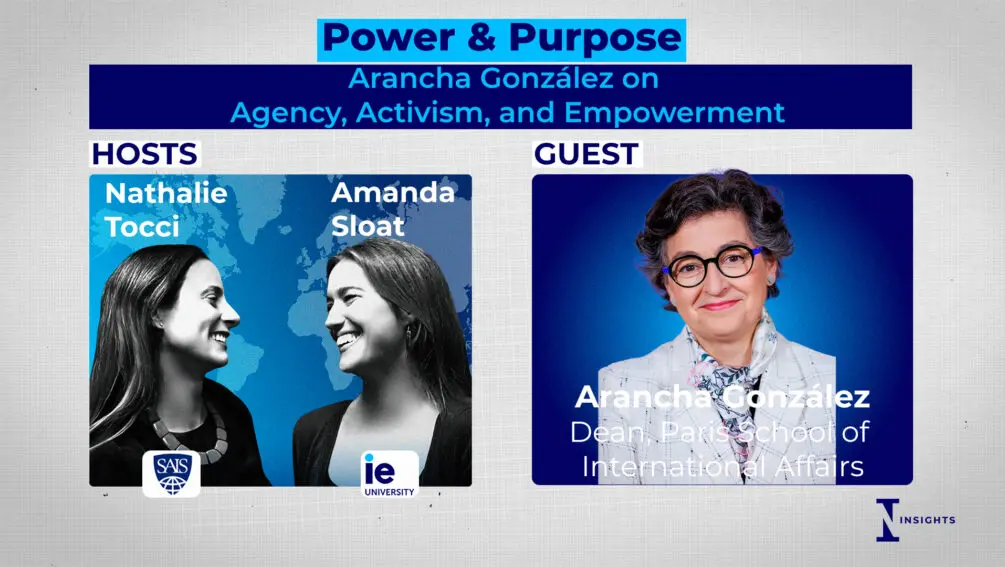
What does it take for Europe to stay open, democratic, and competitive in a world driven by power? Arancha González joins Power and Purpose for a hopeful conversation about Europe’s resilience. Together with Amanda Sloat and Nathalie Tocci, she explores why Europeans should focus on wellbeing as much as GDP, how to respond to Trump without projecting weakness, and why activism must override optimism or pessimism in politics.



© IE Insights.
Transcription
Amanda Sloat
Welcome to power and purpose. I’m Amanda Sloat.
Nathalie Tocci
And I’m Nathalie Tocci.
Amanda Sloat
Today we are joined by Arancha Gonzalez, Dean of the Paris School of International Affairs at Science Po in Paris, the first woman to hold this prestigious position. Before joining academia, Arancha had a distinguished career in public service, including serving as Spain’s Foreign Minister and holding senior positions in the United Nations, World Trade Organization and European Commission. We’ll be talking today about France, Spain, Europe’s role in the world and her fascinating career.
Arancha. Welcome to the show.
Arancha González
Very happy to be with you.
Nathalie Tocci
So Arancha fantastic for you to be with us. And I wanted to start with you by talking about Europe, which is really a passion that you, Amanda and I, I think we all share. I find often listening to you and reading you that you have particularly at this point in time a refreshingly more hopeful view on Europe than what you would often hear.
I tend to often be perhaps slightly darker with you. So I guess I’m asking you this question to do some lifting up. My personal pessimism about this often stems from the fact that in many respects Europe used to swim with the tide. It used to live in a world that was multilateral, that was rules based, that was integrating and in a sense kind of Europe represented a kind of microcosm or a mesochasm of that.
So it kind of lived in a world where it felt comfortable. And now we often talk about the world being driven by power politics, crude power, talk a lot about defense. And this is not Europe’s comfort zone. How can we as Europe, as Europeans, as European Union adapt to a world in which power politics is the name of the game?
Can we transform without losing our soul?
Arancha González
For many decades Europe was a mini version of the world. And this is why Europe felt very comfortable. Not that the world didn’t go through difficulties. Not that Europe did not go through difficulties. We have gone through huge difficulties. As a latecomer to Europe, I’m now talking about Spain, who only joined the European Union after the death of the dictator.
I probably appreciate it a little bit more how important this unfinished Europe was. But today the world has separated from the EU. The world has become a more hostile place. And so Europe has a choice to make. And if I hear what Europeans want they want Europe to remain this very specific space which combines competitiveness, solidarity and openness in a democratic space.
They want this to remain this European option and to remain. But for that obviously Europe has to toughen up. It has to become tougher because the world has become tougher. And this is where we are. And I’m hopeful Natalie for a very simple reason because when I look at the world and I look at Europe and I don’t look only in macro terms we’ve got a certain tendency to look at macro.
GDP is this, growth is this. I look at micro. I look at wellbeing. And when I look at wellbeing I’m hopeful. In Europe we live longer. Child mortality is lower. Inequalities are smaller. Homicides are lower. Student debt is lower. Poverty rates are lower. Public debt is lower. This is also Europe. This is why I’m hopeful.
I want to see the glass half full. Because this is how I think this energy from the European citizen can be transformed into more integration, which is the only way forward to keep this European option alive.
Nathalie Tocci
If one were to find themselves behind a Rawlsian veil of ignorance I guess kind of still living in Europe would probably be the option that many, if not most people in the world would actually go for. I think you’re absolutely right.
Amanda Sloat
It certainly seems like a good option to me as in American Exile here in Europe.
Building on that Arancha I wanted to ask one of the things that seems to be forcing Europe to toughen up a little bit these days is the response to President Trump and the attacks that he’s been making on Europe.
You’re a former Spanish politician. You’re currently sitting in Paris and closely observing French politics. And so I’m interested in your view of how Europe is responding to Trump.
Over the last year we saw many Europeans choose to be quite deferential, to try and placate him, not to push back on things. And strikingly both Macron and in his own way and Sanchez have been two of the European politicians in the last couple of months that have been pushing back the strongest.
And so I’m curious your assessment of how Europe has been approaching him. And in particular there’s a lot of articles appearing recently about France and Gaulism and strategic autonomy and whether France has of course been right all of these decades and Europe should have listened to Paris much longer ago to not be in this week position that they are in today.
Arancha González
Yeah. Let’s look at the structural and then at the particular because I don’t want to confuse the two. I think structurally what we are seeing seen from Europe is a huge division in America. It’s a division in enormous two halves of the country. And the difference between the two halves is enormous.
One half just has a very inward looking. It has a very pessimistic outlook. In the world it wants to recover some form of greatness. And the other half is more open. It’s more engaged with the rest of the world, understands that the greatness of America comes from its engagement with the rest of the world.
But the difference between those two sometimes is so thin that at every election in the US we just hold our breath. And maybe we learn that we cannot just simply hold our breath every four years, that we cannot have such a structural dependency and therefore we have to become stronger in our own way, that we have to be more autonomous, more capable of defending what we stand for irrespective of where there’s the structural division in the US ends up every four years.
So that’s the structural part.
And then we’ve got the particular, the how to deal with the current U.S. administration. And I can tell you Amanda that my own experience from the first Trump administration is that the US president does not like weakness. He absolutely does. He doesn’t respect weakness.
And so when you see where we may want to see compromise he sees weakness. And that’s a reality. Which is why I’ve been advocating that we Europeans had to be a bit tougher now. Not reckless, not antagonistic, not unwise just simply more capable of defending what we want to stand for.
We also are sovereign right. In this world of sovereigns. We also have our own views on what this sovereignty is.
So yeah this is I think little by little with the passing of time where the center of gravity of the European Union is moving because we’ve kind of seen the writing on the wall and we’ve gone through a set of episodes from the Turnberry deal last August agreeing a trade deal with an administration only to find out a few months later that where it was these much tariffs now is so much higher with read the national security strategy.
We’ve read the National defense strategy we’ve heard the speeches of the vice president under Secretary of State and therefore we are now way more sober. And probably a bit tougher. And that’s okay because we want to defend our own interests and that’s important.
Nathalie Tocci
I definitely agree that this is what we should be doing and this is what we should have learned from the last year. I wonder though whether this is actually what we’re learning in the sense that you do indeed see some signs. And I think the reaction to Trump’s threats on Greenland was one sign of a kind of toughening up.
And yet what you also see is that as soon as you give then half a kind of phony chance to step back into flattery you take it. Right. I mean think about the European reaction. I know it’s been a divided reaction but let’s say the majority of European official Dems reaction for example to Marco Rubio’s speech at the Munich Security conference.
That was fundamentally I think not that difference from that of JD Vance’s speech last year but because it was couched in kind of we the West kind of language Europeans kind of jumped onto it and kind of looked at it as a sign of reassurance.
So I wonder whether we can and we are keeping up the toughness and the stamina in the sense of that of that toughness or whether the minutes in which we get dangled kind of half a fake carrot we basically go for it.
Arancha González
Yeah I pay less attention to the glasses and the smiles. Sometimes you just have to smile and I want to look more at what is being done. I will judge Europeans desire to defend their own interests by what it is done.
And if I look at what is being done yes slowly. It’s not easy when you are 27 and you’ve got to move this machinery forward and build consensus. Today building consensus is extra complicated but I think the direction of travel for the European Union is pretty clear.
Governments are spending more and doing more to improve defense and security to the point that we now have the US complaining that Europe maybe is going a little bit too European on defense.
Amanda Sloat
We would like you to buy our kit.
Arancha González
Yeah. Okay. But sorry. We are also in the world of not being in a position to have the cake and eat it right.
We found that we had to be more serious about our security and our defense. And I think this is the direction of travel but it will be also with greater European industry and industrial base development is what we are seeing with slowly but steadily internationalizing the euro.
It is what we are seeing with the numerous trade agreements being negotiated by the European Union a signal that our direction of travel hasn’t changed. We do not want to disconnect from the rest of the world. We continue to be open to the rest of the world.
So in other words let’s judge Europe not by the smiles or the claps but rather by the euros.
Amanda Sloat
I appreciate your optimism and hope things continue to play out in that direction.
Well I’m sure the three of us can talk about transatlantic relations for the rest of the day but wanted to move to talking about you and your story.
I have to say for those who are not able to see us Arancha is holding up a pin that says don’t be an optimist or a pessimist but be an activist which is actually a great transition point to talking about you and your career.
Since you have played that role in government capacities both as a civil servant and then as a politician. But I want to go back to something you started with which was Spain coming late in the sense to the European project because of the dictatorship under Franco.
You were born in the Basque Country growing up during the height of violence by ETA the groups seeking Basque independence. And you came of age during Spain’s transition to independence during Franco’s death.
And so I’m curious how that childhood that political frame of reference at the time has shaped how you see Europe now and also has shaped how your career trajectory started to develop already from a young age.
Arancha González
Yeah for me growing up I was born in a dictatorship and my childhood took place in a dictatorship. I know what it is not to have freedom. I know what it is to demonstrate for your freedom and for your rights.
Which is why I probably am very marked by democracy. For me growing up Europe was democracy was a light in a very grey country was a ray of hope.
But it was a democratic hope which is why I always put the premium into maintaining this space of not only collective progress not only collective freedoms but also individual freedoms. Because I have lived in a space where this individual freedoms were not there.
So growing up for me it was all about moving into a light. I devoured every publication that I could every newspaper.
I was living in the Basque Country very close to France. So I remember going with my parents just crossing the border to the other side not only because the jeans and the shopping was not so enticing on the other side but also because you could buy the books and buy the newspapers that you could not read on the other side.
I’m very much shaped by this Europe and this is why I’m European by definition because this was the project that meant so much for our family and for so many Spaniards.
Amanda Sloat
I understand you also spent a lot of time in England as a child and that your mother wanted you to study foreign languages because she had not learned them as a child. And you speak what sort of six languages now so really are a true European in that sense.
Arancha González
I remember when we were small I’ve got two brothers and she would always say you have to learn languages. You don’t know how lucky you are. When I was a kid I wanted to learn languages and I couldn’t so please please this is what will open so many doors. This is what will help you connect with the world.
So yeah I did French at school. I did English private. And then when I felt I could take a third one I took German.
And then at some point after doing my university years I went to Brussels and then all these languages were so helpful because you could connect with so many people and it really brought you close.
Not only work wise but friendship wise that the world was so much bigger.
So it’s I guess it’s given me an appetite for looking beyond my borders. I was born in the countryside. I lived in a small village during my six years and I love going back to my little home and my little territory and I’m very local about that.
But I love this idea that there is no contradiction between having very deep roots and still wanting to open the window to the rest of the world that has so much to offer and from where you learn so much.
Nathalie Tocci
So Europe was while you were growing up in a dictatorship an idea of freedom which you now and then experienced when you crossed the border.
You then start experiencing that idea of freedom as Spain transitioned to democracy and then entered the European Union.
And then as you were mentioning right there your first professional stop was in Brussels and you spent quite a few years in Brussels in various positions particularly in the European Commission.
And so you were there really in the golden age in many respects. Take the period that goes from the late 1980s the single European Act onwards onto monetary integration eastern enlargement.
This is really the moment in which I really felt the European Union was in its heyday.
Could you tell us a little bit about that experience as you move from Europe as an abstract idea of freedom into a Europe that is made of technicalities in Brussels. And how did those two visions come together.
Arancha González
I was very lucky because I first started in the private sector as a lawyer in a law firm and I was advising my clients on trade and state aid. It was at the time of the German reunification and I was working for a German law firm that was advising lots of companies that were purchasing in the privatization effort in eastern Germany or ready to invest in eastern.
So I saw something that looked very much like what I had seen in my own country this connecting eastern Germany with the European Union is making sure that we would add more pieces to make this a real European Union.
And then at some point I left the private sector and I made a very conscious move to the public sector because I decided that what I wanted was not to advise clients on how to apply European law. I wanted to make European law. I thought this was super interesting.
And I did this in international trade in trade defense defending European companies against unfair trade practices. At the time it was Japan and Korea. Then it was China but at that time it was Japan and Korea.
And then negotiating trade agreements which is where you understand also how the international economy is not simply a zero sum game that you find these places that can be winning and that actually are winning.
But I saw lots of great stuff happening in the European Union but I also saw terrible things happening in the European continent.
I was part of a team that worked with the countries of the former Yugoslav republic after the Balkan wars had to reconstruct a set of trade agreements.
I saw the damage of war the pain that it had created the divisions that it had generated and how to rebuild that tissue of trust between the countries that had fought a terrible war the scars of which were evident when I would travel to the region.
So I also saw that part.
Again strengthened my conviction that the avenue was to do this the peaceful way. The avenue was to do this bottom up. The avenue was to reconnect the economies and the people and that would help also rebuild a continent that was once again divided by yet another war in this case a civil war.
Amanda Sloat
So after over a decade in Brussels working in these various issues within the European Union you moved to Geneva in a very different set of multilateral organizations the WTO the International Trade Center.
I’m curious given your love of Europe in the EU what prompted the shift in city and focus.
Arancha González
There is what you plan and then there is the unexpected.
I got a phone call from the commissioner.
Amanda Sloat
Absolutely this is what we tell our students. You cannot have the life plan.
Arancha González
Don’t plan too much because then things happen and then you get the phone call and then it’s happened to me a few times in my life. So the commissioner with whom I was working in Brussels became the director general of the World Trade Organization and he called me he said hey why don’t you come with me and become chief of staff.
And frankly it was not in my books. I had always thought oh my God would I want to live in Geneva. And then I moved to Geneva.
My hunch was that this was a big Europe. I had the impression that Europe was international and then I land in Geneva and then I sit in the World Trade Organization in one of the first meetings in 2005 we were just about to go into a big ministerial gathering in Hong Kong.
And I look around the room and I think my God this is not Europe this is really international. The distance between two Europeans is infinitely smaller than the distance between two countries sitting in this room.
The challenge is the same. How do you make these countries agree. How do you make them build consensus. How can they find that sweet spot where they all say yeah okay let’s go. Some of them may say okay fine but we go.
The challenge was the same but this was the international world. And I have to tell you I loved it because you feel this is where you see how powerful these spaces where you rationalize the use of force where you change this for the power of finding solutions that will allow each party to bring something back home.
It’s so much more powerful. So yeah I started my career in the truly multilateral space first in the World Trade Organization. An incredible time with huge ups and huge downs with a hugely successful ministerial conference in 2005 with the financial crisis of 2008 and the crash of international trade.
The World Trade Organization was a microcosm of that.
Nathalie Tocci
So from the European to the international. And I guess then another rather unexpected turn is back to the national particularly you become Spain’s foreign minister.
I had a couple of questions. You become Spanish foreign minister I understand as a technocrat you’re not party political although of course the government itself was a political government. What is it like? What are the challenges but also what are the relative strengths that you derive as a technocrat in a political government.
And then assuming the part of that answer is going to be positive the other side of the coin that I wanted to ask you about that experience has to do with the fact that you were then replaced and at some point that experience comes to an end.
If you could tell us a little bit about how that came about and how you lived it.
Arancha González
Well let’s say that that was the beauty. I leave this as a beautiful experience. It’s great to be technocratic because people underestimate you. And it’s great when they underestimate you because the little that you can bring then produces miracles.
I had done for 20 years of my life before getting to national politics I had done that at the international level. I knew my interlocutors. I knew the codes of international life. I could be operational on day number one.
But I always reminded everyone that I was a technocrat. It’s a great shield and in a way it’s easier to navigate the very aggressive polarized political space that we have if you don’t want to be partisan. You want to be something different.
I’m very focused on producing results. It was very tough because two months after taking office we had the Covid pandemic. Imagine the role of a diplomat confined in your home but with huge needs around the world that you had to find a different way to deal with.
I’m very proud of lots of things that I contributed to during this period. Whether it was the first ever European borrowing together to invest together. Had I been told when I joined the Commission in the 90s that I would see this in my lifetime I would have laughed. And yet we did it and I’m proud that I was there to do it.
Spain’s first feminist foreign policy we did it. The first part of our handshake with the UK around Gibraltar. This historical difficulty between the two. So in the end when you are in politics you don’t count how many days you’re going to be there. You focus on doing things and you know that you are on borrowed time because you serve at the mercy of the prime minister who appoints you and decides that your term has finished.
The only regret I had the day I left is a sense of unfinished business because there were many things that we were working on that I would have liked to see get to the finish line.
But I’m proud of what we did and I’m happy if someone else took this and then brought the unfinished business to the finish line.
Nathalie Tocci
It’s wonderful to hear you talk about it in this way because you rightly talk about what you’re proud of and you don’t talk about the fact that it ended as a failure.
Which brings me to ask you you talked about what you’ve been proud about. What would you say instead has been something that you did live as a failure.
Arancha González
I had a few of them during my tenure as foreign minister but one that I live very profoundly was the assassination of two Spanish journalists one journalist and one cameraman.
They were kidnapped in Burkina Faso.
It was very personal to me because I knew one of them. He came from a village small place in Navarra and I’ve got family in that place.
So it was very personal to me.
We tried to rescue them from the terrorists that had kidnapped them the jihadis that had kidnapped them in Burkina Faso and I couldn’t.
They were assassinated and all I could do was to repatriate the corpses.
I remember this very often and I feel this as a failure.
Standing in the tarmac receiving the corpses with their families is something that I will never forget.
Amanda Sloat
Across all of these positions how did you manage to maintain a sense of health and well being and where do you come down on whether work life balance is actually possible.
Arancha González
For me it is hiking. When it becomes too stressful I go and hike. I love nature so just spending time out there in nature putting your effort and your mind into climbing that mountain or walking that hill already helps me get rid of anxiety and stress and helps me focus.
I couldn’t do that very often but whenever I can that is my therapy. To go out in nature.
Nathalie Tocci
You have worked a lot on the empowerment of women particularly when it comes to economic issues and trade.
Could you give us a sense of where do you think we stand when it comes to women leadership and what more can be done.
Arancha González
We are not in a good place actually. We are moving backwards because we are now considering the fight for equality which is what this is about and equality is about democracy. If we are not equal and we live in the same place this is not democratic. I see this fight as a fight to strengthen democracies. Now this fight has been captured by those who pretend that this is another form of culture war and that those that fight for gender equality are in reality woke.
Well yes I believe in equality and I believe in equality because I want to live in a society that considers that all its citizens have the same rights. This is unfinished business. We have to be very careful to make sure this is not a battle of women for women with women. We must make this a battle for our societies working together with men with boys with young men who are now being told that this is a fight against them. No it’s not against them. It’s for stronger democracies. There is no reason why we should accept inequalities in the 21st century starting with the inequalities between men and women.
Amanda Sloat
As we wrap up your current phase in academia what advice would you give to young listeners who are thinking about public service.
Arancha González
My message is not to accept the idea that the world is as it is and there is nothing you can do. Nor to believe it is a world as you would love it to be. The world will be what we make of it. I worry that the way we frame our political discussions is taking agency away from young people. I want to make sure they feel empowered that they feel they have agency. Nothing is inevitable. Ensure that they are in the best position to shape this world. That means understanding nuance. It is not black and white. There are enormous shades of grey in the middle. It is with these nuances that they will have to make trade offs and shape the world. For me it is empowerment and agency that matters a lot today.
Nathalie Tocci
Alongside empowerment and agency could you share one thing that has made you smile over the last few days.
Arancha González
I went to a great exhibition in Paris of the German painter Gerhard Richter. Incredibly beautiful paintings super inspirational. After visiting the exhibition a great dinner with friends. That is a great way to end a tough week: art, friends.
Nathalie Tocci
That is wonderful Arancha. Thank you so much for this joyful hopeful conversation.
Amanda Sloat
We need to have you back more often.
Arancha González
Remember it is not optimism or pessimism, it is activism.
Nathalie Tocci
Thank you Arancha for that: agency empowerment and activism. I hope all of you have enjoyed listening as much as Amanda and I have.
Amanda Sloat
Thank you so much.