

Rory Stewart on Curiosity, Courage, and Conviction
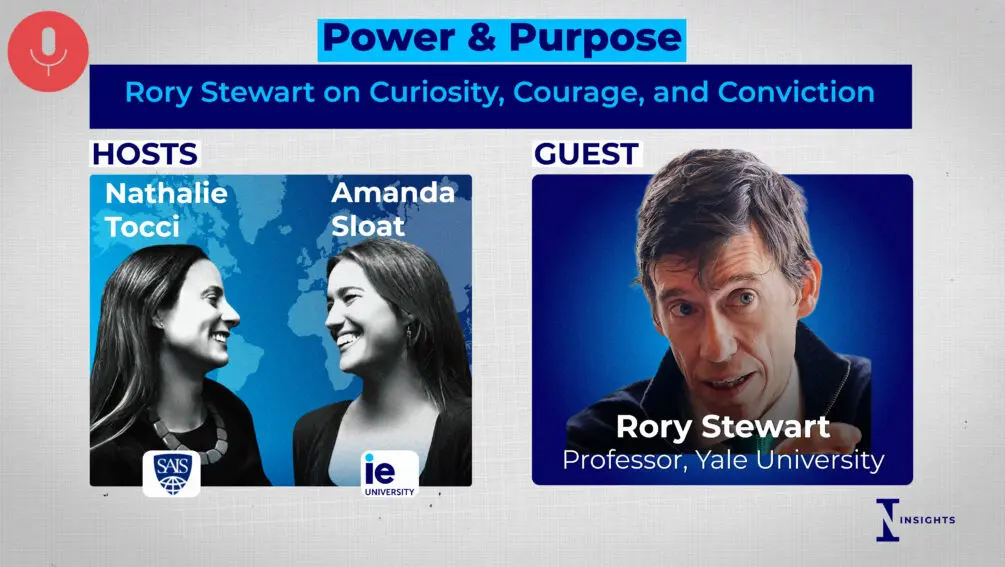
What happens when political ideals collide with reality? Rory Stewart speaks to Amanda and Nathalie about the challenges confronting democracies on both sides of the Atlantic, and how social, technological, and political pressures are reshaping our world. He shares his personal reflections on finding your purpose, seeking new experiences, and maintaining integrity and perspective amid the demands of public life.



Rory Stewart is the author of Politics on the Edge and co-host of The Rest is Politics podcast.
© IE Insights.
Transcription
Amanda Sloat
Welcome to the final episode of Power and Purpose in 2025. Thanks to everyone who tuned in for our first semester. After a short break for the holidays, Nathalie and I will be back with new episodes in January. If you remember back to our first episode, Nathalie explained that our approach was not women only, but women mainly, that we would feature the occasional man.
Today we are delighted to welcome our first occasional man, Rory Stewart. Rory is currently the Brady Johnson Professor of the Practice of Grand Strategy at Yale University. It would take too long to recite his entire biography, so I’ll hit a few highlights. He’s a former infantry officer and diplomat, member of parliament and cabinet minister. He served as a deputy governor in Iraq, and established the Turquoise Foundation in Afghanistan to restore heritage buildings and revive traditional crafts.
Particularly impressive to me, he speaks 11 languages, he’s written six books, with Politics on the Edge being particularly relevant to our conversation today. He spent two years walking across South Asia, and he’s the host of top-rated podcast The Rest Is Politics with Alastair Campbell. Rory, welcome as our first occasional man guest.
Rory Stewart
Lovely to see you and thank you for having me.
Nathalie Tocci
Transatlantic relations are very close to our heart and of course, your heart as well. And it’s been a rough year, really, hasn’t it? From Vice President J.D. Vance’s speech in Munich to Trump siding with Russia in the Ukraine war and, of course, the 2025 National Security Strategy. I mean, it’s quite clear that there’s a pretty fundamental transatlantic rupture going on.
I wonder if you could give us your sense as to whether you think that this is only, quote unquote, Trump related or whether there is something more structural going on?
Rory Stewart
Well, I think unfortunately, it’s fundamentally structural because even if many, many people in the United States don’t agree with what Trump’s done, he’s exposed the vulnerability of the system that was created after the Second World War. So, in effect, we created a system where America did something which almost no superpower has ever done in history, which is an extraordinary decision post-1945 to try to organize the world through what was called the rules-based international order, there were a lot of multilateral institutions, United Nations, NATO, the World Bank, the IMF and all this kind of stuff.
And yes, of course, there was American power behind all of it, and there were American interests behind all of it. But America chose to exercise its influence, often with allies, emphasizing rules and emphasizing multilateralism. And because people believed in this, many countries in the world, in particular American allies, Western Europe, Canada, Japan, South Korea, and many places in Latin America, opened themselves up and made themselves vulnerable to the United States in a way that would have been unimaginable with any other power in the world.
You know, we became conscious after 2014 that Europe was very dependent on Russian gas. We became very conscious after, I suppose, the same period just how dependent we were on China for a lot of our products. But our reliance on America is 99 times greater. I mean, America is integrated into every single aspect of our defense systems, our tech stacks.
The dollar is the global currency. And so we essentially became this sort of American… yeah, we allowed it in to everything. And what Trump has done is he’s suddenly let us see something that was unimaginable, which is the possibility that suddenly America could weaponize those dependencies, that America could turn around and say, you’ve now made yourself entirely vulnerable and dependent on us, and we are now going to extract in return, and we’re going to threaten you in return.
Once you’ve seen that, you can’t put the genie back in the bottle. Now there’s another issue, which is also that there’s clearly a very large constituency in America that supports America First, that is fed up with playing the role of the global policeman. And that probably extends to the Democratic Party as well as the Republican Party. But the deeper problem for America’s allies is we can never again look at America in the way that we did for 80 years.
Nathalie Tocci
Yeah. I mean, just a quick follow up on this. You point, Rory, to the actual concrete, real dependencies that are out there, and I think that’s absolutely right. But I’ve started asking myself to what extent is there, say, a psychological component to all of this, especially when one goes outside Europe and the United States, for that matter.
Even you see countries, I mean, let’s just take, I don’t know, the case of Mexico, for example. Yeah. I mean, Mexico is highly dependent on the United States, but it seems to have a greater degree of agency in the sense. It seems to be more willing to at least try and, let’s say, fight it out in some way.
So I’m wondering whether there’s also a degree of learned helplessness that we Europeans have that somehow we have to now unlearn.
Rory Stewart
Well, that’s certainly true. I mean, Latin American countries had a much more uncomfortable relationship with the United States over the last 200 years, and particularly the left in Latin America, and of course Mexico is run by a left wing government, has been very, very conscious of Yankee imperialism, and therefore their whole systems and their whole political process is set up for the possibility that America may be trying to operate as a regional hegemon and screw them over and topple their governments.
And the CIA’s up to stuff and there are DEA agents on the ground and all this kind of malarkey. None of that is part of the lived experience of Western Europe. So it’s not very surprising that if you are Mexico or if you are Lula in Brazil, let alone if you’re Venezuela ,or Nicaragua, or Cuba, you have a way of responding to the US which is not really easy for Canada or Western Europe.
It’s also true that partly because of that history, those countries have experimented with much deeper relationships with the Non-Aligned Movement, with China, with Russia, with other arrangements. But even they, of course, understand the reality of this. I mean, in the end, Mexico was very, very quick to be extremely compliant with Trump’s initial requests in a way that was very surprising.
And, Colombia tried to speak out against some of the killing of people in boats off the coast. But faced with 50% tariffs, everybody kind of reels. And it’s a really interesting question. If you are a big country like Brazil or India, who haven’t traditionally been pushed into the Chinese camp, how do you deal with this amount of economic pressure?
Amanda Sloat
Well, I have to say, as an American who has devoted her entire career to strengthening and building the transatlantic relationship, I find the situation completely depressing and sadly agree with your analysis, Rory, that it is going to fundamentally change the way that Europe views the United States. And I also agree with you that there are broader trends in the United States that future leaders are still going to have to deal with.
You know, I don’t think that we’re going to have Biden’s Build Back Better in ‘28. If we have a change in leadership, it’s going to have to be building something new. And one of the broader trends that seems to be going on is also real frustration with democracy. And we’re seeing that in the UK.
We’re seeing that in Nathalie’s country. We’re seeing that in the US and elsewhere in Europe. And you write a lot about that in Politics on the Edge, describing how hollow British democracy had become. You talk about leaving Westminster with the sense of shame. I’m curious how you see this broader crisis of democracy playing into what’s happening in the US, playing into how Europe’s responding, whether there’s anything that can be done to save that.
Rory Stewart
Well, I think the first thing, Amanda, is that I don’t think any of us, or certainly I, am coming across people with a very good explanation of what’s happened here. I mean, we can all, and a lot of books by distinguished commentators and academics coming out now at the moment, trying to provide a story of how we went from what seemed in the 90s and early 2000s like a kind of great period for liberal democracy and how we w end up where we are now, which feels authoritarian, populist, protectionist, isolationist, etc.
And, you know, people say it’s, I don’t know, neoliberal economics has affected people’s median incomes, and it’s basically economic grievance which is driving this. Other people will put the emphasis on the breaking of the international system through these catastrophic interventions in Iraq and Afghanistan. You know, other people might put an emphasis on the rise of China.
You know, I, though, am more tempted to the idea that right at the center of this is social media, that it’s not actually the case that there are objective features that you can see in macroeconomic indicators which explain why the US votes for Trump or why Italy votes for Meloni or why Britain now looks like it’s going to vote for Nigel Farage.
Because the economic structures of these countries are completely different. You know, in Europe we think, you know, maybe everybody’s voting populist because we don’t have GDP growth like the US. But in the US, obviously you have GDP growth like the US and you’re still voting for Trump. So, you know, and I can continue to produce these counterfactuals back and forth across the world. In many ways actually, real median incomes have improved since 2008. And in many Western countries, inequality has actually diminished, inequality of income, inequality of wealth. You know, in the UK, for example, one of the things people always talk about is young people finding it difficult to get on the housing ladder. Well, housing is more affordable now in the UK than it’s been almost any time in 20 years as a multiple of people’s income.
So I think that there is something right there on our phones at the center of this. We can talk about it in much more detail, but one of the most telling moments for me is when Nigel Farage, the leader of the Reform Party in Britain, the kind of populist in Britain, was challenged about crime statistics. So he’s going around feeding this idea that we’re facing this terrifying crime wave driven by people getting off boats.
And the data shows that crime is coming down very steeply over the last five years. And, for example, knife crime. You can actually see hospital admissions, and there are many fewer people being admitted to hospital for knife wounds. His response was, look at your phone.
In other words, he means, well, that’s not the picture you’re getting on TikTok. And so I think we have a response that feels like the 1930s, these sort of proto-fascist parties emerging. But the objective conditions are not like the 1930s. I mean, 1920s in Germany is civil war in the streets. It’s inflation running at 10,000%. It’s people with wheelbarrows of Deutschmarks. It’s unemployment rates at 30, 40%. We don’t have any of that stuff.
And yet our response feels like a moment of extreme economic collapse and emergency. And that must be, I think, the way in which we perceive it, rather than the underlying reality.
Nathalie Tocci
You’re absolutely right. And given that technology is in principle neutral, one cannot help but think that given that it’s certainly not having a very neutral effect, that there is kind of project, I mean, without falling into conspiracy theories, but there is quite obviously a sort of drive there. Going back to the earlier conversation about the transatlantic relationship and the idea that the United States, or rather the Trump administration, is out there under the cover of saving democracy in Europe, actually doing so by fomenting and strengthening these far-right parties.
In some respects, it looks like it’s part of a strategic project really aimed at undermining Europe and undermining European unity through the work done precisely by these parties.
Rory Stewart
Yeah, but I think the interesting thing about social media is, without sounding too much like a kind of philosopher based in Bologna, there’s some kind of weird postmodern effect going on here, right? I mean, it’s partly the aesthetic or the narrative drive of social media, by which I mean the way in which the people who design these algorithms think about human attention, think about how to capture our attention through polarization that leads to that project.
You know, one way of putting it, sorry, it’s being very pretentious, but one way of putting it is that when Elon Musk posts “Britain is in civil war,” it’s partly that he delights in the notion that Britain is in civil war. And of course, by saying it, he slightly increases the chance of Britain ending up in civil war. I mean, it’s not an honest description of the thing. And there may be a sort of weird wish, a sort of subconscious wish for drama on the part of the people who run these platforms, the tech bros, the authoritarians.
And one of the strangest bits, we’re talking just after the release of the US National Security Strategy. And I’d love to get Amanda’s view on this. The thing that makes no sense to me at all is why would they say it? I mean, traditionally, even if people in the American administration thought that actually their relationship to Europe and Latin America was to create vassal states, that they were going to undermine their elected governments, support far right…
I mean, traditionally, if you go back to every previous US national security strategy, even if you felt that, you would disguise it. You would say, we believe in a multilateral order, we believe in partnership. And then you would do all that stuff secretly. I mean, it’s completely extraordinary, as it were, for a gangster to say openly here on a document, I’m going to screw you over rather than pretending to be polite and screwing you over in the background.
Amanda Sloat
I mean, I think that is the nicest thing you can say about the National Security Strategy, which is that it’s honest. You know, if you look back at the National Security Strategy produced by the first Trump administration, it sounded like it was written by a traditional group of Republicans who had a perspective on the world, albeit with a cover letter from Trump that had more of a Trumpian take on the world.
And so the National Security Strategy, I think, is helpful in the sense that, to your point, it says the quiet part out loud. It is very clear on how the administration views the world. And in a way, it shouldn’t be a surprise to anybody in Europe. I mean, J.D. Vance set all of this out already in February in his Munich Security Conference speech.
Rory Stewart
I mean, why would you say it? I mean, I guess if you were a critic of American policy, let’s say you were a Latin American leftist intellectual, you would say America was always a neo-imperialist hegemon. It just cloaked itself in the language of multilateralism, cooperation, a rules-based order.
And what’s astonishing is if they really want to do this, you know, if they really want to achieve that world, if your aim is to—reading that, let’s just take the European section—they seem to be saying we’re going to strengthen far right parties, some of them like the AfD, which are neofascist parties. We’re going to lean in behind populist governments like Hungary.
We’re going to resist the entire policy direction of what they call minority governments trampling on human rights, for which I believe read France, Germany. If you were really—and we’re going to force them to open up to American goods, they’re going to not regulate our tech, they’re going to pay far more money, we’re not going to put any money in, and we’re going to force them to help us against China.
If that was really where you wanted to be in ten, 15 years’ time and you were Machiavelli, you would say, don’t tell anyone.
Nathalie Tocci
I guess. So the two possible explanations: one is that they are not Machiavelli in the sense that Machiavelli was quite a bright fellow, and perhaps we’re not exactly talking about the brightest of minds. So that’s one possible explanation. And the second is hubris. You hide something if you actually think that it’s not that easy to achieve it.
If you have an overinflated sense of what you can do, you just kind of, you know, put it out there.
Rory Stewart
But I suppose that’s very interesting. So I suppose maybe the idea here is that if you really feel that Europe is entirely powerless, then there’s no cost to it, right? I mean, I suppose if you’re a bully in a school playground and you actually think the other child is completely unable to defend themselves, then maybe you would announce all the horrible things you’re going to do to them.
Amanda Sloat
And it’s consistent with other things they’ve been saying and doing. I mean, we have a human rights report produced by the State Department that ranks El Salvador higher than Germany when it comes to free speech. It’s consistent with blog posts by the State Department, by social media posts by the Deputy Secretary of State, who was in Brussels last week for meetings with NATO and the EU.
So they haven’t been shy about these being their aims and they have in fact published them in piecemeal form and in different venues over the last year. So this really is just the consolidation of a lot of what they’ve said and frankly what they’ve been doing over the last nine months.
Nathalie Tocci
Rory, let me jump to you. I mean, we could carry on talking about this stuff for the next, you know, 40 minutes and a lot more, but this is really going to be about you. And so we want to really sort of tell your story. And let me begin—you know, we were talking about childhood just a second ago.
You are the son of a soldier. You were born in Hong Kong. You lived in Malaysia. You then went on to boarding school and then on to Oxford, where you studied PPE. By the way, I studied PPE as well in Oxford. Could you give us a little sense of that background and especially how that background shaped who you are today?
Rory Stewart
Well, so I think the one thing that’s maybe unusual about me is that—or maybe was more unusual when I was young—is that my father was 50 when I was born. So he was born in 1922. And he’d fought in the Second World War. And he then in 1945 joined the British Colonial Service. So he was an administrator in the British Empire in Malaya until independence in 1957.
And then he became an intelligence officer right at the height of the Cold War. So he was the British representative in Vietnam during the Vietnam War. And then he moved, when he retired, back to Malaysia in ’78 and then to Hong Kong, working on China from ’81, which is just when Deng Xiaoping is beginning to open up, right the way to 1997, when Hong Kong ceased to be a British colony and became an autonomous region of China.
So my connection to my father is a sort of deep insight into a very, very different world. I mean, a world where his values—and I was very, very close to him, I mean, I think that’s another maybe unusual thing—was formed by fighting in the Second World War, being part of the British Empire and then being an intelligence officer.
And finally, number two in our intelligence service during the Cold War and then focusing on Asia. He was really an Asia specialist for 50 years. So I came to government very much from a world which was about military and foreign service. The people that I grew up around, my father’s friends and my father’s heroes, were generals, spy chiefs, slightly less ambassadors because he tended to think that diplomats were a bit hopeless.
But some ambassadors, and generally a sense—I mean, he was a guy who had been a public servant all his life but absolutely despised bureaucracy and civil service and thought that everybody who worked in government were a bunch of cookie pushers who never made decisions and kept setting up committees. So he was a real believer in trying to get around the system.
I mean, if you want a man committed to Machiavelli, my father was obsessed with Machiavelli. I mean, his great thing as an intelligence officer overseas was to always send, last thing on a Friday night, a cable saying, unless I hear from you by first thing on Sunday morning, I’m going to launch this operation, knowing that there was a skeleton staff and nobody was there for the weekend.
And his great philosophy was, you know, it was never apologize, never explain, never seek permission.
Amanda Sloat
Having grown up with this, then made the decision yourself, at least initially, to join the bureaucracy. You served in the Army. You served briefly in the Foreign Office, and then left and in quite dramatic fashion spent two years walking 6000 miles across countries like Iran, Pakistan, Afghanistan, the Himalayas. When I left the White House, I spent a year doing my own global wandering.
But my months down under look quite tame in comparison to your adventures. What prompted you to leave? Was it similar frustration with the bureaucracy? And did you have some personal quest or questions you were trying to answer for yourself that motivated this journey?
Rory Stewart
Well, I don’t, I mean, I don’t know whether you’d feel this or whether listeners who are interested in public service feel this. I mean, I was very, very conscious as somebody in my 20s about what I felt was the extraordinary gap between what we told ourselves that we were doing and what we were actually doing. I felt our real-world impact was frequently so laughable.
And I’m afraid this is true when I talk to friends working for the United Nations now. So much of our life was bound up with statements, platitudes, careerism, internal bureaucratic maneuverings. I mean, I’d been in the embassy in Indonesia during the most incredible moment where Suharto, who’d been the military dictator for 32 years, was toppled in the middle of my time.
The Asian financial crisis happened, democracy emerged, and it was, if you were a journalist or a geopolitical commentator, the most extraordinary moment where this incredible, huge Muslim country in Southeast Asia suddenly liberated itself. But I was also very, very conscious that I, as a foreign diplomat, had so little impact. And my government was actually able to do so little to steer it.
I sort of almost felt that I was a sort of strange kind of vanity project, that my reporting, you know, allowed, in theory, the British government to be getting this very high-quality insight into the details of Indonesian politics. But what the hell were they going to do with it, right? And then I went to the Balkans, and there I was the British representative in Montenegro, and this is just after the Kosovo War.
And there I suppose I was a little bit more jealous of my colleagues working then for the special representative and for these sort of administrators who were helping to set up the new Bosnian and Kosovo state, people working on setting up customs services, doing refugee return, because I felt this was kind of practical government administration on the ground.
I then, as you say, spent two years walking. That again had a very odd effect on me because, of course, the villages that I slept in in Afghanistan—so I slept in 550 different village houses on this walk and walking 20, 25 miles a day, I’m sitting on people’s floors and listening to them talk about their lives.
And, of course, I then returned to Kabul. And I’m getting to Kabul, this is just after 9/11. So I’ve done this walk just after 9/11 and finished just after. I’m now in Kabul in January and people are beginning to create this vision for what they’re going to do in Afghanistan. This is the beginning of what’s going to turn out to be a $2.2 trillion intervention.
It’s $2,200 billion that’s going to be spent. And the theory that drove it from the beginning was encapsulated by Ashraf Ghani, who went on to be the president of Afghanistan. I remember him saying in January 2002, every Afghan is committed to a gender sensitive, multi-ethnic, centralized state based on democracy, human rights and the rule of law. And even then I thought, I can’t even translate this into language.
I don’t know how I would say that in Dari. And actually, what I found in all these villages I’ve been staying in is that you’ve just described exactly what is not there. I mean, it might be more honest to say: this village is not committed to a gender sensitive, multi-ethnic, centralized state based on democracy, human rights, rule of law.
And so by the time I’m posted to Iraq and, of course, I’m right in the middle of that Iraq intervention and I’m in many ways, I have a split personality. On the one hand, I’m thinking, this is completely insane. What am I doing? I’ve just turned 30, and I’m responsible for a province of almost a million people and then a province of a couple of million people.
And I’m holding elections and setting up police forces and putting funding into schools and clinics and rebuilding electric wires and dealing with large rioting crowds. And on the one hand, I’m thinking this is mad. You know, why has anybody given me this job? On the other hand, of course, I’m feeling great sort of daily satisfaction with getting all this stuff done.
We’re building all this stuff. But it’s insane. I mean, one of the things I noticed at the end of my time in Iraq is that I was sending in every week reports to Baghdad saying, this week, you know, we brought another 1200 people into the police, and we opened another 300 km of electric line, and we got the petrol stations going.
And I did an employment program for 2,000 people. So every week sounds like we’re getting all this stuff done. But if you compare when I arrived and when I left, the city was objectively far, far worse. At the beginning of my time, I’m able to walk through the town. By the end of my time, literally people are firing rocket-propelled grenades into my compound and I have to abandon the compound and flee to an airbase.
Amanda Sloat
I worked in Iraq as well for six months in 2006, and we were leading a governance program. And we were training members of parliament how to hold committee hearings, you know, sit in a horseshoe shape, and these are the questions you ask. And at the same time, suicide bombers at the checkpoints were preventing them from getting in.
And I didn’t feel like the most fundamental problem facing Iraq was the shape of their committee tables. But, Rory, right, so we don’t completely depress listeners who care about public service and want to find a way to change the world. What advice do you give to them? I mean, I completely agree with you on the problems in a lot of these institutions.
And when I graduated from university, my psychologist father, who, like you, was very influential in my life, somberly told me that the grass is brown everywhere. And he’s completely right that there’s challenges with all of these organizations and institutions. And so where does that leave people that want to make a difference?
Rory Stewart
Well, I think the first thing, if one’s talking to younger people who are going into this kind of work, is get a sense firstly of where you want to be, what level. I mean, one of the problems I find with students is they often say to me, I want to work in, you know, maternal child health care.
This is actually an example I’m stealing from my wife. And what Shoshana would say if somebody says that to you is the problem is not the issue. The problem is, where do you want to work in that tree? When you say you’re into maternal child health care, do you want to be a nurse in a village delivering a baby?
Do you want to be working in the provincial capital in Nigeria with the health system? Do you want to be working for Save the Children, coordinating that maternal child health stuff out of Geneva? Do you want to be in Washington with USAID? Do you want to be in the World Bank? Do you want to be in a university writing policy on maternal child health care?
Are you somebody who wants to get their hands on a baby? Are you somebody who wants to live in a provincial capital in Nigeria? Or are you somebody who likes doing, I don’t know, randomized controlled trials in a university in a first world capital? And these things, you can only find out, I think, by trying. I mean, we, you know, we adjust over our lives, but particularly early on. I mean, somebody once said to me, Atul Gawande, this is a beautiful line—he said, say yes to everything until you’re 35 and say no to everything after 35.
Nathalie Tocci
But, you know, Rory, actually listening to you, I think you have this sort of incredible combination of an incredibly deep commitment to public service and yet at the same time a very independent mind and understanding exactly where you want to be. And I think that also has to do with understanding actually who you are. I remember one of the very first things that I did—I was in my early 20s, first job in a think tank.
I must have been not more than 22 or 23. I’d just finished my master’s, I hadn’t started my PhD, and I write this paper and it was on the Cyprus conflict. It creates a bit of a stir and the director of the think tank asks me to change it and I refused. I just couldn’t make myself change it.
And that was actually the moment in which I realized that although I was kind of committed to policy and I wanted to work in policy, I just couldn’t see myself working in an institution. So I think it’s incredibly important to sort of understand, I mean, the the point you were just saying now, you know, understanding who you are, experiencing things, because it’s only by experiencing them that you understand who you are and then play to your strengths.
Rory Stewart
Nathalie, your story then is a really revealing one, right? I mean, essentially what you’ve told us is that, I mean, you’ve put it quite… I mean, you could play that two ways. You could play it as the great moral story of you holding on to your integrity. Or you could put it in a more straightforward way, which is to say, whatever you think ethically of your choice, that’s who you are.
And therefore you need to just accept that you’re not going to be very comfortable working as a junior civil servant because you actually have very, very strong views and you want to hold to your views. I mean, I felt this, I had a very interesting lunch last week with a colleague who’d been in Parliament with me. Later in my career, I became a Member of Parliament, and I ran to be Prime Minister against Boris Johnson.
And during that campaign, I said, Boris Johnson is a terrible human being, will be a terrible Prime Minister. I totally reject his vision of Brexit. And I refused to serve in his cabinet. And he defeated me, became Prime Minister. And then he said, called me. And he said, of course, Rory, you know, I’ve got a cabinet position for you.
And I said, don’t be ridiculous. I refused to serve in your cabinet. And he pointed out that many of my colleagues had made similar noises but had agreed to be in his cabinet once he’d won. Right.
So my colleague was saying to me, but, Rory, how do you balance this? So if I want to put it in very dramatic terms, I was the Secretary of State for International Development. I ran DiFID, and I was responsible for a budget of $20 billion a year. And there was a significant risk that Boris Johnson would abolish the department, halve British international development spend.
And this would affect many, many people around the world that were dependent on British development assistance. So in theory, I could have said to myself, swallow my pride, deal with my ego, I’ll take the job, buttress his statements about which embarrasses count, I’ll use the fact that I’ve got a big national presence and use that to make sure he can’t abolish this department.
He can’t reduce the spending because he’s given me this role and he wouldn’t take me on otherwise. And I chose instead to leave. Right. And sure enough, now that international development spending is less than half of what it was, and Britain has effectively given up on and abolished the department. So my friend was saying, you know, how do you make this moral choice?
But of course, the answer is it’s not really a choice. I mean, it’s simply to do with who you are. I could not be in Boris’s—
Nathalie Tocci
Exactly. There’s not a right and a wrong. You know, great that there are those people that are able to fill a certain position and try and mitigate the damage, but you just need to know that you’re that kind of person. And if you’re not, you’re not, you know, you kind of do a better job just doing something else.
And this is relevant—
Rory Stewart
This will be relevant to Amanda’s colleagues. I mean, there will be people that Amanda knows who’ve decided to work for the Trump administration, and they will be telling themselves, you know, I’m trying to stop the world getting worse. It’s better I’m here than someone else. There are crazier people out there, you know. And then there’ll be other people who’ll be like, nope, not in my name.
I’m not being part of this train wreck.
Nathalie Tocci
Yeah. Rory, you mentioned that when you ran unsuccessfully for the British Conservative Party, you then spoke out and got expelled from the party for opposing a no deal Brexit. You also ran unsuccessfully for London mayor. Now, why do I mention all this? In this podcast we really try and get into what was it in someone’s path that did not actually go exactly according to plan.
And do you consider these to be failures or not? Or what is it that you learned from them?
Rory Stewart
So, let’s see. These are sort of unambiguously failures. They were devastating failures. I mean, if you believed, as I did, that Boris Johnson was going to be deeply damaging to Britain, deeply damaging to the Conservative Party, and that my entire idea of my country depended on the idea that we would never vote for someone like that—you know, that this was not Trump’s United States, that this guy was such a transparent buffoon and that everything I had invested in idealistically and my idea of Britain required me to believe that people would not select that guy—and then they choose him over me, it’s very, very tough.
And then I think it took a very long time to process because in a way, had I lost to a more sort of conventional politician, it would have felt less bad because I’d set this guy up as the kind of sum of all horror. The loss was much more brutal.
And then to go straight from that within a few months into then running to be Mayor of London as an independent, again trying to get back on the horse and feeling, okay, look, I’ve been beaten in this run to be Prime Minister, but I’m going to do something, I’m going to up the ante. I’m going to do something much more insane, which is I’m going to try to run without a party for Mayor of London.
So I’m going to run against the Labour incumbent, and I’m going to run against the Conservative candidate. And these people have millions of pounds of funding, and I’m going to try to do this thing crowdfunded on social media as an independent. And then the experience was an extraordinary build in the polls, a lot of attention and a system that felt like it could work for me because it was a strange system where if you got into the last two, there was then a runoff and you could then win.
So it’s a system that actually Macron used to try to do this in France. Brutal fight to try to raise money, brutal fight to try to get media coverage and make sure that I could get this done. And then seven weeks before the election, the election was canceled because of Covid and delayed for another more than a year.
And then eventually the electoral system was changed. And I had to ask myself—so Covid happens. Britain really locks down much more than the US. And I’m asking myself, now locked down in my house, unable to go out in the streets, am I going to be able to run an insurgent street campaign? And actually, do I have it in me?
Right. Because I’d been running towards the finish line. It’s very intense, these kind of campaigns. I’d been doing for months whatever, 20, 25 meetings a day, not sleeping, assuming the whole thing is going to finish in May. And now it’s just being given another year. Can I keep going at this pace? And I left with relief, but also subconsciously, of course, you know, I failed again.
So I think one shouldn’t minimize that sense of failure. And one shouldn’t minimize the sense that anybody who is trying to do these big things, maybe from the outside it seems as though their lives are going reasonably well, but from the inside they’re so conscious of the fact that they haven’t lived up to whatever it is they wanted to do.
Amanda Sloat
Can I push you then on the personal aspect of that? I mean, how did you deal with that? I mean, two successive public failures that affected you personally as well as, as you have described, had a very negative effect on what you believed was right for the direction of the country. So how, on a personal level, do you manage that?
Rory Stewart
Well, I think I processed it largely through writing a book. I mean, Politics on the Edge is two and a half years of my trying to be as honest as I can about not just the system, but also about myself, my own failings. And to try to be clear—I mean, you know, I’m honest in the book, for example, about the fact that I felt that I became physically, mentally, spiritually worse as an elected politician.
You know, I remember moments in 2015 where, although privately I was beginning to conclude that David Cameron’s government was going in the wrong direction, I was so desperate to get promoted to be a minister, I was sending him creepy little texts saying, great speech, Prime Minister, well done, you know, go for it, and thinking kind of “ugh” about myself, right?
And so, yes, the process of writing was very important. I also went on big silent retreats for ten, 11 days to meditate. And I found myself in a sort of very—I mean, another thing that I’ve been, I don’t know whether this will resonate with anybody in small ways or big ways, but I mean, I also found myself in a very odd position, which is you can become for people a sort of symbol of what might have been.
So people can project onto you, oh my God, I always said, you know… So I get stopped in the street, I suppose, many, many, many times a day. And some of the times I’m stopped, people are saying, oh my God, we need you. You should have been Prime Minister. When are you going to come back? When are you going to come back to public service?
And that also is a very odd thing, because you’re carrying this sort of projection. And it’s very difficult to turn around and say, listen, this is nonsense. I’m not going to be able to come back and save you. It’s not how the system works. It’s not who I am. It’s not how elections work.
I mean, this is like somebody saying, I don’t know, I really like Pete Buttigieg and his speeches, so he’s going to be the president tomorrow. It’s just not the deal.
Nathalie Tocci
It just doesn’t happen. Right.
Amanda Sloat
Since you’re our first occasional man, I would be remiss, by the way—
Nathalie Tocci
By the way, Amanda, Rory’s answers there confirm why we just picked the absolutely right occasional man.
Amanda Sloat
Absolutely. Absolutely. But, so I would be remiss if I didn’t ask you a question that is often asked of women and, frankly, is rarely asked of men, which is work life balance. You referred to your wife earlier. You have two children. But you have also described ten-day meditation retreats, running yourself ragged in these political campaigns. How do you balance these two parts of your life?
Rory Stewart
Well, I think it’s not possible. I think it’s not possible. I think there’s a fiction that it’s possible. And you choose. But I had an opportunity recently to go for a very big international job, and it would have involved my being on the road, to do it well, I reckoned 200 and 250 days a year, and I didn’t pursue it because I don’t feel I want to be in a situation where I am away from my family.
She calls all the time. Equally, I don’t believe people who say I can run a really big international setup with staff all over the world from London or New York. I think you’ve got to be in the field with them. You’ve got to be with your teams, you’ve got to be out on the ground with them. So, and it is difficult because I realize now that many of the people that were part of my father’s universe did do these crazy things.
I mean, to explain really crazy: my father’s father, my grandfather, who was a British man, a Scottish man in India from the late 19th century through the mid 20th century, was only given leave once every four years. So my father was in Scotland as a little boy, and he saw his father when he was two.
He saw him when he was six. He didn’t see him when he was ten because his father was ill during that leave, saw him again when he was 14, and then didn’t see him again until he was deployed for the invasion of Japan in 1945. So he grew up really not knowing his father at all. And that’s true for friends of mine who are Special Forces officers.
I mean, they will deploy 12 months into the field with burner phones, and they just will not see their families at all. And I want to resist the idea that people suggest it’s not necessary to do that. I think to do your job well as a Special Forces officer, it probably is necessary to be 12 months in the field.
There’s a real benefit to immersing yourself, but the impact on your personal life is catastrophic. I mean, this is a job for single people.
Nathalie Tocci
I think you really put your finger there on the fact that there are choices to be made. We always end this on a positive note. Can I ask you, Rory, if you sort of think back at the last few days, what is the one little thing—or big thing perhaps—that has given you joy?
Rory Stewart
Well, I think the thing that gives me most joy, apart from being with my children and wife, is getting up in the morning early before anyone else is up and walking out into a small public garden and just being with the trees, being with the birds, being with the dawning sky. Feeling the air, feeling a new day beginning.
And if I have one real regret, it’s that so much public service involves having to live in cities.
Nathalie Tocci
We’re gonna leave you there with that thought of Rory walking out in the morning and being with the trees. This has been an absolutely delightful conversation, Rory. I mean, thanks so much for sharing so much. We just kind of almost instinctively felt that it would be easier to get women to talk about certain things, but you have proved that actually we can have delightful conversations with men that are actually very willing to put things out there.
And I think this has been such a gift.
Rory Stewart
Well, thank you so much for having me, and it’s been lovely to be with you both.
Amanda Sloat
Thank you.
Rory Stewart
Bye-bye.
Amanda Sloat
Let me also take this occasion to thank the wonderful team that Nathalie and I have supporting us behind the scenes. I hope everybody has a wonderful holiday season, and Nathalie and I look forward to being back with you and another wonderful guest in January. Power and Purpose is an IE Insights podcast produced in association with IE University and Johns Hopkins School of Advanced International Studies, production and sound design by Reptile Studios.