

Are Empty Offices the Key to Solving the Housing Crisis?
Huge amounts of office space and old factories sit empty while our cities struggle to provide affordable housing. Could underused buildings and former industrial sites help address the housing crisis? Anna König Jerlmyr, the former Mayor of Stockholm, explores how cities can unlock new housing opportunities through redevelopment, planning reform, and long-term urban investment.
Transcription
One of these areas in the center of Stockholm used to be the largest open drug scene in our city. It was unsafe. People were just rushing to the metro and not stopping. And there were only drug dealers at the site on the square. So we wanted to transform it. So we invited a lot of culture workers and different artists.
And what we could see is it takes three things for a crime to be committed: It takes people making the crime, but also the victim, but also the opportunity. And we actually took away the opportunity. So there was a lot of “eyes on the street”, Jane Jacobs, and the results from the police were that crime reduced by 50% in just one year. So this theory is really working.
A lot of young people don’t know where to live. We need to make our cities livable and thriving also for them. We also need a lot of young people to come to our cities and to stay in our city. For the city itself that creates tax revenue when new people enter the city and can also work.
What we can see in our studies is that future young people and talents choose cities over companies, and that has changed during the last couple of years. And we can see that cities compete when it comes to human capital, not only financial capital, and it’s becoming more important. What is important to think about is to develop the theories of Jan Gehl and implement it, because what he said is: life first, and then place, and then buildings.
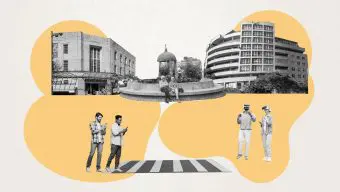
So transforming brownfield to new possibilities, new homes, new squares, unleashing a great potential. So a brownfield site could be a gas plant, it could be a former slaughter area or a meatpacking district, it could be a former industrial area near the harbor, but it’s often located near the city center. There are thousands of former industrial sites that lie vacant and could be reused.
We haven’t discussed so much I think in Europe the potential of also converting former offices to housing that could also create affordable housing, but also convert these unused areas. And now when we have so many brownfields around Europe, and I saw just recently a report from C40 that we have 2 million hectares of brownfield areas that could be transformed to 230 million homes, many of them affordable.
That brings hope. This is not just creating homes. It’s actually to building resilient, quality of life places where people can afford to live. We have the Meatpacking District in Stockholm, where we also used to culture and great restaurant to create the DNA of the place. So there will be a place for the culture sector as well.
And of course, London and Paris have great examples. Regent’s Park and also areas in Paris where they also include affordable housing because it’s more economic to transform a brownfield to a new development instead of taking greenfield areas. And then you can also work with incentives like lower rents for 15 years ahead. One thing that is quite difficult is the contamination of the area.
And that creates the longer perspective and investment spread from the city side. And that will take some time, but that is costly. But the benefit when people move in, it will pay off. And I think we can’t use any more greenfield as we have done in the past. We need to look at existing sites and repurpose them.
Another big obstacle is also the planning regulations. So if we want to convert, in our city, if we want to convert from offices to apartments, it’s a lot, you have to change the whole planning regulation or the zoning and that takes years. They convert a lot of offices now in New York, to more affordable housing on Manhattan in a way that is not possible in my country, for example, because we have a lot of regulations, but they have a special person in charge that changes regulations to change the permit systems.
I mean, 94,000,000ft² of empty office space in Manhattan. If we have zoning rules and other impediments, shame on us.
Will they result in housing that’s affordable? What you need is really committed stakeholders that also have the patient capital, pension funds are great, private investment as well. But also real estate actors and others that have the patience to see that this will take time. It takes courage to use what we have in a smarter way, but also have the courage to action, say like 30% or 40% of the area will be affordable.
We have so many spaces that are not used. And for me, it’s waste an office not used or, square not functioning, it’s waste. And we have to also to deal with that in the same way as we do with construction waste or consumer waste. We need to scale up. Affordable housing is the main challenge along all the cities in the world.