Let us introduce you to the possibly exciting world of Finance & Investments. We say “possibly exciting” because it may—or may not—be the right pathway for you. This guide, along with other materials and a sequence of workshops and activities, will help you decide. We’re here to help, so dive in, keep an open mind, and explore.
More than a decade on from the financial crisis, the banking sector has changed dramatically, and institutions have had to adapt to new regulations and shocks. As the world is still rocked by the post-pandemic supply chain crisis, high inflation and high interest rates, the finance (and financial services, in general) industry is at the nexus of these adjustments and offers many stimulating and impactful challenges and opportunities.
For instance, financial services should be the key lever in fighting climate change by directing funding away from fossil fuels, or revolutionizing business models and customer experience using technology. Moreover, the need for funding and banking is constantly growing, but the role of banks is being questioned, and often being provided, by private equity firms or tech companies.
Students considering financial services have traditionally only studied finance, economics and mathematics, but an increasing proportion of current talent have backgrounds in other areas, such as computer science, data analysis and engineering. Even joining a traditional bank will involve grappling with technology, ranging from cloud computing to machine learning.
Studying the Finance, Investments and Accounting pathway at IE Business School provides you with a transformative educational experience that imparts a wide range of finance and financial services skills to connect society and truly rule the overall economy.
Career Areas
The IE University Finance, Investments and Accounting pathway is very broad and diverse, offering a variety of subpaths that match different skills and interests. Careers in finance and financial services encompass the following six main areas:
Corporate Finance & Investment Banking
Private Equity, Venture Capital & Alternative Investments
Asset Management & Global Markets
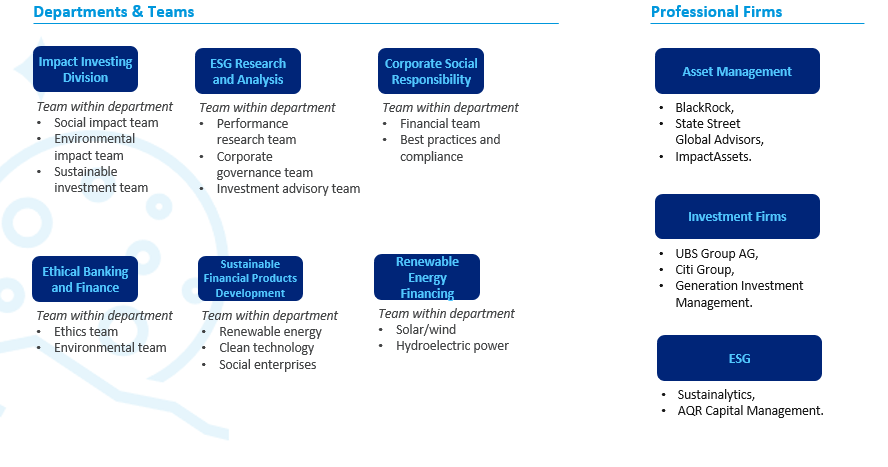
Sustainable Finance & Impact Investing
FinTech & Digital Finance
Financial Analytics & Forensics
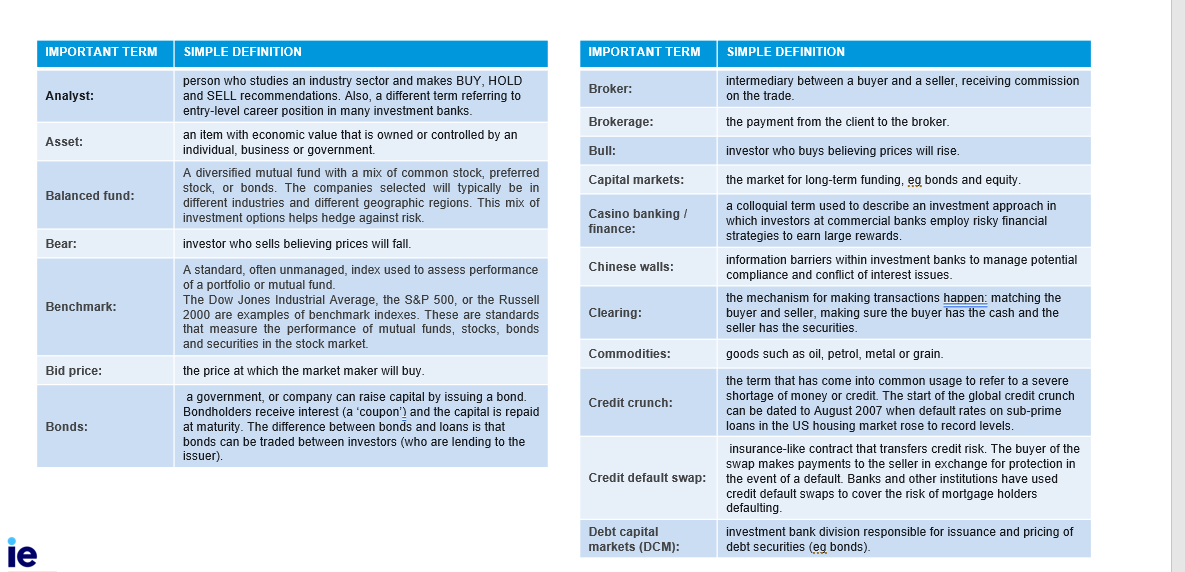
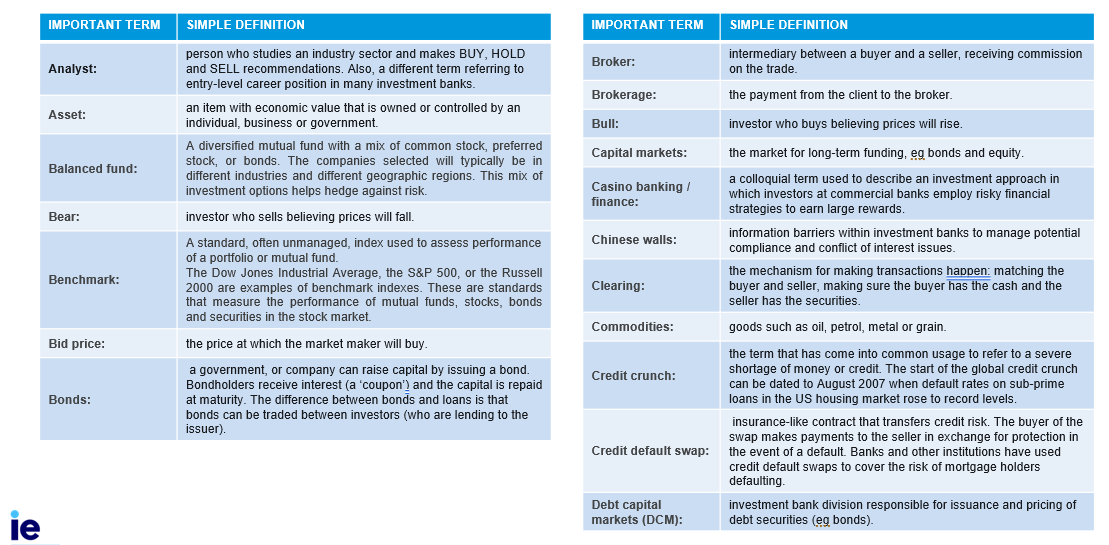
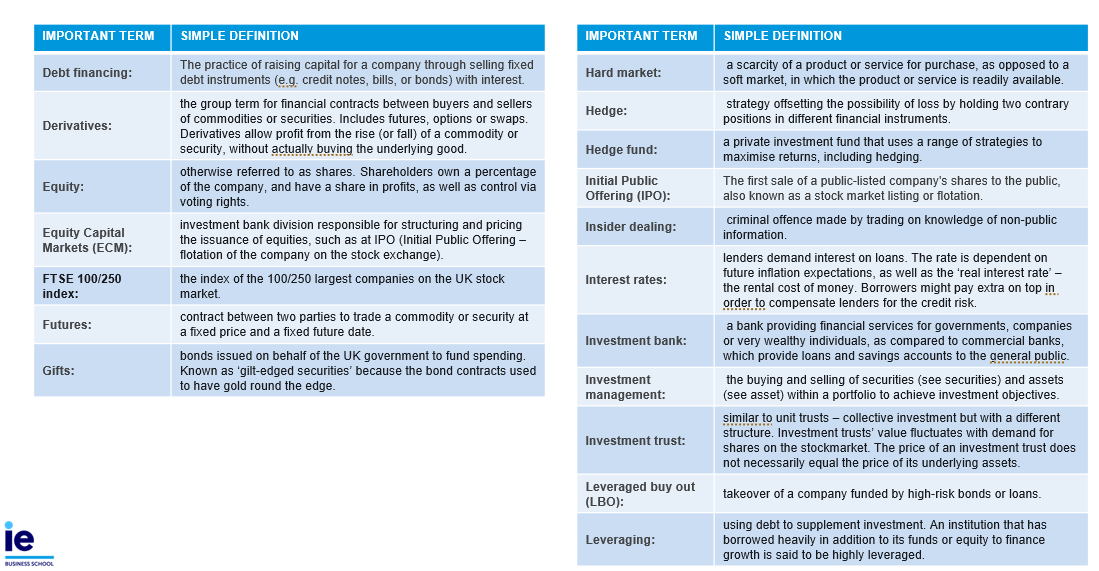
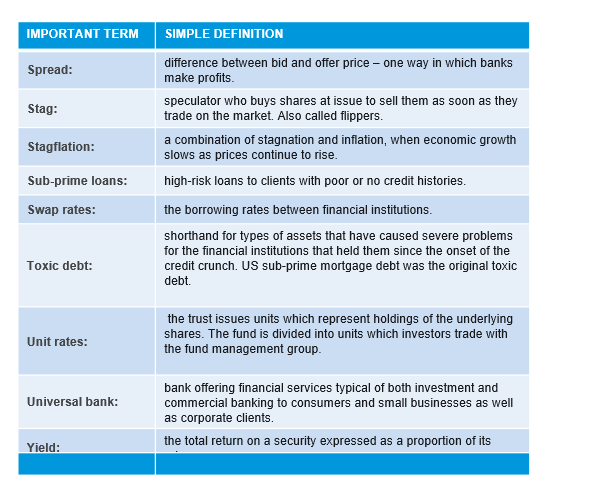
Relevant Terminology
PATHWAY PANEL
You can find the recording of the Finance & Investments panel session in the following link.
Access code: yuUP8=BY
Exploring jobs in Finance, Investments & Accounting
We encourage you to use LinkedIn to explore titles and job vacancies within this pathway. Please watch this brief video outlining how to use LinkedIn’s advanced search function by clicking on the link below.
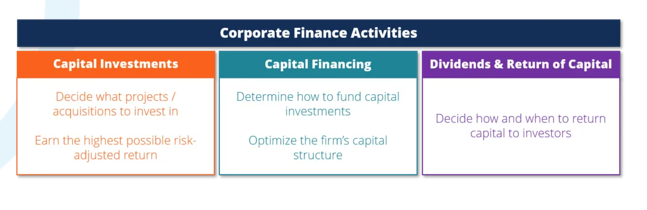
The ultimate purpose of corporate finance is to maximize the value of a business through planning and resource implementation, while balancing risk and profitability. The three most important activities that govern corporate finance are:
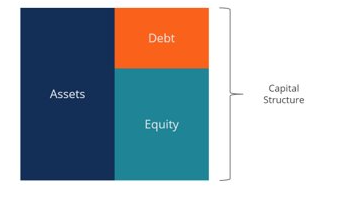
Corporate finance deals with the capital structure of a corporation, including its funding and the actions that management takes to increase the value of the company. A company’s capital structure is crucial to maximizing the value of the business, and its structure can be a combination of long-term and short-term debt and/or common and preferred equity. Corporate finance also includes the tools and analysis used to prioritize and distribute financial resources.
A company that is heavily funded by debt is considered to have a more aggressive capital structure and, therefore, potentially holds more risk for stakeholders. However, taking this risk is often the primary reason for a company’s growth and success.
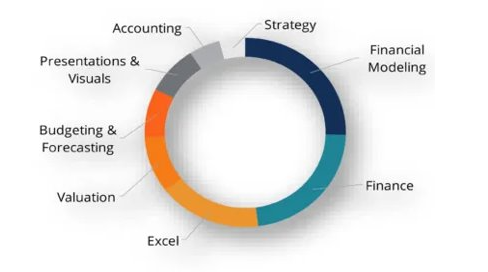
A typical career path in corporate finance starts in Financial Planning & Analysis (FP&A), perhaps as a controller or budget planner. Eventually you’ll follow the career path of a Chief Financial Officer (CFO) in a small company or in a big multinational, where you will have to deal not only with accounting but also have a heavy focus on financial modeling, finance, Excel, business valuation, budgeting/forecasting, PowerPoint presentations and business strategy.
Responsibilities in this Career Area
Investment Banking
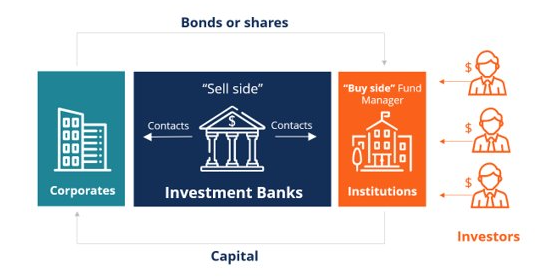
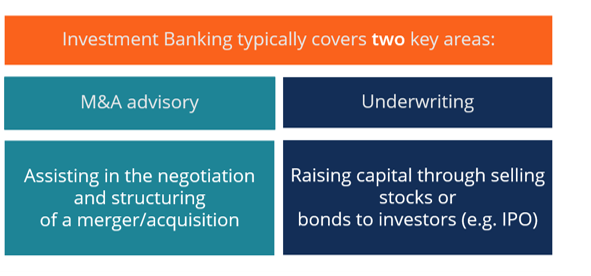
Investment bankingis the division of a bank or financial institution that serves governments, corporations and institutions by providing underwriting (capital raising) and mergers and acquisitions (M&A) advisory services. Investment banks act as intermediaries between investors (who have money to invest) and corporations (who require capital to grow and run their businesses).
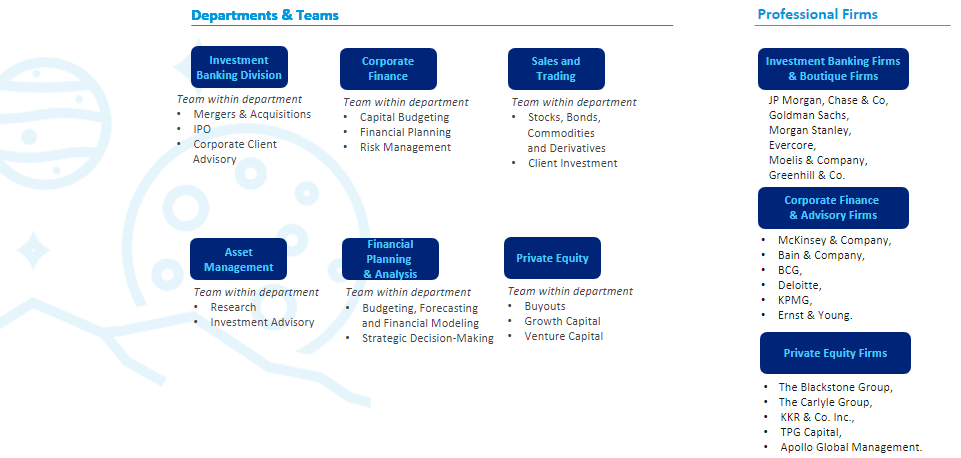
Full-service investment banks offer a wide range of services that include underwriting, M&A, sales and trading, equity research, asset management, commercial banking and retail banking BUT the investment banking division of a bank typically provides only underwriting and M&A advisory services.
M&A Advisory Services
Or a job working in mergers and acquisitions (M&A) is one of the most sought-after and high-profile roles in investment banking. Senior M&A bankers travel the world and advise on the world’s biggest and most complex deals, reshaping entire industries.
M&A bankers are professional advisors. They operate at the highest levels, working with large global companies (corporates, as they’re known in banking), advising chief executives how best to position their organizations for the future. Unlike management consultants, who help companies determine and implement the best strategy without necessarily changing the company’s component parts, M&A bankers drive strategy through structural change.
M&A jobs are about working with clients on deals to buy and sell companies.
M&A juniors—analysts—work on Excel models to help value companies involved in deals.
M&A juniors put together pitchbooks in PowerPoint to help senior bankers win a role advising on deals.
M&A jobs are well paid: $110k+ salaries in year one are the new normal.
M&A jobs can involve gruelling hours. M&A juniors complain of 100-hour weeks.
Two years in M&A can leave you well-positioned for the future, with opportunities available in private equity, hedge funds and elsewhere.
M&A bankers encourage the companies they’re working with (clients) to join together with other companies as equals (a merger), to buy and control a smaller company or part of a company (an acquisition), or to sell part of their own operations (a disposal). Mergers, acquisitions and disposals happen for different strategic reasons.
Globally, the top three banks in M&A are Goldman Sachs, JPMorgan and Morgan Stanley. These are the banks that work on the biggest and the most complex deals, often involving buyers and sellers in different countries. But there are a number of other big US and European banks that are also active in M&A, and many also lend the money to finance the deals.
While the biggest, multi-billion-dollar deals grab the headlines, the majority of deals are below $500m in size, and there are a number of so-called mid-market M&A firms which earn good money advising on these deals. There is also a large number of so-called boutiques, which are independent, privately-owned firms run by a small number of senior M&A bankers who’ve left big banks to set up on their own.
Boutiques are typically purely advisory houses—unlike banks, they don’t actually provide the financing for deals themselves. The best-known ones include Rothschild, Lazard, Moelis & Co, Evercore, Centerview Partners and Perella Weinberg Partners, but there are hundreds out there.
Typically, an M&A analyst will be responsible for the financial analysis that underpins an M&A deal. This includes building a financial model, running the valuation and financial impact analysis, and preparing materials to present this analysis to the client. Very occasionally, an M&A analyst will also be asked to present this analysis to the client. Sometimes they will also be the point of contact for any questions or requests from the client relating to the analysis.
Day-to-day life as an M&A analyst largely depends on the deals you are working on but broadly speaking, mornings and early afternoons involve client interaction, status and/or diligence calls and discussions to agree on the workstreams the deal team should focus on, as well as next steps. By the afternoon or evening, meetings are less frequent, and you can focus on progressing on the deliverables, which can range from Excel modelling to preparation of marketing materials.
In 2023, the pace of M&A work has started to drop off, but long working hours(75+ a week) are still considered the norm. One reason for this is that M&A is a fast-paced, ever-changing work environment and the intensity of the job will depend on the type of project you are working on. Deal execution tends to be unpredictable by nature as it’s a live situation, whereas business development/pitching tends to be more predictable. Hours are especially long when deals reach a crunch point, or when you’re working on multiple transactions.
As your M&A career develops, your job becomes increasingly client-facing. The role evolves from being technical and analysis-driven to becoming strategic and advice-driven. M&A jobs offer a wide variety of exit options. Many graduates stay at banks for their two-year M&A training program and then leave (if not even sooner) for jobs in private equity, hedge funds, corporate development teams in large companies or even consulting firms.
If you want to work in M&A, your required skills will mainly be based in financial analysis and technical areas for a short period of time, but the role also will require a degree of independent and proactive work (for example reading broker notes) to stay current on the market environment.
Alongside independence, proactivity, and having a desire to learn, M&A analysts need to be confident with numbers and have a quantitative mindset. They also need to have good people skills and to be able to communicate and interact with people confidently. Ultimately this is a client-facing job and clients look to M&A bankers to provide good judgement and advice.
Salaries and bonuses in M&A
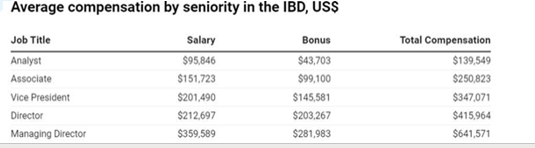
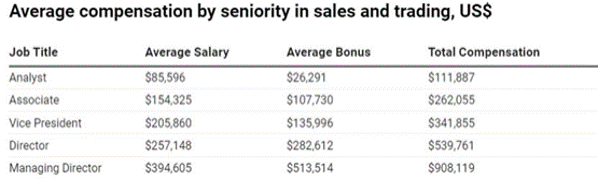
M&A jobs pay large salaries and bonuses to match the long hours. Investment banks offer first-year analysts a base salary of around $110k before bonuses. Salaries increase as you rise through the ranks. Recent salary and bonus surveys suggest that first-year associates are typically earning around $175k, while directors (about eight years in) can earn a basic salary of $300k in the US. Managing director pay is more varied, and depends strongly on the firm in question, but a salary of around $500k is considered standard.
Your total compensation (comp) also includes a bonus. For M&A bankers the size of the bonus depends strongly on fees paid to the bank when a corporate it is advising completes an M&A transaction. Bonuses can be 80% of your salary as an analyst, and are even greater than your salary as you become more senior. Bonuses at most banks are paid predominantly in shares, with a smaller cash element.
Investment Bankers
Capital markets underwriting services in an investment bank require bankers that are all about facilitating expansion for their clients. When companies want to make investments and expand, they need to raise money to do so. Sometimes they just take out a bank loan, but if you want to raise a lot of money at the best rates possible—or if your financial needs are a little bit more complicated than the average lending officer can accommodate—then you might need to go to the global capital markets and sell debt or equity to investors. If you do that, it’s the capital markets divisions of an investment bank you’ll be talking to.
Investment bankers working in capital markets are responsible for providing advice to companies on capital raising, and then finding investors to provide the money. As they depend on investors to be able to deliver the cash to the corporations, capital markets teams are usually split into debt capital markets (DCM) and equity capital markets (ECM), specializing in either bond or equity issuance.
DCM brings a unique combination of corporate finance (a profound knowledge of how a client’s business operates and how to advise on their financial needs), fixed-income and mastering of complex financial products. The high-volume nature of debt issuance means DCM bankers must be able to develop relationships with clients over time and provide them with relevant market information at regular intervals.
ECM bankers, on the other hand, have to go out and make deals happen by understanding the market complexities for that day and week, by reading newspapers, listening to the research briefings, and participating in team meetings. As soon as a pitching processopens up, it’s the senior ECM bankers who will hop on a plane and try and sell the investment bank to a potential client. This is the origination stage of the deal, and although it’s the directors and managing directors who are expected to be the face of the bank, junior employees are engaged in preparing the marketing material required to convince a client to go with a particular bank. If they’re successful, the team involved moves on to the execution stage of the deal.
Investment bankers working in capital markets are responsible for providing advice to companies on capital raising, and then finding investors to provide the money. As they depend on investors to be able to deliver the cash to the corporations, capital markets teams are usually split into debt capital markets (DCM) and equity capital markets (ECM), specializing in either bond or equity issuance.
DCM brings a unique combination of corporate finance (a profound knowledge of how a client’s business operates and how to advise on their financial needs), fixed-income and mastering of complex financial products. The high-volume nature of debt issuance means DCM bankers must be able to develop relationships with clients over time and provide them with relevant market information at regular intervals.
ECM bankers, on the other hand, have to go out and make deals happen by understanding the market complexities for that day and week, by reading newspapers, listening to the research briefings, and participating in team meetings. As soon as a pitching processopens up, it’s the senior ECM bankers who will hop on a plane and try and sell the investment bank to a potential client. This is the origination stage of the deal, and although it’s the directors and managing directors who are expected to be the face of the bank, junior employees are engaged in preparing the marketing material required to convince a client to go with a particular bank. If they’re successful, the team involved moves on to the execution stage of the deal.
Capital markets bankers help clients raise money through public markets.
Capital markets bankers usually specialize in equity or debt. They’re known as equity capital markets (ECM) bankers and debt capital markets (DCM) bankers.
Capital markets jobs are well-paid. The highest pay goes to people originating deals and bringing in new clients rather than just executing on capital raising transactions.
Entry to the best capital markets teams is highly competitive; junior bankers get ahead by impressing bosses with skill and hard work.
Skills you’ll need for jobs in ECM or DCM
Capital markets is a job in which long hours are constant; if you aren’t rushed off your feet with deals to execute, you’re expected to fill in the gaps by working on pitches. Capital markets bankers are famous for their attention to detail. Since the actual service is something of a commodity, banks try to differentiate themselves by reassuring the client that they will be able to make the transaction go without a hitch, so any tiny mistake in a pitchbook or model will tend to undermine the overall branding.
Because of the way that the capital markets division works, people in these jobs also need to be good at teamwork. It’s the same in equity capital markets (ECM). Senior capital markets bankers need to have broad internal and external contacts, as well as strong interpersonal skills, marketing capabilities and strong project management skills to balance the interests of complex stakeholders.
Finally, if you have a capital markets job you’ll also be required to multitask. Even a relatively simple capital markets transaction will call for many different skill sets as it moves through the pipeline, from pitching to modeling to legal and compliance to project management. An ECM or DCM banker is expected to stay with the transaction and to liaise with the clients all through the process, and to retain grace under pressure.
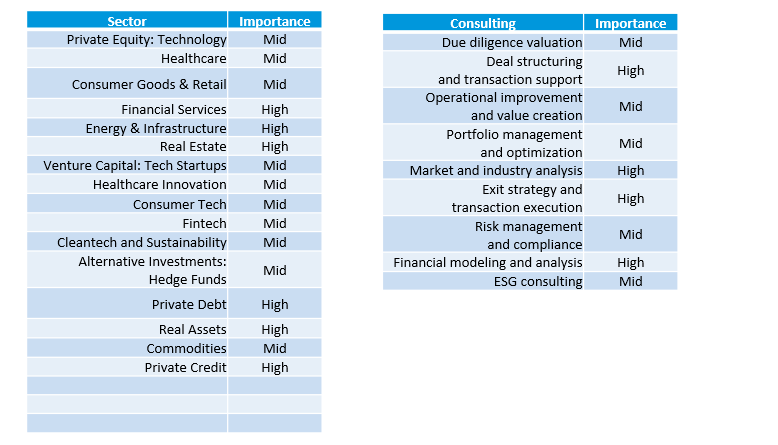
Job landscape
Sectors
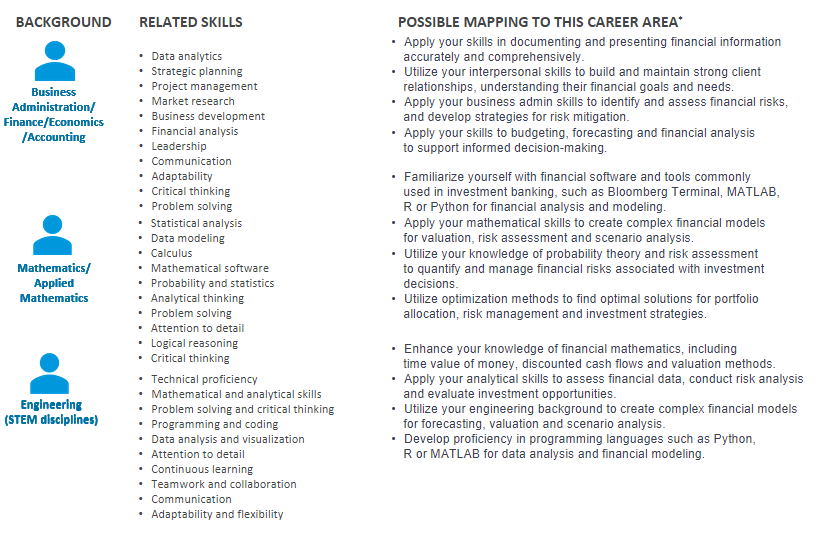
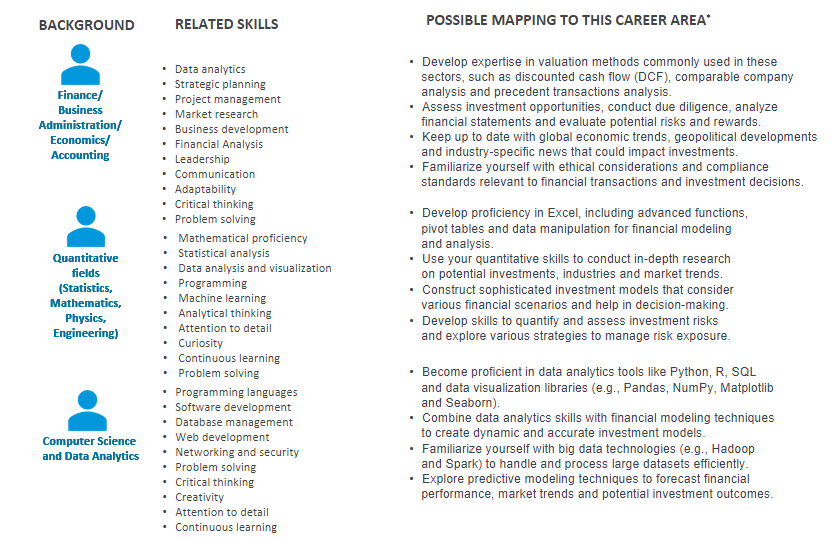
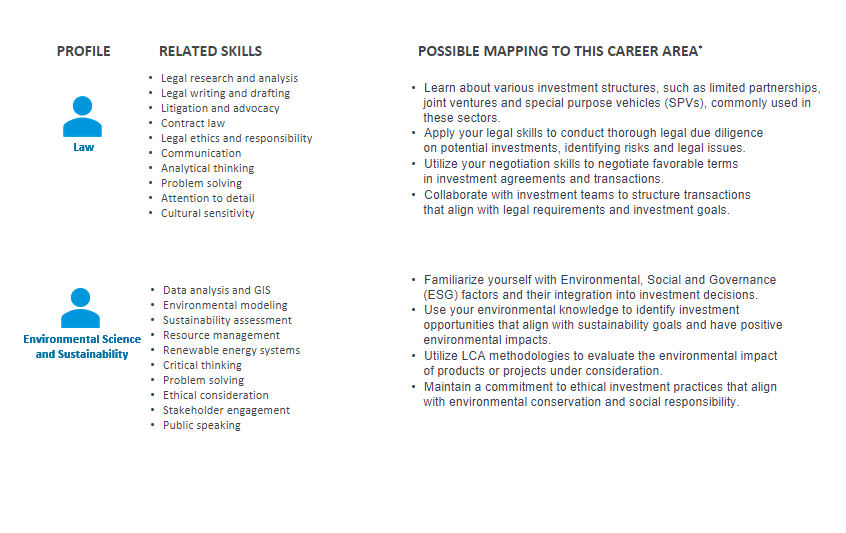
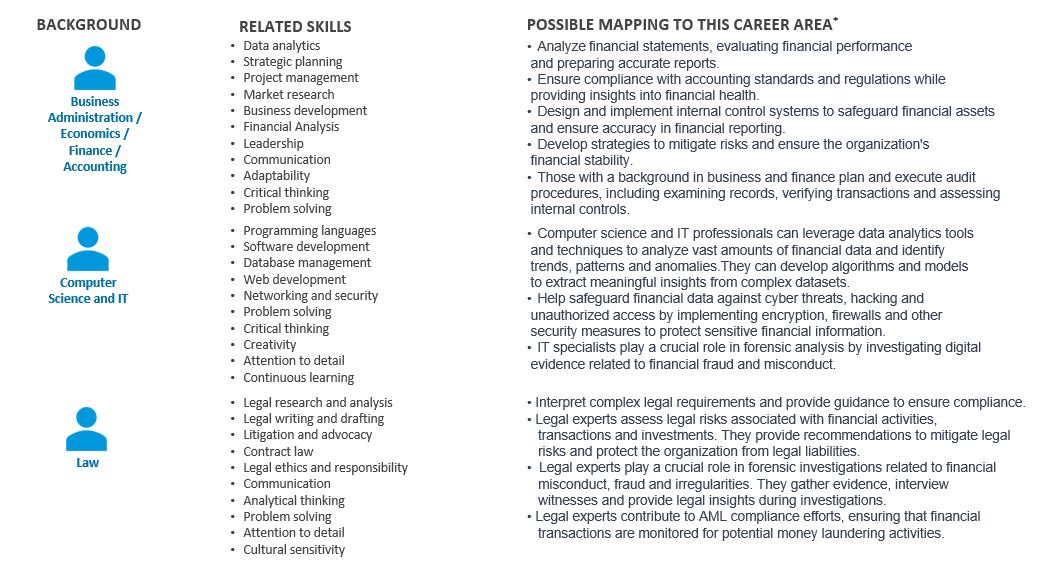
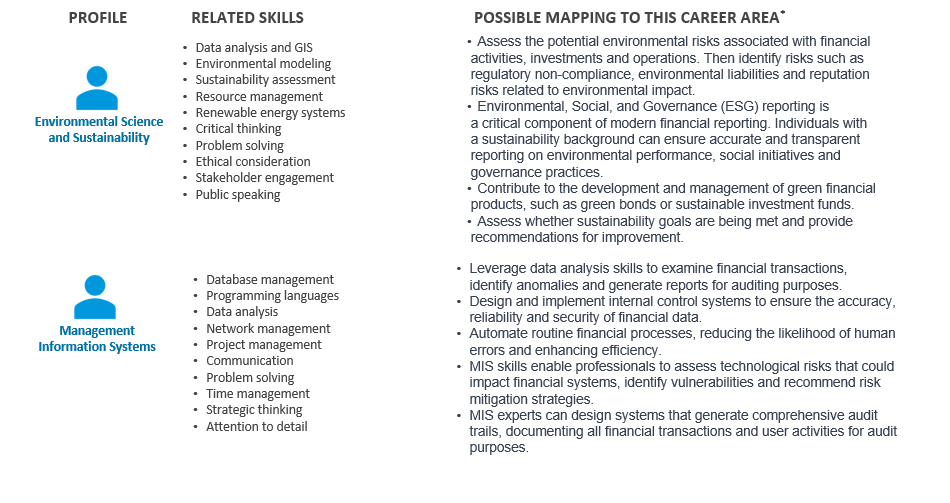
Mapping your background to this Career Area
Exploring Jobs in Corporate Finance & Investment Banking
We encourage you to use LinkedIn to explore titles and job vacancies within this pathway. Please watch this brief video outlining how to use LinkedIn’s advanced search function by clicking on the link below.
Fintech is a combination of the words “finance” and “technology.” Although it’s a blanket term that can mean many different things, broadly speaking, it describes the evolution of an industry where new technology use-cases are developed and deployed to streamline more traditional-looking finance functions.
While the general public typically associates fintech with really cutting-edge new concepts like blockchain and algorithmic trading, the term applies to a very wide variety of many more applications. They include, but are not limited to, everyday banking, insurance and other back-office risk management functions.
Mobile banking—something that hundreds of millions of people around the world take completely for granted—is actually technology supporting the delivery of traditional banking services (aka fintech). Even your Starbucks app is a form of financial technology in that it facilitates payments and a proprietary rewards program using a mobile device (referred to as embedded finance or fintech).
Fintech jobs are fundamentally different to jobs in traditional finance, especially in a startup.
Software engineers and product managers (PMs) work on building and maintaining the infrastructure of the firm, as well as developing new products for it to begin selling. Sales and partnerships people look for institutions and clients to utilize their services or help broaden consumer awareness of the fintech.
Those interested in founding a fintech will find themselves in an executive role far earlier than they would in traditional finance. While the size of your team may not exceed that of one run by a banking MD (or even some VPs), the role would then also encompass engaging with venture capitalists, private equity firms and other possible investors in the company, and departments also intermingle far more frequently and the chain of seniority can also be far more ambiguous .
As for working culture, it very much depends. Fintechs can be work-from-home friendly or offer amazing benefits like a four-day working week, but the additional workload can take its toll. For fast-growing fintechs, certain structures that provide stability for employees [such as HR practices] might not be in place. Some fintechs prioritize their investments in growth, scaling and product building over supporting employees.
Fintech jobs these days are not great. They’re not terrible (depending on your sub-sector of choice), but they’re not great. After a mammoth few years for investment, funding rounds are smaller and sparser in 2023. Initial Public Offerings (IPOs) were infrequent even during the sector’s heyday; now they are exceedingly so. The industry is also at its winter for crypto fanatics, although regulation in EU called MICA is finally bringing some light into the darkness.
It’s not the only industry racked with regulation problems. BNPL was another star-child for fintech as firms like Klarna ballooned in popularity and value. The UK is clamping down on its use now, though issues over profitability spelled uncertainty for BNPL even without regulators to worry about.
The top three locations for fintech unicorns (startups valued above $1bn), are New York, London and San Francisco. Each is home to a number of the most prominent fintechs operating today. Each have too many to count, but one of London’s most prominent fintechs is Revolut. New York has Ramp and San Francisco has Chime.
Many of the biggest fintechs come from outside the major hubs. Stripe, arguably the face of fintech in 2023, has its headquarters in Ireland. NuBank, one of the largest digibanks, is based in Brazil. Rapyd, another payments giant, is based in Israel. Grab is Asia’s biggest fintech, and is based in Singapore.
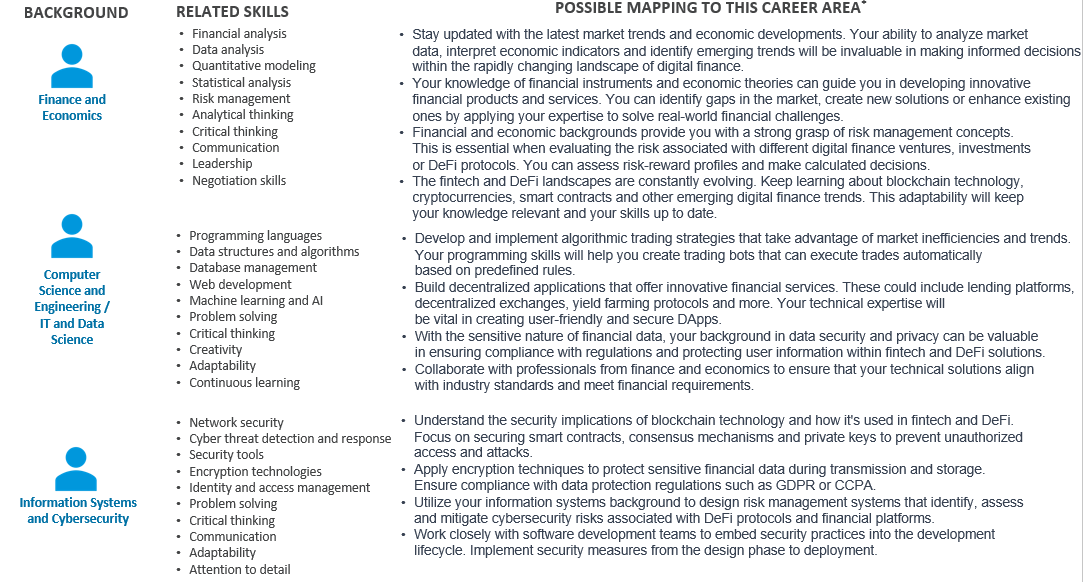
Job landscape & Mapping your background to this Career Area
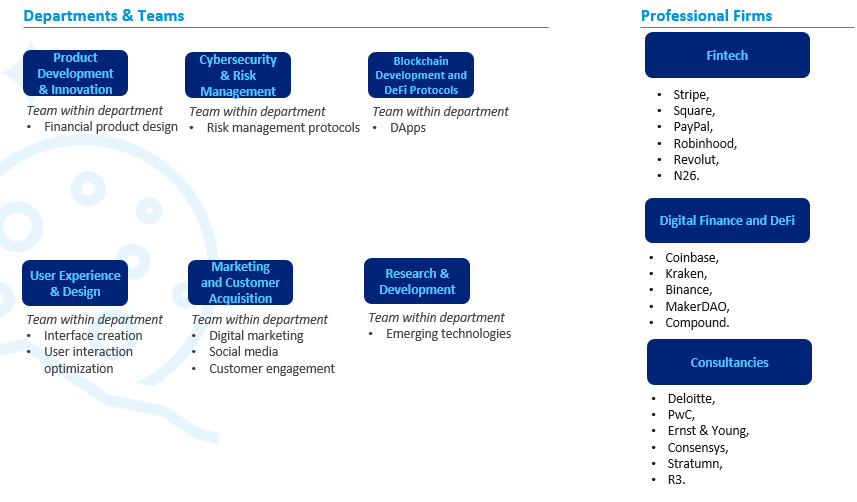
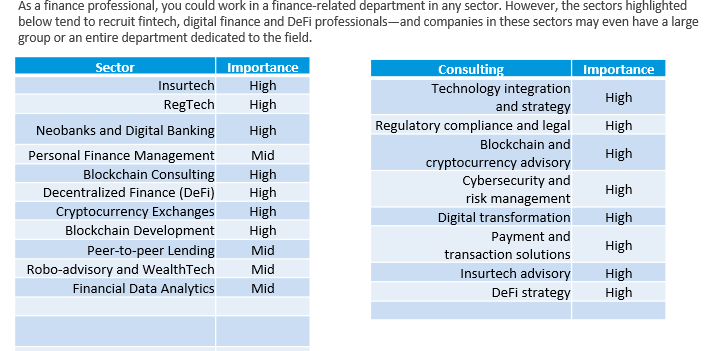
Where do Fintech, Digital Finance & DeFi professionals work?
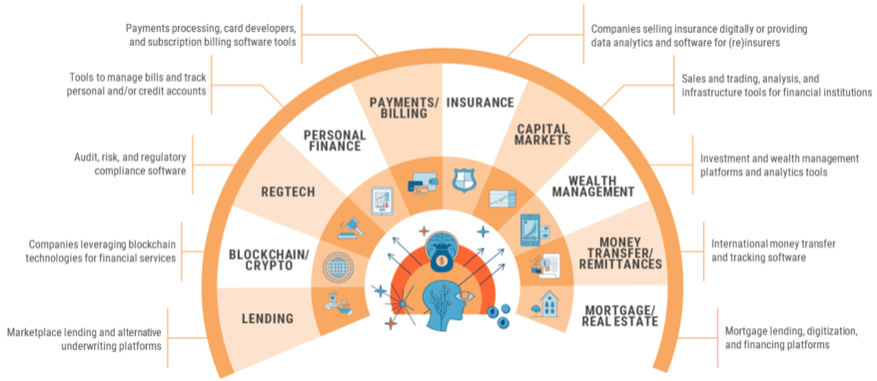
Sectors
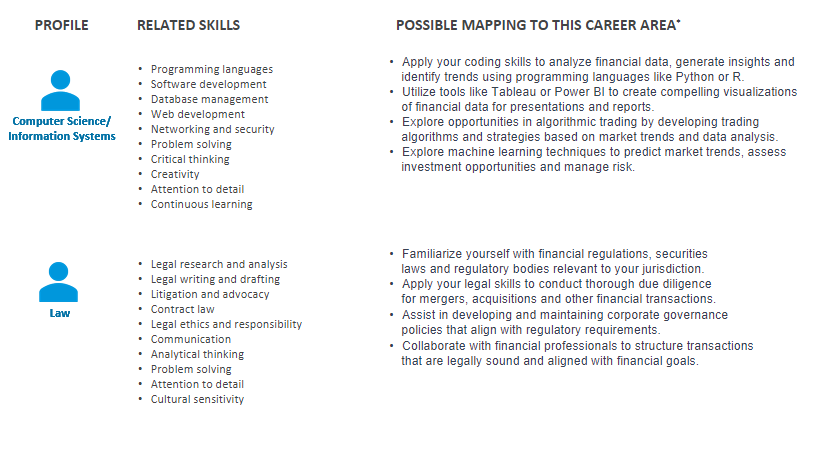
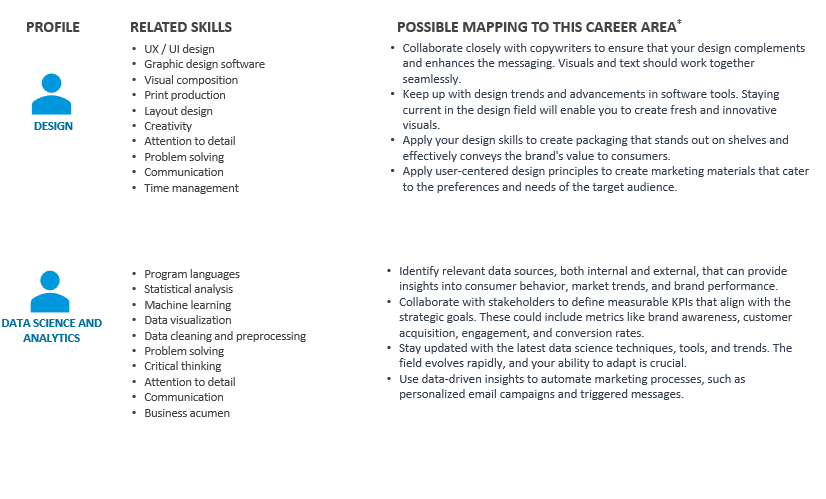
Mapping your background to this Career Area
Exploring jobs in Fintech, Digital Finance & DeFi
We encourage you to use LinkedIn to explore titles and the availability of jobs within this Career Area. Please watch this brief video outlining how to use LinkedIn’s advanced search function by clicking on the link below.
Private equity is sometimes confused with venture capital because both refer to firms that invest in private companies and exit by selling their investments in equity financing, for example, by holding initial public offerings (IPOs). However, there are significant differences in the way firms involved in the two types of funding conduct business. Private equity invest in established, high-growth business whereas venture capitalists invest in early-stage, high-risk startups and businesses.
Private equity funds are pools of capital to be invested in companies that represent an opportunity for a high rate of return. They come with a fixed investment horizon, typically ranging from four to seven years, at which point the PE firm hopes to exit the investment profitably. Exit strategies include IPOS and sale of the business to another private equity firm or strategic buyer.
Private equity jobs are some of the most desirable in finance, so competition can be intense.
Private equity funds invest in large companies that are not yet listed on public markets.
Senior private equity professionals are paid salaries, bonuses and carried interest—a proportion of the profits made when an investment is sold. Carried interest can be huge (20% of the total gains on the investment).
Private equity is a vast industry covering a range of investment firms, from global companies like Blackstone, KKR and The Carlyle Group to hundreds of smaller players that specialize by geography or sector, such as Vitruvian Partners, Sovereign Capital or Bridgepoint. The biggest firms tend to operate beyond just private equity and invest in asset classes like real estate and credit as well.
Fundamentally, private equity firms, also known as general partners (GPs), raise money or equity from investors, which are known as limited partners (LPs). These limited partners include big pension funds, or the offices of wealthy families or individuals. The private equity firms invest the money they raise in buying private (unlisted) companies.
Private equity firms then operate these companies alongside the existing management team, known as a management buyout. Having acquired a company, they (ideally) improve the way it operates before either floating it via the stock market or selling it to another private equity firm or a big corporation. At this point (the exit), they return the limited partners’ original investment, plus the additional return they’ve made, after keeping some of the extra for themselves. This extra is paid to senior staff as carried interest, which receives favorable tax treatment.
Private equity firms also make money by maximizing the amount of debt (or leverage) on a deal. Leveraged buy-outs (LBOs) are deals where a private equity firm targets mature and stable companies using a little of the private equity firm’s own cash (or equity) and a lot of money they’ve borrowed from other sources, including bank loans.
Historically, most private equity firms like to recruit junior talent from investment banks. This is because banking juniors have completed a two-year training program and have a good grounding in the fundamental aspects of financial modeling, pricing companies, and mergers and acquisitions (M&A).
For this reason, a first job in an investment bank is still the best launchpad for a private equity career. Another way into private equity is by training in transactions services with a Big Four accountancy firm or by doing private equity commercial due diligence in a strategy consultancy.
Working in private equity is all about analyzing good business investments, and then beating the competition to acquiring an asset. This might be through direct negotiation with a company that a PE firm has identified as a good target to purchase, or through a formal auction process run by an investment bank that’s selling a business to a group of competing buyers.
There are similarities to working in private equity and to working in M&A (and this is why junior M&A bankers often move into private equity). However, as a private equity professional, you’ll be the one instructing the bank and the person actually doing the deal.
Historically, most private equity firms like to recruit junior talent from investment banks. This is because banking juniors have completed a two-year training program and have a good grounding in the fundamental aspects of financial modeling, pricing companies, and mergers and acquisitions (M&A).
For this reason, a first job in an investment bank is still the best launchpad for a private equity career. Another way into private equity is by training in transactions services with a Big Four accountancy firm or by doing private equity commercial due diligence in a strategy consultancy.
Working in private equity is all about analyzing good business investments, and then beating the competition to acquiring an asset. This might be through direct negotiation with a company that a PE firm has identified as a good target to purchase, or through a formal auction process run by an investment bank that’s selling a business to a group of competing buyers.
There are similarities to working in private equity and to working in M&A (and this is why junior M&A bankers often move into private equity). However, as a private equity professional, you’ll be the one instructing the bank and the person actually doing the deal.
Skills wise, investment banking candidates will already have a basic grounding in finance, and be able to read balance sheets and understand how companies are valued. Strong analytical skills are essential.
But private equity firms are also looking for ultimate all-rounders: people with insightful thinking and the ability to build relationships. Candidates should be confident and persuasive but also hard-edged when it comes to negotiating. They sell with their eyes and mouths and buy with their brains. It’s all about winning the deal. Alongside this, you’ll need to be interested in how businesses work, rather than simply sitting behind a desk and looking at numbers, although there is an element of that as well.
When it comes to salaries and bonuses, private equity firms usually pay slightly below or on a par with investment banks—and like banks, salaries and bonuses vary significantly depending on the firm in question. The real money is not in the annual compensation, but in carried interest, which usually goes to professionals from around principal upwards (although some firms pay carried interest earlier). “Carry” is derived from the profits that are made on the LP’s original investment and is typically 20% of the returns (once a predetermined hurdle rate has been met).
Venture capital is financing given to startup companies and small businesses that are seen as having the potential to generate high rates of growth and above-average returns, often fuelled by innovation or by carving out a new industry niche. The funding for this type of financing usually comes from wealthy investors, investment banks and specialized VC funds. The investment does not have to be financial, as it can also be offered via technical or managerial expertise.
Getting into venture capital isn’t easy, though. Many try, and many fail. The venture capital industry is professionalizing as it expands and matures, and as a result, funds are becoming pickier about who they recruit.
VC funds are typically engaged in four things:
– Trying to find new investments (sourcing).
– Analyzing potential investments.
– Trying to win investments over other venture capital funds, and then…
– Trying to support companies once they’ve invested in them.
To work in venture capital, you will need to be good at least one of these things.
Key Differences between Private Equity and Venture Capital
A private equity firm’s strategy is to buy mostly mature companies that are already established. Private equity firms buy these companies and streamline operations to increase revenues. Venture capital firms, on the other hand, mostly invest in startups with high growth potential.
Private equity firms mostly buy 100% ownership of the companies in which they invest. Venture capital firms invest in 50% or less of the equity of the companies. Most venture capital firms prefer to spread out their risk and invest in many different companies.
Private equity firms usually invest $100 million and above in a single company. These firms prefer to concentrate all their efforts on a single company, since they invest in already established and mature companies. The chances of absolute losses from such an investment are minimal. Venture capitalists typically spend $10 million or less on each company, since they mostly deal with startups with unpredictable chances of success or failure.
Private equity firms can buy companies from any industry, while venture capital firms tend to focus on startups in technology, biotechnology and clean technology—although not necessarily. Private equity usually hires investment bankers, whereas venture capital firms usually hire consultants or tech experts.
Alternative Investments
An alternative investment is an investment in assets different from cash, stocks and bonds. Alternative investments can be investments in tangible assets such as precious metals, real estate or wine. In addition, they can be investments in financial assets such as private equity, VC, infrastructure funds, real estate funds, distressed securities, crypto currencies and hedge funds.
Generally, alternative investments tend to show a low correlation with traditional investments (stocks and bonds). In addition, some alternative investments involve extremely complicated valuation and are highly illiquid. Due to such reasons, certain types of alternative investments are quite popular among financial institutions and high-net-worth individuals.
Alternative investments may be a great addition to an investor’s portfolio. Many alternative investments provide significantly greater returns relative to traditional investments. Also, the availability of a wide range of alternative investments makes them a viable option despite the investor’s risk tolerance or perceptions of the market.
Private equity is sometimes confused with venture capital because both refer to firms that invest in private companies and exit by selling their investments in equity financing, for example, by holding initial public offerings (IPOs). However, there are significant differences in the way firms involved in the two types of funding conduct business. Private equity invest in established, high-growth business whereas venture capitalists invest in early-stage, high-risk startups and businesses.
Private equity funds are pools of capital to be invested in companies that represent an opportunity for a high rate of return. They come with a fixed investment horizon, typically ranging from four to seven years, at which point the PE firm hopes to exit the investment profitably. Exit strategies include IPOS and sale of the business to another private equity firm or strategic buyer.
Private equity jobs are some of the most desirable in finance, so competition can be intense.
Private equity funds invest in large companies that are not yet listed on public markets.
Senior private equity professionals are paid salaries, bonuses and carried interest—a proportion of the profits made when an investment is sold. Carried interest can be huge (20% of the total gains on the investment).
Private equity is a vast industry covering a range of investment firms, from global companies like Blackstone, KKR and The Carlyle Group to hundreds of smaller players that specialize by geography or sector, such as Vitruvian Partners, Sovereign Capital or Bridgepoint. The biggest firms tend to operate beyond just private equity and invest in asset classes like real estate and credit as well.
Fundamentally, private equity firms, also known as general partners (GPs), raise money or equity from investors, which are known as limited partners (LPs). These limited partners include big pension funds, or the offices of wealthy families or individuals. The private equity firms invest the money they raise in buying private (unlisted) companies. Private equity firms then operate these companies alongside the existing management team, known as a management buyout. Having acquired a company, they (ideally) improve the way it operates before either floating it via the stock market or selling it to another private equity firm or a big corporation. At this point (the exit), they return the limited partners’ original investment, plus the additional return they’ve made, after keeping some of the extra for themselves. This extra is paid to senior staff as carried interest, which receives favorable tax treatment. Private equity firms also make money by maximizing the amount of debt (or leverage) on a deal. Leveraged buy-outs (LBOs) are deals where a private equity firm targets mature and stable companies using a little of the private equity firm’s own cash (or equity) and a lot of money they’ve borrowed from other sources, including bank loans.
Historically, most private equity firms like to recruit junior talent from investment banks. This is because banking juniors have completed a two-year training program and have a good grounding in the fundamental aspects of financial modeling, pricing companies, and mergers and acquisitions (M&A).
For this reason, a first job in an investment bank is still the best launchpad for a private equity career. Another way into private equity is by training in transactions services with a Big Four accountancy firm or by doing private equity commercial due diligence in a strategy consultancy.
Working in private equity is all about analyzing good business investments, and then beating the competition to acquiring an asset. This might be through direct negotiation with a company that a PE firm has identified as a good target to purchase, or through a formal auction process run by an investment bank that’s selling a business to a group of competing buyers.
There are similarities to working in private equity and to working in M&A (and this is why junior M&A bankers often move into private equity). However, as a private equity professional, you’ll be the one instructing the bank and the person actually doing the deal.
Historically, most private equity firms like to recruit junior talent from investment banks. This is because banking juniors have completed a two-year training program and have a good grounding in the fundamental aspects of financial modeling, pricing companies, and mergers and acquisitions (M&A).
For this reason, a first job in an investment bank is still the best launchpad for a private equity career. Another way into private equity is by training in transactions services with a Big Four accountancy firm or by doing private equity commercial due diligence in a strategy consultancy.
Working in private equity is all about analyzing good business investments, and then beating the competition to acquiring an asset. This might be through direct negotiation with a company that a PE firm has identified as a good target to purchase, or through a formal auction process run by an investment bank that’s selling a business to a group of competing buyers.
There are similarities to working in private equity and to working in M&A (and this is why junior M&A bankers often move into private equity). However, as a private equity professional, you’ll be the one instructing the bank and the person actually doing the deal.
Skills wise, investment banking candidates will already have a basic grounding in finance, and be able to read balance sheets and understand how companies are valued. Strong analytical skills are essential.
But private equity firms are also looking for ultimate all-rounders: people with insightful thinking and the ability to build relationships. Candidates should be confident and persuasive but also hard-edged when it comes to negotiating. They sell with their eyes and mouths and buy with their brains. It’s all about winning the deal. Alongside this, you’ll need to be interested in how businesses work, rather than simply sitting behind a desk and looking at numbers, although there is an element of that as well.
When it comes to salaries and bonuses, private equity firms usually pay slightly below or on a par with investment banks—and like banks, salaries and bonuses vary significantly depending on the firm in question. The real money is not in the annual compensation, but in carried interest, which usually goes to professionals from around principal upwards (although some firms pay carried interest earlier). “Carry” is derived from the profits that are made on the LP’s original investment and is typically 20% of the returns (once a predetermined hurdle rate has been met).
Venture capital is financing given to startup companies and small businesses that are seen as having the potential to generate high rates of growth and above-average returns, often fuelled by innovation or by carving out a new industry niche. The funding for this type of financing usually comes from wealthy investors, investment banks and specialized VC funds. The investment does not have to be financial, as it can also be offered via technical or managerial expertise.
Getting into venture capital isn’t easy, though. Many try, and many fail. The venture capital industry is professionalizing as it expands and matures, and as a result, funds are becoming pickier about who they recruit.
VC funds are typically engaged in four things:
– Trying to find new investments (sourcing).
– Analyzing potential investments.
– Trying to win investments over other venture capital funds, and then…
– Trying to support companies once they’ve invested in them.
To work in venture capital, you will need to be good at least one of these things.
Key Differences between Private Equity and Venture Capital
A private equity firm’s strategy is to buy mostly mature companies that are already established. Private equity firms buy these companies and streamline operations to increase revenues. Venture capital firms, on the other hand, mostly invest in startups with high growth potential.
Private equity firms mostly buy 100% ownership of the companies in which they invest. Venture capital firms invest in 50% or less of the equity of the companies. Most venture capital firms prefer to spread out their risk and invest in many different companies.
Private equity firms usually invest $100 million and above in a single company. These firms prefer to concentrate all their efforts on a single company, since they invest in already established and mature companies. The chances of absolute losses from such an investment are minimal. Venture capitalists typically spend $10 million or less on each company, since they mostly deal with startups with unpredictable chances of success or failure.
Private equity firms can buy companies from any industry, while venture capital firms tend to focus on startups in technology, biotechnology and clean technology—although not necessarily. Private equity usually hires investment bankers, whereas venture capital firms usually hire consultants or tech experts.
Alternative Investments
An alternative investment is an investment in assets different from cash, stocks and bonds. Alternative investments can be investments in tangible assets such as precious metals, real estate or wine. In addition, they can be investments in financial assets such as private equity, VC, infrastructure funds, real estate funds, distressed securities, crypto currencies and hedge funds.
Generally, alternative investments tend to show a low correlation with traditional investments (stocks and bonds). In addition, some alternative investments involve extremely complicated valuation and are highly illiquid. Due to such reasons, certain types of alternative investments are quite popular among financial institutions and high-net-worth individuals.
Alternative investments may be a great addition to an investor’s portfolio. Many alternative investments provide significantly greater returns relative to traditional investments. Also, the availability of a wide range of alternative investments makes them a viable option despite the investor’s risk tolerance or perceptions of the market.
Job landscape
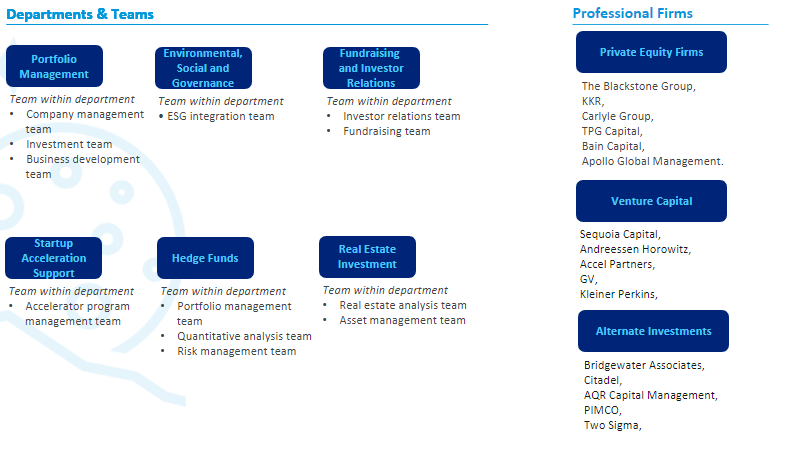
Where do Private Equity, Venture Capital & Alternative Investments professionals work?
Sectors
Mapping your background to this Career Area
Exploring jobs in Private Equity, Venture Capital & Alternative Investments
We encourage you to use LinkedIn to explore titles and the availability of jobs within this career area. Please watch this brief video outlining how to use LinkedIn’s advanced search function by clicking on the link below.
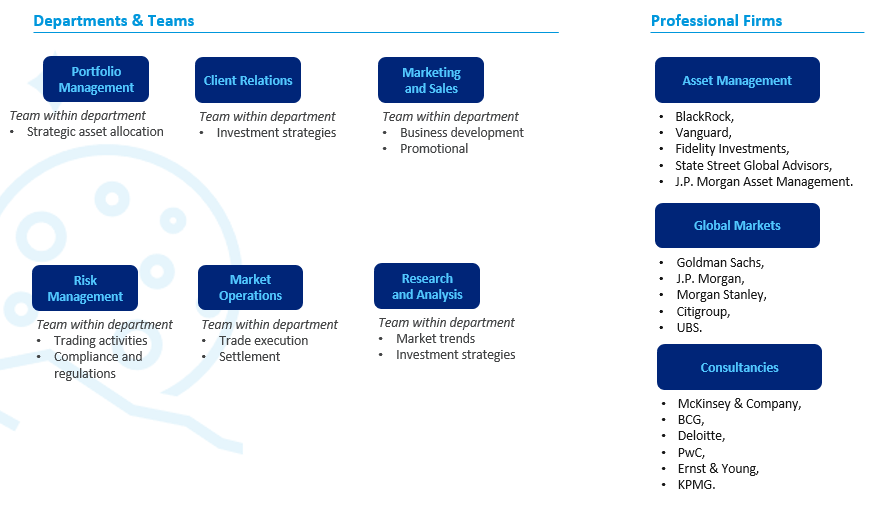
Asset management describes managing money on a client’s behalf. The financial institutions managing the money are called asset managers, and they develop and execute investment strategies that create value for their clients. Broadly, this process involves “putting money to work” by buying, holding and selling financial assets with the potential to achieve a client’s investment goals. Examples of financial assets include stocks, bonds, commodities, shares in private funds and more. In the broadest sense, an asset is anything that delivers value to its owner and the stakeholder(s) it serves. Stocks, bonds, residential properties and commercial office buildings are all examples of assets.
Wealth management is essentially asset management where the client is an individual or family. It’s all of this, plus understanding an individual or family’s entire balance sheet, cash flows, budgets, goals and other detailed elements of their financial situation. This can include terms of employment, funds held in trust or holding companies, insurance needs and charitable giving. The top five asset management firms globally are:
BlackRock (USA)
Vanguard Group (USA)
Fidelity Investments (USA)
State Street Global Advisors (USA)
Morgan Stanley (USA)
Source: Refinitiv as of March 31, 2022
Asset management, the “buy-side,” aims to increase the value of a client’s investments over time, and they receive a fee for their services. Unlike hedge funds, which “hedge” investments and try to make money even when markets fall, asset management firms typically “go long”—they invest in products in the hope that their prices will rise. For this reason, they are also known as “long only investors.”
Large asset management firms manage money for pension investors around the world.
The role most people aspire to is that of portfolio manager, where you manage a pool of funds yourself on behalf of clients.
You don’t necessarily need to be highly mathematical for these roles—unless you work for a quant fund.
Broadly speaking, there are two basic kinds of fund within the asset management industry:
Passive: Also called “index-trackers.” Exchange-traded funds (ETFs) are a good example
of passive investment. They track an index, or a basket of assets, but are also a tradable security, so their value goes up and down like a stock on a stock exchange.
Active: This is where human skill and experience comes into the fund management industry. A team of portfolio managers, analysts and researchers use their expertise and a plethora of research, quantitative analysis, forecasts and judgement to make a decision on what assets to invest in with the aim of beating the market.
Responsibilities in this area
Careers in Asset Management
Portfolio managers or fund managers are the kings and queens of the asset management world. This is the pinnacle of an investment career, and you’ll need to work your way up. The roles on offer in the asset management industry include the following:
Investment jobs: This is where you find the portfolio managers who run the investment strategies. They tend to specialize in one asset class, whether that’s equities, fixed income or property, and manage the day-to-day investment decisions across the funds they look after. Supporting them are teams of buy-side research analysts. Their role is all about generating investment ideas for portfolio management teams to act upon.
Distribution: While investment teams deal with the money management side of the business, distribution teams are all about bringing client money into the fund.
Sales, or business developmentprofessionals deal with large institutional investors, find out what their investment needs are and try to recommend the products of their employer. Product development/management roles ensure that a fund manager is present in all the markets and asset classes they should be, has the right funds available to investors in the right markets, and that there are no obvious gaps. They also liaise with the risk and compliance teams to ensure any new products will keep regulators happy, that a fund’s pricing structure is correct and that a firm isn’t falling behind their competitors in any areas. Marketing professionals make sure that the right messages about the products reach potential and existing clients. Business operations roles are back-office functions as well as IT, HR and accounting positions.
Skills needed in Asset Management
Unlike at investment banks, where analyst is only the first rung on a much shorter career ladder, analysts in fund management learn the trade. They study the financial results of companies, consume huge amounts of information and news on the companies and sectors they cover, and—when they’re good enough—make investment recommendations. Some people choose to stay as analysts throughout their careers.
During your formative years, it’s likely that you’ll be studying for your chartered financial analyst (CFA® Institute) designation. This is an industry standard on the buy-side.
Graduates don’t necessarily need a degree in mathematics, economics or computer science to get a job as an asset manager. They do need to show critical thinking and a genuine deep curiosity about how companies work and what drives human behavior.
Some regard asset management more as an art than a science, and humanities subjects can often be just as good a way of acquiring critical-thinking skills.
Asset managers must also be aware of a whole range of factors that drive growth and performance, particularly big trends such as environmental, social and governance (ESG) factors as climate change becomes a big area of focus for the pension fund clients of investment management firms.
Global markets is also often referred to as sales and trading. It’s the part of an investment bank that connects buyers with sellers and that stands in the middle to take a piece of the action for itself. At a sales & trading division of an investment bank, your main job will be “market making.” This is the term banks use for making markets—or, to put it more simply, enable clients to buy and sell securities.
What will you buy and sell in a sales and trading job? The answer is more or less any kind of financial product. Some banks will even have physical commodities operations where actual metals, hydrocarbons and shipping services are traded as if they were stocks and bonds. But the three main categories of tradable securities are equities (shares, which represent part ownership of companies), fixed income (any sort of tradable debt, like bonds) and derivatives (securities where nobody literally owns anything, but the two sides agree to a contract to make payments to one another based on a predetermined formula).
Although we often hear about roles in sales and trading (S&T) lumped together, in reality the jobs of sales and trading are very distinct, demanding different skills and responsibilities. However, in most banks, the salespeople and traders work together in a symbiotic way; traders depend on salespeople to help them buy or sell the securities they would like to trade. Salespeople depend on their traders to help
make prices for securities that their customers would like to transact.
Global Markets or Sales and Trading jobs
Generally, sales jobs in investment banks are slightly more strategic than trading jobs. In sales, you have to understand the big picture and to maintain relationships with your clients. The better you understand the big economic drivers and market trends, the more likely you are to be able to anticipate the investors’ needs and to give them useful advice. Trading jobs are more focused and intense. To be a trader, you’ll need
to understand the structure of supply and demand at any given moment in time; some of the best traders actively avoid information about longer timeframes as a distraction from what they can see happening on the screen in front of them.
Sales and trading is a very results-focused job where good or bad performance is immediately obvious.
To succeed, you’ll need energy, concentration, and coding and math skills.
Sales and trading jobs working with products like fixed income, equities or derivatives are very well paid, but job security is limited. A single bad year, and you could be replaced.
Entry to the best trading desks is super competitive; investment banks tend to hire a lot of juniors and promote the ones who perform best.
The best salespeople and traders go on to work for hedge funds or family offices.
Global markets open early every day; you need to be in the office even earlier, and at any given minute something could suddenly turn into a crisis. Sales and trading jobs don’t tend to require the punishingly long hours that are associated with investment banking, but the hours can still be very intense.
Sales in particular is a noisy, people-focused job which is more suitable for extroverts than introverts, because although dominated by computers, the people making the decisions are human beings and successful salespeople need to be able to form relationships with them on a human level. Sales and trading jobs also need concentration and attention to detail. Some structured products and algorithmic roles also need advanced quantitative skills. There’s not much room for “big picture” types in sales & trading; everything is either a profit or a loss, worked out to the last fraction.
Job landscape & Mapping your background to this Career Area
Where do Asset Management & Global Markets professionals work?
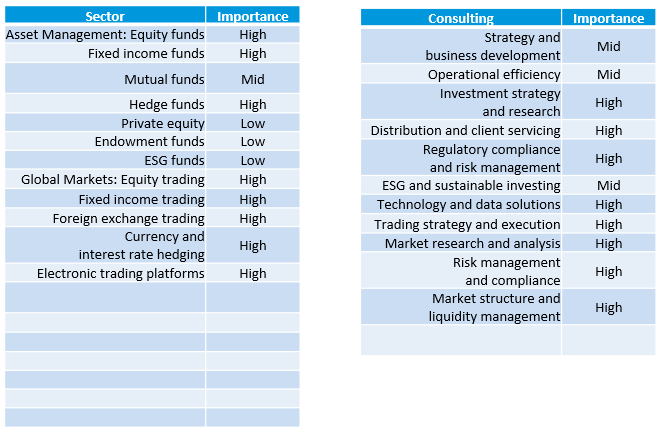
Sectors
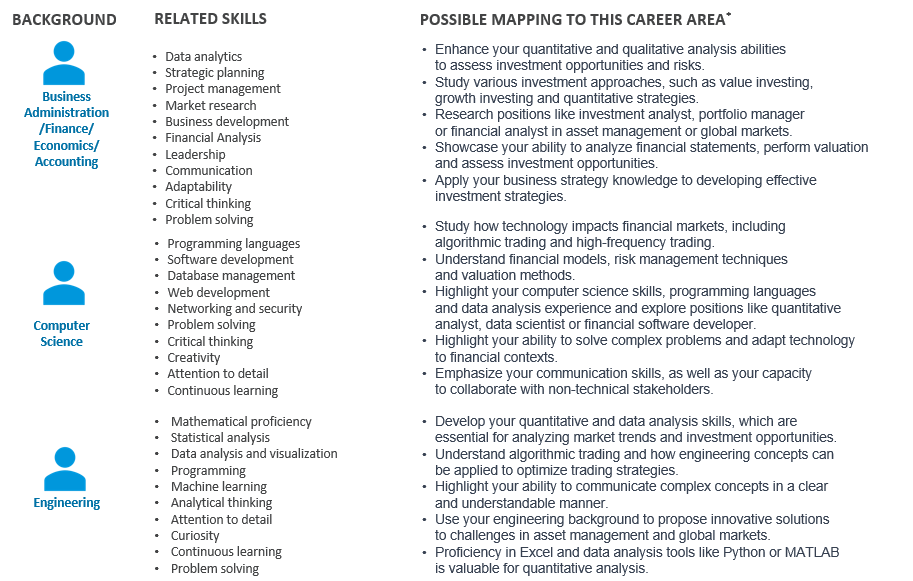
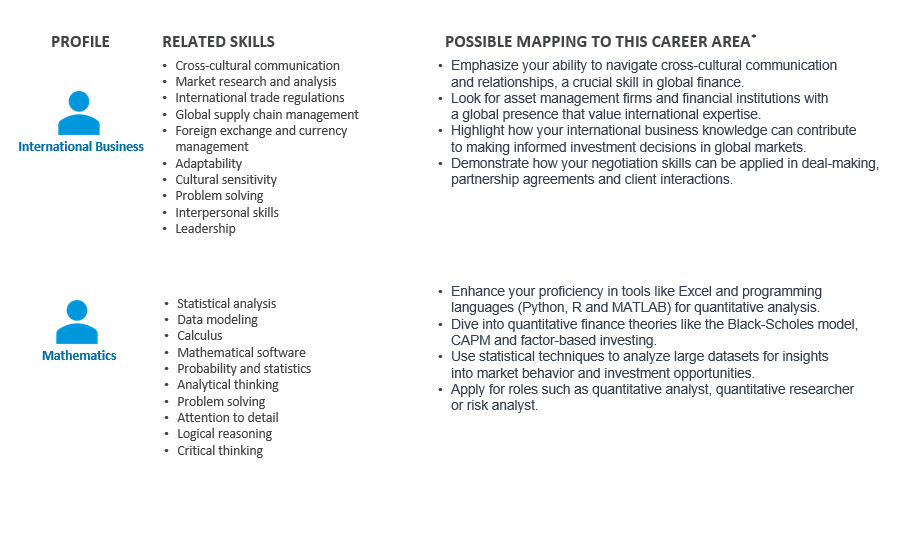
Mapping your background to this Career Area
Exploring jobs in Asset Management & Global Markets
We encourage you to use LinkedIn to explore titles and the availability of jobs within this Career Area. Please watch this brief video outlining how to use LinkedIn’s advanced search function by clicking on the link below.
Sustainable finance refers to the process of taking environmental, social and governance ESG considerations into account when making investment decisions in the financial sector, leading to more long-term investments in sustainable economic activities
and projects. Green banking—or banking pegged to the environmental aspect of ESG issues might just be the hottest topic of today. Impact investing is a strategy that seeks to create a specific positive impact or outcome. What sets it apart from pure philanthropy (like cash donations) is that impact investing includes an expectation of financial returns that are (at least) comparable to market returns.
With as many as 450 financial institutions, banks, insurers and asset managers committing to invest $130 trillion of private money to help the world become a net-zero carbon emitter by 2050, ESG job opportunities in the sector will abound for years to come. That $130 equals approximately 40% of all assets under management, globally.
From now on, financial services firms will have to issue more green bonds, publish mandatory sustainability disclosures, carry out proper climate risk surveillance, increase their global ESG reporting standards, and improve the consistency of data in fields such as climate change.
Sustainable finance roles/jobs in finance that are being created:
Sustainable Finance Investment Banker and Green bonds specialists The green bond market reached record levels in 2023, bringing the total cumulative labelled issuance to $2.3 trillion.
ESG Coverage Bankers Investment banking coverage bankers, in charge of client relationships, will also have to step up their game and ESG knowledge to help pass on the message to clients.
ESG Portfolio Manager (PM)—Integration Asset management firms are hiring ESG-specialist PMs to help governments and corporations undertake their net-zero transitions.
ESG Product Specialist Transitioning to their own sustainability targets will require a lot of explanation to clients, a role that ESG Product Strategists or Specialists will carry out.
Chief ESG Officer Consultancy and accountancy firms, charities and trade finance bodies will need leaders to champion their ESG efforts.
Head of ESG Data Services As an employee or as a consultant, climate change and other sustainability factors will require accurate data in order to value investment projects and assess their risk.
ESG Analyst The “analyst” job may include an entry-level research assistant role or a PhD-educated specialist in deforestation. NGOs and governments are also potential employers.
Impact Investing is not the same as ESG, although there are certainly some common themes. Impact investing often focuses on improving environmental or social outcomes, which is part of peoples’ confusion. But impact investing is not ESG.
ESG is an analysis framework that helps stakeholders understand and manage risks and opportunities within an organization (or a portfolio). And while this framework is often applied to investment decisions and/or analysis (called ESG investing), it’s not the same as deploying funds with the express intention of generating a positive externality or impact beyond the four walls of the organization itself.
To qualify as impact investing, there must be a return expectation that is in line with or greater than that of the market. Of course, expected returns do not necessarily lead to actual returns.
Impact investing can mean many different things and can be characterized in a variety of ways. But for a capital allocation decision to qualify as impact investing, two important hurdles must be cleared::
A positive impact is clearly articulated and outlined; and,
A financial return expectation (at least comparable to the market) must
be intended.
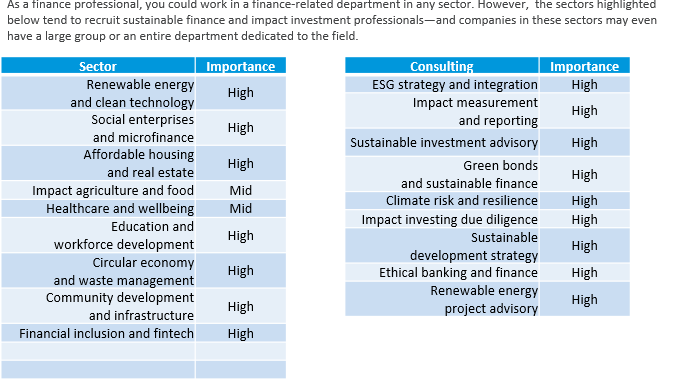
Job landscape
Where do Sustainable Finance & Impact Investing professionals work?
Sectors
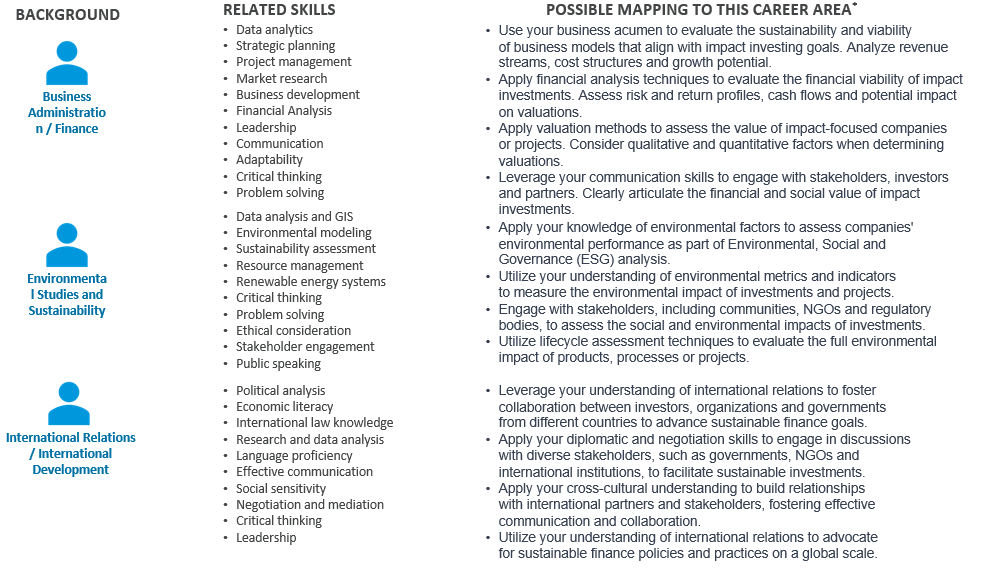
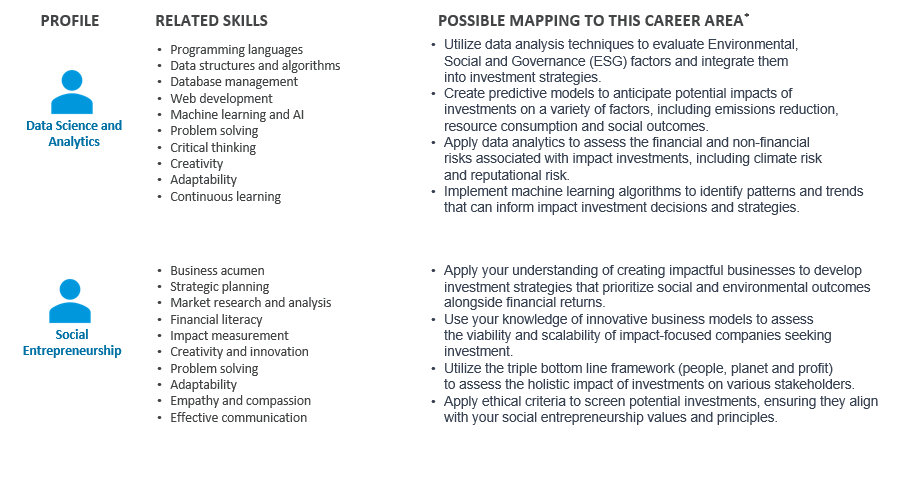
Mapping your background to this Career Area
Exploring jobs in Sustainable Finance and Impact Investment
We encourage you to use LinkedIn to explore titles and the availability of jobs within this career area. Please watch this brief video outlining how to use LinkedIn’s advanced search function by clicking on the link below.
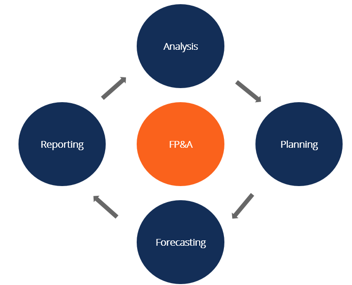
Financial Planning and Analysis (FP&A) teams play crucial company roles by performing budgeting, forecasting and analysis that support the major corporate decisions of the CFO, CEO and the board of directors. Very few, if any, companies can be consistently profitable and grow without careful financial planning and cash flow management. The job of managing a corporation’s cash flow typically falls to its FP&A team and its Chief Financial Officer (CFO).
Corporate financial planning and financial analyst professionals utilize both quantitative and qualitative analysis of all operational aspects of a company in order to evaluate the company’s progress toward achieving its goals, and to map out future goals and plans. FP&A analysts consider economic and business trends, review past company performance, and attempt to anticipate obstacles and potential problems, all with a view toward forecasting a company’s future financial results.
FP&A professionals oversee a broad array of financial affairs, including income, expenses, taxes, capital expenditures, investments and financial statements. Unlike accountants who are in charge of record-keeping, financial analysts are charged with examining, analyzing and evaluating the entirety of a corporation’s financial activities and mapping out the company’s financial future.
Skills for financial analysts are individuals capable of handling and intelligently analyzing a mountain of different types of data and data evaluation metrics. Financial analysts are good problem solvers. They are able to decipher the various puzzle pieces that constitute a company’s finances, and envision putting the pieces together to formulate a variety of possible growth scenarios.
If you just don’t like math or working with spreadsheets like Excel, you may want to consider an alternate career path! However, if you’re a creative problem solver, with a natural or cultivated talent for financial analysis, modeling and forecasting, then becoming a corporate financial analyst may be the perfect career choice for you.
Corporate financial planning and analysis (FP&A) is a career choice that offers a wide variety of opportunities and higher-than average compensation. With the proper skill set and a natural inclination for the work, you can carve out a very satisfying career for yourself as a corporate financial analyst.
Corporate FP&A plays a major role in supporting decisions made by a company’s CEO, CFO and the executive leadership team. As such, the opportunity to add value in FP&A is huge, and having a good team in place can lead to a huge potential boost in cash business planning, including budgeting, forecasting, cash flow optimization, return on investment analysis, capital structure and ultimately the value of the entire business.
FP&A Salary and career journey
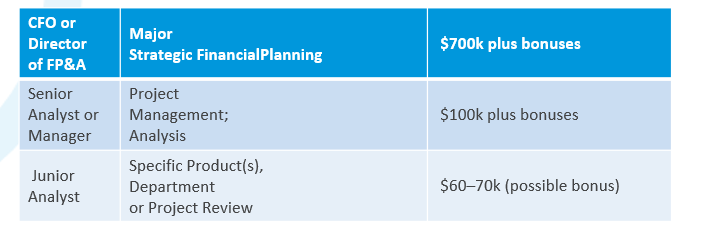
It typically takes about three to five years to make the transition from a junior to a senior financial analyst. Along the way, you might have the opportunity to showcase your skills, getting assigned the title of manager—in charge of a specific financial project, such as changing the way the company does inventory reporting or overseeing a substantial capital expenditure project. See tentative salaries in the chart below:
Job landscape
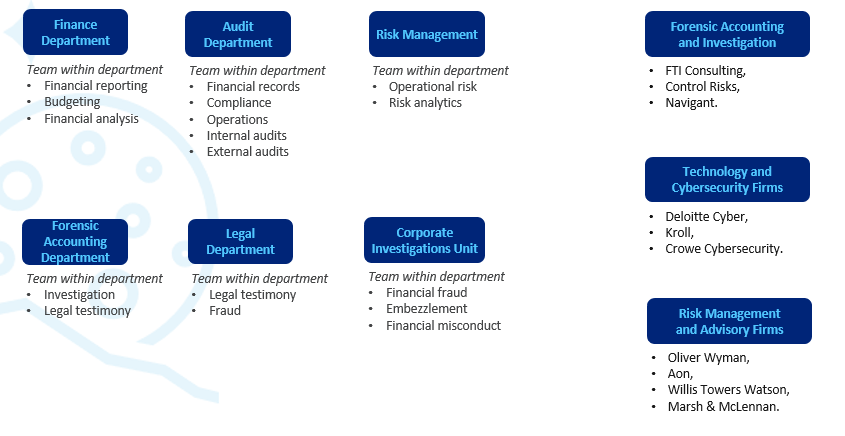
Where do Financial Control, Forensics & Audit professionals work?
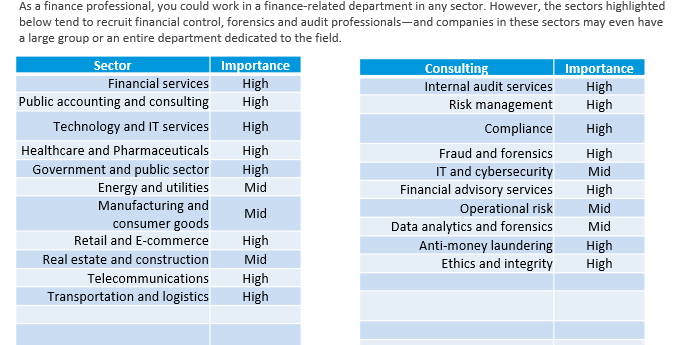
Sectors
Mapping your background to this Career Area
Exploring jobs in Financial Control, Forensics and Auditing
We encourage you to use LinkedIn to explore titles
and the availability of jobs within this Career Area.
Please watch this brief video outlining how to use LinkedIn’s advanced search function by clicking on
the link below.