Fostering Innovation, Policy and Impact Through Social Sciences Research

On May 6–7, 2025, IE University hosted the CIVICA Global Forum, a landmark event titled “Leveraging Social Sciences in Higher Education: Navigating Global Challenges and Complexities.” The forum brought together leaders from academia, public policy, international organizations, and the private sector to explore the transformative potential of social sciences in shaping inclusive, resilient, and forward-looking societies.
The event opened with remarks from Manuel Muñiz, Provost of IE University, who underscored the critical role that universities—and university alliances such as CIVICA—play in addressing today’s most pressing global challenges. In an increasingly fragmented and multipolar world, institutions of higher education must act as bridges: between disciplines, between nations, and between knowledge and action.
Reimagining Europe’s Future: Enrico Letta and the Fifth Freedom
A keynote address was delivered by Enrico Letta, Dean of the School of Politics, Economics and Global Affairs. Reflecting on his Much More Than a Market report, Letta called for the integration of a “fifth freedom” into the European project: the free movement of innovation, research, and education. According to this vision, the existing four freedoms of the European Single Market—movement of goods, services, people, and capital—are no longer sufficient to meet the demands of a rapidly changing world. Letta stressed that embracing this fifth freedom is essential for Europe to enhance its competitiveness, preserve democratic values, and lead globally in knowledge production and civic engagement.
Higher Education in Uncertain Times: The CIVICA Leadership Panel
The forum’s core discussions began with the CIVICA Leadership Panel, “Higher Education in Uncertain Times: Geopolitics, Climate Change and the Growing Impact of New Technologies.” Moderated by Waya Quiviger, Professor of Practice at IE School of Politics, Economics and Global Affairs, the session featured leading figures from the CIVICA alliance: Manuel Muñiz, Provost of IE University and Chair of IE New York College; Tymofii Brik, Rector of the Kyiv School of Economics; Cornelia Woll, President of the Hertie School; Carsten Q. Schneider, Interim President and incoming Rector of Central European University; and Jeremy Perelman, Vice President for International Affairs at Sciences Po.
Panelists explored how higher education institutions must evolve to remain resilient in the face of mounting global instability. They emphasized the importance of foresight exercises, interdisciplinary research, and challenge-driven approaches to prepare for technological shifts and geopolitical disruptions. Institutions must function not just as knowledge hubs, but as public service actors embedded in both global and local ecosystems.
Speakers addressed why universities are increasingly becoming targets in ideological and political struggles: as creators of knowledge, they are centers of power and influence. This necessitates a defense of methodological rigor, freedom of inquiry, and academic spaces as ideologically independent arenas. Emphasis was placed on teaching students not what to think, but how to think—and on educating for the common good through civic engagement and public-minded scholarship.
The discussion also explored how universities can strengthen their societal relevance, particularly in the face of growing mistrust, political polarization, and the politicization of science. Speakers called for a renewed commitment to pluralism, intellectual diversity, and the creation of inclusive environments where all perspectives are welcomed.
A timely point of reference was the recent controversy surrounding Harvard University, raising concerns over academic freedom and the risk of brain drain in the U.S. context. While not a moment to celebrate, the situation was viewed as an opportunity for European universities to assert their leadership in upholding values of openness, critical thought, and social responsibility.
The panel also reflected on the financial vulnerabilities of higher education worldwide. In the current landscape, no funding stream—public, private, or philanthropic—can be considered entirely secure. Institutions must actively pursue diversified funding models and cross-border alliances to ensure their sustainability.
Lastly, speakers emphasized that the most vital contributions of universities lie in their intangible assets: their commitment to knowledge creation, innovation, civic formation, and social values. Even in times of scarcity, these qualities can become sources of institutional strength.
Fostering Innovation, Policy and Impact Through Social Sciences Research
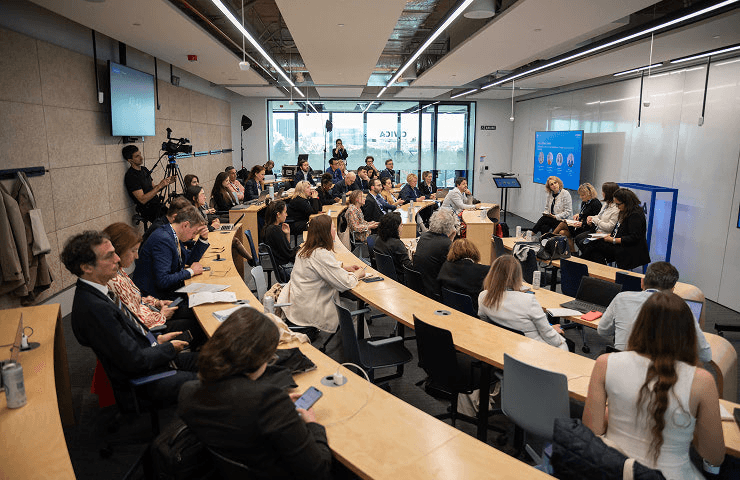
Following the Leadership Panel, the forum continued with a thematic breakout session titled “Fostering Innovation, Policy and Impact Through Social Sciences Research,” moderated by Ilke Toygur, Director of the Global Policy Center. Panelists included Marina Cino Pagliarello, Professor at the European University Institute; Valentina Tartari, Professor at the Stockholm School of Economics; and Dina Waked, Dean of the School of Research at Sciences Po.
This session addressed the unique contributions of social sciences to policy and societal transformation. Panelists discussed how democratic challenges—such as polarization, inequality, and institutional fragmentation—highlight the need for bottom-up, trust-based, and relational approaches rooted in social sciences.
One central theme was the difficulty in measuring the impact of social science research compared to STEM fields. While the latter often yields quantifiable outputs, the former deals with complex, long-term societal dynamics. Universities and classrooms remain key vectors for disseminating social innovation and building the next generation of engaged citizens.
Panelists highlighted persistent gaps between academia and policymaking, noting that institutional incentives rarely reward policy engagement. Evaluation systems, career structures, and remuneration models need reform to encourage researchers to contribute to public debates and policymaking processes. There was also consensus on the need for interdisciplinary skills and new communication strategies to translate rigorous academic work into actionable insights.
Another key insight was the epistemological challenge of policy engagement in the Global South. Participants stressed the importance of recognizing diverse knowledge systems and avoiding the imposition of Western-centric frameworks. Co-production of knowledge, rather than unidirectional transfer, is essential for creating inclusive, equitable policies.
Panelists also discussed the tension between research complexity and policy ‘simplicity’. While researchers often seek to explore and complicate issues, policymakers need clear, actionable solutions. Still, scholars can play a critical role by helping policymakers frame questions more rigorously, while also becoming more responsive to the urgency and constraints of the policy world.
Finally, the discussion broadened to question how innovation is framed in policy terms—whether it is seen as progress, welfare, development, or growth. Regardless of the framing, participants agreed that innovation must be grounded in public service and contribute to collective problem-solving.
Looking Ahead: The Role of the Global Policy Center
The Global Policy Center at IE University reaffirms its commitment to bridging the gap between research and policy. As an institution embedded within a university, it plays a vital role in addressing the challenges of today’s fragmented and multipolar world. By fostering collaboration between scholars and decision-makers, supporting interdisciplinary inquiry, and promoting evidence-informed policymaking, the Center aims to contribute to building more resilient, inclusive, and innovative societies.
In an era marked by uncertainty, universities are not just transmitters of knowledge—they are architects of the future.