GPC Chair and Dean Enrico Letta highlights the need for Europe-Latin America cooperation at the International Economic Forum Latin America and the Caribbean 2026

On January 28th and 29th, the International Economic Forum Latin America and the Caribbean 2026 was held in Panama City, organized by CAF Development Bank of Latin America and the Caribbean in partnership with the Government of Panama. The high-level forum brought together political leaders, senior policymakers, economists and business executives to discuss the region’s economic outlook and its role in a rapidly changing global order.
Enrico Letta, Chair of the Global Policy Center and Dean of IE School of Politics, Economics & Global Affairs, took part in the panel "Latin America, the Caribbean and Europe: Toward a New Shared Strategic Agenda." Other panelists included Josep Borrell, former Vice President of the European Commission and Advisory Board member for the Global Policy Center; Iván Duque, former President of Colombia; Laura Chinchilla, former President of Costa Rica; Eduardo Frei, former President of Chile; and moderator Andrea Rizzi, Global Affairs Correspondent and columnist for El País.
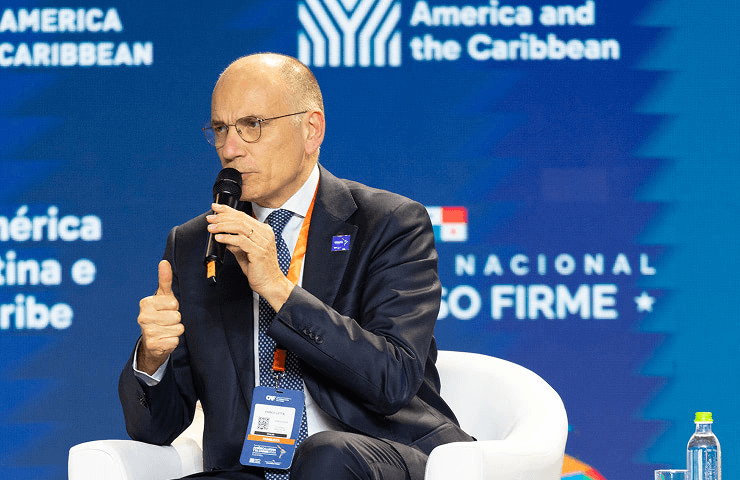
The discussion focused on the need for renewed strategic partnerships between Europe and the region amid geopolitical tensions, global fragmentation, and the green and digital transitions. Borrell described a world divided by ideological and strategic lines, and stressed that closer Europe-Latin America ties could serve as a counterbalance to disruptions in the international order. He described the Trump administration as a "disruptive factor" signaling "a radical change" in global security dynamics.
Borrell noted that both regions remain divided, but closer engagement between them could serve as a counterweight to global disruptions. Yet, he also stressed the asymmetry of the relationship: Latin America relies heavily on European markets, while Europe has a more limited interest in the region’s market. Commenting on economic ties between the continents, Duque highlighted the need for sustained trade strategies, noting that European investment in Latin America has slowed and that agreements such as Mercosur–EU remain incomplete.
Letta pointed out a shift in global trends of economic interdependence, noting, "Globalization is moving towards regional integration in different continents. It is less intercontinental and more intracontinental." He highlighted the importance of strengthening internal cooperation to remain relevant on the global stage. "The economy of the future will be dominated by three major actors: the United States, China, and India. For Europe and Latin America, integration within our regions and collaboration between us are the only viable paths," he added.
Commenting on similarities between the regional weaknesses of Europe and Latin America, Letta said, "We know that we are not autonomous. We are not technologically, financially, or energetically independent, and we must do something to become autonomous and independent." He added that both regions must work together to support multilateralism and effective international institutions, and see agreements like Mercosur as an opportunity rather than a challenge.
Beyond this session, the Forum addressed a wide range of themes, including macroeconomic stability and fiscal space, development banking and investment, clean energy and the energy transition, digital innovation, South–South cooperation and results-oriented diplomacy. Across plenaries and panels, participants explored how the region can enhance competitiveness, attract investment and position itself as a provider of solutions to global economic and political challenges.