Harmonising European power: the Global Policy Center hosts high-level debate on strategic autonomy

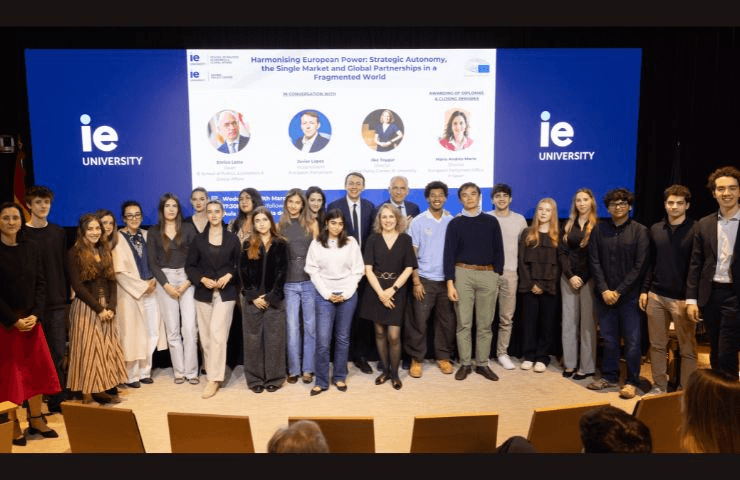
On Wednesday, March 18th, the Global Policy Center, in collaboration with the European Parliament and IE School of Politics, Economics & Global Affairs (SPEGA), hosted a landmark event titled "Harmonising European power: strategic autonomy, the Single Market and global partnerships in a fragmented world." The session served as the closing ceremony for the joint EU–European Parliament course on European Affairs, "Decoding Europe: integration and strategic autonomy in times of global change."
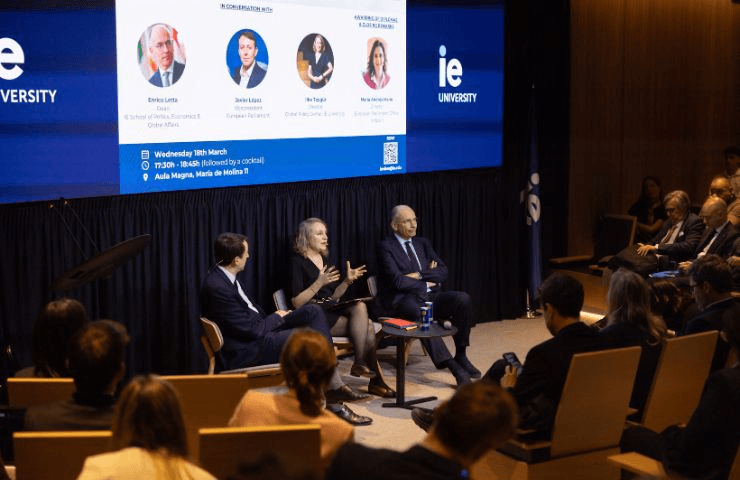
The discussion featured Javi López, Vice-President of the European Parliament; Enrico Letta, Dean of IE School of Politics, Economics & Public Affairs and former Prime Minister of Italy; and Maria Andrés Marín, Director of the European Parliament Office in Spain. The session was moderated by Ilke Toygür, Director of the Global Policy Center, who framed the dialogue not as a response to "doom scenarios," but as a spotlight on the authentic sources of European power.
A transition moment for the 21st Century
In her opening remarks, Dr. Toygür noted that for the EU, the challenge is no longer just surviving the decline of a rules-based order: "This is not a limited crisis; it is a transition moment." The panelists addressed how this shift, compounded by years of intense external shocks and growing internal pressures like rising populism and political deadlocks, demands a reimagined European project. Navigating this era requires a project specifically adapted to the technological, decarbonization and defense realities of the 21st century.
When asked if the EU can move beyond the paralysis of unanimity, Javi López was emphatic: "We need to move faster. We must use 'passerelle clauses' for majorities and end the tyranny of unanimity, particularly in foreign policy." However, he cautioned that this agility must be anchored in democratic legitimacy and accountability. "Our main problem is not institutional; it is one of political will," López stated. "We need a 'mindset emancipation.' Europe is not a geopolitical appendix to anybody. We must have the courage to say 'no' when something goes against our interests."
Trade as the antidote to protectionism
Enrico Letta addressed the vital link between the 2028 Single Market reform deadline and global trade agreements with regions like India and MERCOSUR. Letta used the beauty and wine industries, where Europe leads globally, as proof that openness is the EU's greatest strength.
"Protectionism is our enemy; it will kill Europe," Letta warned. He argued that European competitiveness depends on the ability to export goods to global markets, making fair trade frameworks with partners like India, Indonesia, Mexico and MERCOSUR essential. He dismissed the protectionist or racially motivated opposition often championed by the far right, noting that while short-term disruptions often spark controversy, the long-term benefits of open markets make them the only viable path forward. Ultimately, he emphasized that Europe’s global influence is strongest when the Union acts and speaks with a single, unified voice.
The MERCOSUR "stress test"
The focus shifted to the EU–Mercosur agreement, described as a strategic pivot for supply chain resilience. Javi López characterized the deal as a "stress test" for Open Strategic Autonomy (OSA).
"We gain autonomy, power and a global voice with MERCOSUR," he argued. Beyond a shared history, López emphasized that the partnership is anchored in common economic interests and the need for a predictable supply of raw materials for the green and digital transitions. For the Union, the true measure of its strategic maturity lies in the ability to move in the right direction despite the inevitable internal political costs.
China, India and the US
The event concluded with a vibrant Q&A session. Regarding China, Letta noted its fundamental role in reforming multilateralism and the need to maintain an open relationship with the Asian giant. On the US, López argued that while the transatlantic bond is a backbone of the liberal order, Europe must react to a current US strategy that seeks to "divide and submit" Europe.
On India, Letta expressed optimism about the UE–India free trade agreement: "India will be the next China. It is a key market for our services and goods, and it is incredibly innovative."
María Andrés Marín provided the closing remarks, echoing the need for political will combined with education and innovation. "We need critical thinkers and strong networks to navigate this fragmented world," she concluded.
A shared space for future leaders
The seminar also provided a unique platform for the next generation of policymakers to engage directly with the architects of European strategy.
Reflecting on the impact of the program, Gabriela Vara noted: "The experience at the advanced seminar was amazing all around. The opportunity to have in-depth conversations on current EU policies, future operational targets or geopolitical complexities with the same professionals who are leading these discussions was completely unique. Overall, incredibly thought-provoking sessions."
For Kiara Horváth, the value lay in the seminar's ability to bridge the gap between theory and practice: "Participating in the Decoding Europe Advanced Seminar was an opportunity to not only gain a comprehensive understanding of the EU, but also get involved in the academic debate surrounding the biggest challenges Europe is currently facing. The interactive nature of the seminar stood out to me in particular, through which the processes of the EU changed from abstract political issues to a firsthand opportunity to deepen my knowledge and incorporate new perspectives. The diverse backgrounds of both the students and faculty present in the seminar also created a unique space in which personal experiences and skills added greatly to creating a multilateral approach, reflecting the complexities of understanding Europe’s and the EU’s internal differences, and their place in the globalized world."