A new security architecture? Think 20 summit debates EU security and defence partnerships with India, Brazil, and South Africa

The Global Policy Center (GPC) launched its latestreport, "Strategic Convergence? The Security Partnerships of the European Union and the Global South(s)", during a plenary session at the Think 20 (T20) Summit in Johannesburg, South Africa, last Thursday, November 13, 2025.
The report's findings, co-authored with researchers from the Observer Research Foundation (ORF), the Brazilian Center of International Relations (CEBRI), and the Institute for Global Dialogue (IGD), were presented amidst the summit’s constructive spirit, allowing to foster strategic engagement among policy experts from G20 countries and deepen discussions on global cooperation.
"Strategic Convergence?” assesses the potential for strategic alignment between the European Union (EU) and major Global South nations (India, Brazil, and South Africa) amidst accelerating global securitization and multipolarization. It underscores the urgent necessity for the EU to recognize Global South's countries role as indispensable security architects, rather than merely recipients, of a reformed global security architecture. The analysis highlights the shift required to move from reactive strategies toward establishing pragmatic, issue-based alliances rooted in mutual understanding and shared interests with like-minded partners.
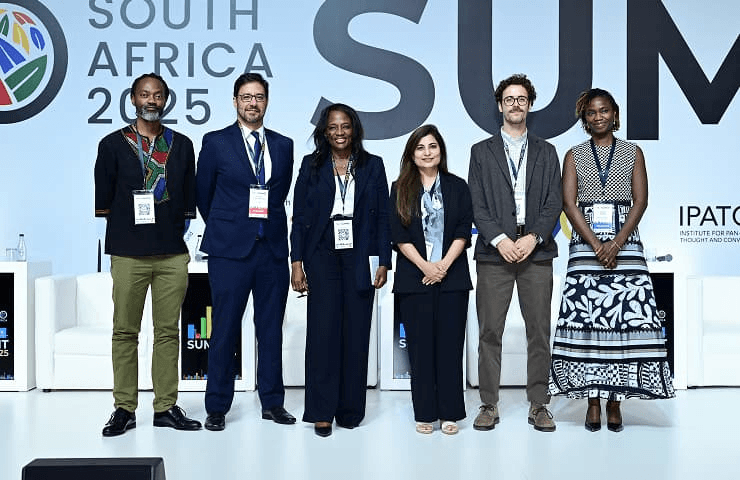
The panel featured the report’s coordinator, Luis de Lossada i Gallart, alongside co-authors Philani Mthembu, Feliciano de Sá Guimarães, and Shairee Malhotra. Beatrice Grace Obado expertly moderated the exchange. The session was opened by Eniola Harrison with institutional remarks about the GPC’s commitment to fostering international dialogue.
A policy roadmap for EU-Global South(s) security cooperation
The panel focused on implementing a fundamental shift in the EU’s foreign policy approach to ensure a more adaptable, inclusive, and legitimate global security governance framework. Various policy recommendations were debated and presented:
Solidifying partnerships and financial commitments. The panel stressed the urgency for the EU to become a more reliable and predictable security partner via the signature of Security and Defence Partnerships (SDPSs), arguing for incentives like the proposed Strategic Partnership Plus (SPP) framework to deepen political commitment with Global South countries. Moreover, Luis de Lossada emphasized the need for 'principled pragmatism' in the EU’s 2028-2034 Multiannual Financial Framework (MFF), ensuring that security instruments (like the European Peace Facility or the Security Action for Europe) are complementary to, and do not undermine, vital funding for sustainable development and the SDGs. A solid link between SDPs and SGD’s 16 (Peace, justice and strong institutions) and 17 (Partnerships for the Goals) was also considered key in the future of the EU’s security and defence relations with the Global South(s).
Accelerating the EU-India security partnership and technology integration. The discussion highlighted that overcoming hurdles in the EU-India partnership requires immediate, decisive action on institutional frameworks, including, among others, accelerating the conclusion of the Security of Information Agreement (SIA) and the Free Trade Agreement (FTA). Furthermore, Shairee Malhotra called for the EU to proactively streamline export controls, identify specific technologies for sharing, and prioritize joint R&D initiatives, potentially integrating India into mechanisms like the EU Defence Innovation Scheme (EUDIS).
Strengthening EU-Brazil defence and transnational security convergence. Feliciano de Sá Guimarães advocated for a dual-track approach focused on defence and security in the EU-Brazil relationship. Key proposals included moving advanced industrial collaboration beyond bilateral projects to EU-level joint ventures in high-tech domains like space and cybersecurity. Furthermore, the author argued that cooperation must be formally strengthened against shared threats like transnational organised crime and illicit financial flows, with dedicated EU financing aligned with Brazil’s priorities for climate and environmental security.
Prioritizing development and multilateralism in EU-South Africa relations. The discussion on South Africa centered on the need for the EU to prioritize security through development over immediate defence cooperation. Philani Mthembu’s recommendations included strengthening multilateral cooperation by supporting and formalizing closer ties between the UN Security Council and the AU’s Peace and Security Council, and ensuring sustained funding for pan-African conflict-resolution initiatives and key South African projects like the Just Energy Transition.
The panel agreed that, by working on the previous recommendations, SDPs could really become a concerted effort to demonstrate that alliances grounded in democratic values and strategic cooperation can drive a more resilient and sustainable future, making SDPs a vital, dual-purpose tool for both security and development.
Explore the full report here.