


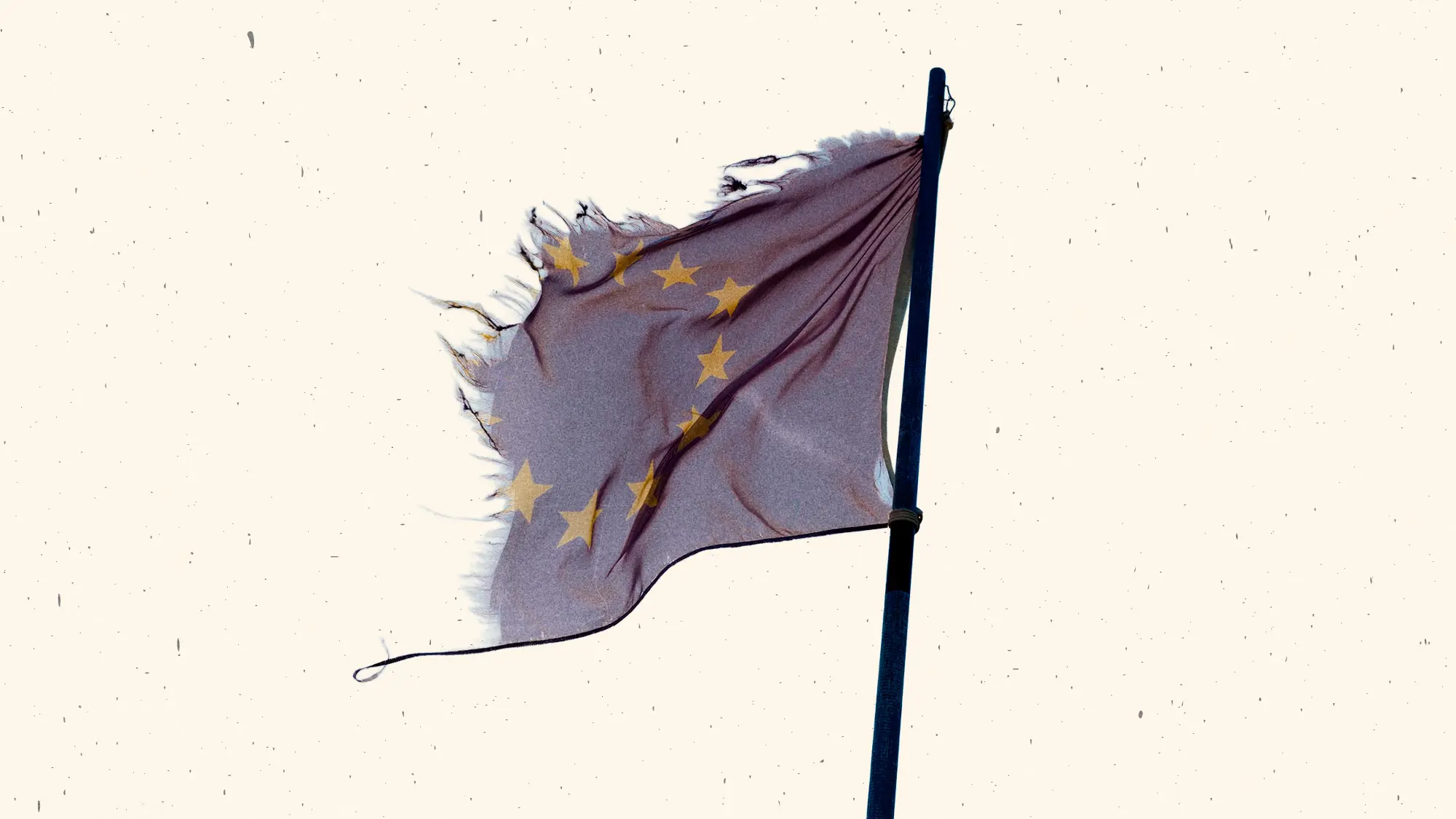
At first glance, Europe does not appear to be in crisis. Restaurants are full, museums are crowded, café terraces spill out onto cobblestoned streets under summer light, and the architecture – centuries of accumulated beauty – makes the rest of the world feel newly built and slightly embarrassed. The quality of life is genuinely high. Nobody is suffering visibly. The lights are still on across the EU, and that might be part of the problem.
The most dangerous kind of decline is the kind that feels comfortable. When warning signs look like prosperity and structural weaknesses hide behind a functioning welfare state and a strong cultural inheritance, the gap between how things feel and how things are can grow dangerously wide. Europe is in that gap right now, and most Europeans may not fully recognize it.
What the numbers actually say
Start with growth – the most honest summary statistic of an economy’s vitality. Over the past decade, the US averaged GDP growth of around 2.5% annually. Europe averaged 1.7%. The gap sounds modest until the mathematics of compounding over time are applied: small differences in growth rates, sustained over years, produce dramatically different outcomes in living standards, tax revenues, and the capacity to fund public services. According to the European Commission, the Eurozone is projected to grow at just 0.9% in 2026. Germany, the continent’s industrial engine and largest economy, posted near-zero growth in 2025 after two consecutive years of stagnation.
Europe’s labor productivity growth has fallen by an average of 1.2% annually from 2000 to 2025, resulting in almost stagnant growth of just 0.2% in the period from 2022 to 2025. This is not a cyclical problem, not a few bad years that a rate cut and a stimulus package can fix. It is structural, which means it compounds silently and resists quick solutions. When GDP per capita grows by 2.5% to 3.0% each year, incomes double every 25 to 35 years. When it slows to 0.5% to 1.0%, doubling incomes can take 80 to 100 years. Europe is moving toward that second scenario.
The Draghi Report, the landmark competitiveness assessment commissioned by the European Commission and authored by former ECB President Mario Draghi, put it starkly. Draghi identified the digital and innovation gap as a central structural weakness in European competitiveness. Around 70% of the EU’s per capita GDP gap with the United States can be attributed to lower productivity, driven largely by the relative weakness of the European information and communication technology sectors.
Of the world’s 50 largest technology firms, only five are European: ASML (Netherlands), SAP (Germany), Spotify (Sweden), Adyen (Netherlands), and Arm Holdings (UK). Not five of the top ten. Five of the top fifty.
The AI gap is not closing – it’s widening
In the technology likely to define the next 30 years, Europe is not in the race. The US produced 40 notable AI foundation models last year. China produced 15. Europe produced three. The EU has roughly 5% of the world’s total AI computing power, compared to the US which has 74% of global high-end AI compute, and China which has 14%. While the US and China dominate AI unicorn creation, Europe converts just 1.5% of seed-stage AI companies into unicorns, compared to 4.8% in the US.
The EU invested only €252 billion in venture capital over the entire five-year period from 2020 to 2025 – across all sectors, not just AI. The ambition sounds large until you note that OpenAI alone plans to invest $500 billion into AI infrastructure over the next four years. Europe’s entire public AI initiative is smaller than one American company’s capital expenditure commitment.
Only three of the world’s 39 AI unicorns are European. Three out of four European AI PhD students trained at American universities remain in the US for at least five years after graduating. Even when the talent is European, the value creation often happens elsewhere (and mostly in the US).
The regulation designed to govern AI arrived before Europe had meaningful AI to govern. The EU AI Act, the world’s first comprehensive AI law, emphasizes responsible AI development, strict data protection, and user privacy. These are not unreasonable goals, but the compliance burden lands heaviest on the companies least able to absorb it: early-stage startups trying to compete with well-capitalized American and Chinese peers.
The lifecycle of a venture-funded company is usually to build until it can sell to Big Tech or go public. For European venture capital-funded companies, the incentives increasingly point toward relocating, and mostly to the US. The rules did not slow down OpenAI or ByteDance. They slowed the founders who might have competed with them.
You cannot compete in an AI race you cannot power
There is another constraint rarely acknowledged in European political debate: energy. The infrastructure of the AI era cannot operate competitively on the world’s most expensive electricity. EU electricity prices for energy-intensive industries remained more than twice US levels in 2025 and nearly 50% above those in China.
Gas prices in the EU reached four times those in the US during the first half of 2025. The consequences for industry are already visible. The European chemical industry has shut over 100 facilities since early 2024, shedding tens of thousands of jobs. Data centers, the physical infrastructure of AI, require enormous quantities of reliable electricity. Ireland, which had attracted significant technology investment for years, has now imposed a moratorium on new data center construction because its grid cannot handle the load. You cannot host the AI revolution when you cannot power the servers.
Both superpowers have understood that energy abundance is a strategic necessity. China invested over $1 trillion in clean energy in 2025. The US benefits from the double advantage of cheap domestic shale gas and the massive capital commitments of Big Tech. Europe, caught between its green transition ambitions and energy security vulnerabilities, faces industrial costs that make large-scale AI infrastructure difficult without substantial state support.
A fragmented continent
The aggregate European numbers are concerning. The disaggregated picture, particularly in Central and Eastern Europe, is worse. Population decline and outward migration are reshaping parts of the region, as working-age and highly skilled individuals relocate to stronger labor markets within the EU.
The World Bank shows regional growth in Central and Eastern Europe decelerating to around 2.5% in 2025-2026, well below the 4% average of the prior decade. Nearly 50 European regions are now classified as caught in “development traps,” concentrated in Bulgaria, Romania, Hungary, Croatia, and parts of Poland. These are not countries that are falling behind on some narrow metric; they are countries where the most productive people are voting with their feet, systematically and at scale.
The EU’s freedom of movement – designed as a strength, a symbol of integration – has, in some cases accelerated the outflow of human capital from the continent’s weaker economies.
The physical architecture of these cities remains beautiful. The culture endures. But economic energy, literally and figuratively, is increasingly uneven across the EU.
A growing bill
One more number reframes everything else: Europe’s decades-long underinvestment in its own security is now due. Russia’s invasion of Ukraine shattered the assumption that the continent’s post-Cold War security order was stable. NATO commitments, long honored in the breach, are now politically unavoidable. McKinsey estimates Europe will need to reach €800 billion in defense spending by 2030 to meet its obligations.
That funding must come from the same stagnant economies, constrained public budgets, and tax bases already supporting healthcare systems, pensions, and energy subsidies. Rearmament becomes more complex when industrial capacity is under pressure, talent is mobile, and technology gaps are widening. The central question is whether the EU’s political systems can make the necessary tradeoffs before circumstances force them.
The problem with feeling fine
There is a version of this story that ends well for Europe. Even moderate AI productivity gains in the coming years could be meaningful relative to Europe’s anemic economic growth prospects. Europe has genuine strengths – in research, in specialized industrial sectors, and in the quality of its scientific institutions. The Nordics, in particular, have developed AI ecosystems that punch above their weight. But these strengths do not automatically translate into sustained competitiveness. They require capital, urgency, and the willingness to make uncomfortable choices – about regulation that protects incumbents rather than enabling challengers, about energy policy that prioritizes ideological consistency over industrial competitiveness, about the talent that leaves and does not return.
As Belgian data scientist Robert Praas put it plainly: “We want to get away with not investing enough and still being competitive. But with our current investment level, we should not really be looking at the United States and China, because they operate at another level.”
The visible signs of prosperity will continue for some time. Living standards remain high, buffered by accumulated wealth and functioning institutions. But the global economy is reorganizing around technologies and capabilities that Europe is not building at scale, powered by energy it struggles to provide competitively at a speed its regulatory frameworks were not designed to accommodate.
The gap between how things feel and how things are will not remain wide forever. When it closes, it is unlikely to do so gradually, or pleasantly.
What Europe can still do
A difficult time is about to emerge: Europe is unlikely to lead the race to build frontier AI, be relevant in semiconductor supply chains, or scale next-generation automation technologies. The gap in compute, capital, talent pipelines, and deployment scale between Europe and the leading ecosystems is substantial and still widening. Accepting this is not defeatism, it is the beginning of strategic clarity.
What Europe does possess is different and potentially just as important in a world that is moving faster toward a more automated, more algorithmically mediated reality. A long-standing tradition of approaching technology through a human lens: not just what can be built, but what should be built, for whom, and at what cost. In a world where AI is often driven by performance metrics and profit, that perspective is a scarce and valuable thing.
It opens up the possibility of leadership in areas where technological capability intersects with societal impact. In healthcare, this could mean applying AI not only to efficiency, but to long-term care systems for aging populations. In education, it could mean rethinking learning in an AI-mediated environment. In scientific research, it could mean advancing innovation with governance models that balance speed with appropriate responsibility. It could be the arena where AI-assisted research in climate, materials science, or drug discovery is governed by principles that the rest of the world eventually has to adopt, because Europe insisted on them first.
The welfare state that Europe built over the past century – imperfect, strained, expensive – also functions as infrastructure. It provides an opportunity for AI to be deployed in ways that are more inclusive, more stable, and more socially embedded than purely market-driven systems. The question is not whether Europe can replicate Silicon Valley or Shenzhen. It cannot.
The question is whether Europe can lead in shaping how these technologies work for ordinary people, at every stage of life, without leaving entire populations behind in the transition.
The future being built right now looks more unrecognizable by each month. Ensuring that it remains livable may prove to be one of the most important roles of all. And it may be the one that Europe, if it aligns its capabilities with strengths, is actually uniquely positioned to play.
© IE Insights.