


For decades, universities benefited from a world that was becoming more interconnected. International student mobility was increasing, research collaboration flourished across borders, and academia operated within a global marketplace of talent and ideas. While governments competed for economic and political influence, higher education has been considered a universal good, driven by openness, exchange, and cooperation. Today, that idea is being put to the test.
The rivalry between great powers, the fragmentation of globalization, rising inflation, and artificial intelligence are now redefining the conditions under which educational institutions are accustomed to operating. Talent, knowledge, innovation – these have become strategic assets, meaning that universities are no longer seen as detached from the dynamics of power and national ambitions but are increasingly becoming tools of competitiveness and geopolitical influence.
Student mobility, talent attraction, and scientific and technological advancement are increasingly associated with a country’s power and economic competitiveness. Nations such as the United States, China, the United Kingdom, and the UAE have consequently dedicated significant resources to attracting talent and strengthening their innovation ecosystems. This is known as the talent economy – a model in which human capital, innovation, and knowledge become primary drivers of economic development.
For universities, this shift is important because while the core mission of higher education remains unchanged, the environment in which they pursue it is increasingly shaped by geopolitical competition and disruption. The first signs of this are already becoming evident. While the number of international students worldwide grew from 2.1 million in 2000 to nearly 6.9 million in 2022, many of the leading destination countries have begun to tighten their immigration policies. In the United States, the Trump administration has made it more difficult for students to obtain study visas. The F-1 visa rejection rate reached 35% in 2025, contributing to a 17% decline in the number of incoming international students. Meanwhile, countries such as Canada and Australia, long regarded as champions of educational internationalization, have introduced measures aimed at limiting the inflow of foreign students.
The same trend can be observed in the field of research. Measures such as the US’s CHIPS and Science Act and the Joint Research Centre (JRC) Strategy 2030 of the European Commission have introduced a new reality: international research collaborations are increasingly being assessed through the lens of national security. As a result, certain areas of research and partnerships are becoming more restricted.
However, these measures are creating a new challenge: while governments seek to protect strategic sectors such as AI, semiconductors, and biotechnology, they are simultaneously restricting the flow of talent needed to remain competitive. A study by McKinsey & Company found that, as a consequence of these new constraints, the United States could face a shortage of as many as 300,000 workers in the semiconductor industry. This highlights that universities and research institutions increasingly find themselves at the intersection of international cooperation and strategic competition.
Demographic shifts are also redrawing the global talent map. Africa will account for more than half of global population growth by 2050, with its working-age population representing 85% of the increase in the global labour force — yet Western universities are failing to capture this potential. The barriers are structural: high tuition fees, limited scholarships, currency instability, and restrictive visa policies price out or deter most African students. Credential recognition gaps further filter qualified candidates before they apply. Meanwhile, South-South alternatives are growing fast, with China, Turkey, and regional hubs actively competing for African talent through deliberate scholarship and soft power strategies. In East Asia, the dynamic differs – the barriers are a bit less financial than cultural and pedagogical. Together, these trends suggest that Western universities risk missing the most significant talent pool of the coming decades, not only because of external barriers, but because they have yet to build the ecosystems of access, recognition, and opportunity that would make enrolment a genuine investment for students from these regions.
Just as geopolitics is redefining the environment in which universities operate, economic forces are reshaping their capacity to do so. Economic forces are transforming the sustainability and growth prospects of the education sector, forcing institutions to rethink how they will finance their future.
The first of these is inflation. Educational institutions are facing mounting financial pressure: struggling to absorb rising costs while operating with increasingly constrained revenues. Global inflation surpassed 8% in 2022, the highest level seen in decades, driving up both operational costs and the ability of families to afford an international education. In the United States, the cost of higher education has more than tripled since 1980. In 2022 alone, institutional expenditures rose by 14.9%, while revenues declined by 5.4%. Meanwhile, in the United Kingdom, nearly half of all universities are facing fiscal deficits, driven largely by declining international student enrolment and rising operational costs.
Financial pressures are quietly narrowing who gets to participate in international higher education.
Adding to these pressures is a growing trend toward reduced public spending on education. Many governments, particularly in the Global South, are facing increasingly constrained budgets in healthcare, pensions, and education. In 2023, more than 40% of the world’s population lived in countries that spent more on servicing external debt than on education or healthcare. Research by the World Bank has shown that a 1% increase in external debt is associated with a 2.9% decline in per-child investment in school-age education. This has created a troubling paradox in education financing: the higher a country’s debt burden, the lower its capacity to invest in future generations.
Exchange rate volatility is also reshaping who can access an international education. For thousands of students from economies with unstable currencies, macroeconomic conditions have become an important factor in their decisions. A 2023 survey found that 51% of international students reconsidered their study plans due to fluctuations in exchange rates, while four in ten reported lacking sufficient financial resources to cope with the rising cost of living in their destination countries.
Collectively, these financial pressures are quietly narrowing who gets to participate in international higher education. As costs rise, public financial aid shrinks, and currencies fluctuate, access to a world-class education is increasingly determined not by academic merit but by macroeconomic circumstance. The risk is a global talent system that is becoming less open, less diverse, and ultimately less innovative – precisely at the moment when the world needs the opposite.
Yet even if universities succeed in adapting to these new geopolitical and economic realities, a deeper question remains: is the current educational model still fit for a rapidly changing world?
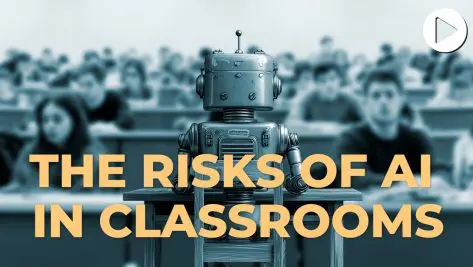
Artificial intelligence is fundamentally reshaping the relationship between education and employability. According to the World Economic Forum, 39% of existing job skills are expected to be transformed or become obsolete, while 59% of the global workforce will require reskilling by 2030. At the same time, automation is beginning to disproportionately affect entry-level positions, declining by 29% since 2024.
This transformation is also changing the way companies recruit talent. In 2024, approximately 45% of employers removed university degree requirements for many of their job openings, raising questions about whether a traditional degree remains a sufficient signal of preparedness for the realities of the modern labor market. The debate, therefore, is no longer simply about what educational institutions teach, but about the unique value they provide in a world where technology is increasingly replacing routine tasks.
Educational institutions have survived wars, economic crises, and technological revolutions. What makes this moment singular is that these three pressures have converged and are reinforcing one another: geopolitics restricts mobility and fragments scientific collaboration; economics erodes the financial sustainability of institutions and students’ access to them; technology calls into question the employability value of the university degree itself. The challenge is not to manage each of these forces in isolation, but to understand that they operate simultaneously and systemically.
This convergence also forces a more fundamental question about the role of universities in a world where talent, knowledge, and innovation have become strategic national assets. As governments increasingly treat higher education as an instrument of geopolitical competition, universities face a choice: become passive tools of national strategy or actively define the terms of their own relevance.
The institutions that will matter most in the decades ahead are not necessarily those with the largest endowments or the oldest reputations, but those that position themselves as genuinely global brokers of talent and knowledge – building bridges where geopolitics builds walls, expanding access where economics contracts it, and developing human capabilities that technology cannot replace.
© IE Insights