

In 1926, Henry Ford made a decision that transformed the way work was organized: he introduced the five-day, 40-hour workweek at the Ford Motor Company. Ford had not invented the eight-hour workday or the desire to work less, but his decision did play a pivotal role in standardizing a model that would eventually spread far beyond his factories.
A century later, much of our working life is still organized around this framework: five days of work, two days of rest. Alongside it sits another familiar sequence: education first, career next, and finally, retirement. This has shaped our offices, careers, education systems, cities, transport systems, and even how we distinguish between “work” and “life”.
Yet these patterns are beginning to fall out of step with the way we actually live. We work from our phones. We learn throughout our lives. Careers are becoming longer and more fragmented. Up to six generations of employees may overlap in today’s organizations. Artificial intelligence can perform tasks we once considered exclusively human, and, for many kinds of work, the office is no longer the only place they can be done.
How, then, can we understand what is to come? For decades, we’ve turned to consultancy reports, management books, and technological forecasts to try to anticipate the future of work. However, there’s another source of knowledge that we tend to take less seriously: fiction.
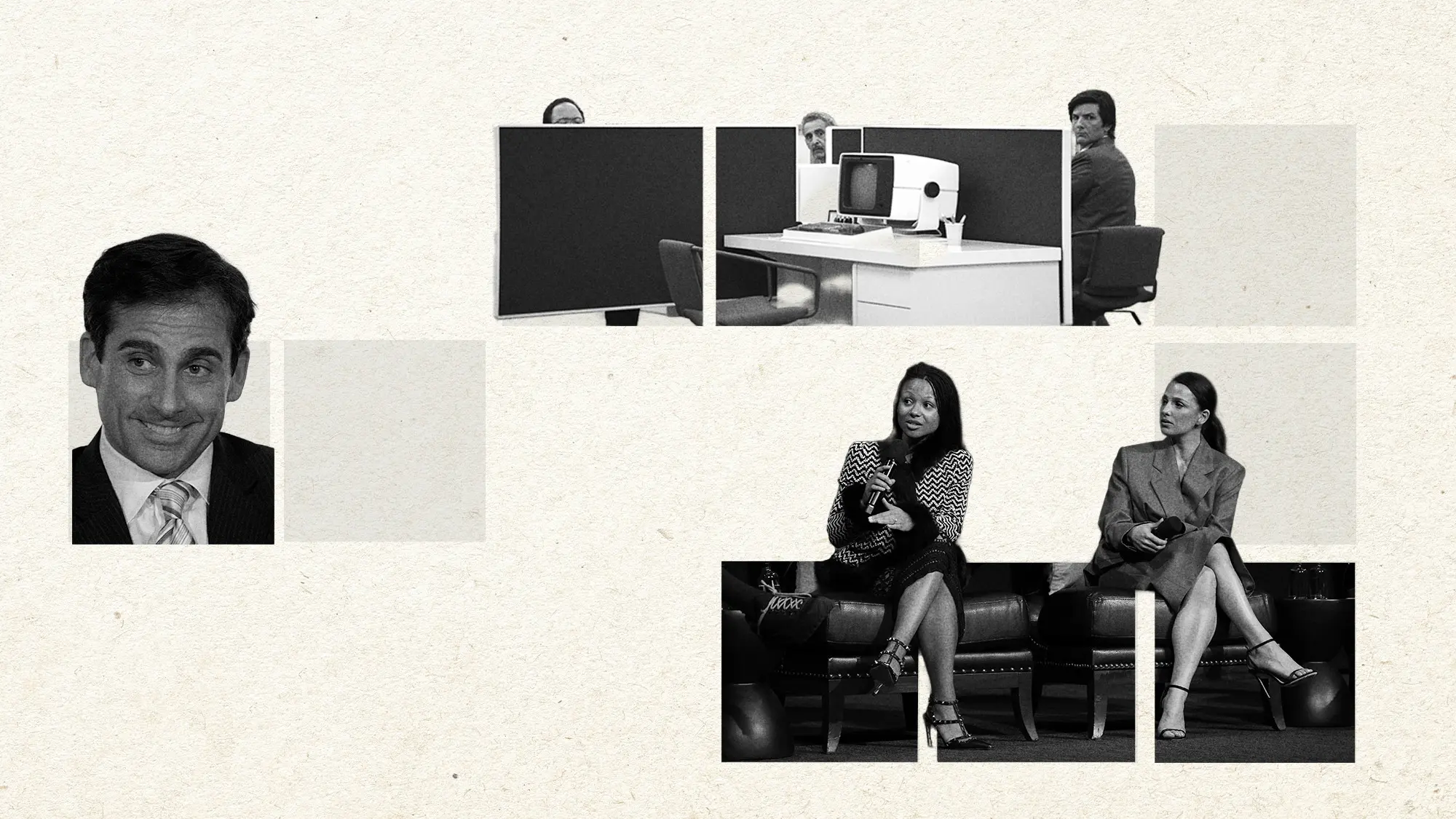
TV shows do not predict the future. Through exaggeration, they can make familiar tensions easier to see. The Office, Severance, and Industry ask why we need to gather, what happens when we surrender judgment, and how much of our lives employers can reasonably claim. Read together, they suggest that the future of work will depend on how organizations manage relationships as well as technology.
The Office and the purpose of being together
The Office is a satire about bad bosses, bureaucracy, pointless meetings, and mundane professional lives. But its seemingly unproductive interactions reveal something just as important: conversations around a table, jokes that go wrong, celebrations, conflicts, romances, rivalries, and silences.
These moments may appear peripheral to the job. They are also part of the social life through which colleagues come to understand one another. The series makes visible how much happens at work beyond the tasks in a job description.
Technology has broken a link we took for granted for a century: going to work no longer necessarily means going to a specific place.
We can write, analyze, program, design, meet, and produce from virtually anywhere. We often work wherever we happen to be, with just our phones. Artificial intelligence will further accelerate this separation between work and location.
Five years from now, today’s debate about how many days a week we should spend in the office will seem rather outdated. The more useful question will be: why is it worth getting together?
If going to an office means commuting for an hour just to sit in front of a computer and attend Teams meetings, we don’t have an office attendance problem. We have a problem with a lack of purpose and a lack of belonging.
The next transformation of the workplace will, therefore, involve shifting from measuring spatial efficiency to assessing relational effectiveness. The office will have to justify its existence not by the number of people it accommodates, but by the quality of the relationships it fosters.
As AI takes on more individual tasks with extraordinary efficiency, as information becomes cheaper and more abundant, certain capabilities that are difficult to automate will become increasingly valuable: trust, conversation, disagreement, tacit knowledge transfer, care, and collective creativity. The layout and routines of workplaces should support those interactions.
This feeds into the concept of relational stewardship, that I have coined: the deliberate work of sustaining trust, shared understanding, and responsibility within an organization. Leaders must create the conditions so that people who have different ways of thinking and learning, and who don’t even understand work in the same way, can trust one another, learn together, and feel part of something.
The question The Office leaves us with isn’t how to get people back to the office. It’s this: what does a human organization offer that an excellent internet connection can’t?
Severance and the risk of losing your judgment
If The Office explores what brings us together, Severance takes the question of what we’re willing to sacrifice in exchange for peace of mind to the extreme.
Lumon employees undergo a surgical procedure that separates their work memories from their personal ones. In a sense, two different people exist: one lives exclusively at work, while the other knows nothing about what happens there.
The premise is science fiction, but the central question raised is very real: how much of ourselves are we willing to give up to shield ourselves from reality?
During the 20th century, companies primarily learned to manage our time. Organizations in the coming decades will battle for something far more valuable: our attention.
AI systems already summarize documents we haven’t read, select information, draft responses, prioritize tasks, and help us make decisions. The real turning point will occur when we stop perceiving them as tools altogether and they become permanent intermediaries between us and reality.
This is where Severance feels disturbingly contemporary. If a system decides what deserves our attention, it shapes what we remember. If it shapes our memory, it influences our judgment. Once it begins to influence our judgment, the most difficult question inevitably arises: who takes responsibility for the decision?
That is why attention, memory, judgment, and responsibility deserve greater emphasis as organizations adopt AI. These abilities help people remain active participants in decisions. They are also comprised within the concept of relational stewardship: colleagues need to understand how decisions are reached and who is accountable for them.
If we grow accustomed to accepting recommendations we cannot explain, responsibility can become harder to locate. It becomes easier to treat a system’s output as an answer for which no one is fully responsible.
Five years from now, the most advanced organizations may not be the ones that have automated the most processes. They are likely to be the ones that have learned to distinguish carefully what should be delegated to a machine and what we must continue to do ourselves, even though the machine can do it better and faster.
Protecting our agency requires us to keep exercising it.
Industry and the limits of availability
Industry portrays a cutthroat professional world of ambition, anxiety, status, and power. Its characters live with the unsettling sense that they have never done enough, yet still want to do more. We might reassure ourselves that we’re simply watching an extreme portrayal of investment banking. That would be a mistake.
What Industry exaggerates is a feature increasingly common across many professions: work’s tendency to demand constant availability and encroach on every aspect of our lives while simultaneously giving us a sense of purpose and belonging.
When work fits into a phone, it also fits into every moment of the day.
And therein lies a huge paradox. The very technology that promised to free us from specific places and schedules has allowed our jobs to follow us everywhere, blurring the boundaries between leisure, learning, and employment.
Employers have always competed for talent, and now to compete to retain it. The next phase will be different: organizations will compete to shape how people work together and build meaningful relationships. And that radically changes how we think about careers, commitment, and success.
Employees aged 25, 45, and 70 do not necessarily want the same things from work, but generational labels explain only part of that variation.
The deeper question concerns the contract between work and life: what can an organization reasonably expect from its employees, and what does it offer in return?
Some people were raised to adapt to their organizations. Others expect their organizations to adapt to them, at least to some extent. Some were taught that careers should have a linear progression; others are building their paths through multiple projects, reinventions, learning experiences, and interruptions.
Even the notion of the “portfolio worker,” anticipated decades ago by Charles Handy in The Age of Unreason, can be interpreted in two ways today: as an extraordinary opportunity for independence and professional identity, or as a cleverly disguised form of precarious employment. It is likely both.
Well-being, learning, flexibility, and purpose therefore need to be considered in the design of jobs and careers. An organization cannot credibly promise flexibility while rewarding only those who are always available. Nor can it make learning a priority if workloads leave no time for it.
The challenge is to distinguish demanding work from permanent availability. A team may need periods of intense effort, but that does not require every message to receive an immediate reply or every evening to remain open to work. Clear expectations about responsiveness, workloads, and recovery time can make that distinction real.
From Organizing Work to Organizing Relationships
The three series mentioned above approach work from different directions. The Office asks us where we will find a sense of belonging. Severance asks how much of our independence we’re willing to give up. Industry asks how much of our lives is about more than just being productive. These are different questions, but they point to the same transformation.
During industrialization, we organized work around production. Later, we reorganized it around knowledge. Now we’re discovering that we’ll have to organize it around something far more complex: the relationships between people, machines, organizations, and life itself.
That’s why 2026 is such a symbolic year. A hundred years ago, Henry Ford recognized that increased production capacity implied rethinking how we divided our time between work and life. The decision to shorten the workweek helped reshape the 20th century.
Artificial intelligence gives us another reason to examine those choices. Debates about a four-day week or the balance between home and office matter, but they do not settle what people need from an organization or what responsibilities should remain with them. We have to decide what we mean when we say “work.”
In five years’ time, our organizations will likely produce much more with less human intervention. However, if machines can do more of the work, we will need to look beyond productivity to understand what makes an organization valuable.
We’ll have to ask ourselves what kind of places they create, what human capacities they strengthen, what relationships they sustain, what responsibilities we take on, and what kinds of lives they allow us to build.
The world of fiction has been warning us about this for some time. The future of work depends less on determining what machines will be capable of doing than on deciding what we should continue to do ourselves and why we need to do it together.
© IE Insights.


