
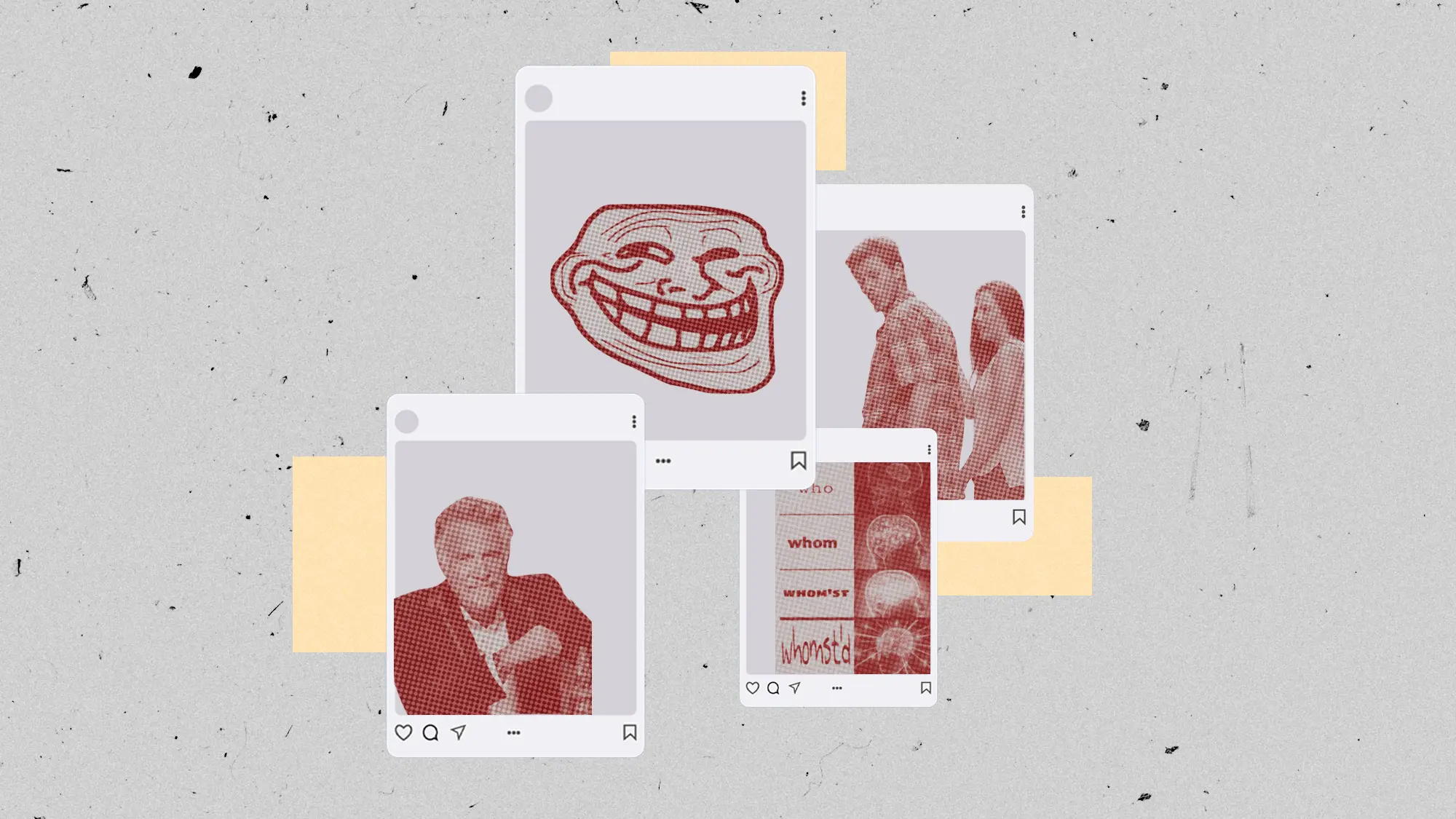
Thus sayeth Rule 42 of the internet: “Nothing is sacred.”
If you did not know that the internet has rules, consider this your first lesson in meme culture. The “rules of the internet” are not “laws” that can be enforced, but observations that hold true no matter where you go online.
Indeed, the internet enjoys tipping sacred cows. When any piece of offline culture – a movie, TV show, or song – gets in the hands of the online peanut gallery, its original meaning ceases to be its only meaning. Someone will reinterpret, remix, and rewrite it, creating new meaning that its original authors never intended.
This sacrilegious innovation has made the internet a crucible for creative, democratic discourse. But it is also the driving force behind toxic online communities who use memes to spread hate.
“Little Dark Age,” a 2018 song by U.S. American rock band MGMT, achieved viral status on TikTok during the first months of the Covid-19 pandemic, nearly three years after its release. MGMT’s moody synths and thoughtful lyrics accompanied a litany of memes, capturing the equal-parts boredom, anxiety, and creativity that permeated social media throughout the quarantine. Give the song a listen, and consider what its lyrics mean to you:
Policemen swear to God, love seeping from their guns
I know my friends and I would probably turn and run
If you get out of bed, come find us heading
For the bridge, bring a stone, all the rage, my little dark age
“Little Dark Age” weaves overt references to police brutality, mental health, and feelings of melancholy. At the time, the United States was reeling from the polarizing second campaign of Donald Trump and the Black Lives Matter protests, the largest mass movement in the country’s history. As music critic Alexis Petridis puts it, the song is, “fairly obviously, an excoriation of Trump-era America and racist police violence.”
If the internet took authorial intent seriously, we would expect “Little Dark Age” to accompany memes that celebrate progressive social movements, condemn systemic racism, and shine a light on mental health.
Instead, “Little Dark Age” has become an anthem for radical racists in North America and Europe.
My research into “Little Dark Age” memes on TikTok, YouTube, and Instagram confirmed a warning from investigators at the Institute for Strategic Dialogue: “[Little Dark Age] is by far the most popular Sound among extremist creators on TikTok.” The song accompanies elaborately-edited, visually-appealing montages featuring historical dictators including Adolf Hitler, esoteric neo-Nazi symbols, and videos glorifying brutal conquests in the Middle East and the Americas.
Although these reactionary memes are a minority, they accumulate millions of interactions, spread rapidly across platforms, and easily outpace memes that reflect the song’s original meaning.
Even governments have appropriated the song as a callous joke. As recently as 2025, Immigration and Customs Enforcement (ICE) in the United States posted a “Little Dark Age” edit glamorizing deportations. The post was removed from X after MGMT filed a copyright takedown request.
It might not be so surprising that some listeners could hear “Little Dark Age” and twist its meaning to confirm their own worldview. What’s shocking is that the extremist derivative of “Little Dark Age” has become the most popular interpretation of the song.
The most popular memes are often those that stray the furthest from authorial intent. To understand why, we need to establish what memes do in the first place.
It is difficult to define a meme. Etymologically, the word comes from the same Greek root (μῖμος) as “mime” and “mimesis,” both reflecting a performative imitation that carries symbolic meaning.
Most researchers who study memes credit British biologist Richard Dawkins with coining the term. In The Selfish Gene (1976), Dawkins argued that cultures undergo an evolution that mirrors our biological origin. Dawkins defines a meme as a cultural unit – a belief or a behavior – that spreads through imitation: parent to child, peer to peer, community to community. The most beneficial “memes” are selected and continue onto the next generation insofar as they enable humanity to flourish.
Like any kind of humor, memes delineate insiders and outsiders.
This definition is an important starting point, but it itself has evolved since Dawkins first proposed it. For one, we now typically use the term “meme” to refer to internet culture, not any kind of widespread behavior. More importantly, not all memes are socially beneficial. On the contrary, many memes spread hateful and anti-social ideas, flying under the radar by claiming to be “just a joke.”
A better definition is best summed up in the famous words of U.S. Supreme Court Justice Potter Stewart, defining obscenity in the media: “I know it when I see it.”
Indeed, if you recognize a meme when you see one, there’s a good chance that you have spent a lot of time online, noticing the algorithmic patterns in which memes are born, grow, circulate, and eventually fade into obscurity.
Mimicry, including internet memes, requires audiences to “fill in the blanks” using their imagination. When a mime pretends to struggle against the wind, there is no real fan blowing against them. Instead, the mime uses exaggerated, symbolic gestures. The performance is a bit ambiguous, but that’s why it’s entertaining. The audience imagines the wind because everyone can connect the mime’s performance to a real experience. We know it when we see it.
But if you do not recognize a meme when you see one, the online world is quick to remind you of your outsider status. The audience will laugh not just at the meme, but also at commenters who say that they “don’t get it,” or even worse, “That’s not what that song means!”
Apply the same logic to “Little Dark Age,” and it becomes clear why this meme works, not just despite, but because, it contradicts authorial intent. While the song’s “true” meaning is “fairly obvious,” it is also ambiguous enough to justify alternative interpretations. Contradicting the “obvious” meaning appears transgressive and edgy, matching the tone of meme culture better than interpretations faithful to authorial intent.
Imagine the response to someone commenting, “That’s not what MGMT had in mind!” This naïve commenter would become the butt of the joke themselves, because they publicly displayed their ignorance toward the sacrilegious norms of digital culture.
Like any kind of humor, memes delineate insiders and outsiders, those who are “in on the joke” and those who are not. Over the past year, parents learned this the hard way when they asked their children why “six-seven” is funny.
It is therefore easier to define memes by paying attention to what they do, rather than just what they are. Memes convey in-group status through humorous repetition. Children who laugh at “six-seven” memes communicate their identity as part of the younger generation, and adults (or Popes) who laugh along are showing their solidarity. Inversely, adults who roll their eyes communicate that they do not get the joke, and more importantly, that they do not resonate with the identity that it represents.
For this reason, memes are powerful tools for political communication. When you repeat a meme and your target audience understands it, they laugh, share, and create new derivatives, reaffirming their collective identity. Outsiders who don’t get it become the butt of another joke, contributing to the cycle of attention and outrage that drives engagement on social media.
In an essay published in El Grito, cultural critic Mario Canal discusses the use of memes to spread ultranationalist sentiment among Spanish youth on Facebook. Creators use kitschy aesthetics to transform ordinary symbols of Spanish identity, like jamón serrano, into nostalgia for the Franco era.
I agree with Canal that condemning memes can make one appear humorless, becoming the butt of the joke, and ultimately increasing the appeal of reactionary digital networks.
Instead of becoming the sanctimonious parents who “just don’t understand,” we should recognize what one of his informants refers to as “the democratization of creative practice” [la democratización de la práctica creativa] that memes can fulfill.
Herein lies the weakness of hateful memes: They are fundamentally uncreative. By glamorizing the past, rather than looking to the future, they demonstrate a lamentable inability to imagine better worlds in which everyone, not just the most powerful, have the freedom and the tools to express themselves. For this reason, Francoist memes make Canal feel “more pity than fear” [màs làstima que miedo].
Personally, when I reflect on “Little Dark Age,” I feel neither pity nor fear, but rather motivation. The best way to combat the spread of hateful memes is to remember Rule 42: On the internet, nothing is sacred. Or, to reprise a line from MGMT, “The humor’s not the same.”
The same ambiguity that makes memes so powerful as tools for exclusion and radicalization also makes memes crucial tools for satire, criticism, speculation, and other forms of democratic discourse. Creators of all stripes must take advantage of the internet’s irreverent atmosphere to tell stories, paint pictures, and build worlds that previous generations did not imagine possible.
© IE Insights.