

Dina Kawar on the Human Cost of Middle East Conflict
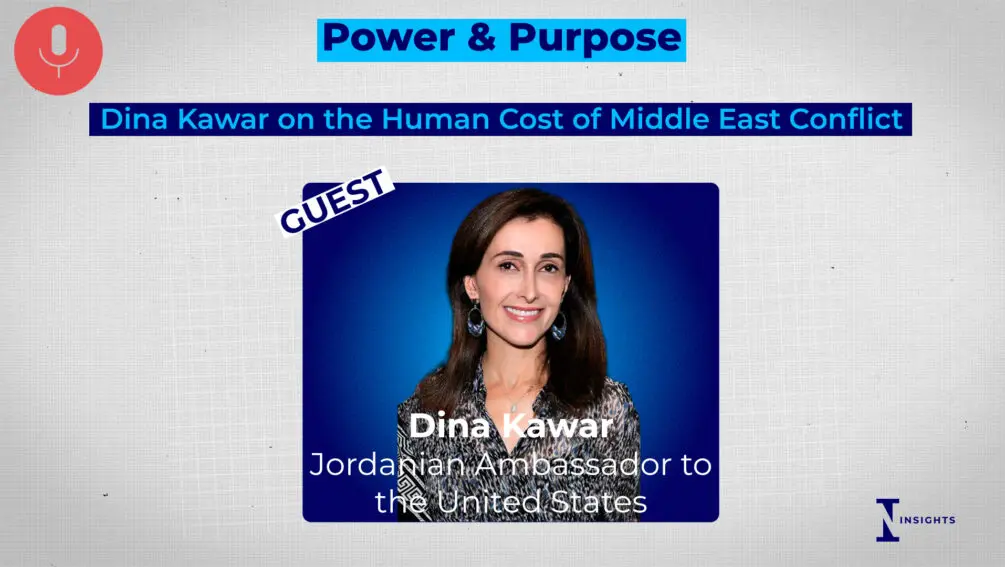
How are overlapping crises shaping diplomacy in the Middle East? Dina Kawar, Jordan’s Ambassador to the United States, joins Amanda and Nathalie to explore the ripple effects of war and the realities of regional interdependence. She reflects on her diplomatic career, the barriers women face in public service, and the mindset needed to lead under pressure.


Transcription
Amanda Sloat
Today we are joined by Dina Kawar who has served as Jordan’s ambassador to the United States since 2016. Her previous diplomatic posts include Ambassador to France and the United Nations where she was the first Arab woman to preside over a Security Council meeting. Today we’ll be discussing Middle East politics multilateral affairs and her impressive diplomatic career.
Dina welcome to the show. Well let’s jump right into the foreign policy topic of the day which is the war in Iran. At the time we’re recording it remains unclear how things will play out as negotiations are stalled. The Strait of Hormuz remains largely closed and numerous countries are feeling the energy crunch. I’m curious how this conflict looks from Amman and what you’re envisioning moving forward in the next couple of weeks.
Dina Kawar
Well we’re watching the negotiations very closely and hoping that there will be a peaceful resolution of this conflict. As you know this war has affected us directly the economic situation and the implications other than the security of course but the economic implications have been disastrous on Jordan. To start with our economic growth depends a lot on the tourism sector and the tourism sector is now at zero.
People are scared. There’s nothing to be scared of. If you were to be in Jordan right now you’ll be okay. But people are scared and the tourism sector is 14% of our economic sector our GDP. And right now because the government is doing its utmost to keep the sector going and keep the employment going it’s costing us. It will cost us around 600 million at the end of the year which is a lot of money for our economy.
Not to mention that it affects the growth the prices inflation with importers of oil and gas. So you can imagine the increase in also how much it will affect our growth. We’ve been struggling since many years now and since the Arab Spring with putting back growth into our economy and injecting. To do that you have to inject money and at the same time we want to keep our debt payments and our level on the international market and our seriousness.
So trying to juggle both growth and a difficult task. But when there’s a war in the region definitely it will affect us immediately. And right now thankfully the US is very supportive economically of Jordan but we need to get to a point where the growth in our economy picks up on its own. And of course the security aspect is a problem.
Now on the Hormuz. Obviously when we started this war Hormuz was never mentioned and now it’s become the major obstacle in this war that will affect the whole economy. We have to remember that the economy of the Gulf states is important for the world’s economy because they invest everywhere. They have large parts of international investments and they are putting their money in AI in the companies in the US.
And obviously they employ a lot of non Gulf people including a lot of Jordanians who work in the Gulf states. So we hope that this will end up soon because the implications are beyond.
Nathalie Tocci
Dina if you turn from your east to your west things are not a lot better. If we think about the Israeli-Palestinian conflict. Of course there was the hope that with the Trump plan beyond a ceasefire there would be the reopening of prospects for a Palestinian statehood that doesn’t exactly seem to be in the making. In fact not only is the ceasefire in Gaza sort of violated every other day by Israel not only is more than half of Gaza still occupied but of course closer to home for you there is growing threats of annexation of the West Bank.
So I’m just wondering if you could talk us through how you see developments in the Israeli-Palestinian conflict.
Dina Kawar
Of course for Jordan the issue of the West Bank of Israel of Gaza is much closer to home. And it impacts us a lot because first of all it’s a neighboring country. And second of all as you know we have a large number of Palestinian refugees in Jordan since years and years. Not to mention that some of the Jordanian population sector is originally Palestinian.
So there’s always an identification with this conflict that people do not understand. A lot of times I have to explain to many people here how this is felt at home. And it’s not just we’re looking at it the same way you would look at a conflict. It is home. And so this is very important.
Amanda Sloat
Can I ask you just to break that down a little bit? What do you explain to people in Washington and what would you like our listeners to understand about how this really feels for people in Jordan?
Dina Kawar
Well if you look at the Jordanian population right now we’re talking about 11 million a bit more. We have around 30% refugees out of which maybe 1.3 if not more Syrian refugees that came with the war. But if you put aside the Syrian refugees which is another issue we can discuss a bit later if you want.
Half of the population almost 2.5 million are Palestinian. What they are identified as Palestinian refugees meaning they have Jordanian passports but they don’t have the national number which means they are not citizens who can vote but have every other right to work to live. It’s a document. And then you have the Palestinians who are Jordanian fully Jordanian but of Palestinian origin.
So there is intermarriage between Palestinians and Jordanians. So any home in Jordan is Palestinian and Jordanian at the same time. So the feeling for this injustice is very much rooted in our DNA. It’s not something we pretend. It’s not something we learn about and say well you know we learned this is right this is wrong. No people feel it.
And so when the Gaza war happened it hit every Jordanian deeply. I mean it hit the whole world as you can see because seeing the mass destruction of Gaza was horrendous and never in our century in watching our Instagram and our Twitter accounts and social media you see people in famine next to countries that are normal.
Never in the 21st century you would hear that there is food standing and waiting to go in but cannot go in. This is not normal. This we have normalized the abnormal in this war. It is not normal. And it’s against international law to have prevented food from going in and aid and medical aid. It is not normal to have collective punishment in situations of war.
And so what worries us in Jordan is that the policies of the extreme right government in Israel is going to be a disaster another disaster for the region because what this government is doing and their policies and the policies of the right wing within this government it’s causing so much tension with allowing settler violence in the West Bank going unhinged.
Do you know that since the beginning of this year around 16 Palestinians were killed in the West Bank? Nobody talks about them. You have to understand that. They go into homes they get people out of their homes they kill them. It’s like no man’s land. And what I’ve tried to say to a lot of people in the West when somebody from yours dies we see his photo on TV.
We know if he’s married or not if he had a love story if he has a family you know everything about him. You give him the credit. In our part of the world it’s numbers. I don’t even see that numbers matter anymore. 16 died today 13 died tomorrow. So this settler violence is a problem.
But I also say to many people here what you don’t realize it’s not just bad for the Palestinians. It is bad for the Israelis. Half of the population of the historic land of Palestine is Arab and the other half is Jewish. And now how will that pair if there is no Palestinian state? What will happen? That’s something that we need to think of.
Is the ground Israel going to be all democratic? And if so are we really going to apply democratic standards to the Palestinians? Who knows. I doubt it. So my thing is the Israelis have become scared but they’re scared. What they don’t realize they are scared of their own policies.
What happened with Hamas was a problem because the Israeli government tried to put aside the Palestinian Authority for many years and undermine them after the Oslo talks. Rabin’s death and killing was the start of a whole new wave in Israel or at least the surfacing of very right wing feelings in Israel.
And right now I say we need to save the West Bank and Gaza and have a Palestinian state. But if the Western governments don’t realize that they need to save Israel from itself then this will go on. And then one day we’ll have another war somewhere else.
When is it that a head of state or a prime minister of a government goes to the UN and shows the map of Greater Israel? Do you find that normal? I mean would anybody else do that? So they have normalized the abnormal and everybody has gotten used to it and does not say anything about it.
But my fear is that this expansionist feeling and living upon the fear of the Israelis is a problem. And this year and last year so many Israelis that contributed so much to the society in Israel to the economy have left. They’re going back to Europe they’re going back to the US. They’re losing the best of their own population that made the economy vibrant.
So these things are things we want to look at. And look we have a peace treaty with Israel. We have the longest border with Israel. We’re making sure that this security de facto you know we would do that to any border. The same is going with Egypt. They have the first peace plan with them. They’ve normalized relations with UAE with Bahrain with Morocco with Sudan and others are on the way.
Nathalie Tocci
Can I just jump in there and perhaps circling back to Amanda’s question earlier I mean what is the connection between these different wars?
Dina Kawar
I don’t like to think that this war was started so that the oil routes would change and move into Israel but I doubt that anybody would be as conspiratorial as saying let’s start with Iran for that because the major problem has been in this Iran war the major is the Hormuz and the realization of how trade lines have become so complicated.
And we talk about oil but there’s food security and many other issues. And the Gulf states did not want to go into war because they realized that the implications are endless and Pandora’s box can open. And we’re seeing its opening its opening in Iran with the start of factions as we read. It’s hard to know what is really going on.
You just read what comes out of it. So the factions in there but definitely Israel’s posturing and feeling of I think it started with Hezbollah with the pagers and the feeling that we did something that was out of a James Bond movie that shows the greatness of their services.
And then I don’t see that they want the war with Hamas honestly I don’t see because the price was so high and Hamas is still there and we’re still in phase one of the Gaza. So definitely our region is all interconnected. Any war that happens somewhere affects somewhere else.
And this is very true. The Gaza wars has delayed the normalization process with Saudi Arabia because of the situation. It has impacted a lot the mood in the Arab world and has brought the Palestinian issue up front.
For many years people had gone on and moved on and it has changed. So I agree with you there is an interconnection but I don’t think Israel thought that Iran’s war would be an easy one. And we’re seeing how complicated it is and how far.
So we’re just hoping that this will end soon. There will be an agreement about Hormuz but about the nuclear and ballistic and about Iranian actions in the region and their proxies which affect all of us.
Amanda Sloat
Well Dina we could talk to you all day about Middle East politics but I want to move on to the personal story of Dina and your very impressive diplomatic career. On this podcast we’re always really interested to know how public servants got their start. And I read somewhere that your family wanted you to become a doctor but that an early encounter with a cadaver in biology class dissuaded you from the medical profession?
Dina Kawar
No you don’t. That was naughty Amanda. But it’s true.
Amanda Sloat
So I was curious of that story and how you made the pivot.
Dina Kawar
Well you know my mother would kill me if she hears me say it because that’s many decades ago when it was right to be a doctor an engineer or a lawyer. You had to take one of the three. And so she thought this political thing was ridiculous like what is my daughter going to do with all of that. So to please her I did. But that was such a horrible I would have been a doctor that I personally wouldn’t go to. First of all I have no clue about the names and the whole thing. But I fixed it so I’m fine now.
Amanda Sloat
But was politics something you were always passionate about and something that you really wanted to pursue instead?
Dina Kawar
I always was interested in international relations and what was going on and following. I went to school in the States. I was in middle school at a girls college. That’s where my late father wanted me to be because he felt it’s very safe and good. And my aunt lived in Oakland.
And then I went to Columbia and I was very interested and still am in political affairs so I enjoyed it. It was a personal thing. And I think when you’re a student if you enjoy what you do you do good.
So I did that and then I went and worked with the Crown Prince at the time Prince Hassan who’s the brother of the late King Hussein for a few years and then went to Harvard for one year for a program and then ended up in Paris.
And His Majesty King Abdullah felt that there should be more women in the service and so that year I was one of two that were appointed. One was appointed in Brussels and I was appointed in Paris. So that was the start of my career.
Nathalie Tocci
So indeed you were one of the first in a fairly small group of women in the diplomatic service. Could you describe a little bit what that experience was? What was it like to be amongst the few women? What were the pros and cons of that experience?
Dina Kawar
Well first of all it’s very hard because you feel that burden. First of all you feel guilty like they chose me and am I worth it. You question yourself as a female at least we used to. And I felt the burden of doing well because I felt if I don’t do well they’re going to say it’s a woman.
And you always have that in the back of your mind. You don’t want to do something bad because there’s accusation and they dissect you at the beginning. I remember when my name came out of course a small society we are at that time at least. Is she good enough? Is she qualified? Does she have a degree?
I was graduated from Columbia from Mills. I went to Harvard. That was like there was always the questioning is she qualified. And this is always the thing that comes up to mind. And that’s very frustrating.
I remember when I was in the Security Council they wanted that year to have a woman Secretary-General of the UN and there were lots of women. And I remember we did these panels because when I was on the Security Council there were a lot of women on the Security Council. So there were these debates about women and a lot of men would raise their hands and said okay yeah we accept a woman but she has to be qualified.
And then I said why is this always added at the end of the sentence like is it possible that a woman who is bored having her hair done and her manicures and doesn’t know what to do with life and say maybe I’ll become Secretary-General. There are so many times things that are said without thinking and you need to stop it.
You need to step back and think of what you’re saying because we’re always looked at and dissected more than others. But now luckily 40 years later things have improved a bit.
Amanda Sloat
For women that may be listening are there strategies that you developed to navigate what was traditionally a very male space in terms of responding to those types of comments having the added pressure to prove yourself what advice would you give to women?
Dina Kawar
First of all work as hard as you can because this is what will cover you up is your work and your production. If you’re mediocre it doesn’t work but work very hard.
Believe and trust that you can go very far because if you don’t believe in your own capacity nobody else will give it to you. Except in my case it was easy I have a king who supports me but I’m saying in a job it’s not always the case.
And I think third of all you should not be sensitive. A lot of things you just throw away because if you’re sensitive and you allow things to bother you they’ve won.
And so right now I don’t take things personally but that’s after many years. But what I try to tell people never take things personally. A lot of times you receive bad vibes or bad comments because of where you are not because of who you are.
Nathalie Tocci
That’s very wise. You mentioned there the fact obviously Jordan is a monarchy. Could you just describe a little bit how you consider the differences or not? What does it mean to be a diplomat in a monarchy as opposed to say being an ambassador in the Italian Ministry of Foreign Affairs?
Dina Kawar
Well obviously we belong to the diplomatic corps and we are part of that. And we have a Minister of Foreign Affairs who dictates and supports our policies and gives us direction on how we go where we go.
And of course we work with other ministries as well because you have the economic file you have other files that are technical. But being the Ambassador of His Majesty is normal in our system because His Majesty overlooks the foreign policy de facto.
So our minister works with His Majesty on a daily basis and so definitely you’re in that capacity. He’s very much in tune with the policies.
And when he comes to the US we organize his visits with the foreign minister but also with his team on what his priorities are. So that’s a different way of doing things but we’re all on the same page and we all see things in the same way.
Amanda Sloat
You had referred to this earlier when you were at the Security Council that there was a lot of discussion about appointing a woman Secretary-General. We’ve had some guests on who have been involved in that campaign.
As I mentioned in the introduction I understand you were the first woman from an Arab country to chair a session of the UN Security Council. I’m curious how you saw that dynamic playing out more broadly what you actually think it will take to get us over the hump to have a woman eventually at the UN as Secretary-General.
Dina Kawar
You know I hate to say it but there’s a difference sometimes in the approach between men and women in political fields. And it’s something that I noticed throughout the years.
Women like to see an end to something and then fold it and put it and then go to something else. There’s a feeling of getting something tangible. I don’t know what it is about the way we think.
It’s like a project and politics is everything but that. Especially in the UN there’s a lot of emphasis on process. Sometimes I used to feel that we get lost in the process and we lose sight of where we’re going.
And then the whole game is the process more than the end. And that’s usually the bad side which I’m impatient with in political processes.
I remember sitting in rooms where people read their statements. Everybody knows what everybody else is going to say but everybody sits and listens and there’s no discussion.
So I hope that we would be able to go back to more freedom in these institutions because that’s the whole idea. But having said that I have a feeling they’re not ready yet for a female at the UN and that’s very unfair. I don’t know if this year we have some names so maybe that would be the start.
But there’s no reason to think why not. It’s the countries that vote. And the last vote came from somewhere close to where we are that it should be a man. So I hope that would change but I don’t have an answer for why it’s that way.
Nathalie Tocci
You were giving some pretty good advice there when referring to the fact that you really need to learn to let things brush over. And of course that is something that you acquire with experience. Thinking about some of our younger listeners that is an extremely important piece of advice. I’m wondering whether you have, because something else that investigators found out about you and that intrigued me is that at some point you said something along the lines of ignorance can actually be a good thing because it allows you to dive into something. Could you explain a little bit because that is something which you don’t have when you have experience.
Dina Kawar
Well ignorance is bliss. I’ll tell you why. Because I was thrown into the Security Council seat. Jordan had a non-permanent seat and in many countries they prepare their ambassadors for years for that role. I was in Paris and I was put in because the ambassador who was before me was assigned as Commissioner for Human Rights. He was a fantastic ambassador who knew the UN by heart. So he went to his post and midway through the term somebody had to go in.
If I had to do it now I’d say no because I didn’t know the UN system. But there was some crazy part of me that said let’s go. It’s challenging. When you get challenged you wake up. It’s easy to stay in the same thing.
I arrived there not knowing the system other than what you read. But what you read is never what you experience. So I was doing things sometimes that were not in the norms of the UN. I remember once the British ambassador told me when we were chairing the Security Council that month you are not supposed to talk to the press and give a brief about the sessions before everybody agrees on what you’re going to say. But in any case go ahead and continue doing it.
He was happy with the results. He said you’re not supposed to do it go ahead and keep doing it. And I laughed because it was true. We then had to find our place because you have the permanent five which is a very private club and then you have us who come in for two years and leave.
We knew what we were doing on the files that concerned us especially being the Arab representative. But we also wanted to create a presence. So we worked a lot on youth because at the time there was ISIS and extremist movements and we wanted to focus on the role of youth in politics. The Crown Prince came to speak at the UN and that became something that is still active.
I also wanted to work on something else. At the time ISIS was stealing a lot of artifacts in the Middle East. They said they were destroying them but in reality they were selling them on the black market. So we worked on that and got everybody on board. Today it’s one of the major things we do we are recuperating items and preventing companies and collectors from buying stolen artifacts.
So what I’m saying is sometimes not knowing the complications and the difficulties gets you further because you’re not inhibiting yourself. That’s the advice I give to young people. Don’t inhibit yourself. Don’t say I can’t do this. Just try. Sometimes you will be surprised and you will succeed.
Amanda Sloat
To give a little shout out to Megan Palser who’s one of our excellent students at IE. I really enjoyed learning about our guests. So I love the advice of ignorance is bliss. But I also heard that sometimes you need to be a little bit crazy. So I’m curious you talk in a very light way but have worked on very heavy subjects. The Israeli-Palestinian conflict I know you’ve done a lot of work on refugees you were just talking about ISIS there. How do you stay healthy and balanced with all of these demanding high pressure jobs and difficult political subjects?
Dina Kawar
It’s not easy because during the Gaza war I was affected personally. Nothing is worse than seeing the destruction the human suffering the children who cannot eat. It’s not possible. You feel like you want to go there.
There are moments in the job like when we saw ISIS and when I first met Nadia Murad who had been abused and used as a sex slave. Those moments remind you every day of the harshness of reality.
But you have a choice. You can sit and be overwhelmed by sadness or anger or you can act. In my position I have the opportunity to meet people who matter. So my way of coping is to use that position to amplify voices and get messages across to the right people. That helps even if it doesn’t take away the anxiety.
Also during moments like Gaza you spend time with colleagues and share experiences. That helps on a personal level because you can talk and process what you’re seeing. But using your position to act is the most important thing.
Whatever people say about what you do whether they think it’s not enough or it’s wrong that’s fine. Those are people who sit and judge. In my position I focus on what can we do to help. That is what matters. And that goes back to my advice to young people just concentrate on your work and keep moving forward.
Nathalie Tocci
Absolutely. Let me ask you Dina what would you describe as your biggest success and why?
Dina Kawar
I think one of my personal successes is the effort and energy I put into helping my colleagues. Helping them enjoy what they do and bringing out the best in them. As much as I have tried to do my job well in my political career the part that gives me the most satisfaction is seeing colleagues leave the job having gained something meaningful that stays with them.
Amanda Sloat
Well Dina let me move on to the final question. You’ve brought so much laughter and joy to this conversation but I wanted to ask if you could tell us something that has brought you joy in the last few days.
Dina Kawar
We’re looking forward to the FIFA World Cup. Our team has qualified and they’re coming to the US. We’re having games in Santa Clara with Austria and Algeria and then in Dallas with Argentina. That’s going to be a lot of fun.
These are the things that bring joy because nothing beats football. It brings people together and creates a happy sense of national pride. We’re looking forward to it and organizing events around it. It’s one of the joyful parts that this job brings.
Amanda Sloat
Well yes the fun part of diplomacy is to do those types of events. Dina thank you so much for joining us and sharing all of your experiences.
Nathalie Tocci
Dina thank you so much for being with us today. This has been a wonderful conversation. We learned so much and I’m sure our listeners have as well. Above all we learned how important it is to brush off negativity and sometimes to unlearn what you know and jump into new challenges. But always to take your work seriously and keep moving forward.
Dina Kawar
Thank you Amanda and Nathalie. It’s been a joy to be with you. I wish all the young people going into this field the very best. It’s a wonderful field.
Amanda Sloat
Really excellent. Thank you again. Power and Purpose is an IE Insights podcast produced in association with IE University and Johns Hopkins School of Advanced International Studies. Production and sound design by Reptile Studios. We’ll be back soon with the next episode. Make sure you never miss an episode by subscribing to Power and Purpose wherever you get your podcasts.