

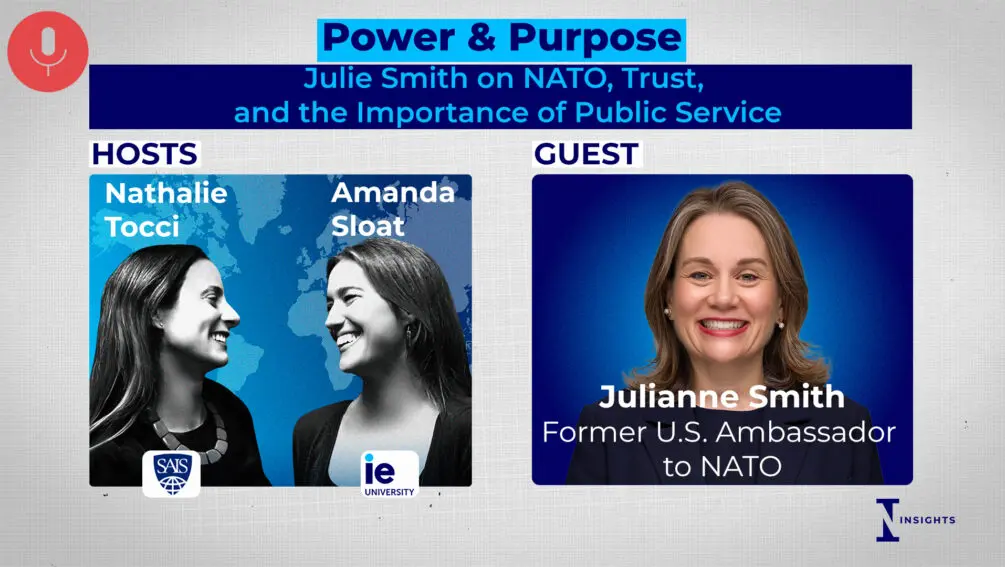
Julie Smith on NATO, Trust, and the Importance of Public Service


Transcription
Amanda Sloat: I am so excited to welcome today’s guest, an old friend, a former government colleague, and a fellow Michigander, Julie Smith. The self-described NATO nerd served as the US Ambassador to NATO during the Biden administration. This role followed a series of positions in the State Department, Defense Department, and White House, as well as numerous think tanks in Washington.
Today we’ll be discussing all things NATO, the transatlantic relationship, and her path from Michigan to Washington, Brussels, and beyond. Welcome, Julie.
Julie Smith: Thanks so much. Good to see you guys.
Nathalie Tocci: And so we have to obviously begin with the NATO nerd, with NATO itself. Not just over the last few weeks and months, but NATO over the last kind of 10 years has been through a real sort of whirlwind. We have had, just under a decade ago, the French President Emmanuel Macron defining NATO as being brain dead. Only a few years after that NATO sort of found new life, enlarging to Sweden and Finland and refining its original mission of deterrence and defense vis-a-vis Russia. And then of course we’ve had Donald Trump, the threats by the majority shareholder in NATO, the United States, towards another NATO ally, Denmark, over Greenland. And now of course, in the sort of latest Trump blip, we have had the US President basically saying that NATO’s future is in doubt and in trouble if NATO allies do not come to the rescue of the United States on a war in Iran that they didn’t participate in sort of co-deciding and coordinating.
So looking at that future of NATO, can you sort of help us in a sense navigate through this whirlwind and understand what holds in store for NATO itself?
Julie Smith: Well, a couple of things on that. I guess first I would say that you’re absolutely right. NATO has been on quite a rollercoaster for the better part of a decade. But I would also say over its 75 plus years of existence, it has seen many, many rollercoasters and all sorts of points of contention with one side of the Atlantic and the other.
You can go back decades and find stormy weather, to put it diplomatically, with the allies. What has always worked for the allies to navigate that stormy weather, I guess, has been, at its core, trust. And so what worries me right now is that there’s no question in my mind that there is a trust deficit in the alliance right now, and it’s rooted.
Nathalie Tocci: Just an understatement there.
Julie Smith: Fine, fine. But let’s just stick with it for now. Bear with me. So the trust deficit is and obviously there’s an enormous amount of tension in the relationship, but trust matters in navigating these differences. And I think the trust deficit stems from two episodes.
So one, in March of last year, the United States, without consulting its allies or our friends in Ukraine, decided to flip the switch and turn off both security assistance and intelligence sharing to Ukraine. It was eventually turned back on about three days later, but I think that moment really shook the alliance to its core. Like, wait a minute, what the US can do that, and we can just be left blowing in the wind?
And then fast forward to the back end of 2025 when we entered Greenland, where we had the largest member of the alliance, most powerful, essentially threatening one of the members of the alliance, Denmark, to possibly seize the sovereign territory of Greenland.
And that also obviously shook the alliance to its core. And despite the fact that President Trump showed up in Davos and said things are going to be all right because we’re not going to take Greenland by force, you tell me, Nathalie, but my sense is this chapter is not over. It has done lasting damage.
And so what worries me about the alliance is not any particular day when we’re arguing over a NATO policy or how much countries are spending, or even if NATO has a role in opening up the Strait of Hormuz. What worries me is that that trust deficit actually has a huge impact on our ability to work together through some of these really acute differences in the relationship right now. And without that trust, I just question kind of how this is going to unfold going forward, because that’s always been the way that we’ve managed all sorts of dark and stormy weather.
Amanda Sloat: Can I ask you, following up on that, beyond the trust piece, how you see things developing in a more practical military sense? You know, when you and I were in government, there’s many people that have frankly never loved the idea of a European pillar in NATO. There was a version to Macron’s idea of strategic autonomy.
Now, I think the sense is in Europe that they frankly don’t have much choice. They have been pushed into committing to spend 5% on defense. Understandably, European countries want to spend their additional taxpayer euros on European defense equipment.
So from a military perspective, how do you see this unfolding? Do you think we are moving towards a European pillar of NATO? Do you think we end up having eventually a more developed European Union defense capacity? And is there a way, if you have a future Democrat or even moderate Republican administration, to put some of this together, which then from the US perspective will leave us in a very different position because we’re no longer going to have a European contingent that was necessarily as compliant as they had been in the past, which we’ve seen even in the early phases of this Iran war, resistance to US using European bases, which is very different from what we’ve seen in the past.
So apart from the trust deficit, talk a little bit about how you see this security side evolving.
Nathalie Tocci: To add to this question, Julie, how much would you, in terms of Europeans doing things without Americans, how much of this do you see this playing out as a European pillar in NATO, as European Union, or as, let’s say, coalitions of the willing in different shapes and forms?
Amanda Sloat: So I think Natalie and I are teaching too much. We’ve just given you a multi-part essay question.
Julie Smith: That’s a lot to unpack. That could be a three hour podcast.
Amanda Sloat: I know. I know.
Julie Smith: So, where do we start here? So good news and bad news.
I mean, obviously the good news is Europeans are investing more in their own national defense and we have to celebrate that. And that started quite a long time ago and was rapidly accelerated during the first few years of the Ukraine war and now is accelerating even faster.
And so fundamentally, irrespective of what happens in the Oval Office here in the United States in future political cycles, the transatlantic relationship is just going to be different because of those investments. Europe will have more autonomy, they will be more independent, they will feel more empowered to challenge US positions, and it will change the role that the US traditionally has played for 70 plus decades in the NATO alliance.
So I guess point one is we’re moving towards just fundamentally a different relationship between Europe and the United States in the security realm because they are going to be more capable.
Number two. The word of the day, anywhere you go in Europe, it seems, is sovereignty and autonomy. And Europeans are very interested in reducing their reliance and their dependence on American capabilities and weapons systems, and they talk quite openly about striving to find solutions that are not tying them to the United States politically or commercially or in a security sense.
And I guess my issue with that is yes, I fully appreciate that national capitals in Europe want to build out their own defense industrial base. But I worry right now about the way in which Europe is going about that. Germany is investing in German industry. France is investing in French industry. And so we do have to step back and wonder whether or not at the end of the next decade when Europeans are supposed to be spending upwards of a trillion euros on their own defense, that we actually end up with a Europe that is very fragmented and you have more interoperability issues because everybody’s kind of developing their own air defense system. Or now Europe has 25 different armored vehicles.
So on the sovereignty, autonomy piece I appreciate the logic behind it and the sentiment, and certainly wouldn’t be in a position to tell anyone in Europe not to go down that path. But I think, I guess where I worry is in the absolutist position that exists on both sides of the Atlantic. So on the one hand you have some Europeans saying, we must buy European at all costs. Don’t look at any US systems. I don’t think that’s entirely realistic. I think there’s certain things Europeans will just have to continue buying from the United States. Two, I see Americans saying, make sure you only buy American and stay focused on our defense industrial base. And I don’t think that’s an entirely fair either.
What I would like to see is more co-production, co-development, joint R and D areas where you can bring American tech and innovation and help European industries with speed and scale. And so I think that’s really the way to look at it, is a little bit of both.
And then, Nathalie, to your question about, well, what does this all translate to? You know, in the future, are we going to have this European pillar in NATO? Is it going to be the European Union taking on a bigger share of the security agenda? Will it be coalitions?
I mean, actually I think it’s going to be a little bit of all three of those things. I think coalitions are going to become more popular. As you can see, Europeans questioning what they can achieve together at 27 across multiple sectors, and even sometimes in the NATO alliance now at 32. It’s not easy, and I can tell you from experience to reach consensus with 32 separate nations with their own histories, geography, relationships in the world, obligations, domestic politics.
And so I guess when I think about it, I see a role for small coalitions in certain cases. I see a role for the European Union to keep charging forward. As long as there’s some coordination with the NATO alliance that’s trying to set standards and requirements. And then yes, I think you will increasingly see Europe moving towards some sort of European pillar inside the alliance.
So I guess I’m fudging the answer here by just saying it’ll be a little bit of all three of those things.
Nathalie Tocci: I think you’re absolutely right there.
Amanda Sloat: I would give you an A plus answer for that. Julie, that was very well structured. I’m relieved.
Julie Smith: Relieved.
Nathalie Tocci: And Julie circling back a little bit, I guess to your trust point earlier, and just going back to the broader transatlantic relationship, is your sense that basically what we’re living through now is a blip or a break? I mean, is this a conjunction, a rather unfortunate one, or is this a structural rupture in the relationship?
Amanda Sloat: And can I just add, I related to that, do you think that Americans understand how upset Europeans are? I get asked this all the time when I speak at events about whether people back in the United States realize how deeply painful this is for all of them.
And so that in a way relates to this question about whether this is just situational in the face of a singular president or as Nathalie was asking, whether there actually is something fundamental in the relationship that’s changed.
Julie Smith: Yeah, no, I definitely don’t land on the situational side of the ledger.
I think this is just structural. I think we’ll look back at this moment in time as turning the page on 80 years of working together. And it doesn’t mean that the relationship is over. I think what it means is something new is coming, it has yet to be defined, but look, Amanda and I served in the last administration and you remember President Biden saying we’re back, and it was kind of this desire to say, well, what we all experienced in the last four years was just a blip. And now we’ll return to the traditional construct of the transatlantic relationship. We both see value in it. We’ll both lock arms and work together on shared challenges.
And I think there won’t be a we’re back moment with a future US administration. You will not hear that. It is fundamentally changed. I don’t see us returning to it again. That doesn’t mean that it doesn’t exist. It’s going to be different and we’re going to define it in different ways.
And in terms of helping Americans understand that we’re turning the page on 80 years and that there’s enormous frustration with the US right now. I don’t know. I’m out quite a bit talking to different audiences across the United States and I don’t feel that people have a real appreciation for that.
I like to give the example of the guys in Denmark that built an app that a lot of Danes now have on their phone that they can kind of go through any store and scan to see the degree to which American components are part of that product so that they can avoid purchasing it. And this is of course taking place in one of the most pro-Atlantic countries in Europe.
And so I try to use that example to help Americans understand that we’re really in a hole, that there is enormous frustration, but also some disbelief and shock at kind of what has transpired in this relationship with Europe just over, well, what has it been about 15 months or so?
Amanda Sloat: Yeah, no, I think that’s absolutely right. And I similarly use the app example because it is a pretty dramatic description of how attitudes here have really changed. Well, let’s move away from NATO briefly and go back to your origins and our state of Michigan and talk about how a fellow Michigan, clearly there’s something about Michigan people, once we get out of Michigan, we just keep going. So, like me, you grew up in Michigan. You went to university in Ohio, studying communications and French. You spent time living abroad studying languages in Paris and Munich.
Tell us about the path of young Julie. You were always interested in politics, if you had a sense of the wider world. What was your journey from Michigan to starting on this path of government and public service?
Julie Smith: Well, yeah, I grew up in the suburbs of Detroit. Didn’t have foreign policy in mind, didn’t have anyone in my family. My parents were art majors. My dad was a graphic designer. And this was a foreign land. I mean, this degree of political science, national security, foreign policy just never crossed my mind at all. I knew I liked languages, I knew I liked history, but I think what really clicked is I was an exchange student.
And this is where these programs can be so important. I was an exchange student in high school in France. Of course, I had visions of strolling the grand boulevards of Paris, but I was put on a farm in the French Alps in the middle of nowhere. And I think they had an exchange student because they just needed some summer help out in the fields. But anyways, nonetheless, that’s amazing. It was a positive experience despite me milking cows and other delightful things. But in French, you know, you get to know all of those things in French.
So it was a turning point because it all felt, you know, I had never been overseas. It felt so familiar, and yet it was so different and I just couldn’t figure it all out, like talking to them about politics and life in general and how the kids studied and you know, it just, for me, it kind of rocked my world. And so I understood fundamentally I was very interested in this place called Europe and I wanted to learn more languages.
And so then fast forward as an undergraduate, I studied at the Sorbonne for a year and just to date myself and so all your listeners can know how old I am, the Berlin Wall fell while I was in Paris. And that obviously was just another shock to the system of what is happening over there across the border. And that spurred a deep interest in Germany. And I told my parents that I was going to take my French degree and move to Germany, which really excited them at the time. And then I learned German and slowly but surely started to put together the languages, the history, research, writing, and understood that I could get a master’s degree international relations, and it kind of put me on this path.
I thought maybe it would lead to journalism, and so I wanted initially to become a journalist, but found my way to foreign policy and national security and never looked back. But really I credit these exchange programs to take a kid in the middle of nowhere in Michigan who had never been overseas and put her in France, and it just changed my life, honestly.
Nathalie Tocci: Amazing.
Amanda Sloat: You and I and Bridget Brink, another Michiganer, we have had.
Nathalie Tocci: I’m going to get a little bit excluded here.
Amanda Sloat: I know, I know, all these Michigan women leading the way in Europe and really poster children for study abroad, having such a huge influence on all of our lives. Totally.
Nathalie Tocci: So to make me feel a little bit included once again, let me move on to another question where actually I feel I’ve got something to share, which is you, Julie, well in fact, like Amanda and like me in this case, have alternated throughout your career between government and think tanks. And you have generally been in government when the Democrats have been in, you’ve generally been out of government when Republicans have been in.
I guess compared to Europe, the revolving doors is far more frequent, if not systemic in the United States, but did you always have a sense that you would ultimately kind of straddle practice and think tanks? Or was it just the way in which it happened?
Julie Smith: Well, I guess it was partly the way it happened. I ended up early in my career mostly working at European and American think tanks. And you know, you do that for a few years and you realize you’re writing all these glorious reports and you think are absolutely brilliant. But if you’ve never served in government, it’s actually really hard to make your work relevant.
And in all honesty, I cringe when I think about some of the things that I have written, or that I wrote in my early years and how detached they were from what is actually achievable when you serve in government, irrespective of what your role is or what agency you serve in.
And so I started to understand. I had missed the opportunity to serve in the Clinton administration. A lot of my friends had done that. I had peers going into the Clinton administration and I kind of missed the boat because I ended up working in Europe. I had a fellowship, the Bosch Fellowship, and then I stayed and I ended up working for a think tank in Germany.
And so when I moved back, the Bush administration was coming in and I knew, okay, I’m not going to have an opportunity to go in now. But next time I’ll have to make a concerted effort. And so I did kind of have a plan. At one point in order to make my research and my writing more relevant, I needed to see how the sausage was made.
And then I did find a way to serve in government when Obama came in ’09. And then I understood after serving in government for his first and second term, the pros and cons of being in government, having an impact, but then losing your voice because everything you say is cleared by, you know, 25 people. And your intellectual tank starts to be more depleted. And then the bonus of going out into think tank land, reading all these books, starting to write again, finding your voice. But perhaps you’re having a lot less impact because you’re not in government anymore.
And so for me, it’s been fabulous to have that yin yang of kind of serving in government, serving in think tanks, intellectually tanking up then going in bringing some of those ideas in. It’s actually, for me, it’s my preferred rhythm. And as a working mother, it’s optimal because I’ve had years, frankly, where I’ve been unavailable. The White House was brutal for my family, seven days a week and lots of long hours. But those think tank years, total flexibility and an amazing opportunity for me to be present all the time with my kids.
So it actually, it’s not just professionally really ideal. It’s been ideal on the family front as well.
Nathalie Tocci: Can I ask you just to follow up? The big value added of coming from the outside and going in is that you learn how to, you know, how the sausage is made and therefore you can contribute to that making more. But at the same time, being out gives you that intellectual and analytical breadth and depth that sort of allows you to think things, perhaps in a more open, creative, whatever way.
Having done this a lot in the United States, but having worked a lot on Europe, where in Europe this is actually done a lot less, are there ways, particularly thinking about both the way in which think tanks work, but also the way in which officials work institutions in Europe work where you can actually notice that there is not enough cross-fertilization going on?
Julie Smith: Yeah one other point I have to say about the US system before we get to Europe it is also equally important to have people in public service who have been there for decades. Because what also happens is the political appointees, like myself, we stroll in and we say we have all the answers, and then there’s a crowd of people waiting for us that say, yes, we tried that in 1985 and it didn’t work and you need some more history and reference.
And so it’s actually super helpful to have both the fresh blood and the new thoughts about problems of the day with the people who have been around the block a few times to say, have a seat lady, there’s a few things you’re not tracking here and we’re going to bring you up to date. And that actually works quite nicely. It’s an imperfect system for lots of reasons. We can do another podcast another day. But anyways, that’s the US system.
So Europe system, yes, you’re right. In most cases, people who commit to a think tank life, it’s quite rare for them to get a bite at the apple to serve in government. And it pains me because I have so many friends in Europe, brilliant, brilliant friends that I would love to see have, you know, love to see them get the opportunity to spend, you know, I don’t know, a couple of years in policy planning somewhere, or on a national security staff, in a foreign ministry, wherever.
Now some people like you find their way and they break the code and they figure out a way to go in and out and have an impact and shape policy. But I think it would serve a number of European governments better if they would find temporary rotations or send people in government out to think tank land to say for one or two years, you will step out.
What happens here is something quite interesting, and that is that a lot of embassies in Washington, before they have, say, a political counselor come and serve, let’s say at the German embassy, that person spends a year at a US think tank. And I love that idea because before they go back into their system, they’re getting a rare break to be on the outside world and do writing, convening, go to all the conferences that exist here. And so I would love to see that happen more on the other side of the Atlantic.
But certainly Nathalie, you must have good ideas on this front. I mean, you’ve thought about it. No doubt. What’s the answer?
Nathalie Tocci: Well, I don’t know what the answer is, but actually I think that there are ways, I remember sort of, you know, several years ago there was this fantastic project that we did here at the Institute for International Affairs in which embedded in the project there was actually the possibility of researchers going into different foreign ministries in France, Germany, et cetera, et cetera. Not just to do their whatever stars or something, but to actually do their research within the institutions. And obviously the institutions were participating as partners in these projects.
So I think there are ways in which one, as you say, can start breaking the mold, but I think it’s a cultural switch, which Europeans still need to make.
Julie Smith: I think that’s right. I think that’s right. I will say the German think tank that I worked at in the ’90s, the SWP, when I showed up at the time, in Bavaria, which was outside of Munich, very far from, again, to date myself, the government, which was in Bonn, not Berlin. I feel like I’m a hundred years old here. But in any case, I showed up at the SWP and I said, this is so odd that you have this think tank way out in the countryside in this beautiful Bavarian landscape, but we’re so far from the capital, and they said, that’s the point. We want the independence. We don’t want to be sitting right next to the capital.
But in my mind, I thought to myself, this can’t be helpful in terms of your ability to shape policy, to the extent that that’s part of your goal. Now today, the SWP is in Berlin. The whole government moved from Bonn to Berlin. But to me it was instructive understanding that my colleagues at the time saw it as an advantage. And they really wanted that kind of distance. So curious.
Amanda Sloat: We’ve got a lot of young listeners and really one of our target audiences is young people that want to go into government and public service. And so, apart from some of the structural constraints, what advice do you give to people? You know, they listened to you talk, you presented as you’re in a think tank, you decided you were going to go into the Obama administration and boom, it happened.
And so how do you unpack that for people that really want to do it, how you actually make that happen? And then more broadly, and this is a very US specific question at the moment, we have a generation of young people that may have wanted to serve in USAID or wanted to be diplomats. And even leaving aside some of the political differences, there’s just not some of those pathways into government at the moment.
And so, you know, you have talked about coming of age politically when the Berlin Wall came down. It was a time of great optimism and change in Europe. And the political situation, quite frankly, is not as inspiring for young people that might be looking at coming into government service now. So what would be your advice to young people who perhaps want to have careers similar to yours about how to think about this in this particular moment?
Julie Smith: Well, first of all, to the extent that there are young Americans listening here, you can’t give up on public service. I mean, we are going to need the next generation to come in and yes, right now the federal government is really not in a good state, to put it lightly. And there are a lot of open-ended questions about what the State Department will look like, what the future of DOD will be, there will be a National Security Council, which is now a shadow of its former self. We don’t have USAID and so in some ways that can be devastating to process. Certainly for somebody like myself having served in many of those institutions, and I worry about where that leaves the capabilities of the US government right now when it comes to national security.
But at the same time, it provides an opportunity. And so maybe what we all need to think about is to reframe it, to say, this will provide us with some new opportunities. Certainly we will do something in the future, I suppose, on development assistance. And so let’s bring in fresh thinkers on what that could look like and look at it more as an opportunity than kind of a heap of ashes, which is how some people describe it.
So number one is don’t give up on public service. Please, please, please, to anyone listening. Number two is know that there are a million paths. And a lot of young people ask me, well, what’s the secret sauce? And which boxes do I have to tick? And there’s no list there. There are people who come to national security. That’s the brilliance to it. And the best asset or aspect of serving in the foreign policy community, kind of all roads lead to Rome. You can come from law, you can come from political science. Amanda and I have met colleagues who’ve studied English or history or foreign languages, or maybe you’re a cybersecurity expert or somebody who knows a lot about WMD.
And so I think you’ve gotta be open-minded to know there are different ways to go in. Of course, you can serve in the Foreign Service and apply that way. You could come in as a political appointee, like I’ve done, in the past, or some other combination where there are certain appointments in government where people are brought in for a very, very specific set of expertise.
So my advice is to pursue your passion and don’t get too caught up on what’s the perfect recipe to get from A to B. And also, don’t be afraid to leave town and go serve in the Peace Corps or volunteer somewhere, or go pick up a new skillset out in Silicon Valley or go learn your third foreign language, or you could do election monitoring. I mean, I think it’s, Washington is always here for anyone who wants to join the conversation. It’s incredibly transient, and I think people shouldn’t be afraid to leave a little while. That’s been my experience and come back and the door is wide open.
Amanda has done this many times as well and now finds herself abroad, but she knows, you know, Amanda, if you ever come back, we, the doors will be wide open.
Amanda Sloat: The door is there.
Nathalie Tocci: And Julie just kind of thinking actually back at all of these amazing things that you have done. And I think also the way in which, you know, you answered there thinking about advice to young students really conveys this incredible passion that you have. Sort of looking back, be it in experiences in government or outside it, what would you say, and I’m sure there are many of these, but what would you say is your proudest moment?
Julie Smith: I think I’d probably take it to my last position in government. I accepted the role to serve as US Ambassador to NATO not knowing there would be a war in Ukraine. So I first talked to the administration about it in the spring of ’21, and we had no inkling at that time that Russia was getting prepared itself to invade Ukraine. So by the time I got confirmed in November of ’21, I mean we were off to the races and Amanda and others were already doing quite a bit to try and persuade our allies that this was coming.
But I was able to grab the baton and I think I am very proud of the way in which the NATO alliance was able to handle that moment to share as much intelligence with allies, our friends in Ukraine, to help them understand that this was going to happen, to prepare the alliance to enhance deterrence on the eastern flank, help our friends in Ukraine and isolate Russia, and then simultaneously add two new members to the alliance, Finland and Sweden, and put China into the strategic concept, which previously unheard of.
So we got a lot done and I think the team really came together. I’m proud of my small role that I was able to play, but I think I will always look back on that three year window and really have immense pride in what collectively, you know, the team and I were able to get done in Brussels.
Amanda Sloat: No, I agree with all of that. And you were always an extraordinary partner to have on the ground in Brussels, and we could do a whole separate podcast of stories we could from that time in office. So one of the things we like to do on the podcast is make the point that careers are not necessarily as linear as they seem. Things don’t always work out the way they plan.
So we have ticked through everything that you have done in your very impressive career. It looks like everything was very thought out and one thing led to the next, which I think the three of us know is not normally the way things work out. So I wanted to ask the flip side of Nathalie’s question, which is what do you see as the biggest failure perhaps in your career or something that may have seemed like a failure at the time, but actually led you in a different and perhaps positive, ultimately, direction?
Julie Smith: First of all, there was no master plan, and it’s incredibly disjointed and all sorts of wacky things have happened throughout my career, and you just take it all in stride and try to extract lessons from all of those chapters.
One thing I’ll say quickly, and then I’ll give you one specific example of a failure, which I think is a good lesson for the next generation. First, I will say when I came out of graduate school, there was a hiring freeze across the US government and I couldn’t find a position in the USG and I certainly couldn’t find a position at any of the think tanks in town. And so I had to go work for a management consulting company, which I didn’t wanna do, and didn’t quite fit my dream job description.
And you know, I was rather unhappy about that, but I had to pay my bills. And I will say at the end of it, I’m very glad I did it. I now know how to speak to the private sector. I know how to read an annual report. I sharpened my presentation skills. So just a good example of, okay, maybe it’s not the perfect job. It doesn’t seem like it fits the plan. But just take what you can from it, do it well, and move on in a couple of years. This too shall pass. So that’s one thing.
The second thing I will tell you is when I was at a think tank in Washington, we hosted a big annual event in town. It was one of my early jobs and my colleagues, I was helping with just the logistics of the event. I was very, very young and it was early in my career and my colleague said, you should go visit the venue and make sure it’s, looks good, bright space, all of that. And I thought to myself and all my wisdom of being, I don’t know, 26 or something, I was like, I probably don’t need to visit the venue, you know? And decided to skip that because I could look at pictures online, I could get on the phone, and we got to the night of the event. Like there was a wall in the middle and we like, oh my God, just an utter disaster. We didn’t have enough room. We had like cramming chairs that, oh, surprised me. Fire me.
But in any case, the lesson there is get the small stuff right. And, you know, I had visions already of someday I will be offering my deep thoughts on all these policy questions. And all I needed to do was get to the bloody venue and make sure it was right for the event. And that lesson stuck with me and I never screwed up the small stuff again.
And I think it’s a good lesson that whatever you’re given as your job description, maybe you’re not the most important person on the team. But your piece of it is important. Do it well and make sure that you cover every little detail so that you’ll then be asked to take on more responsibility down the road. So that was a tough lesson for me. But one that I’m not afraid to admit was a huge mistake. Huge.
Nathalie Tocci: Well, I think that what’s really good about actually the way you frame this, Julie, is also that it is only thanks to failures that you kind of make your next step forward and you correct mistakes. And you know, if you don’t fail, then you don’t improve in many respects. So I think that’s a really, really broader, important lesson for all of our listeners to keep with them.
Another theme that we discuss a lot on this podcast is the role of women and women leadership. And of course in your case, you know, you have spent all your career in national security and Pentagon, NATO. I mean, this is very much a man’s world. How has it been to be a woman in this world?
Julie Smith: Well, it’s not easy. And I think we have to acknowledge that. And I’m glad that you’ve made this part of your theme on the podcast.
It’s funny, when I first went to the Pentagon, my first government job, I tried very hard not to acknowledge differences. I wore my black suit every day, or navy. I just wanted to fit in. I didn’t wanna be a woman in national security. I just wanted to be someone working on national security. I wanted to fit in with everybody, and it was almost like I was resisting the differences and some of the unique challenges.
And then over time I realized, no, you just, you’ve gotta own this. First of all, you have to acknowledge there are unique challenges. I think women clearly face unconscious bias in some of these circumstances, if not blatant discrimination or sexual harassment in some cases. And that all has to be acknowledged and that I had a role to shape that, to support other women, to build networks, to write about some of the challenges, to speak about some of the challenges as I’ve done over the years.
And so what started off with a certain set of assumptions has changed dramatically over the last 20, 30 years for me. And I do think that we have to understand and acknowledge that national security is still a field where women have made enormous strides. But we still, for example, have not had a female Secretary of Defense. We’ve had female Secretaries of State and national security advisors. But it is to this day still very male dominated and that presents some challenges and I think we have to speak openly about it.
And women also have to show up for one another. And you need male champions to also acknowledge some of those challenges and to help address them in the workplace. So I am glad you always make this kind of a part of the conversation that you’re having.
Amanda Sloat: What advice would you give? What is your hard-earned wisdom after working in a very male dominated space? You know, you and I have talked about this a lot. I mean, the experience of sometimes being the only woman at the table, having to struggle to get your voice heard. You’ve talked about the need for male allies, for women to reinforce one another. But what specific advice would you give to our women listeners? We also have people that are currently in government, on how you navigate some of these challenges, discriminations and real difficulties, frankly, that you can face as a woman in this space.
Julie Smith: Well, you have to have your own network of allies, and if you don’t have one, you have to build one. Women that you can lean on for advice. More senior women. Pull up the junior women behind you, support them, reach out to them. But I also think more specifically, I often tell women in particular, whether they’re mid-career or younger, or more senior in their career, keep fighting the imposter syndrome.
You know, so many women talk about showing up and wondering whether or not they should join the conversation. And I remember speaking to former Secretary of State Madeleine Albright about this. She was very open when she showed up at the United Nations, sat down behind the plate that said United States, and was hesitant to chime in with all the men sitting around the table there in the United Nations and how it took her a while to kind of first listen to what others were saying to understand, okay, not everyone around the table is a genius. Not every thought is like a lightning bolt here. Some of these ideas are bad ones. I should take a risk and join the conversation.
But I mean, Amanda, I don’t know if you had this experience, but the first time I went to the Situation Room, I was terrified. I was like, first of all, where’s my seat? I don’t even know where, what, where’s the room? Where do I sit down? Everybody looks like they belong here. There are very few women in the room. Do I raise my hand? How does this all work? I think I’ll just not say anything for the first three meetings.
And it’s very intimidating and you really have to stop and get yourself to understand, not everyone is sharing the most unique or brilliant thought, and you too can join the conversation. And I think it’s so important for us to push ourselves and try to raise that hand and chime in and not worry about it being the most brilliant thought ever on the face of the planet.
Nathalie Tocci: Yeah, that’s so true. Julie, perhaps just one last question on another theme that we love touching on in this podcast, and that is the sort of broader work-life balance, whether it’s possible, how do you try and for your own work-life balance? I do kung fu, Amanda does yoga. What do you do? And you have a wonderful family. You have amazing children. How has that equation worked in terms of balancing family and work?
Julie Smith: Oh, that’s a whole nother podcast, work-life balance. I mean, you know, I’m definitely a subscriber to, women can have it all, but not at the same time. Which takes us back to the prior theme of serving in government and working 60 hour weeks and then coming out and having total flexibility. That’s been really important for me personally to kind of manage the work-life balance.
But I don’t, I just definitely have had many times where I’ve felt that I was kind of a 50% employee and a 50% parent and spouse and not really winning in either category. And that’s hard. That’s hard to deal with in terms of what I do to unplug and clear my head and bring about some sanity.
I mean, for me it’s always I have to go to the woods. I have to walk in the woods. I have to be with nature, and I need to be alone. And as it turns out, when I was in Brussels, I had a security detail that was with me at all times except for Verrewinkel Park, which was behind my house, my residence, and I could go there alone without the security detail. And honestly, I think it saved me. I could walk in that park by myself with my thoughts and totally unwind without two guys walking behind me. So that was really important.
And then cooking, I’m kind of, I don’t know, I think my other calling in life is to bake and cook. That is just important outlet for me. Not always great for my health ’cause I bake a lot. I’m eating cakes and all the rest all the time. But it’s important. I think you know why, because in our field there’s nothing you can point to and say like, that’s what I did today. Whereas if you bake something, you’re like, look, I have like a proper item. I can point to something more concrete.
So yes. And then just managing it all. I mean, I have to have a shout out to my husband. I mean, there’s no way any of this would’ve worked without my unbelievable husband. And he too has had moments of surging and then pulling back, often paired with my surging and pulling back, and so he can go for the promotion if I am kind of working 20 hours a week, and then when I was in Brussels, he kind of had needed more flexibility because I was unavailable, at least at the start of the war. And so as a partnership I’m just immensely grateful for being able to do this with my husband, and I just don’t see how it would’ve worked without him.
And the boys are stronger for it. And the boys also have had incredible opportunities to live abroad, and twice in Germany and Belgium, and I won’t lie there have been huge challenges associated with career choices with moves overseas. I mean, just immense challenges, but also huge benefits for all of us as a family. And I’m glad that we had those opportunities.
Amanda Sloat: No, absolutely. Well, Julie, I think we are probably clocking in our longest episode to date with you, and I think we could have done an hour on NATO, an hour on women, an hour on everything. So it is with great reluctance that I need to bring our conversation to a close.
So wanted to ask you our traditional last question, so we end on a positive note, although you’ve brought a lot of positivity to this conversation, which is to tell us something that has brought you joy in the last few days.
Julie Smith: What has brought me joy? Well, it’s back to cooking. I mean, I’ve mastered a couple of really tough recipes of late. I am challenging myself, definitely in the dessert category, so a couple of cakes, multiple layered cakes.
And then a friend sent me an apron actually that says this NATO ambassador also happens to be an exceptional chef. And I love baking and wearing that apron, and quite proud of that. It’s the joy of taking on a really complicated, sometimes multi-day recipe of some kind, and I gotta have you guys over for dinner.
Amanda Sloat: Clearly, clearly that is the conclusion of this podcast.
Nathalie Tocci: Well, thank you so much for this, Julie. This has been an absolutely amazing conversation. What I think I really bring away with me is really this idea of never being scared to make your voice heard, always learning as much from successes as from failures, and never, ever, ever losing faith in public service. Thank you so much for being with us.
Julie Smith: Thanks, you guys.
Amanda Sloat: Thank you, Julie. Thank you.