

Gabriela Ramos on Mexico, Multilateralism, and the Fight for Gender Equality
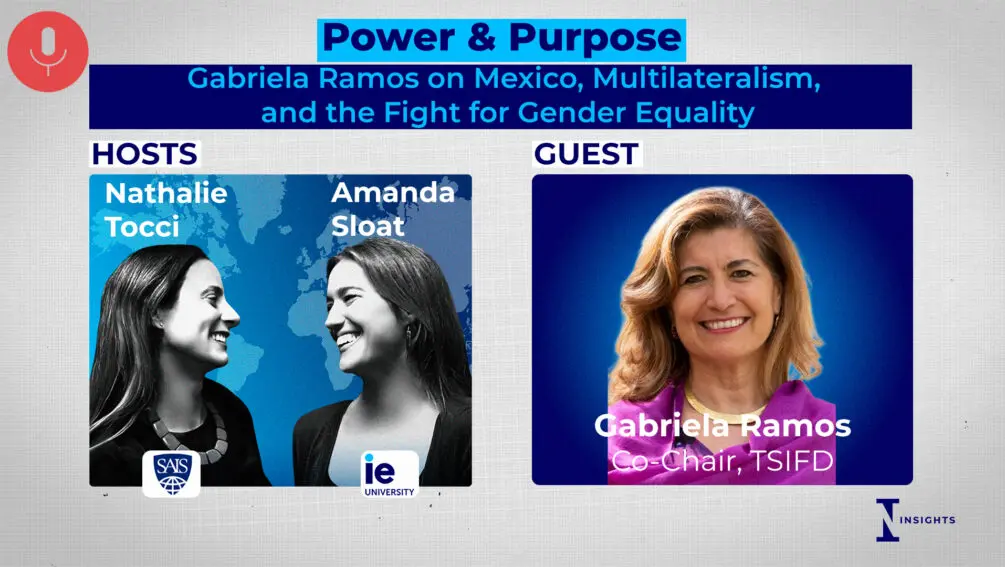
Gabriela Ramos joins Amanda and Nathalie to reflect on Mexico’s changing relationship with the United States, the weakening of the multilateral system, and the effort needed to sustain international cooperation. She discusses parental expectations, professional trade-offs to sustain family life, and the purpose that sustained her through achievement and failure.
Gabriela Ramos is the co-chair of the Taskforce on Inequality and Social-related Financial Disclosures (TSIFD), leading the development of a framework for financial transparency and social impact. Previously, she held the role of Assistant Director General for Social and Human Sciences at UNESCO (2020-2025), Chief of Staff and Sherpa to the G20 of the OECD (2006-2020), and she was a member of Mexico’s Foreign Service. In 2025, she was Mexican Candidate for Director General of UNESCO.


© IE Insights.
Transcription
Amanda Sloat
Welcome back to Power and Purpose. We are delighted to be joined today by Gabriela Ramos, a Mexican economist, former diplomat and international civil servant who spent two decades at the OECD before moving to UNESCO. She currently serves as the co-chair of the Task Force on Inequalities and Social Financial Disclosures. Her expertise spans international economic governance, AI ethics, gender equality and multilateral institution building, all of which we look forward to discussing today.
Gabriela, welcome to the podcast.
Gabriela Ramos
I’m so glad to be here. Thank you for the invitation.
Amanda Sloat
Well, even though you live in Paris, let’s start with politics closer to your birth home in Mexico. Latin America has slipped out of the headlines in recent weeks with the focus on Iran. But the Trump administration certainly has been active in the region over the last year. He threatened tariffs to force Mexico to take more action against migrants and fentanyl.
He’s raised the prospect of unilateral military action against drug cartels. We’ve seen military action in Venezuela. In February, he helped the Mexican government take down a prominent cartel. How do you see Trump in the United States viewed in Mexico these days? Is the United States seen as a threat? Is it still seen as a reliable neighbor? What’s your sense of the bilateral relationship these days?
Gabriela Ramos
Let me start by saying that it’s not about President Trump, even a president we had in the late last century. He used to say that Mexico was very far from God and very close to the US. Meaning it’s a challenge. It’s a challenge because it’s a superpower. Because the US doesn’t have friends. They have interest independently of who runs a country.
And therefore it has always been a very intense and difficult relationship to manage because we are so interlinked and more since we signed the North American Free Trade Agreement in 1994 when we signed the agreement, the economy has become completely linked. Border migration, cultural exchanges, history. So we are very, very linked. And that could be an asset. When you have a partner that wants to play a game and that can become very difficult and very risky.
When you have somebody like Mr. Trump at the helm because he’s unreliable, because he’s uncertain, because you don’t know what is next, because the measures that he’s taking, for example, in all these massive departures and the way he’s treating migrants or not migrants, even legal residents, but with their feet here because they look like Mexicans are a real problem.
I think that President Sheinbaum had been successful at avoiding the worst interference. But it’s also true because there are a lot of people in the US that understands that Mexico is too important to the US, and creating instability in Mexico would be far worse than anything else. So I think that this has limit the kind of actions that we know Mr. Trump would like to have, like, pursued the drug dealers themselves.
They have not done that. But it is very, very unstable and it’s very risky, and it has caused a lot of havoc in Mexico.
Amanda Sloat
Is your sense that attitudes of the Mexican people are changing towards the United States? I published a piece recently in the Washington Post talking about how much attitudes have changed in Europe that students don’t want to study in the US anymore. People don’t want to go there on vacation. I’m curious if those are similar attitudes that are changing in Mexico, or if, because of the history and proximity, those dynamics have largely not been affected.
Gabriela Ramos
I think it’s having an impact, short term impact. There is a by historic standards, very, very low migration, which is interesting. The crossing the border from the Mexican side has just cooled off very, very low. Yes, there is the sense that is no longer safe to go to study in the US, although there are a lot of scholarships and programs that I would think will continue to impact positively on the decision making for students in Mexico.
I think the short term is very bad long term, I’m not sure because we’re very interlinked and there are millions of Mexicans first, second and third generations in the US. So these links are very difficult to break just because of a very bad period of relationship. Although it’s true that the famous need for diversifying the links is becoming much more and strategic element, particularly for business sector, but also for students.
There is a massive flow for Mexicans to Spain, for example, we see more Mexican students choosing to go to the Netherlands, to the UK too. But I’m not sure this is going to be long term because geography is destiny. It’s just an impressive, attractive country and the US now is going through very bad times, but it’s a very interesting country and it’s very close.
So I don’t think that long term, hopefully we will get a decent presidency sometime in the US. I would think that maybe not resume in the very same way, because now that you have been beaten so hard, is difficult to recover trust just fully. But I’m thinking that the links and the geography is too strong to just derail this relationship.
Nathalie Tocci
Amanda brought in Europe there. And let me continue with that triangulation, because of course, in many respects, both Mexico and more broadly, Latin America and Europe are in a similar predicament when it comes to the United States, and both in different ways. I mean, you used, I think, an incredibly important word, which is diversification. I mean, you both are looking at how is it that they can, in a sense, dilute dangerous dependencies.
As a Mexican living in Europe, if you could perhaps reflect a little bit about how you see European and Latin American approaches to this question of how to dilute dangerous dependencies, not only in the present, but also given that trust has been broken, looking ahead into the future.
Gabriela Ramos
My reaction for Europe maybe is different than from Mexico, because Mexico needs to be super active and very fast and is one country and is one president, and we’re a presidential system. So the limits of what you can say and you cannot say are not so clear as in the case of Europe. The Mexican president has been super strong, and therefore she is admired because she has taken a very strong stance.
Europe looks somewhat lost in many ways. You can see some countries, like the president of Spain being very tough, very strong, very clear, very independent. But then you see the European Union trying to get to grips into this thing, and therefore the messaging has not been very fortunate. I think it has been clumsy, it has been noisy, it has been not coherent.
All of us. And I am, of course, admirer of the European values and the way that Europe has come together and overcoming so many differences. We wish we had a stronger European voice, which we don’t. On the other hand, knowing Europe, we also know that things are moving. We are seeing how the European Union is trying to build instruments to counter this thing.
We know. I mean, I’m not very fond of the fact that Europe is investing so massively in defense, and this probably is not taking the headlines, but this has meant that Sweden or the UK or Germany are diminishing the funds for international development, even for the UK, in the very same size than the US, which is just huge.
And therefore I’m not happy about that. But I can understand why the priority of the Europeans is to see how they can continue supporting Ukraine. I think this decision that they made in terms of they did not get the frozen assets to cover for Ukraine military needs, but they got agreement to put €90 billion.
And therefore I think that Europe sometimes is very slow, is very clumsy, not very understand what is going on. But then it’s a scaffolding. And when you take the scaffolding it looks like okay, so I’m hoping that this will be the case, the results of the election in Hungary. I feel that we might be able to be faster.
That was a real blockage and many people said it. Hungary was has 1% of the GDP of Europe and has so much power in blocking the decisions regarding Russia or the decisions regarding Ukraine. And therefore, I think that we might see that this is going to get faster.
Amanda Sloat
Can I zoom out a little bit further, building on that, and ask about your view of what’s happening in the multilateral system, which is a space that you’ve worked in for most of your career? It’s no secret that Trump is not particularly a fan of multilateralism. You already talked about the impact that cuts by both the US as well as other countries are happening in the development space.
Growing conversations about the role of middle powers with Carney. We had an Indian guest on previously. We’re talking about the rising powers and roles of the global South and some of these other countries. So I’m curious in the context of everything we have been talking about in the broader shifts we’re seeing in the international system, what your sense is of how this is affecting dynamics within the UN and some of these other multilateral institutions.
Gabriela Ramos
I feel that multilateralism, it’s really experiencing a very, very bad period. Very bad period, because you have the withdrawal of the US of not only UNESCO for the second time. And I went through leaving UNESCO without the US and leaving UNESCO with the US because we managed to get UNESCO back when I was assistant director general there.
But then they left. They left the Human Rights Council. They left 60 institutions cutting the contributions, which at least is 20% less of the budget of the institutions. And it might sound like, okay, you need to adjust 20% less is huge. And then the worst part is the disappearance of USAID, the American institution that really channeled lots of funds for international development.
So the multilateral system is in disarray because of the funding, but it’s also in disarray because it’s very interesting. In my experience, the US is always a difficult partner, no matter who is at the helm, because they’re so powerful, because they’re so big, because they have so much leverage. And therefore, for my experience, when I was Sherpa to the G20 and during the first Trump administration and the second time, what really was worrisome was that the US has always been an organizing force, always.
And you can be with them or you can be against them. But they were always organizing the conversation. They were always putting themselves in defending human rights, in trying to foster certain agreements. And whenever they agree, things get done, like it happened with the climate agreement. It was Mr. Obama with the prime minister of China and then, of course, the French diplomacy.
But at the end, it was really this power broking that the US has. So now you have this huge vacuum, and when you see that some delegates of the US can refer to the human rights framework as the so-called because I heard it on the so-called human rights, it’s like we are really lost. And then you have many other countries that are not very fond of human rights or those frameworks for the matter that gain a lot of space.
So this is the real problem of leadership, lack of leadership, lack of organizing center there. And not only that, there is a full attack on international institutions. For me, the response of the international institutions has not been as effective as it should. If I was the Secretary-General of the UN, I would have called all of my institutions to ask them to show the world what they have meant in the work.
How many millions the World Food Programme has fed? How many have not died because of them? How many businesses have been promoted to a change because of the WTO, and to understand international trade standards and the certainty that that provides? How many students have been able to go to school because of UNESCO or UNICEF? Look at the impact.
And that’s my problem with the UN system. That is not very fun. In looking at the impact, how would you change things on the ground? But we do change things on the ground. I know that the UN system can become cumbersome and it’s true. It needs reforms, is very slow, but it’s very slow because we have 195 countries agreeing to each other.
Come on. And the things that we achieve, like the recommendation of the ethics of AI, which was very difficult to negotiate and it was a recommendation, is not binding, but nevertheless, it’s an international standard. It’s not easy. But when countries get together and agree on something that they want to achieve, they produce magic. And therefore it’s the member states that need to put their act together.
So where do we go from here now that we have this reality check? I feel that then, as Mr. Carney said, it is very important that other countries pick up the pieces and try to build it up, at least to build a bridge until we get better leadership or leadership that is more interested in international cooperation. And this was well done, I think, in the very first Trump presidency by President Macron, when he called everybody to recommit to the climate agreement, I think we did something of the sort, because there are so many frameworks that are at peril now where other countries might say, climate, I’m not sure if I didn’t feel agree on that or not. It’s very important that at least we try to preserve that until we get better leadership. We need some countries to step up.
Nathalie Tocci
Yeah. I mean, I think exactly. So the building on global coalitions of the willing, in the same way as, you know, this is happening also at regional level, particularly in Europe. I completely agree with you.
Amanda Sloat
Well, you’ve raised so many important issues that we want to circle back to on AI, on gender equality, on the benefits and struggles of working in multilateral organizations. So let me shift this from a policy conversation to a personal conversation, and want to go back to young Gabriela. Growing up in Mexico, you’ve talked in some other interviews about the importance of your early education in Mexican public schools.
I know you did a master’s at Harvard Kennedy School. You were a Fulbright, a Ford MacArthur fellow. Take us back to your thinking. When you were young, were you always interested in public service? How did some of these educational experiences in Mexico, in the US, end up shaping your thinking about your possible career?
Gabriela Ramos
Well, I think everything starts at home. And, you know, because I work a lot on gender issues and trying to understand all these social codes and norms that put women in one place and men and another, I started to look at how I was raised, and of course, I felt very lucky because I had my mom and my dad.
Both of them were so independent minded and so ahead of their time because they were in the 60s. My mom could have been a very traditional, nice housewife. She wasn’t. She was a miraculous after she tried to find her own way. My dad was an engineer and they were always very interested in ensuring that their children fulfilled their full potential, not in the sense of you’re going to be the best and you’re going to be the brightest.
And but in the sense of service. I was born in Michoacán. Michoacán, unfortunately, is a state that was fine when I was born. Now it’s becoming a very tricky state, not very well covered, but I still remember my dad had a ranch. He was an engineer and he had a factory, but then he also had a ranch. And I remember going to the ranch, which was beautiful.
And then I was looking at the neighbors of the ranch, all these very skinny families, poor families. And I was very young, and I was looking at their houses with no light, with no floor. And it was very sad. You cannot forget when you see a little skinny girl coming out of a very shabby house, looking at you so dirty.
And I’m like, no, this cannot be. In any case, my dad was amazing because instead of saying, my girls, you don’t go out because you’re girls, you take care of your dresses, you worked or no, they would always say, my girls are going to be doing fantastic things in life. I was very young and I was thinking, what am I doing? Okay, but he knows me because he’s my dad.
And so these kind of things and I would like to tell all of the families to say that to their children, you’re going to do great things. You don’t know what, but you’re going to do great things. And then they of course, invest a lot on education and things. Actually, when I decided to go to public policy and foreign affairs, because I decided to study international relations, my dad said, what, you should be an engineer.
And I’m like, no, I’m not going to be an engineer because he wanted me to go to his factory. But that was very interesting because then fast forward, I launched a movement in Mexico in the early 2000s, when I was the head of the office in Mexico, to promote more girls going to STEM. And I was going with the Minister of Education to all of his trips to bring mentors, women engineers that would talk to the girls in the schools to just to let them know that they could be whatever they wanted to be.
And I invited my dad once and my mom to come. And then my dad told me, you are an imposter because I told you to be an engineer, and now you’re engineering. And I’m like, my God, you’re right. But then I said, you know that it doesn’t matter. The fact is that you thought I could be an engineer.
That was what is important. It doesn’t matter what we do in life. So I think this is really important to try to encourage families to see that the potential of their children, and particularly of girls, is shaped by the comments that you make day by day. And therefore I think this is a very important thing. And then, of course, I went to international relations, which was making him not so happy.
But my professors there then recommended me to go to the Foreign Service. I went there, I was happy I joined the Foreign Service. I always invested a lot of effort and therefore I was first in the promotion in 1989 and I was invited by the Foreign Minister to work with him, which I was real, because I didn’t know anybody.
I didn’t have any political links, I didn’t have any recommendations, only my professors and my school that believed I should be joining the Foreign Service, and I did. But then for our listeners, is not always funny over cereal, because as a woman, then you need to make choices. And my first post as foreign official was Paris. And I was like, yes, I’m going to Paris.
Well, surprise, surprise, my husband really was not ready to move. I had a little baby and I was expecting a second baby. So no Paris, no Foreign Service, thank you very much. So I had to quit. I launched my own consultancy. Then I saved the whales in Laguna San Ignacio and a huge campaign. I worked to allow Mexicans living abroad to vote in the elections.
But then I was invited to join the OECD. I didn’t want to do it because I had my little girls. But then I was convinced I applied for the job in Mexico City, and then the rest is history, because a very prominent Mexican became the secretary-general of the OECD. And then he invited me to come.
Nathalie Tocci
So the rest is history. Let’s go to that history, because one of the questions I’m often asked and I struggle to answer is this question of the national versus the multilateral, right. Yes, I want to work on foreign policy. Yes, I want to work in public service. But should I pursue a career as a national diplomat, or is a multilateral setting the right choice for me?
If you could talk us through a little bit how it worked out for you and me, I understand that eventually you left the diplomatic service essentially because of personal choices, but are there particular characteristics that you feel fit best with one as opposed to another? Are these actually not mutually exclusive in the way in which people should be thinking about their careers?
Gabriela Ramos
Well, that’s a very good question, because, you know, it brings the students to think that they can organize everything because of the choices they make, but they actually don’t. And I’m sure that you agree with me that life takes you. The only thing you can do is to be well prepared for when the opportunities arise. I never thought I was going to be in the multilateral.
I always saw myself as a diplomat for my government, and that was a source of pride, because it was great to represent your country, because I negotiated anti-bribery convention, and it was great to be sitting there and to bring the interest of your country. That is one of the most rewarding feelings to bring the voice of your country to negotiating tables, or to bring the voice of your country to different meetings or gatherings.
I could have stayed there, and it was only the timing, because what is very interesting is that when I was elected secretary-general of the OECD, I was the head of the OECD in Mexico. So I was still in the world of I am in my country. I’m going to continue. And I was working actually, particularly for my country, to reform different policy areas.
So when I came and I started working for him to help him in his uptake of the job, he invited me to go to Paris and joined the OECD internationally. And I said no, because I thought my husband is not movable, but I will continue working for you here in Mexico. And he said, okay, thank you. And then one night I was having dinner with my husband and I said, well, would be so great to go to Paris.
And twice I say no to Paris. That’s not great. No. And I said, why did you say no? I said, because of you. And he said, well, ten years got past and, you know, that time was not possible. This time it might. Like what? So you see, it’s more how the opportunities presents. And the only thing that young people can make is to be super well prepared wherever they are, to be ready to take the opportunities when they come and then move on.
The comparison between foreign policy of a member state and multilateral setting is very similar and is very interesting, because at the end, you are using a tool that can be your power in the government or your convening, and try to bring countries together to agree on certain things to achieve positive outcomes for the world. And I feel it’s always the outcome based that has driven my agenda more than the tools that you have, the tools that you have, you just use them.
The outcomes is what we really need to pursue.
Amanda Sloat
And I want to follow up and ask you about gender dynamics throughout your career. I know you’ve been very active on gender equality. It’s something that you’ve worked on in the digital and AI world in terms of concrete measures to address the role of women there, but I’ve also been struck over the last couple of minutes, as you’ve shared some of your personal story, the way some of these gender issues and also family issues, to make it broader, have played out.
You talked about the expectation of your parents in some ways, you’ve talked about the dynamic with your husband, about the very real choices you faced as a mother and a policy professional. And I know for a lot of young people thinking about going into these careers, especially international careers and ones that require movement, these are going to be the hard choices that they are going to have to make.
So my macro question is more on the struggle for gender equality and how we deal with that in the workplace. But I’m also interested in how you navigated that personally, and especially when you reflect back on your career leaving the diplomatic service, it’s ended up leading to other good things. What lessons you take away from some of the very real choices and trade-offs you’ve had to make to balance your personal and professional career?
Gabriela Ramos
I think you put it right on the spot, because these trade-offs, I think that you need to be super flexible. I still remember a very good friend of mine, Benedict Lara, who was the economist in charge of Mexico at the OECD. She always told me women have right to do things out of three, never three, just two out of three.
And you make your choice. Husband, children or professional career. And I was like, no. Yes. Or you are divorced and you have your professionals, or you have your children or you have your no. And said, no, I want them all. And I think that girls or women that are listening to us, they need to be a wanted all women.
And that means that you always need to be struggling. When I said no to the first promotion, which was Paris, Amanda, it was Paris.
Amanda Sloat
I know, I know, it’s hard for our listeners to imagine somebody giving up the chance to go to Paris.
Gabriela Ramos
I have to say that I hated my husband. I said, how is it possible he’s blocking me? He’s not. And then I started thinking, I think I said no. He has been very supportive many times and now I need to be supportive. So you always need to be clear that having a husband and children would always demand to find the equilibrium.
The real question here is how do we ensure that women has the same chances? And how do we ensure that the systems that allow for people to succeed in their professional careers is better prepared to support women needs and personal situation? And we saw it when we launched the gender strategy at the OECD. It was women have no limits.
We are having more girls that graduate from university. We are having better grades from girls in school. So too in Afghanistan. They don’t allow girls to go to school. So we are backtracking in many ways on gender rights. But the fact is that as soon as you get into the maternity stage, women drop from the labor market. It’s a name change, it’s just amazing.
And then they try to get back to the labor markets after the kids are a little bit in school, but they never get to have the same opportunities they would have had if they didn’t do a break. And therefore it’s not for women to fix women. Reality is for the system to allow dual parental leaves, so you at least take the incentive and not take it or leave it basis.
So it’s not that your husband pass to you or his leave, but that he needs to take it. Because in that way, you are sending the incentives for the businesses not to think that because a woman is in a childbearing age, she’s going to be leaving and it’s better not to invest on her these kind of things. The question, as I said, that STEM is really for boys.
How come the schools continue to hold those kind of messages where maths is for boys and girls are for nice things? So my work for gender has not been really to, of course, I mobilize women. I have partnered with so many amazing women that have moved the agenda, but it’s more from the policy side where those policies that will help us to push.
You mentioned the question of the ambition the family has on children in the PISA report that the OECD, we did an analysis on gender expectations, and it was just shocking because families on the spectrum there women there girls to be engineers, they have lower ambitions for their school journey than for men. And then surprise, surprise, when you ask the top performer girls in the PISA maths report if they are good in maths, 30% will say yes.
So I think this is the kind of things that I have been pursuing.
Nathalie Tocci
I think another major success of yours has been, you know, the work that you did in terms of ethical guidelines on AI. So there’s a lot there. Something though, that we’re very keen to talk about in this podcast is when things don’t quite go according to plan. I was just thinking back at when we last met last year, and you were campaigning to become UNESCO director-general, and in fact, you were the only female candidate amongst three finalists, and you were the first Mexican woman to stand after we met.
You then withdrew your candidacy. And I’m just wondering if you could talk to us or share whatever you want to share about what happened there, but especially how you felt about this. Did you live it as a failure? Was this something that you, in the end, learned from? Did you feel that it took you to perhaps a different destination, that it wasn’t quite the one that you had planned, but it is great nonetheless.
Many of our listeners look at all of the amazing things that our guests have done. And of course, behind those amazing things are all sorts of other things that are just as important, but perhaps don’t get as much visibility.
Gabriela Ramos
We had such a great conversation when I was a candidate. It was great to see you in that position. I have to say that first it was the failure. Yes, but I can tell you that being the candidate nominated by your country to participate in this kind of high level competitions has been the greatest honor. And again, going back to the question of representing your country, that’s the ultimate representing your country.
So for me, I will do it again. Even though it was very painful not to win. What did I learn from that? That it is not only about merit. And you should not be thinking that I have all the credentials. My credentials are the best because at the end, countries have so many interests and so many things to encourage that are not even related to the topic at hand.
Many countries will change their vote for a candidate for something completely different that is not linked to the future of the organization. I learned that and it was very painful because probably I arrived with a more Pollyanna view that countries were really willing to get the best in terms of the proposals of how to handle the institutions. And the best.
Of course, I define myself like that because I was the only candidate that had 25 years handling international organizations. I was not working in an international organization. I was the number two of the OECD when we reformed the organization, when we transform it, when we put it in the G20, when we launched the international tax reform. I mean, and then at UNESCO, I have been there for five years.
I knew where the bodies were buried.
Amanda Sloat
Where the bodies are buried. Yes.
Gabriela Ramos
So I felt I had all this experience to really push for more effective and more impactful institutions. But then you get to see that it’s not about that. And I have to recognize also that the Egyptians did an amazing campaign because first they started two years earlier and because they have been trying to get the UNESCO for the last three terms and the last two terms.
They just lost it. I miscalculated because in my quest to be like, yes, this merit based, I didn’t realize that the Egyptians, having been twice turned down, many countries were feeling that it was really their time. And maybe if I would have been more open to listen to those messages, I mean, I might as well put my name.
It doesn’t matter. But I would have been less frustrated than what I was. And therefore, sometimes when we embark in very important initiatives for ourselves, we might not listen to the real issues. And that’s very important because you are so into your project and to your plan, onto your, you know, that you are not listening what people are telling you and many, many.
And that’s why I, at the end, I stepped down because key countries that I will not name, but where I’m very close to the presidents, I’m very close to the ministers of foreign affairs, the ministers of foreign affairs will receive me and know and they will tell me. We cannot change our vote because we committed a direct and we committed six months ago, and the divisions have already delivered.
So there were many things that didn’t work. It was painful. Yes, of course, because it would have been amazing to be the general of UNESCO, for God’s sake. It’s just amazing. But more than anything, because I understood the power of UNESCO when I moved from the OECD to UNESCO, I thought, what is this place? Because it’s the molar number of members more advanced.
I was a chief of staff. My leader was always supporting with reform. The HR policies were reforming the old policies. We were really, we had a Rolls-Royce. There was a world tour. As I moved to UNESCO and I was like, My God, I mean, these people are completely lost. The quality of the human resources was not as good and the processes were painful.
The UN system is painful. Duplications, competition among institutions. And it was painful. But at the end I felt that I managed to reform it. But member states always have the last voice, and that’s what happened in this case. And I wish well, Mr. El-Enany, who really did a fantastic campaign, and I hope that he will be able to navigate this very complex times for UNESCO.
Amanda Sloat
Thank you for sharing so open and honestly your experiences and your experiences of what was in many ways a public failure given the publicity around your candidacy. I know we could continue to talk to you for many hours about your fascinating life, your fascinating career. But as we start looking at winding down our time together, I wanted to circle back on another topic that we like to talk about, which is well-being and how you stay healthy, physically, sane, emotionally and mentally during very busy jobs.
In public service, you’ve spoken about balancing a family life. You’ve been in situations like UNESCO, where there was a lot of uncertainty about whether you would get a job or not. You’ve worked on very high profile initiatives. What are some tools that you have found to enable you to stay healthy and connected, and maintain a sense of balance in your life?
Gabriela Ramos
It’s a very interesting question, because I always think I’m not in balance. I try to keep a well-being. And of course there are things that we know sports. I’m super supportive. I did try it when I did the marathon. I continued to cycling. I continue to run, I continue, this is my skill and that’s important. My husband is also super sportive, so we are two of a kind.
But I would say that what really keeps me going and I think keeps me sane, is the realization that there is so much to be done and so much to be fixed. And I don’t want to sound arrogant, but really having this sense of purpose. But I think there is so much to do in this world that we cannot waste the possibility of us helping to do something, and then the chances present itself.
And so if you go through life achieving these things that improve people’s life one way or another, you become addictive. And that’s what keeps me strong, thinking that there’s so much to be done that we cannot spare any moment, big or small, like give you more opportunities, like give you big opportunities. You take them and run with them.
Nathalie Tocci
We normally ask our guests to share with us one thing that has given them joy, that has made them smile over the last few days.
Gabriela Ramos
I can say that the Hungarian elections, because I’m a progressive and I’m a real social animal. And so I’m very glad that we have a normal government there. Not. But it makes me smile meeting people like you. It makes me smile. Getting to know Kailash Satyarthi, the Nobel Prize that is saving kids out of slavery. To know this lady, the minister of Gender in Tunisia, I want to tell the listeners that there are more good people around the world doing fantastic things.
The problem is that we always see the headlines and the headlines are not very positive. But I’m always thrilled to see people that are doing things like this lady that I talk to you the first, who is now a refugee in New York, but give this girl 23 years old, that she wanted to allow women in Afghanistan to run in the streets because they couldn’t do it even before the Taliban.
And she organized herself to do it. That what makes me smile. And I think there’s so many people like that, including this wonderful podcast. So I will keep on smiling, even though the news and the headlines are not very nice nowadays, but they will be someday.
Nathalie Tocci
Gabriela, I really think that not only are there so many of these people around, but that it’s really up to us to ensure that we are and we will continue to be ever more connected. So I really wanted to thank you for this wonderful conversation. It’s been actually really uplifting. You’ve taught us a lot about what it means to be confident, what it means to be prepared, but also what it means to just jump on the opportunities when they arise and just kind of, you know, embrace surprises when they come around.
So thank you so much for sharing all of this with us today.
Gabriela Ramos
Now, thanks to you for doing this wonderful podcast.
Amanda Sloat
Thank you so much. So I am sorry the listeners could not see your beautiful smile, but I think they could hear it in the infectious energy and positivity of your voice. Thank you so much Gabriela.