- Home
- News And Events
- News
- Rebuilding The Social Contract In The Digital Age
Rebuilding the Social Contract in the Digital Age

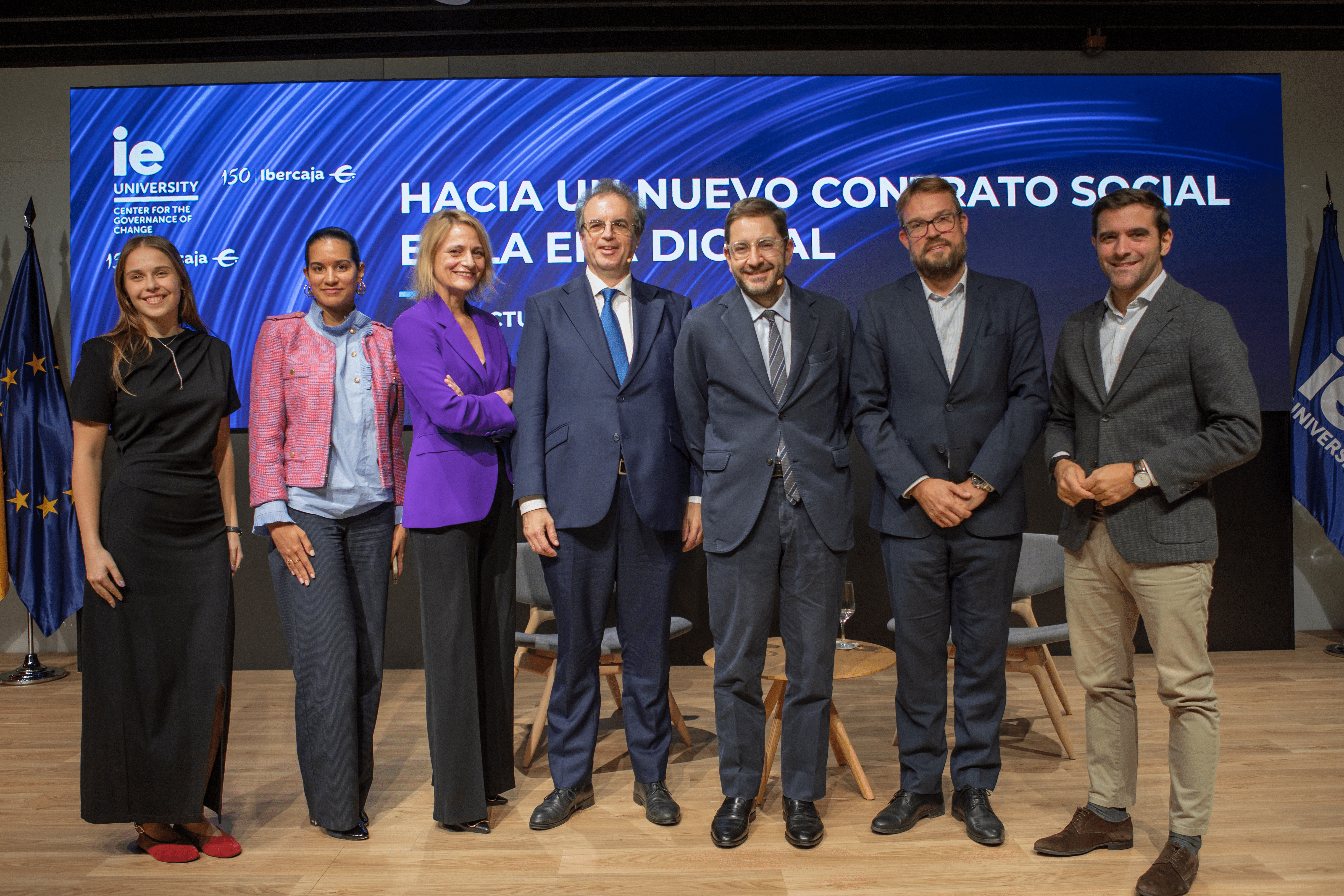
Madrid, Spain - On Tuesday, at the IE tower, we hosted a conversation with Francisco Serrano, Chairman of Ibercaja, and Manuel Muñiz, Rector of IE University and President of the CGC, on how the digital revolution is transforming the relationship between citizens, businesses and institutions, and what a new social contract would require in response. The event is part of the research program The Digital Revolution and the New Social Contract, led by the CGC with the strategic support of Ibercaja and Santander.
The cracks beneath the surface
Manuel Muñiz opened the dialogue by posing a paradox: we live in the most materially abundant era in history, yet societies are increasingly unsettled. Trust in institutions is falling, polarization is rising, and openly disruptive political projects are gaining ground. For Muñiz, the social contract has two dimensions, economic and political, and both are under strain. Economic growth alone is not enough; it is equally necessary that its gains do not shift increasingly toward capital at the expense of labor income. His message was clear: the window for offering consensus-based responses is closing.
Francisco Serrano shared this diagnosis, stressing that we are at a historic turning point in which the speed of transformation breeds uncertainty and allows emotion to prevail over reason. Drawing on Ibercaja’s 150-year history, he emphasized the importance of putting people at the center and helping strengthen the “glue” that holds society together. He also warned of risks such as the loss of autonomy to actors operating outside the sphere of the state, and the distributional gaps that digitalization may widen.
A framework for understanding change
The event is part of a broader research effort. Irene Blázquez, Director of the CGC, opened the session by highlighting how digitalization and “geopoliticization” are reshaping the foundations of the social contract, a collective framework involving citizens, government and business. Miguel Otero, Research Director of The Digital Revolution and the New Social Contract, presented the conceptual framework developed with José Luis Martí and Jennifer Schradie. Their diagnosis points to a central problem: the erosion of intermediary institutions (political parties, public administrations, associations) that historically connected citizens to centers of decision-making. These spaces have largely been replaced by social media, and rebuilding that institutional fabric is, according to Otero, where research can add the most value.
From reflection to proposals
Carlos Luca de Tena, Executive Director of the CGC, closed the event by linking the research to the urgency of the moment: the protests spreading across cities throughout Europe are visible symptoms of the discontent the program examines. In the coming months, the CGC will develop 50 recommendations for a new social contract suited to the digital age, aimed at translating the diagnosis into concrete, ethical and inclusive proposals.
About the research program
The Digital Revolution and the New Social Contract is an interdisciplinary CGC research program developed with the strategic support of Ibercaja and Santander. It analyzes the systemic changes driven by the digital revolution and their impact on social cohesion, public trust and democratic governance. The initiative brings together experts from different disciplines to develop proposals that address the fractures technological transformation is creating in contemporary democracies.
Learn more about our research program The Digital Revolution and the New Social Contract and access all its publications here.