- Home
- News And Events
- News
- The Next Ten Years Of Work: Can The Arab Region Turn Ai Disruption Into Opportunity?
The Next Ten Years of Work: Can the Arab Region Turn AI Disruption into Opportunity?

AI is already reshaping employment, skills, and productivity across the Arab region. As investment and adoption accelerate, policymakers face growing uncertainty over how labor markets will evolve in the decade ahead.
Through three alternative future scenarios set in 2035, our latest report, "Artificial Intelligence and Employment Futures for the Arab Region", developed in collaboration with the United Nations Economic and Social Commission for Western Asia (ESCWA) and the International Labour Organization – Regional Office for Arab States (ILO-ROAS), offers policymakers a structured framework to anticipate uncertainties and shape proactive responses.
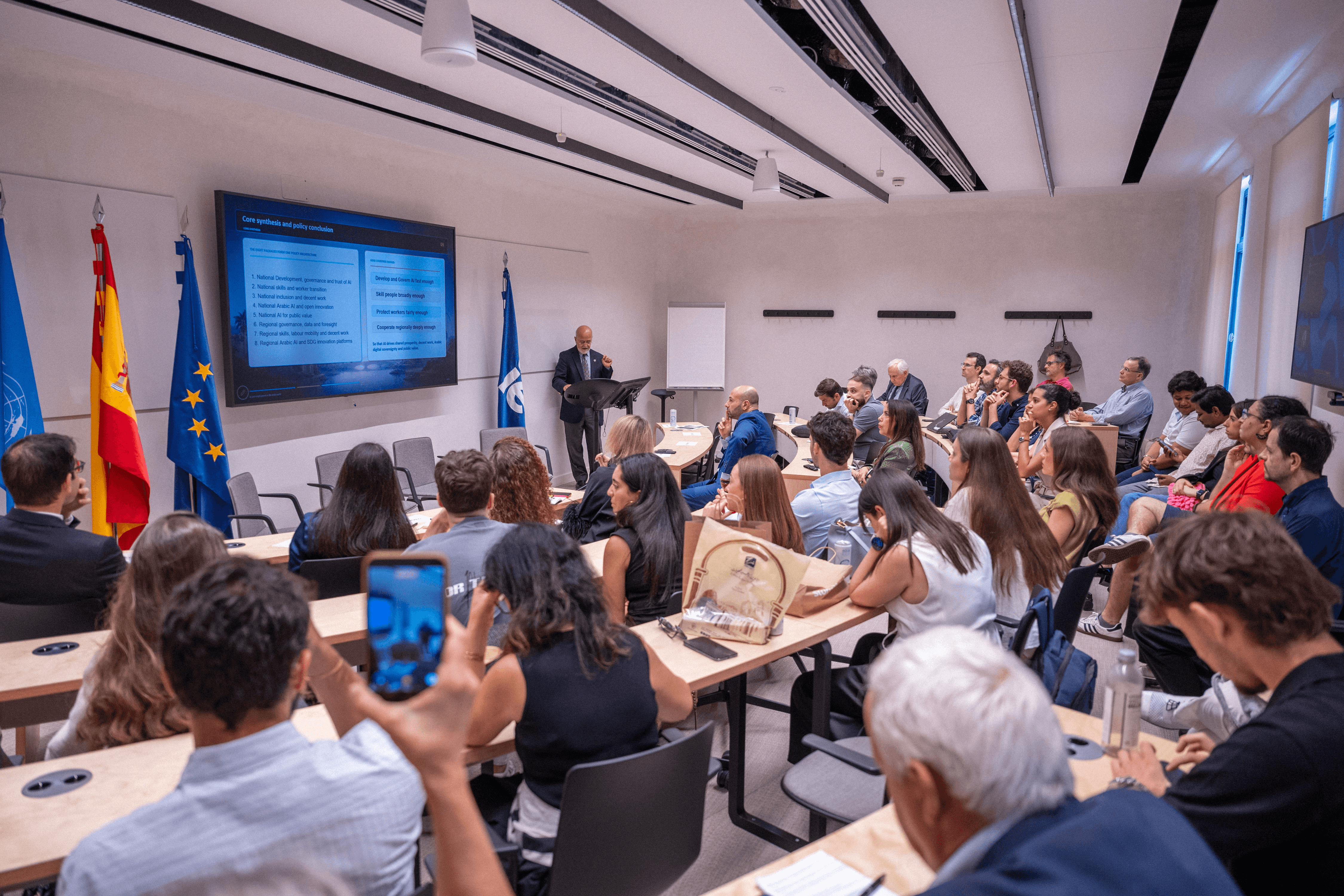
Key recommendations include:
- Make learning lifelong: Build lifelong learning systems, modernize curricula, expand AI training for SMEs, and strengthen public-private-academic partnerships.
- Make inclusion the default: Protect displaced workers, widen access to AI opportunities, modernize workforce formalization, and steer AI towards jobs with social value.
- Strengthen AI-readiness within institutions: Accelerate cloud adoption, build public-sector AI capacity, guarantee human oversight, and establish AI observatories to monitor labor market impacts.
- Deepen regional cooperation: Strengthen strategic foresight, harmonize rules for cross-border AI-enabled work, and promote decent-work standards for platform workers.
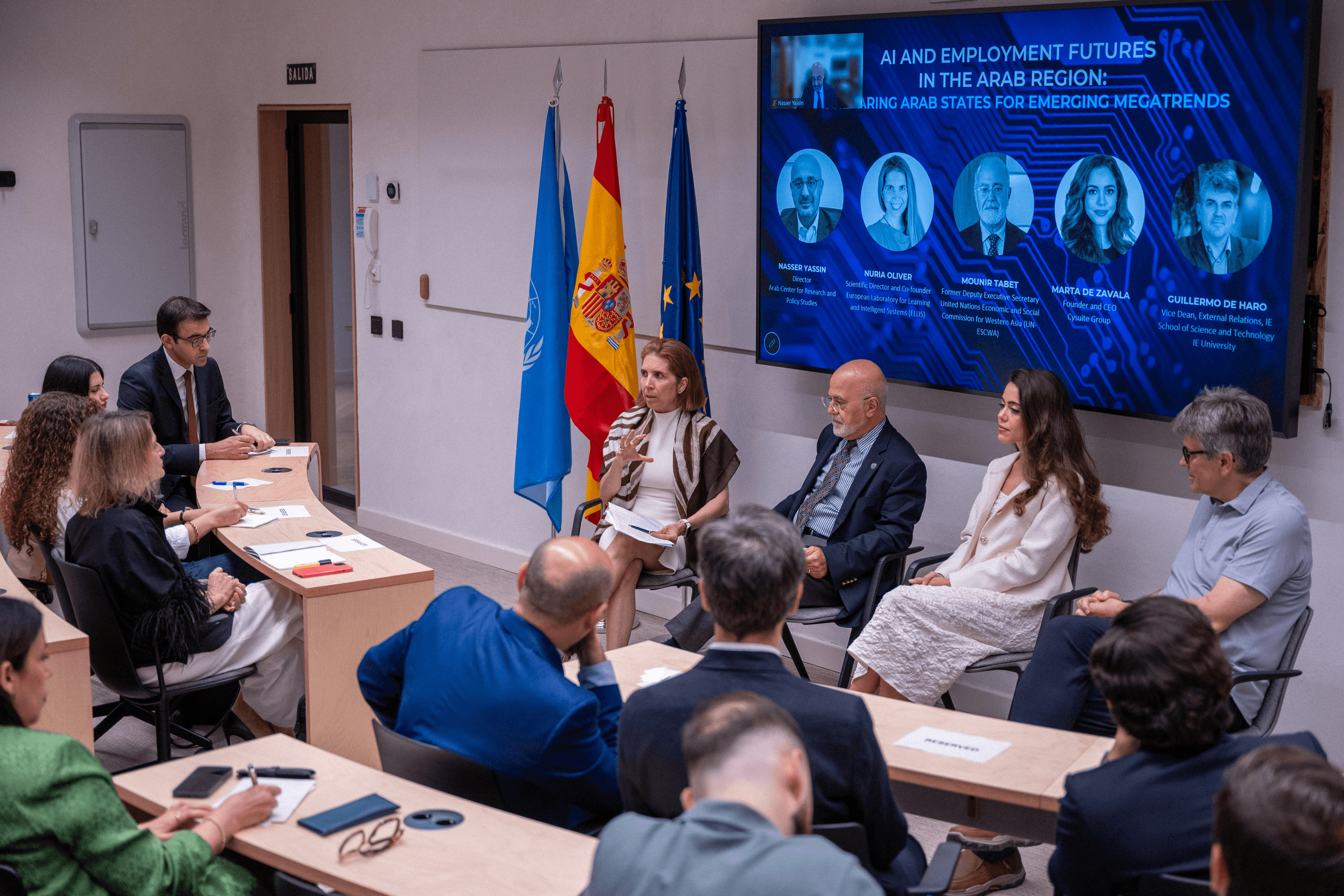
To mark the report's launch, we hosted a public presentation by lead co-authors Steven Kenney (Founder and Principal, Foresight Vector) and Mounir Tabet (former Deputy Executive Secretary, ESCWA), followed by a panel discussion featuring Dr. Nasser Yassin (Director, Arab Center for Research and Policy Studies), Nuria Oliver (Director and Co-founder, ELLIS - European Laboratory for Learning and Intelligent Systems), Marta de Zavala (CEO and Founder, Cysuite Group), and Guillermo de Haro (Vice Dean of External Relations and Academic Director of Graduate Programs, IE School of Science and Technology). The discussion was moderated by Mounir Tabet.
Our sincere thank you to all the speakers for sharing their insights, and to ESCWA for its partnership, trust, and support throughout this collaboration.