IE Foundation and Impact Bridge Present the Academic Case Moda re- on Sustainable Fashion and Social Inclusion

IE University, through the IE Chair of Social Entrepreneurship and Impact Investing, presented the multimedia case Moda re-, the social cooperative promoted by Cáritas, recently incorporated into the Harvard Business Publishing catalog as an international benchmark in sustainability, circular economy, and social inclusion in the textile sector.
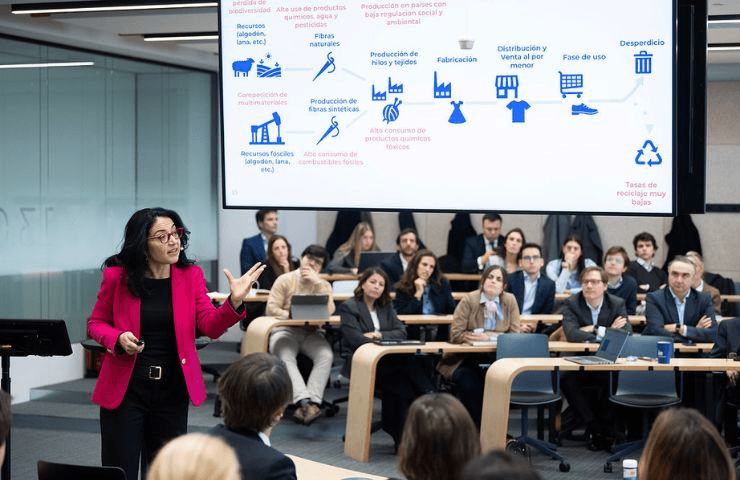
The session featured the participation of Natalia Peiro, Secretary General of Cáritas Española; Arturo Benito, CEO and Founder of Impact Bridge; and professors Rachida Justo and Concepción Galdón, co-authors of the study and leading voices in social entrepreneurship at IE University. The speakers highlighted the relevance of the case as an academic tool to inspire new forms of sustainable leadership.
The multimedia case, titled "Moda re-: A Quest to Re-Store Sustainability and Re-Imagine Fashion," was recently added to the Harvard Business Publishing academic catalog—a recognition that reinforces its educational value and positions Moda re- as a global example of social innovation and sustainability.
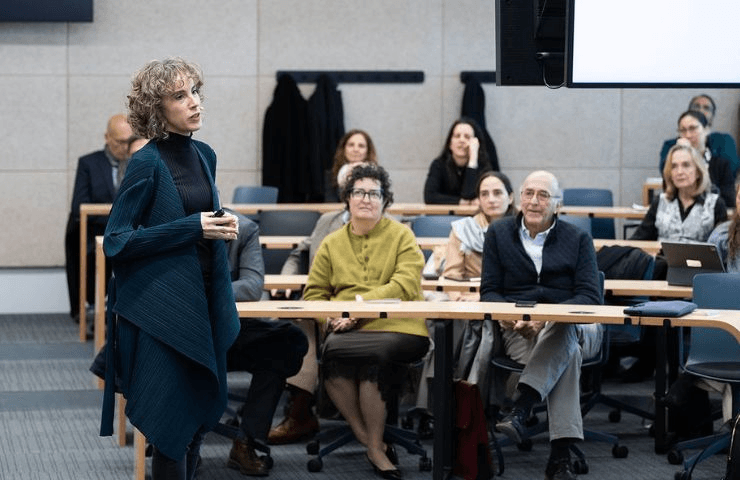
Developed by IE University with the support of Impact Bridge, the case examines how Moda re- has transformed the management of used clothing in Spain through a pioneering model of circular economy, social inclusion, and decent employment. The cooperative, promoted by Cáritas, integrates every stage of the garment lifecycle (collection, sorting, reuse, recycling, and resale) creating social value, reducing environmental impact, and offering job opportunities for people in vulnerable situations.
The project’s impact is both tangible and transformative: over 1,600 jobs created, half of them held by individuals at risk of social exclusion; more than 400 million m³ of water saved; and thousands of tons of CO₂ emissions avoided. In addition, its professional training program enables 60% of participants to secure stable employment, consolidating a model that unites sustainability and social cohesion.
The multimedia format of the case, combining videos, testimonials, and practical exercises, allows students to analyze the systemic challenges faced by social enterprises and to reflect on how to lead the transition toward more sustainable and equitable models.
For IE Foundation and Impact Bridge, which financed the project’s expansion through the IB Impact Debt Fund Spain, this case stands as an example of how cooperation between academia, investors, and social organizations can accelerate knowledge transfer and contribute to building a more equitable and sustainable future.