

Sweden and Finland – the two newest members of NATO – have signed detailed industrial security and research deals with the US, so-called Technology Prosperity Deals (TPDs). The agreements highlight a growing tension: while the EU pushes for greater European defense integration, countries facing immediate security concerns are pursuing bilateral transatlantic partnerships at a faster pace.
Enrico Letta’s 2024 report, Much More Than a Market, argues that “the Single Market should bolster European defence capabilities.” Mario Draghi’s later report, The Future of European Competitiveness, went a step further by calling for a new “Defence Industry Commissioner” for the European Union.
While the bilateral TPDs between US, Finland, and Sweden are nonbinding – and have thus managed to avoid wider scrutiny – they sit alongside existing defense mechanisms, such as NATO’s Joint Force Command Norfolk (JFC Norfolk) in Virginia, where the UK, also a TPD signatory, assumed command from the US in September 2026. Norfolk plays a key role in protecting the North American homeland and manages the transatlantic bridge and the Arctic seaways.
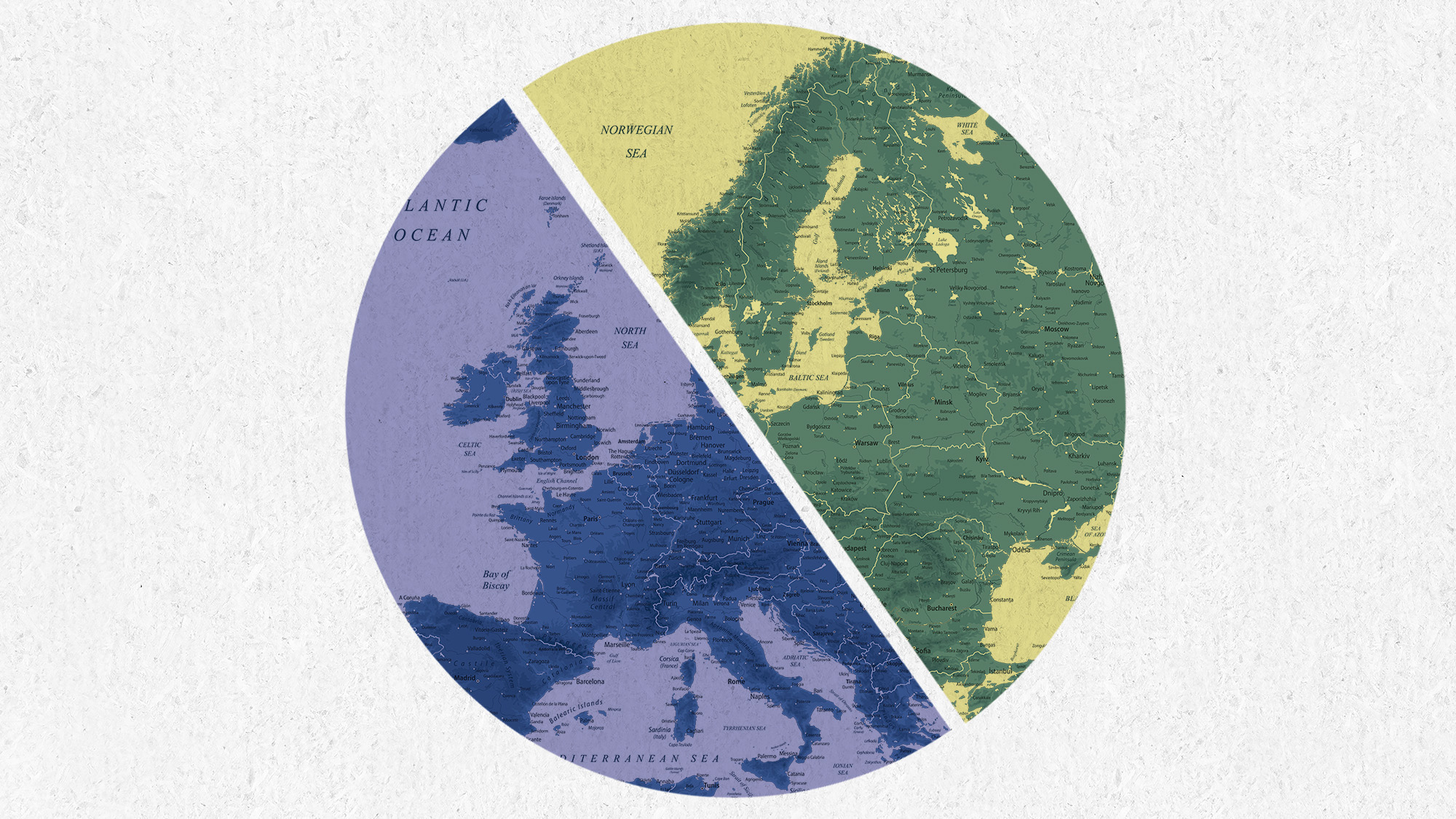
Finland and Sweden, together with the rest of the Nordic countries – all within JFC Norfolk’s area of responsibility – are strengthening their transatlantic defense ties as Letta and Draghi call for more unity.
Fast US Bilateral Defense Industrial Deals
Why is this happening? At the core lies one geopolitical supercycle where the US seeks to recoup industrial production, and two complementary defense needs that meet in the Arctic. Europe’s bureaucratic inertia risks pushing Nordic countries to prioritize more responsive transatlantic partnerships over common European defense initiatives. Washington is offering fast bilateral deals for the Nordic region while Brussels moves slowly on defense-industrial integration.
As the US seeks ways to safeguard the Arctic seaways against increasing Chinese influence, both Sweden and Finland – with the rest of the Nordic region – are looking for ways to safeguard their sovereignty against an increasing threat from Russia. Given their proximity to Russia, they can’t afford to wait for Brussels. Smaller states find the bilateral route easier, which could weaken the case for a common European defense market over time.
The Swedish TPD, signed by Marco Rubio in May, is aimed at the “full spectrum of advanced manufacturing technologies.” The deal specifically supports bilateral defense technology transfer and reduced defense regulatory friction between the two countries. These are activities that both Letta and Draghi want Sweden to pursue through greater EU cooperation as well. While the Finnish TPD doesn’t specifically mention defense technology transfer, as the Swedish agreement does, it includes provisions for scaling promising defense technologies with dual-use applications to operational and industrial deployment.
Funding the New Defense of Europe
The rise of these bilateral deals could complicate not only common European defense contracting, but also how it gets funded. While the new defense push in the US has been seeded by nimble venture funds such as Andreessen Horowitz’s American Dynamism and Founders Fund, Europe’s more fragmented investment landscape includes the NATO Innovation Fund alongside national and EU funding initiatives. France has not joined the NATO Innovation Fund, while the UK is not a member of the European Defence Fund.
How the Europeanization of NATO will be funded amid bilateral deals and fragmented government funding is an open question, leaving room for independent hybrid solutions such as the Scaleup Europe Fund, managed by Swedish investment firm EQT, which targets €5 billion and brings together a mix of the European Commission and private investors, such as Germany’s Allianz, Denmark’s Novo Holdings, Spain’s Santander, and Sweden’s Wallenberg Investments.
According to Resilience Media, European defense startups had raised $7.4 billion in venture capital by September 2026. More than 85 percent of that went to mega-rounds involving companies including Helsing, Quantum Systems, and Finland’s ICEYE. The share of defense tech venture capital going to EU startups across NATO and allied countries rose from 15 percent in 2025 to 21 percent in 2026, with the U.S. still accounting for a 75 percent share.
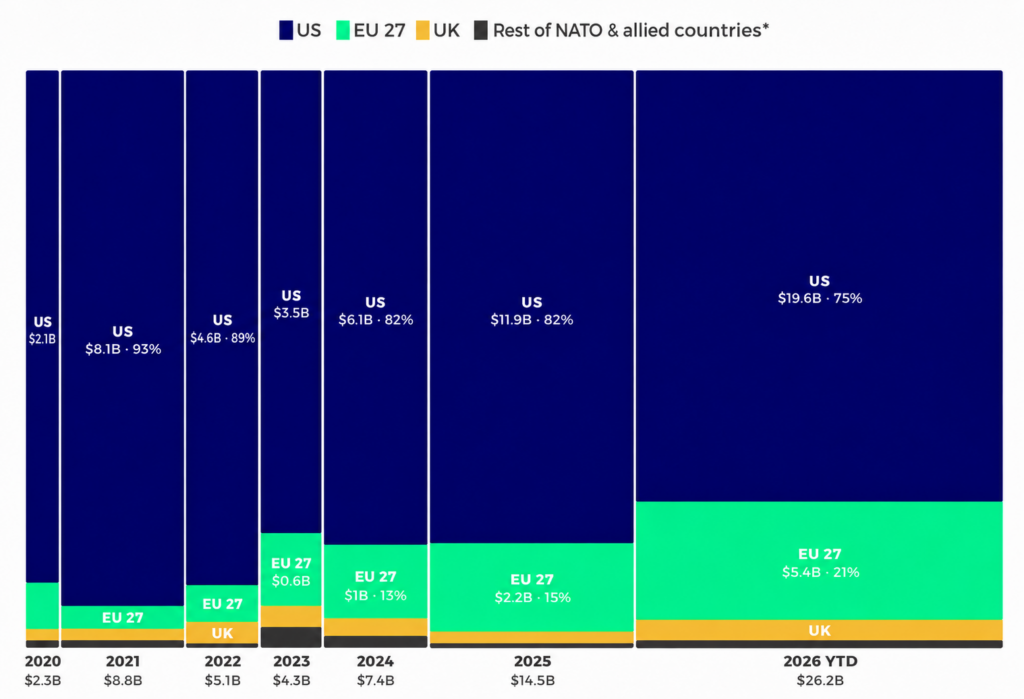 VC funding in defence startups across NATO and allied countries since 2020. (Resilience Media, dealroom.co)
If Nordic firms and governments find US funding and regulatory channels faster than European ones, EU-level defense-industrial projects risk losing some of their strongest protagonists. Brussels needs to accelerate – and extend – projects such as the Commission’s Programme for Agile and Rapid Defence Innovation (AGILE), which is aimed at helping bring disruptive defence technologies from the lab to the field. EU proposals, such as the European Parliament’s March resolution on a single market for defense, need to move from vision to action.
The Scaleup Europe Fund doesn’t yet have a free mandate to invest in autonomous hard defense, such as kinetic drone defense. If the European Commission, which has a one-billion-euro anchor investment in the fund, allows those investments, other limited partners will likely follow suit.
How Can Europe Catch Up?
Europe needs to stop sitting on the fence and start embracing hard defense instead of tiptoeing around non-autonomous dual-use and deep tech investments. What Europe is practicing currently has been labeled by defense insiders as “defense washing,” where projects adjacent to defense are branded as actual defense to meet defense spending targets.
The common fallacy in rebuilding European defense is that if common procurement is fixed and streamlined throughout the region, European defense startups will come. This is only partially true. A more important issue is to clear self-inflicted hurdles for investing in new kinetic defense technologies, specifically autonomous systems.
Successful joint procurement in Europe would require a common intelligence agency. The 2024 report from former Finnish President Sauli Niinistö called for an EU-level intelligence cooperative service, but that garnered resistance from the European External Action Service, which runs the Intelligence and Situation Centre.
Involving its national security agencies has been the main enabler for the US to successfully integrate new defense technologies into its old defense base. IQT, the venture capital arm of the CIA, brought us Google Earth and played a crucial role in helping Palantir bridge its valley of death before government procurement. The UK’s National Security Strategic Investment Fund was built with IQT as a model. Europe doesn’t have this. Without joint intelligence, joint procurement becomes increasingly difficult as new defense is being built on digital intelligence platforms.
Currently, Europe lacks a common homegrown command-and-control system (C2). In April, Germany decided against adopting software from US company Palantir for its armed forces. Helsing released its own C2 platform Clarity on November 11 while France is pushing its Arcadia. Spain decided not to renew its existing military intelligence contract with Palantir.
While JFC Norfolk is gravitating toward working with the NATO Maven Smart System, the rest of Europe needs to decide quickly. One likely candidate is Helsing’s new Clarity, which has been developed as a direct rival to Maven. It follows a similar operational approach to Maven, and Helsing has recruited from Palantir, including Robert Fink, the former Palantir engineer who led Clarity’s development. This relationship with Maven is like a red rag to Europe’s most Atlanticist-skeptical governments. But it may be even more unlikely that Germany will adopt the French Arcadia platform.
Without a clear path to a common C2 system, shared intelligence and access to investors who are able to throw large tickets at autonomous systems, Europe risks seeing its most defense-needy members increasingly drift toward bilateral transatlantic deals rather than rallying for European unity. This fragmentation also has consequences beyond defense as industrial reshoring initiatives – cue the TPDs – are being built on the same digital platforms as defense with mostly the same investors.
And if unity in defense starts showing signs of cracking, then what will happen to the single market? If Europe wants to create a truly functioning Single Market, it has to gather around common defense first. Fast.
© IE Insights.