

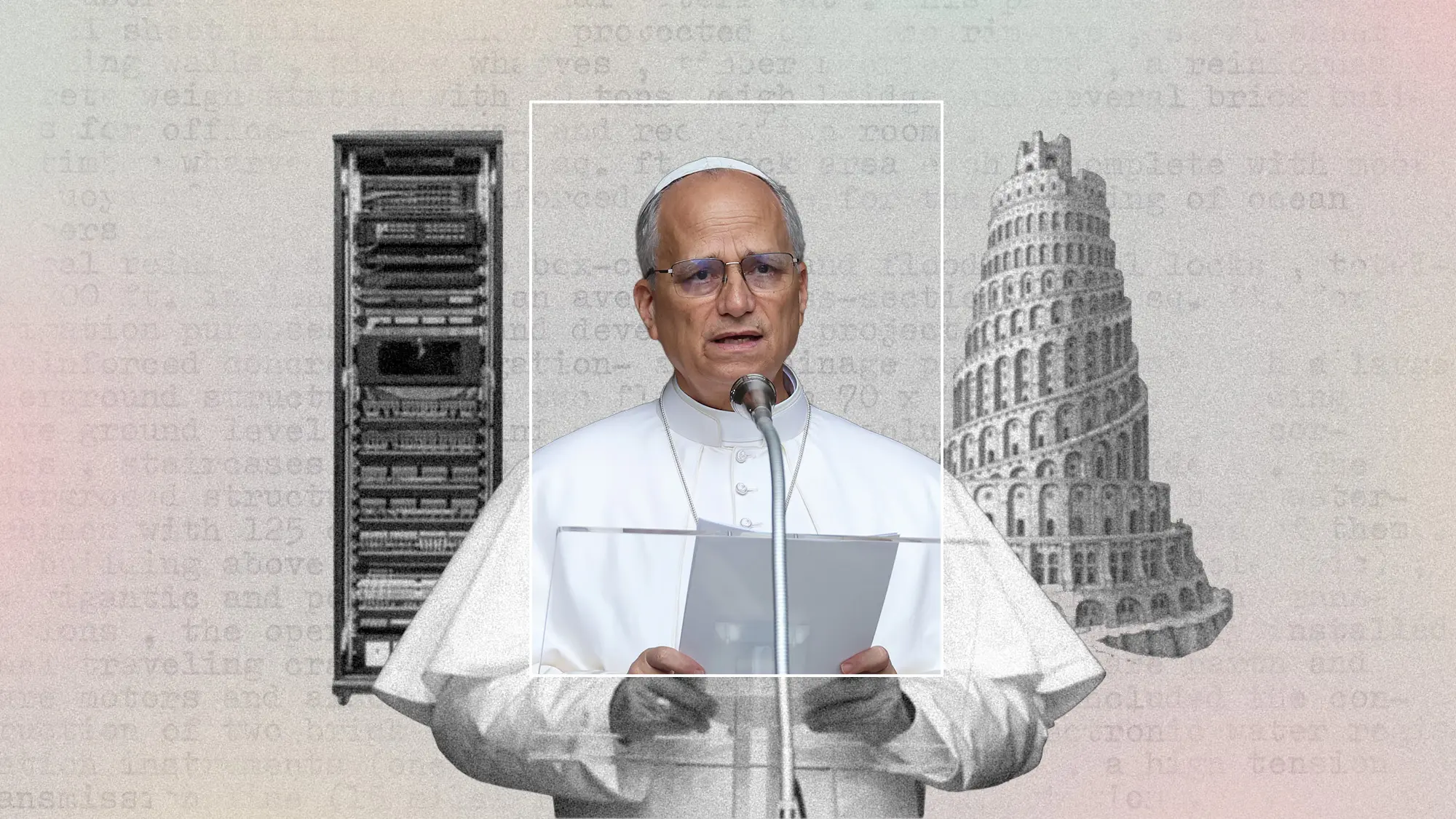
Since the publication on May 25 of the latest encyclical letter by the current Pope, Leo XIV, there have been a myriad of reactions in the press, mostly positive, to this document. In case the whole document was too cumbersome to read, the Holy See also provided a letter of presentation summarizing the most relevant points and terms (among them the much celebrated “disarmament of AI”), and even a ten-bullet point summary to be distributed among members of the Catholic Church. In truthiness, there is little most people would not agree with: inequality is growing and it is bad, our younger generations seem stultified (alas!, that wonderful nostalgia of the elderly who remember always a rosy past!), some people are getting unbelievably rich with our data, and nobody seems to be able to control any of this.
Anyone working with artificial intelligence (that wonderful oxymoron of our time) has been hearing all this for years. Many of us have been explaining this in our classes for as many years: yes, the crypto-bros exist because they trade with a commodity that we supply for free – our data – in exchange for software and content that we then use, sometimes – but not always – to waste our time and sometimes our dignity, and to get us hooked.
It is as if we cultivated the opium poppy for free, gave it away to traders, who then process it and sell it back to us for a lot of money. The profit margin is huge; it is basically all profit with little investment. This is what we have been doing with our data for decades, in exchange for social platforms where participation has become a must, and appliances that promise to make our lives easier. So, we sold our souls for nothing and now we are waking up, slowly. In the meantime, we have realized, once more, that the only unquenchable capacity of human beings is not love, but stupidity.
The words of Leo XIV resonate throughout the world for many reasons: because they seem to imply an antagonism with the current occupant of the White House – one of most divisive leaders of our time – because people always like Davids confronting Goliaths, and because he addresses an issue that few people understand but many fear.
There are indeed many angles that Catholic theology could provide in analyzing artificial intelligence, but Robert Prevost has chosen the Social Doctrine of the Church to center the discussion. His understanding, and the idea that permeates the entire document, is that artificial intelligence is making our lives more miserable while benefiting only a few in the process. To explain this, he uses two biblical images: the Tower of Babel, as narrated in the Book of Genesis, and the reconstruction of the walls of Jerusalem after the Babylonian exile, as narrated in the Book of Nehemiah. The first signifies self-interest and affirmation without God, the second implies cooperation for the greater good and the glorification of that same God. For Leo XIV, AI is a social question because it is our current Babel and it is damaging us as human beings.
As a historian, I find that difficult to believe. Humans have been mistreating humans since the first fights in the caves. They have also been helping one another, as described in the Book of Nehemiah, since exactly the same time. The quest for domination over the weak is not a novelty of the AI era. The Pope mentions slavery, but many others could be mentioned as well: child labour, which is also present today, segregation by race in many first-world countries well into the twentieth century, denial of votes to women, or persecution of people for their sexual orientation. The world has always been a cruel place to live in. What is radically different, and so is perceived by many, is that this new tool is out of control, and I think people find that the scariest. Contrary to other technologies developed and sponsored by national governments, such as nuclear energy, this new technology has been fed by us with our data without many realising it or even being able to refrain from doing it (that doomed moment when we accept the cookies), and the consequences are also felt by all of us. More worryingly, the people controlling all this seem to be themselves out of control, and with enough money and resources to silence those who denounce their immoral practices. It is important to constantly remember, however, that algorithms can be trained, and that the person who programs an algorithm to grant or deny health care to someone could have trained the same algorithm with another purpose. It is the purpose, not the algorithm, that is to blame – and the purpose, for the moment, is still human. AI is a tool. It is not the moral behind the tool. Naming current evils as being the result of AI development, as an abstract concept, fails to mention the moral responsibility of the actors taking the decisions behind the tool, both the developers and the users. And I think this is where the real problem is.
AI is based on a different development model, whose exponential growth has invaded and changed our lives like no other before and much quicker than ever before, and despite the best efforts made by legislators, national governments and international organisations, there is a growing impression that we cannot catch up with the speed of change and that they still get away with it. Its ‘disarmament’, as it is, seems to me almost impossible. And I am not sure people would agree to dispense with it either. If tomorrow, we all suddenly decided to close all the apps that move our data, the tyranny would stop. Of course we are not going to do that. Because, we have also realized that we like many of the things that AI brings to our lives. For a start, it has democratized content and access like never before, and not only in Eurasia, but also in the so-called Global South. It facilitates daily tasks for many and it contributes daily to the communication and employment of millions of people. The time of COVID showed very well how can we keep moving thanks to new technologies that had not been fully developed until then. The second thing that AI tools have brought to our lives, as the Pope rightly says, is efficiency, and efficiency could be morally wrong, when it becomes an end in itself or is used for the wrong purpose, but it is very attractive because it helps humans to fight the only thing we cannot buy with money, and that is time. People, who strive to live longer, and better, achieve more things in less time, have the feeling that they can do more with less, and AI is there to help them, or so they think. And, despite the best intentions of the Pope or any other social leader, and despite the many positive reactions in the press these days, I am afraid AI is here to stay, and to stay in the same private hands, because governments are not clearly investing in breaking the monopoly for reasons only known to themselves, so we are really in a pickle.
In such a situation, the Pope can only appeal to the morals of those controlling the business, against which we have lost any possible leverage. And here is where the image of Nehemiah becomes important for more reasons than one. The narration explains how Nehemiah asked each and every family in Jerusalem to take responsibility for rebuilding a part of the city’s walls, thinking about the greater good and believing that if they all did their share the new building will stand, unlike the Tower of Babel.
One could like or dislike, or find it alarming or comforting, the naivety of such, apparently very socialist, claim. Underlying it, however, there are certain features that have happened before in the history of humankind whenever a change in communication models had taken place. In 1492, Johannes Trithemius, at the time Abbot of Sponheim wrote his treatise De laude scriptorium (Praise of scribes), in which he praised the many advantages of copying a text in a scriptorium, in contrast to using one of those modern printing presses. Only a few years after his treatise, the expanding republic of letters carried with it the rise of the reading public, and that, in turn, led to what Elizabeth L. Eisenstein, identified years ago as “the displacement of pulpit by press.” The Church, all churches, were quick to react to this new tool of spreading and communicating information. For the first time in history, they had lost control of the message, which was now available to anyone who had enough funds to pay a printer to get his work published, as Cervantes did with Don Quixote. The Catholic Church labeled silent individual reading as dangerous, individualistic, even peccaminous, and reacted, like all other denominations of Christianity, by publishing Indexes of Forbidden Books, imposing the necessity of the “nihil obstat imprimatur” (“to be printed without objections”) and, in the case of the Catholic Church, by granting to the Inquisition the inspection of private libraries in order to try to control the message arriving to society. Miguel Delibes’ last novel, The Heretic (1998) describes the situation perfectly well. The result was that more people died in Renaissance and Early Modern Europe by order of Christian tribunals, not only Catholic, accused of writing, printing or owning forbidden books than accused of any other crime, including witchcraft and infanticide. The enemy to be defeated had been clearly identified, and the reasons provided (dangers of exposition, dehumanization, sowing of chaos) were strikingly similar.
In their efforts to control messaging, though, all Christian churches in Europe and its colonies counted on the unconditional support of the governments to which they served or with whom they collaborated. And if we believe Marshall McLuhan (The Gutenberg Galaxy, 1962) and others, it was precisely thanks to the arrival of the printing press that medieval societies could evolve into modern participating democracies.
So Pope Leo XIV is, of course, correct in denouncing the inequality and dehumanization that AI might bring, because the world itself is unequal, inhuman and brutally cruel with the weakest and most vulnerable. And we should be vigilant to make the world a better place. But we should also be careful not to fight the right battle for the wrong reasons.
© IE Insights.