



Eighty-nine percent of organizations say they use AI regularly in at least one part of the business. Just 37 percent can point to any effect on profit. That second number hasn’t moved in a year.
Two years into the most aggressive technology deployment of the decade, the gap between adoption and returns has stopped closing. The usual explanation is that we’re early. Give it time, better models, more data. The evidence points somewhere else.
The 95%
MIT’s NANDA lab spent the first half of 2025 looking at what happened inside enterprises during the AI adoption wave. Against an estimated $30–40 billion of enterprise spend, they found 95% of organizations were getting nothing back. Only one custom enterprise tool in 20 survived past the pilot.
When the researchers ranked the barriers preventing companies from achieving meaningful transformation with AI, model quality came second. A $20 ChatGPT subscription routinely outperformed enterprise systems costing thousands of times more, and the same employees who praised the consumer tool distrusted the internal one built on identical technology.
What failed sat around the model. The systems didn’t remember. They didn’t learn from correction. They didn’t fit how work got done. MIT calls this the learning gap, and it belongs to the organization, not the engineering team.
Boston Consulting Group found the same shape from outside. Across 600-plus large US public companies from 2022 to 2025, only 6% qualify as genuine AI leaders. These leaders earn nine percentage points more in industry-adjusted shareholder return than their median peer. The tier just below them, the ones investing, piloting and announcing, earn a premium of 0.6%. Statistically insignificant.
Almost all the value sits with the 6%, and effort has very little to do with who gets there.
The one-to-one problem
So why are 94% of companies falling short? The clearest answer I’ve read comes from innovation strategist David Alayón, writing in Comunidades de Impacto that today’s AI is “extraordinarily competent at one-to-one conversation” but falls short in collaborative processes where teams need to co-create and build consensus.
Put that next to the MIT findings and they start to make sense.
Current generative AI is, by design and by interface, a one-to-one technology. One person, one thread, one context window. It’s very good there: 80% of McKinsey’s respondents report better personal productivity, half report better decisions. Those gains are real.
But almost nothing that decides whether a company makes money happens between one person and a screen. Pricing is many-to-many. Handoffs between functions are many-to-many. Killing a product, absorbing a regulatory change, rebuilding a broken process, all many-to-many. The value sits in the five-person conversation.
We put a one-to-one tool against a many-to-many problem, then acted surprised when personal productivity gains never showed up in the P&L.
What the winners do
A recent report from Deloitte and Oxford Economics puts it plainly: organizations taking a technology-focused approach are 1.6 times more likely to fail to get returns that beat expectations than those taking a human-centered one. Despite this, 59 percent of organizations are taking the technology-focused approach. The majority is doing the thing that correlates with losing.
Indeed, AI leaders grow headcount three percentage points faster per year than laggards, and their outperformance comes from revenue growth (+10 points) and margin expansion (+6 points). Cost-cutting doesn’t appear anywhere in it. The replace-people-and-book-the-savings version of AI describes the group that’s losing.
Operationally, humans remain key to ensuring a timely rollout. Adoption reaches production in around 90 days when middle managers and power users drive it, compared with stalling for nine months when a central AI function owns it.
The number you’re multiplying
If most of the value depends on people, their condition matters.
Gallup puts global employee engagement at 20% in 2025, the lowest since 2020, at an estimated cost of $10 trillion in lost productivity, around 9% of global GDP. Manager engagement fell from 27% to 22% in a single year. Every change program in every company runs through managers.
That engagement matters is among the best-documented findings in organizational research. In a comparison between teams in the top and bottom quartiles for engagement, the more engaged teams had:
+23% profitability
+18% productivity and sales
−81% absenteeism
−41% quality defects
−18% to −43% turnover
On the customer side, CX leaders beat the S&P 500 by 415 cumulative points while laggards trailed it by 374, a 7.8× spread that has more than doubled in five years.
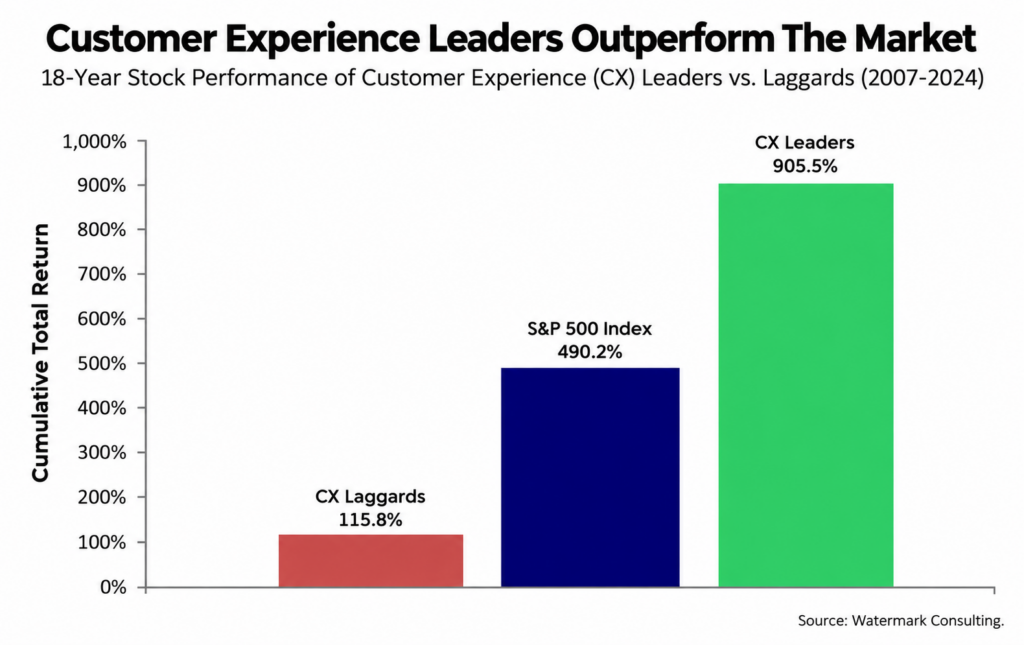
Technology multiplies. Engagement, belonging and trust are the number it multiplies. Zero times the best model on the market is still zero.
Where to draw the line
In 2003, the MIT economist David Autor and colleagues argued that technology replaces tasks, specifically routine ones, rather than whole jobs. Non-routine work survived because nobody could write down its rules.
Twenty years on, the boundary has moved. Fabrizio Dell’Acqua and colleagues gave 758 consultants, roughly 7% of the firm’s individual contributors, access to GPT-4 across two kinds of work. On tasks inside AI’s current capability, quality rose more than 40% and the work finished 25% faster, with the largest gains going to the weakest performers. On a task just outside it, one requiring quantitative data to be reconciled with qualitative interview evidence, consultants using AI were 19 percentage points less likely to reach the right answer.
Same tool. Same people. Opposite outcomes. Nothing on the surface separated the two tasks.
The researchers call this the jagged frontier. The boundary is real and invisible, and working out which side of it a piece of work sits on takes organizational knowledge. That knowledge lives inside the people doing the job, and it surfaces only if someone asks them and it’s safe to answer honestly.
Which points to a triage any leadership team could run on a Monday morning:
Fully predictable work → automate it. Access, reminders, status updates, standard reporting.
Pattern-following work inside the frontier → augment it. Drafting, clustering, summarizing, first-pass analysis.
Relational work, and anything outside the frontier → keep it human, on purpose. Judgement calls that mix hard and soft evidence. Mediation. Sensitive decisions. Anything where someone needs to be believed.
That third category carries a measurable penalty. Dietvorst, Simmons and Massey showed that people abandon an algorithm faster than they abandon a human after watching either make a mistake, even when the algorithm is demonstrably more accurate. And a Washington State University study of more than 1,000 US adults found that naming “AI” in a product description lowers purchase intention, driven by a fall in emotional trust, with the sharpest effect on high-stakes purchases.
Automating relational work costs trust you can count.
Klarna is the case everyone cites and almost everyone gets wrong. In 2024 the company replaced work equivalent to roughly 700 customer service agents with AI. In May 2025, CEO Sebastian Siemiatkowski publicly acknowledged that an over-emphasis on cost-cutting had degraded service quality, and Klarna started hiring human agents again.
Klarna has been clear that it didn’t reverse its AI strategy; it moved to a dual-track model. That’s the whole lesson. The technology worked. Substitution as a design principle didn’t.
BCG’s own framing of an AI transformation: roughly 10% of the effort is technology, 20% is data and algorithms, and 70% is people, processes and organizational change. Executives quote this rule constantly.
Now look at your own organization and answer one question: who owns the 70%?
You almost certainly have someone accountable for the 10%. A Chief AI Officer, a head of technology, a transformation lead with a budget and a dashboard. You have a data team for the 20%.
The 70% is usually nobody’s job. Trust. Redesigned handoffs. The willingness to experiment. The community of practice where an engineer admits the internal tool breaks on edge cases, and the safety that makes admitting it survivable. It gets split between HR, internal comms and a values poster. No budget line, no owner, no metric.
None of this is an argument against AI; it is simply the case that the constraint has moved. What’s scarce in 2026 is an organization that can learn fast enough to absorb what the technology offers, and that capability gets built out of relationships.
The question
A community is “a group of people who share goals and struggles (a purpose), recognize themselves as part of a ‘we’ (belonging), and take care of one another”. In the organizations getting this right, community works as the operating system of the business, with decisions made together with people rather than for them.
Everyone has access to roughly the same models, which is exactly why the models can’t be the advantage. So here’s the question nobody wants on the agenda: if 70% of the value depends on people, who in your organization has that 70% as their job, with a name, a budget and a number they’re measured on?
If the answer is “everyone,” it means no one.
© IE Insights.