The Case for ‘Boring Businesses’: Lessons from the Tech Venture Bootcamp

Mentoring BidMagnet, a student venture applying AI to public procurement, offered Álvaro Aira Guerrero an opportunity to explore the potential of often-overlooked business processes.
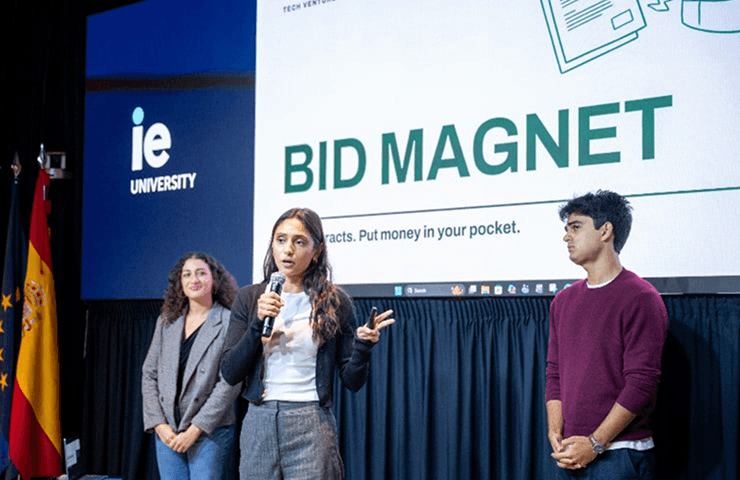
Public procurement may not be the most obvious starting point for a technology venture. But for the team behind BidMagnet, a platform designed to connect government contracts with specialized IT companies, the complexity of public tenders presented an opportunity to apply artificial intelligence to an established, often cumbersome process.
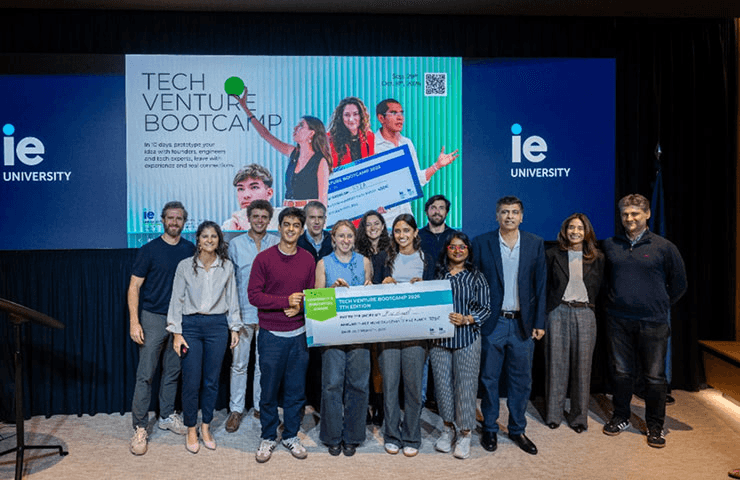
The project secured third place at the seventh edition of IE University's Tech Venture Bootcamp (TVB), a ten-day program bringing together students from different academic disciplines to develop and test technology-based business ideas. Organized in collaboration with IE Venture Lab, IEX Labs and IE School of Science & Technology, the Bootcamp combines design thinking, coding, data analysis and generative AI with mentoring from experienced professionals.
This edition attracted 215 registrations, a 63% increase on the previous edition, and welcomed students from Universidad Politécnica de Madrid for the first time.
The BidMagnet team brought together six students from business, technology and data-related programs: Simmran Sunner (MBA), Jyothika Surya (MBDS), Gabriel Santiago (BCSAI), Miguel Chapero Berzi (BCSAI), Nabila Gabriella Kesrewan Rey (MBA) and Lola Vortmeyer (MTGA).

Despite his background in healthcare, Aira Guerrero was drawn to BidMagnet's focus on public procurement. He saw an opportunity to help the students move beyond the concept of an AI-powered platform and examine the practical requirements, documentation and decisions involved in pursuing a government contract.
In the following interview, he discusses what distinguished BidMagnet, how the team's thinking developed and why aspiring founders need to understand a problem before deciding how technology should solve it.
What initially stood out to you about BidMagnet and the team behind it?
What initially caught my attention was actually somewhat unexpected. I had assumed I would gravitate towards teams working on healthcare or social care challenges, as those are naturally close to my professional interests. Yet BidMagnet stood out almost immediately.
I was surprised that a team with such diverse profiles, working on an idea that was already relatively tangible and well grounded, had not yet found a mentor. In a format such as the Tech Venture Bootcamp, where there is limited time to turn an idea into something meaningful, having a problem that is both concrete and actionable is a real advantage.
I have always found so-called “boring businesses” particularly interesting. Public tenders might not sound like the next great technological revolution, but they represent an area with enormous scope for improvement. More importantly, procurement is one of the mechanisms through which genuinely innovative solutions eventually reach society, particularly in public services and other sectors that affect all of us.
That combination made BidMagnet particularly compelling to me: it was not trying to manufacture a problem to fit an exciting technology. It was looking at a very real, often cumbersome process and asking how an AI-native approach could fundamentally improve it.
How did the team's idea evolve during the Bootcamp? Was there a particular turning point?
For me, the in-person session we had on Saturday was an important turning point. Until then, much of the discussion had understandably approached the problem from a business or conceptual perspective.
During that session, we went much deeper into what a tender actually looks like in practice: the documentation involved, what you need to look for, how you approach an opportunity, which requirements really matter, and where some of the less obvious difficulties lie.
That shift from discussing “the idea of managing tenders” to understanding the reality of navigating one made the problem much more concrete.
Once a team genuinely understands the problem it is trying to solve, many product decisions become considerably clearer. In BidMagnet's case, I think that gave them a much stronger foundation from which to decide what to build and where AI could create genuine value.
As a mentor, how do you help students turn an idea into something technically feasible and commercially viable?
For me, mentoring starts with listening.
I would rather help them understand where the coastline is while allowing them to navigate the route they have chosen.
In practical terms, one of the most valuable things a mentor can provide is real-world context: concrete examples, first-hand experience, edge cases and the details that are difficult to acquire without having encountered the problem yourself.
Students rarely lack ideas. What they often lack is the level of detail required to test those ideas against reality.
That is why I place so much emphasis on understanding the problem before becoming attached to a particular solution. Once the problem becomes tangible, technical feasibility and commercial viability stop being abstract questions.
You can begin asking much more useful ones: does this solve something people genuinely struggle with, can we build it, and would somebody actually use or pay for it?
The BidMagnet team combined students from business, data and technology programmes. How did those different perspectives influence the project?
BidMagnet was particularly interesting in this respect because the team was genuinely diverse, not only in terms of academic backgrounds, but also in age, experience and perspective.
A natural leadership figure emerged early on, already from the initial presentation of the idea, but that did not translate into a team in which one person drove everything. Each member took a proactive approach, roles became relatively clear, and yet responsibility for the outcome remained collective. I think that balance is extremely valuable.
The combination of business and technology students was particularly powerful. There are surprisingly few environments in which people approaching a problem from those two perspectives can work together so closely and with such freedom.
The Tech Venture Bootcamp creates precisely that space: a problem can be challenged from a business perspective, translated into a technological idea and then actually materialised into something tangible.
That movement from problem, to idea, to execution is where the diversity of the team becomes much more than simply having different profiles around the table.
Beyond developing a startup idea, what can students learn from an experience like the Tech Venture Bootcamp that is difficult to replicate in a classroom?
I think the greatest lesson is simply learning to materialize ideas.
I am a very creative person myself, so I can easily put myself in their shoes. When you have lots of ideas, the temptation is always to keep thinking: another possibility, another feature, another direction.
An experience like the Tech Venture Bootcamp forces you to do something rather different. You have to bring an idea down to earth, test your assumptions, make decisions and turn something conceptual into something that another person can actually understand, challenge and eventually use.
And I think the value extends beyond students who already see themselves as future founders. For people who are simply ambitious about changing things, it gives them the opportunity to work alongside others with the same drive, on concrete problems, with an extraordinary degree of freedom.
That freedom is difficult to reproduce in a traditional classroom. However open-ended an academic assignment may be, there is normally still an element of evaluation and, ultimately, obligation behind it.
The Bootcamp is different precisely because participation and ambition are voluntary. You are building because you have chosen to build.
To me, that makes it a much closer approximation of the founder experience: there is no predefined answer and nobody is telling you exactly what the outcome should look like. You have the freedom to decide what is worth pursuing, but also the responsibility to turn that freedom into something real.
Find out more about the Tech Venture Bootcamp