"The Future of Work: Thriving in the Age of AI" and Touching Qubits at the Perspektywy Women in Tech Summit

At the Perspektywy Women in Tech Summit in Warsaw, IE Sci-Tech faculty explored how emerging technologies are reshaping who participates in STEM, and how.
More than 14,000 participants from 90 countries gathered in Warsaw for the Perspektywy Women in Tech Summit, an event dedicated to women in STEM, technology and innovation.
One of the keynote speakers was Rafif Srour, Dean of Programs at IE School of Science & Technology, who addressed the future of work in the age of AI. Also participating was Irene Alda, Academic Director of the Bachelor in Applied Mathematics, who presented Quantum Hack VR, an immersive learning experience designed to make quantum computing more accessible through virtual reality.
The annual summit brings together students, researchers, educators, entrepreneurs and industry leaders for two days of talks, workshops and networking focused on expanding participation in science and technology. This year's program featured speakers across topics ranging from artificial intelligence and cybersecurity to engineering, entrepreneurship and scientific research.
The Future of Work
The summit demonstrated growing interest in a question that extends far beyond the technology sector: how emerging technologies are changing education, careers and the skills people need to thrive.
Rafif Srour addressed this theme in her talk, The Future of Work: Thriving in the Age of AI.
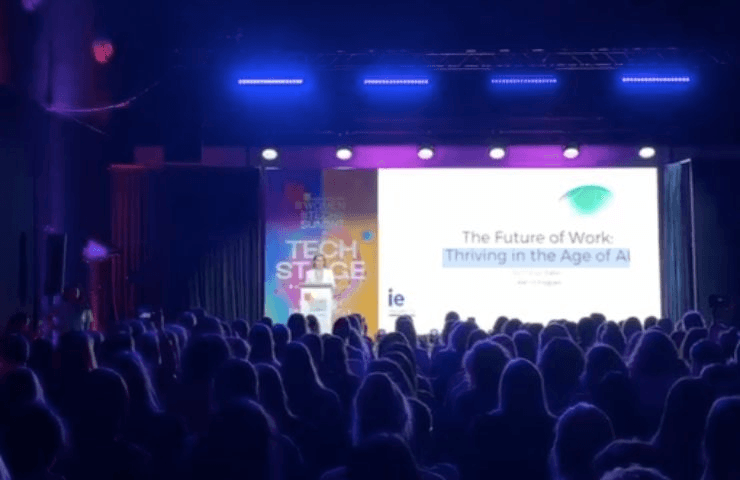
The session examined how individuals and institutions should respond to technological change that is already underway.
As Srour noted, "the most honest answer about the future of work is that we do not fully know what it will look like." What is already clear, however, is that "AI is already changing the structure of opportunity."
One consequence, she argued, is the gradual disappearance of entry-level tasks that have traditionally allowed young professionals to learn through practice and experience.
"One of the most worrying signals is the disappearance of the 'bottom rung' of work: the entry-level tasks through which young graduates have traditionally learned, practiced, made mistakes and gradually become experts," she said.
"If AI removes those early pathways, universities and employers will need to rethink how talent is developed, how expertise is built, and how young professionals gain the judgment that comes only through experience."
This shift, she suggested, requires a broader conversation about education itself. While today's students are often highly adaptive and digitally fluent, institutions must also help them develop "depth, patience, critical thinking and the capacity to stay with complex problems."
Touching Qubits with Quantum Hack VR
Irene Alda presented a different challenge: making highly technical concepts accessible to broader audiences.
At the summit, Alda showcased Quantum Hack VR, a virtual reality experience developed alongside collaborators Eduardo Sáenz de Cabezón, Cristina Álvarez Martínez and Emilio Guillot.
The project uses an immersive, game-based environment to introduce participants to concepts such as superposition, entanglement and quantum gates. Alongside the demonstration, Alda shared early findings on the platform's learning impact.
The value of virtual reality lies in its ability to make abstract concepts tangible. As she explained, "the game allows one 'to touch qubits' and see a physical representation of what it means for them to be in a superposition or entangled state, allowing players to grasp these abstract concepts better."
Beyond Representation
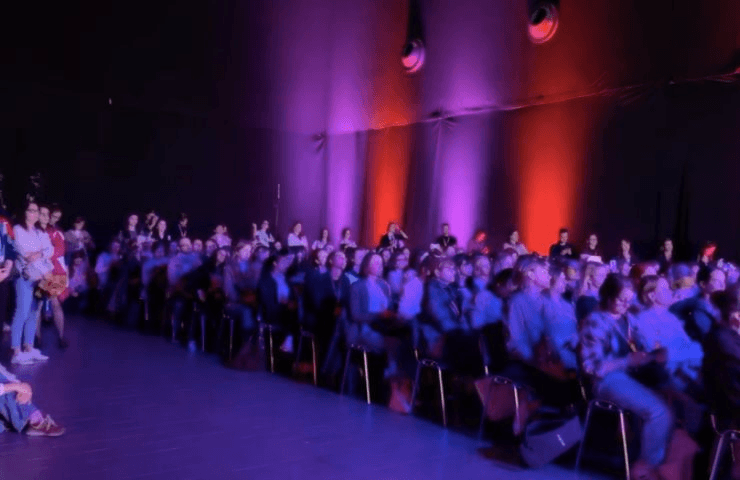
The discussions in Warsaw pointed to the larger issue of representation; ensuring that access to emerging technologies is matched by access to the knowledge required to understand, shape and govern them.
Whether through debates about AI's impact on work or new approaches to teaching quantum computing, many of the conversations focused less on technology itself and more on participation - who gets involved, how they learn, and what skills will matter as technical systems become more widely available.
"What impressed me most at Perspektywy was the strength of the ecosystem: universities, industry, researchers, students and leaders all in the same space, not only discussing the future of STEM but actively shaping it together," Srour said.
She argued that "progress does not happen through representation alone." Instead, the goal should be to create environments where women are present "in the rooms where decisions are made, technologies are designed and priorities are set."
Participation must become structural.
"It is not enough to invite women into STEM; we have to build the conditions for them to lead, influence and define the direction of science and technology."
Srour and Alda’s talks highlighted the importance of preparing more people to engage with increasingly complex technologies. The future of STEM will depend not only on new discoveries, but on who has the opportunity to understand, shape and apply them.