The Hard Work Behind Apple's Simplicity

Drawing on 16 years at Apple, Neil West explored why creating simpler technology often requires the hardest decisions.
Putting a £10 iTunes gift card inside every new iPhone box seemed like a sensible idea. It would introduce customers to Apple's music store, encourage spending and potentially reduce marketing costs. Neil West, then working at Apple, thought it was an elegant commercial solution.
Steve Jobs disagreed.
The proposal was rejected because Jobs believed the promotion would interfere with the carefully designed experience of opening an iPhone for the first time. What made sense commercially did not necessarily serve the product.
For West, who spent 16 years at Apple, the episode illustrates one of the company's most important principles: simplicity requires more than good design. It demands difficult choices, including the willingness to reject ideas that appear perfectly reasonable.
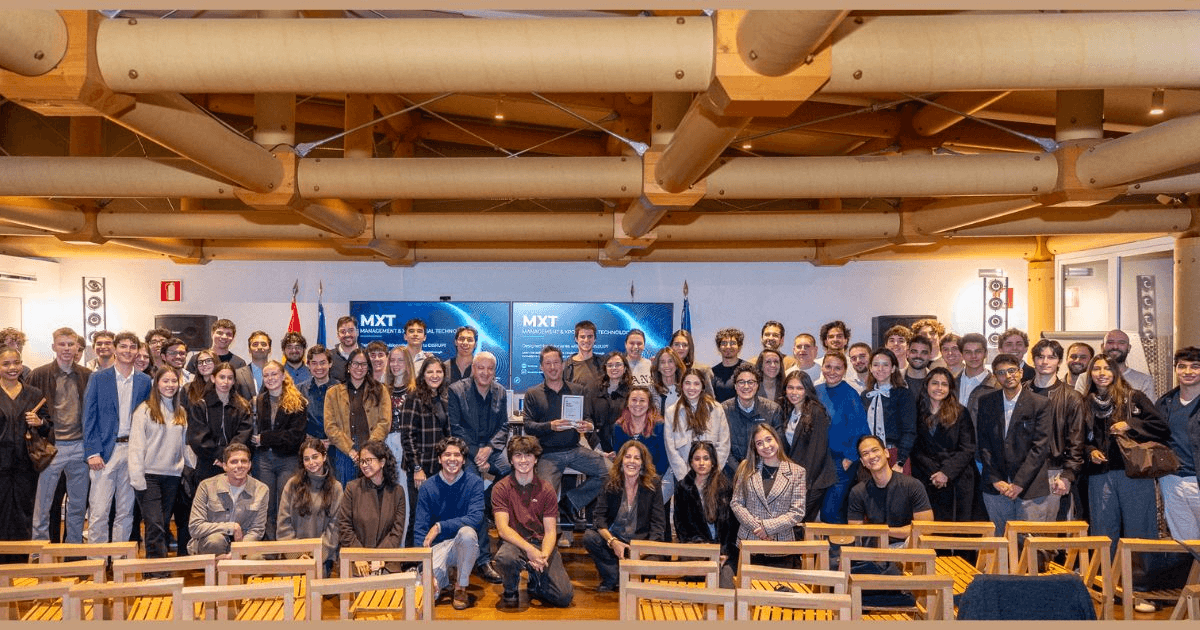
West shared this and other lessons with students opening session of the third edition of IE University's Management & Xponential Technology (MXT) program. The session was opened by Rafif Srour, Dean of Programs at IE School of Science & Technology, and David Suárez, Vice Dean of IE Business School, reflecting the collaboration between both schools, alongside Leticia Cabral Castillo, Managing Director at IEX Labs, the program’s Academic Director, Raquel Cabero Quiles, and Academic Lead Joe Haslam.
West drew on his experience as Head of Music for Apple UK and Europe and later Head of Services for Southern Europe. His recently published book, It Just Works: The Nine Simple Rules of Apple's Success (Macmillan Business, 2026), examines how simplicity shaped Apple's products, communications and operations.
The discussion reinforced a key principle of the exponential mindset at the heart of the MXT. Technological progress is often associated with adding capabilities, but West's experience suggested that significant advances can also come from questioning what is necessary in the first place.
The Discipline of Saying No
Apple's products have not always been the cheapest, most powerful or first to market. West pointed to the Macintosh, iPod and iPhone as examples of technology that succeeded partly by making previously complicated tasks easier for consumers.

The iPod was not the first portable music player, but it offered a simple proposition: "1,000 songs in your pocket." The iPhone combined functions that previously required several devices.
Delivering those experiences, West argued, was anything but straightforward.
"Simplicity is hard. It is about grinding down problems, reducing the complexity, getting to a place that's brilliant, and then saying, that's not good enough, let's go again," he told students.
The challenge is that complexity rarely announces itself as a problem. It often arrives as an attractive new feature, an additional capability or a promising commercial opportunity.
"Complexity never comes labelled complexity. It always comes as a cool feature or an exciting new opportunity," West explained. And rejecting those opportunities can be difficult.
"Saying no to bad ideas is easy. The problem is that you've got to say no to good ideas."
For technology teams, this creates a tension between what is technically possible, what makes business sense and what ultimately improves the product.

It is a tension particularly relevant to MXT, which brings together students from business, engineering, computer science and other disciplines to examine technological possibilities from different perspectives. West's experience demonstrated why decisions about technology cannot be separated from questions of strategy, design and customer behavior.
Simplicity Begins Before the Product Exists
One student challenged West on a fundamental question: shouldn't product teams first explore the complexity of a problem, adding features and capabilities, before deciding what to simplify?
West disagreed with the premise. For him, simplicity isn't something engineers introduce once a product has been developed. It begins much earlier, with complete clarity about the problem they are trying to solve.
"Does everybody on the team and everybody in the organization know exactly what problem it is you're trying to solve? You have to begin with that."
He returned to the original iPod and its five-word promise, "1,000 songs in your pocket."
According to West, this was not a marketing slogan created after engineers had finished building the device. It was established by the product team at the beginning, becoming a guiding principle for subsequent design and engineering decisions.
"It became a north star for every decision, every innovation, every iteration that they made," West explained.
That clarity helped determine what belonged in the product and what did not. Without a shared understanding of purpose, teams become vulnerable to accumulating features that may be individually attractive but collectively undermine the intended experience.
Another student raised a different challenge. Apple's integrated ecosystem makes its devices convenient to use together, but does that simplicity also make it harder for customers to switch to competing products?
West acknowledged the commercial advantage of Apple's interconnected devices. Their convenience encourages customers to remain within the ecosystem, even when individual products may not fully meet their expectations.
"People don't want to think about their technology," he said, describing the appeal of devices that work together without requiring users to manage the connections themselves.
The exchange added a further dimension to the discussion: simplicity is not simply a technical or aesthetic decision. It can also influence business models and customer relationships.
What Simplicity Demands of Technology Leaders
As emerging technologies make it easier to develop prototypes, test ideas and introduce new functionality, West's message is particularly relevant to students working at the intersection of technology and business. Greater technical capability does not automatically produce a better product.
His experience at Apple points to a different discipline: understanding what a product is meant to achieve, recognizing when an attractive idea threatens that purpose, and doing the difficult work of removing unnecessary complexity.
For students preparing to build the next generation of technology, the question is not simply what technology makes possible, but what is truly worth creating and how it can transform businesses and society.