- Home
- News & Industry Updates
- News
- Private Equity Day Connects Ie Students With Industry Leaders
Private Equity Day Connects IE Students with Industry Leaders

IE Talent & Careers brought leading private equity professionals to campus for a conversation on access, recruitment and the skills now shaping one of finance’s most competitive fields.
IE Talent & Careers hosted Private Equity Day, bringing together more than 100 students and professionals working across one of finance’s most competitive and traditionally hard-to-access sectors. The central message from the panel was clear: the industry is changing, and students who understand its demands, culture and expectations will be better positioned to enter it.
Through a panel discussion and networking session, the event offered a closer look at exactly how the industry is changing, what firms are looking for in junior talent, and why direct contact with employers matters more than ever.
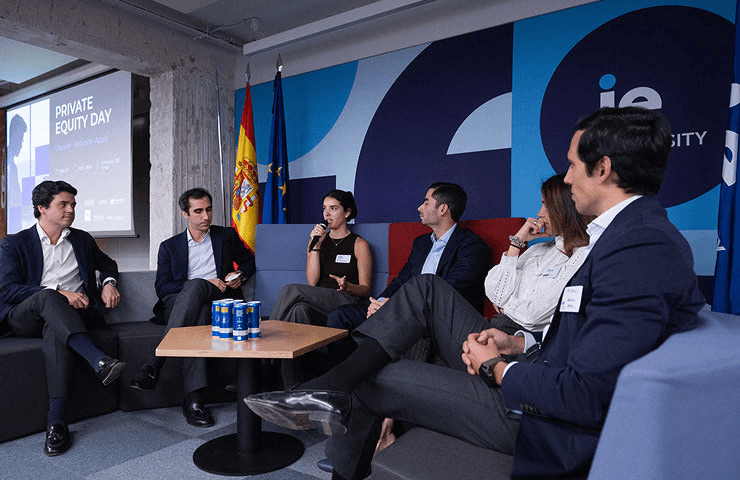
Moderated by Javier Tordable, Vice Dean of Finance at IE Business School and Head of Finance at Talent & Careers, the event featured professionals from Three Hills Capital, CAPZA, Magnum Capital Industrial Partners, Ardian, Portobello Capital and PAI Partners. Together, they described an industry that remains highly selective, but is becoming more open to early-career talent than in the past.
For Tordable, that is precisely why events like this matter. He noted that many of the most competitive roles still depend on personal connection, while the alternative can feel distant and impersonal for students trying to break in.
“Having the edge of getting to know the professionals themselves will help students a lot, not only to get tips and advice, but also to drop their names when they’re doing interviews,” he said. “It will move the needle for them. It doesn’t get any better than somebody who’s working there telling you and advising you how to get the job.”
Students in attendance pointed to that same advantage.
Analucia Jauregui, a student in the Dual Degree MBA and Master in Business Analytics and Big Data, said events like this “open the doors to know about possibilities that are currently in the market and job industry.” She added that “the biggest plus of this event is the networking that you get to do with the companies that are coming to the event afterwards, and to really know what they’re looking for.”
For others, the value was also long-term. “Maybe we’re not looking for a job right now, but it could be a good chance for the future,” said Fernando Tena, a Master in Finance student.
One of the main themes of the session was that access to private equity is still difficult, but the path in is no longer as fixed as it once was. For years, the industry was widely seen as accessible only after experience in investment banking or consulting.
Tordable noted that “things are changing,” explaining that in recent years firms have introduced more analyst programs, and are hiring more juniors.
Panelists also made clear that greater access does not mean lower competition. Junior roles remain limited, highly selective and often filled through targeted pipelines. Even so, several firms described off-cycle internships, junior analyst hiring and internal promotion as important entry points.

Francisco Pichardo, Senior Associate at CAPZA and an IE BBA 2019 alumnus, explained that his firm hires off-cycle analysts throughout the year and tries to retain strong performers when headcount allows.
Isabel Bordas of Portobello Capital similarly noted that most openings in her firm are entry-level because the company prioritizes internal promotion. The overall picture was of an industry that is demanding and difficult to enter, but increasingly transparent about what it expects.
Another recurring theme was differentiation. In an increasingly crowded market, panelists stressed that capital alone is no longer enough to distinguish one firm from another.
“We mainly offer capital, and that’s not different. Really, what makes a difference is our expertise to help management teams or founders and it’s all about pattern recognition,” said Alvaro Molina de Ena, Director at PAI Partners. He added that “sector expertise and human capital is the key,” presenting specialization as essential to standing out.
Across firms with different strategies, there was a shared emphasis on value creation and operational expertise. “What can make a very good mid-market deal versus a very, very bad one, is having the correct managers leading the ship,” Pichardo said. Private equity was therefore presented not simply as financial engineering, but as a field built on understanding businesses, sectors and people well enough to help them grow.
That same emphasis carried into the discussion on recruitment. When asked what they look for in candidates, panelists returned repeatedly to qualities that go beyond technical skill: curiosity, responsibility, strategic thinking, humility, trust and discipline.
For Molina de Ena, attitude is foundational. “It’s all about motivation and intellectual curiosity,” he said. “When I interview people, the first thing and the only thing that I look at is, can I be with this person 12 hours a day and have fun?”
Nacho Lucaya Castán, Senior Investment Manager at Ardian, added that responsibility matters just as much, because in this kind of environment “it needs to come out of your own gut.”
Bordas emphasized strategic thinking, arguing that candidates need to be capable of “thinking outside the box” and anticipating what lies ahead. Pichardo framed discipline as equally important.
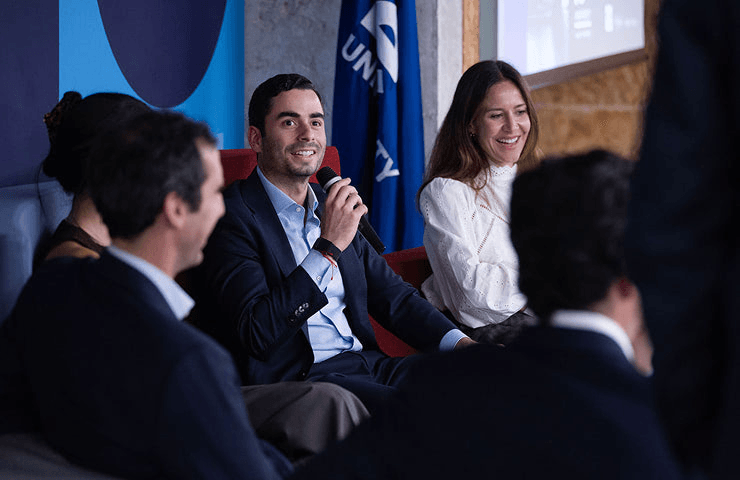
“Discipline is motivation for breakfast,” he said, noting that motivation matters, but does not always survive pressure, uncertainty or exhaustion. “When we work a lot and we are a bit unmotivated, that’s when you need to be disciplined.”
Juan Banús Cortés, Investment Director at Magnum Capital Industrial Partners, supported that view and framed trust as central to long-term success. “You have to become someone reliable,” he said. “They need to know that you will always be there.”
Taken together, the panel suggested that while hard skills may help candidates clear the first filter, soft skills are what sustain a career. That balance between technical ability and judgment was especially visible in the discussion around AI.
Panelists described AI as an increasingly important tool, but not a substitute for independent thinking.
Banús Cortés said that AI competence will increasingly become non-negotiable: “It’s disrupting everything and you have to be prepared.” Bordas described AI as “a performance enhancer,” adding that it “doesn’t substitute” the work, but “helps you and puts you in an advanced position.”
At the same time, Ana Fernández Garrido warned against overreliance, especially among junior professionals. She said it is “a shame that very junior people use it a bit too much” and “without making the effort of thinking before,” stressing that “you have to make the effort to do your own thinking and mistakes.”
Lucaya Castán struck a similar balance. “AI can do the manual work,” he said, “but you still need to dominate the manual.” Molina de Ena emphasized accountability, reminding students that no matter how useful the tool becomes, “you’re responsible for the work that goes out of your inbox.”
The panel closed with practical advice on applications and interviews, where preparation, clarity and authenticity emerged as key priorities. Banús Cortés urged students to prepare thoroughly and take the time to understand what companies do. Fernández Garrido encouraged candidates to be concise and natural, saying it is better to have “simple messages that are concrete,” and advising students to be “normal, laid back, not too aggressive” and to “not show off.” Similarly, Pichardo warned candidates to not memorise answers from the internet and instead use their own experience to stand out.
Bordas described private equity as “a people’s industry” where “relationships are extremely important,” encouraging students to use their networks and make the most of the people around them. Lucaya Castán noted the importance of prior experience, explaining that when firms receive a large volume of CVs, relevant internships often determine who gets the first call. Molina de Ena also described the CV as “the first impression that someone gets of you,” adding that it often determines whether a candidate makes it into the 5-10% who reach the interview stage.
The final picture that emerged from Private Equity Day was that while technical knowledge and experience still matter, trust, judgment, humility, curiosity and the ability to show genuine interest in the work seem to be just as important.