

People with disabilities continue to face a 41-percentage-point employment gap, higher rates of temporary contracts, and a salary difference of more than €5,000 per year compared to other workers.
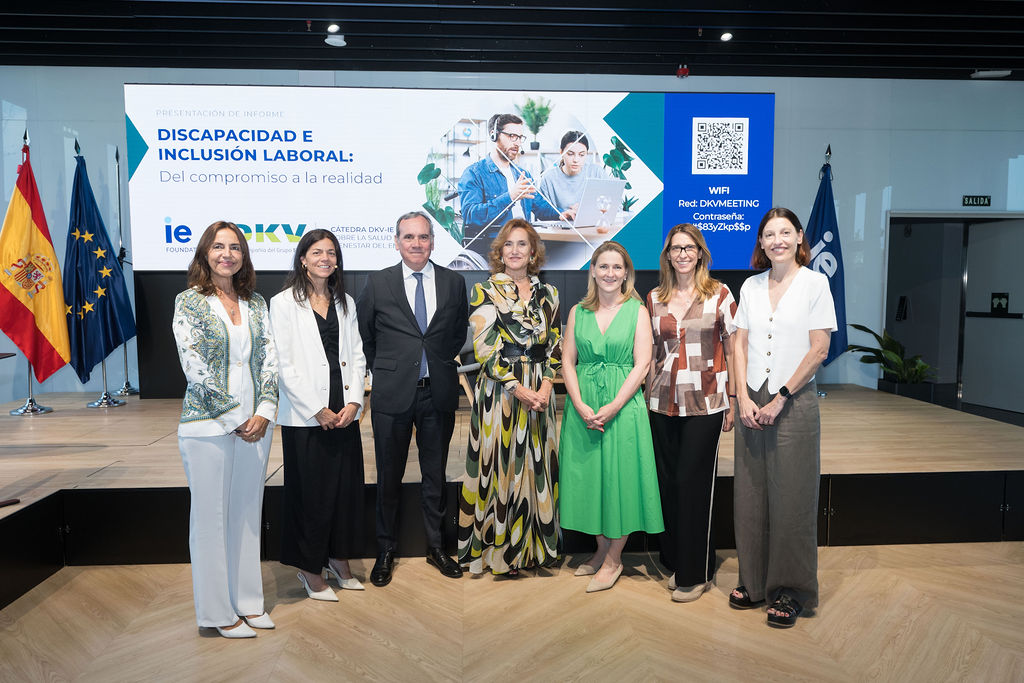
Inclusion and accessibility are the top workplace priorities for people with disabilities. These are some of the key findings of the report “The Inclusion of People with Disabilities in a Changing Work Environment,” developed by the DKV-IE Chair on Employee Health and Well-being at IE Foundation. The study, led by IE University researchers Rocío Bonet, Laura Jiménez, and Marco Minervini, analyzes the challenges and opportunities of workplace inclusion in a changing organizational environment.
During the presentation of the report, Laura González-Molero, President of DKV, stated that “companies have the opportunity and the responsibility to create environments where everyone feels accepted, valued, and part of a shared mission. Inclusive organizations are also more innovative, more human, and more sustainable.” Similarly, Silvia Agulló, DKV’s Director of Sustainability, noted that “workplace inclusion is also a matter of health, well-being, and dignity. As a company committed to caring for people, this project connects fully with our purpose of building a healthier future together and contributing to a society in which no one is left behind because of disability.”
Globally, close to 785 million people with disabilities are of working age, representing roughly 10% of the world’s population. However, their employment rate remains significantly lower than that of people without disabilities. In Spain, according to Spain’s National Statistics Institute (INE), the employment rate for people with disabilities stands at 28.9%, compared to 69.7% for people without disabilities; reflecting a structural gap that persists over time, despite recent regulatory advances aimed at promoting the hiring and workplace inclusion of people with disabilities. Moreover, when they do find employment, it tends to come with worse conditions: lower wages, greater instability, and less job security.
The report highlights that this inequality carries not only a high social cost but also an economic one. According to the World Bank, excluding people with disabilities from the labor market can result in losses of 3–7% of GDP due to underutilized talent, lower aggregate productivity, and increased spending on social benefits.
Transformation of the Labor Market
New organizational practices such as hybrid or remote work, highly collaborative teams, and shared workspaces have transformed the labor market. Based on a study of more than 800 workers and interviews with companies and specialized organizations, the report examines how these new ways of working are affecting the workplace inclusion of people with disabilities.
The report notes that new work practices offer significant opportunities to improve access to employment and working conditions. However, they can also have unintended effects, such as greater isolation or perceived inequality of treatment within organizations. It also finds that employees are willing to trade higher salaries for jobs that offer greater flexibility, with no significant differences observed between people with and without disabilities in their preferences for new ways of working.
The main obstacle to bringing people with disabilities into the labor market is not technical, but cultural and organizational.
Although the regulatory framework supporting workplace inclusion has been strengthened in recent years, the report concludes that the main barriers still lie within organizations themselves. These include a lack of strategic commitment, limited understanding of disability inclusion, and persistent bias and stigma in recruitment and talent management processes — factors that reduce job opportunities and worsen working conditions.
The study’s data also shows that people with disabilities experience higher levels of discrimination, fewer job opportunities, and a greater sense of isolation than people without disabilities. Interviews conducted for the report identify the main barriers as companies’ lack of understanding about disability, persistent bias and stigma, unrealistic expectations in hiring processes, and an insufficient adaptation of roles and workplaces. However, these effects can be mitigated when companies partner with social organizations with expertise in inclusion and build genuinely inclusive workplaces where people with disabilities feel accepted, included, and valued.
In these contexts, opportunities for meaningful interaction with colleagues become especially important. “Several findings surprised us. The first is that people with disabilities do not have significantly different job preferences, which contradicts many preconceived ideas. The second is that remote work — often presented as a solution to foster their inclusion — is preferred only when the workplace environment is not inclusive of these individuals. Our findings suggest that the right question isn’t how to adapt work to people with disabilities, but how to adapt organizations so that people with disabilities want to be part of them. When the workplace culture is genuinely inclusive, the workplace stops being a barrier and becomes a place people truly want to be,” said Rocío Bonet, professor at IE University and director of the Chair.
Inclusive Organizational Culture
The report concludes that new ways of working are not inherently inclusive and that preference for these new work environments depends on how inclusive the company is, as well as on the needs and characteristics of each person with a disability. To move toward effective inclusion and make companies more attractive environments for people with disabilities, the study proposes seven recommendations:
- Foster an inclusive organizational culture, led by senior management.
- Conduct a comprehensive cost-benefit analysis of new work practices.
- Provide individualized workplace accommodation.
- Design more flexible roles suited to diverse abilities.
- Strengthen ongoing support and training.
- Establish mechanisms for monitoring impact.
- Partner with social organizations with expertise in inclusion.
The DKV-IE Chair, an initiative by DKV and IE University through IE Foundation, aims to generate cutting-edge knowledge on employee well-being and the impact of organizations on employee health. Since its creation in 2023, it has conducted research on key areas such as mental health, prevention culture, and, now, workplace inclusion of people with disabilities.